|
| |
|

|
Nakar Gabab
|
|
of Pedantic Nitpicking
May 2001
time: 00:17
|
|
Hello again, all. I don't know how many folks here played SMAC, but I'm fairly comfortable in saying it was a lot of us. And I'm also fairly sure those of us who have, remember Vel's discussion of city placement paradigms. He mentioned a model folks had tried based on the AI Yang player's spacing (known as the Yang Model, or the Infantry Defense Model). In short, each base/city was spaced three squares apart (i.e. 2 squares between). When connected with roads, defensive infantry could move from any one base to any other nearby base in a single turn, never having to stay outside a base where they would be vulnerable. Worse yet, with mag-tubes, it became nearly impossible to take and hold a base of that sort!
Now the model itself is a good idea, I think, even in Civ3. But there was something else I was curious about. I realized that, in order to produce culture, you gotta have cities. That's obvious. But you can only build one improvement in any single city... one temple, one cathedral, and so forth. I also recalled people saying it was nearly impossible to win a cultural victory the 100,000-total-points way. And it all clicked...
...why not use the close-spacing model EXPLICITLY to build as many culture-producing improvements as possible with the least amount of land? This is particularly true when you consider how quickly you maximize your territory - because there's so much overlap, nearly every square will be used before aqueducts, and afterwards, just about every city will be able to operate at capacity without hospitals. No hospitals means no excessive pre-Ecology pollution from population, although it would admittedly hurt the city defense-wise... but you can always migrate most of the workers from a couple close-by cities to the "major" one... all you really need to do in some of the cities is rush-build a temple, cathedral, library, maybe a university or something... and let them sit there generating culture. A size 1 city with the same improvements generates just as much culture as a size 32 city, after all.
If through this method you can eventually hit 1,000 culture a turn, you are certain to win the game as long as no one else does and/or kills you in somewhere under 100 turns (depending on when you 'hit' the 1k-a-turn mark, which will probably be fairly late). And THAT is where the Yang defense model helps a bunch - you can shuttle defenders about your empire quickly, thus guaranteeing that, if the enemy takes a city, they won't keep it - if your troops don't take it back, your clustered culture surely would.
I can see potential corruption issues, but perhaps with pop-rushing this method would afford a real chance of a 100,000 culture win in a standard-size game, or thereabouts. 
|
|
| |
|
|
|
Dimension
|
 |
Columbus OH
Feb 2001
time: 00:17
|
|
In SMAC I always placed my cities 3 apart, but it doesn't seem to work out that way too much in Civ3. In light of corruption, I don't know how well this strategy applies to winning culturally.
You need 40 cities with a Temple/Library/Cathedral/University that have been around 1000 years, then a capitol with those improvements plus a few old Wonders to reach 1000 Culture/turn. So, that's 100,000 culture after 100 turns, minus the culture you got earlier. Sounds like you'd win quickly.
The problem I see is that even with that strategy it would still probably be much faster to win from 20,000 culture in your capitol before you got 100,000 overall culture. On the surface, it would look like getting 40 cities and making 1000/turn is easier than getting your capitol up to 200/turn, but if you were focusing on making all your wonders in your capitol, you would win by culture long before your capitol was producing 200/turn.
Literature is a mid-Ancient tech. Say you beeline for Horseback Riding, take over a few civs and get their tech so you've got about the first 10 techs, then start researching Literature. Or, say you're playing a passive game and just manage to trade for some techs, Literature is just 3 techs away, no matter how you look at it.
My point is that Literature is a very early tech, whereas Education is a full era away, and it'll take you awhile to get 40+ cities, too. Even with Literature as your most advanced tech, your capitol can have:
Palace/Temple/Library = 6/turn
Pyramids = 4/turn
Colossus = 3/turn
Heroic Epic = 4/turn
Great Library = 6/turn
The Oracle = 4/turn
Not that you'll get all of them, but that's 27/turn, and as early as you get them, they'll be 1000 years old fast. 100 turns later when you DO have Education and 40 cities, you'll already have 5000 culture in your capitol, and you can get 13 more a turn (26 later) from Cathedral/University/Sistine Chapel.
I'm just trying to explain a phenomenon I've seen. I haven't actually won with culture, but when I do win, even though I've got Cathedrals in all my cities and Universities in most, I'm generally closer to a 20,000 capitol culture win than a 100,000 overall win.
I guess the bigger issue here is that, while your capitol can create massive amounts of culture very early, it's just not practical to have a ton of cities in the Middle Ages.
|
|
| |
|
|
|
Hermann the Lombard
|
|
Hoboken, NJ, USA
Jun 1999
time: 00:17
|
|
Well, with the Yang model, perhaps combined with the Beer model (the 3-ring model, old ad reference), you have a maximum number of cities with a minimum amount of corruption, ideal for this culture quest.
|
|
| |
|
|
|
mengo76
|
 |
Nashua, NH, USA
Nov 2001
time: 00:17
|
|
yes! the thread i had resisted starting for the last 2 or 3 weeks has been started by someone else! 
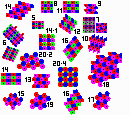
first of all, i never played SMAC, just civ2. and in civ2 i was always anti-overlap. but in civ3, i was annoyed at how it took so long for you to get above pop=12 because of hospitals and all the wasted space that resulted in... and at the same time i realized how many cities you would need to get 100,00 culture, and i'd never be able to secure so much terrain for perfectly non-overlapping cities with the AI expanding as fast as it does...
so i started thinking of city placement patters with overlap. i fired up Paint (yes, the cheapo drawing program that comes with windows!), zoomed in to pixel resolution, put the grid on, and started playing with patterns! i came up with patterns for cities using 5 squares (besides the city square) all the way up to 20 (the optimal non-overlap pattern). i'm sure there are still many variations out there - for example, any "rectangular" pattern (e.g. 8 or 11) can have their rows or columns shifted, so that no city falls on a mountain square. (by the way, dont you think there should be a tech or civ-specific trait that allows you to build cities on mountains? think macchu-picchu - but i digress)
anyway, enough rambling, here is the fruit of my hours and hours of boredom at work. zoom in with your favorite graphics editor and you'll see the patterns better.
 Attachment: citypatt.gif Attachment: citypatt.gif
This has been downloaded 384 time(s).
|
|
| |
|
|
|
Spaced Cowboy
|
 |
Dallas TX
Nov 2001
time: 23:17
|
|
quote:
Originally posted by mengo76
yes! the thread i had resisted starting for the last 2 or 3 weeks has been started by someone else!
first of all, i never played SMAC, just civ2. and in civ2 i was always anti-overlap. but in civ3, i was annoyed at how it took so long for you to get above pop=12 because of hospitals and all the wasted space that resulted in... and at the same time i realized how many cities you would need to get 100,00 culture, and i'd never be able to secure so much terrain for perfectly non-overlapping cities with the AI expanding as fast as it does...
so i started thinking of city placement patters with overlap. i fired up Paint (yes, the cheapo drawing program that comes with windows!), zoomed in to pixel resolution, put the grid on, and started playing with patterns! i came up with patterns for cities using 5 squares (besides the city square) all the way up to 20 (the optimal non-overlap pattern). i'm sure there are still many variations out there - for example, any "rectangular" pattern (e.g. 8 or 11) can have their rows or columns shifted, so that no city falls on a mountain square. (by the way, dont you think there should be a tech or civ-specific trait that allows you to build cities on mountains? think macchu-picchu - but i digress)
anyway, enough rambling, here is the fruit of my hours and hours of boredom at work. zoom in with your favorite graphics editor and you'll see the patterns better. |
Did you ever do one with maximum city size with no overlaps, is it possible??
|
|
| |
|
|
|
gopher
|
|
I eat my own poop
Dec 1999
time: 00:17
|
|
The Yang method is missing one very important factor to work as well in Civ3 than SMAC. That would be the almighty BOREHOLE . With that, production could support an adequete defence force.
In Civ3, your Culture might be powerful (that infastructure costs, along with small production can lead to disaster), but the territory would be small. Luxs are not a problem, since you got HapProd from the culture buildings, but good luck getting Oil or Rubber.
But hey, we learn by experimentation (After we discover the Scientific Method, that is), so try it out!
|
|
| |
|
|
|
Nakar Gabab
|
|
of Pedantic Nitpicking
May 2001
time: 00:17
|
|
quote:
Originally posted by gopher
The Yang method is missing one very important factor to work as well in Civ3 than SMAC. That would be the almighty BOREHOLE . With that, production could support an adequete defence force.
In Civ3, your Culture might be powerful (that infastructure costs, along with small production can lead to disaster), but the territory would be small. Luxs are not a problem, since you got HapProd from the culture buildings, but good luck getting Oil or Rubber.
But hey, we learn by experimentation (After we discover the Scientific Method, that is), so try it out! |
Good point. No boreholes make production a bit of a trouble... but that's what pop-rush unit factories are for. Sure, there's no boreholes, but even Yang couldn't whip his people into building that big defense force in a few turns...
...and hey, that might work, too. If a city gets just a bit too unhappy from the pop-rushing, simply disband it and send a settler to the exact same site, building a 'real' city there (again, this goes against building lots of culture, but you don't need TOO many unit factories, and you ought to have enough cities to compensate, perhaps). Your other cities will easily absorb the area left behind, so the AI has no chance to settle there before you can - plus all the improvements, roads, etc. are in place to start with.
|
|
| |
|
|
|
gopher
|
|
I eat my own poop
Dec 1999
time: 00:17
|
|
quote:
Originally posted by Nakar Gabab
Good point. No boreholes make production a bit of a trouble... but that's what pop-rush unit factories are for. Sure, there's no boreholes, but even Yang couldn't whip his people into building that big defense force in a few turns...
...and hey, that might work, too. If a city gets just a bit too unhappy from the pop-rushing, simply disband it and send a settler to the exact same site, building a 'real' city there (again, this goes against building lots of culture, but you don't need TOO many unit factories, and you ought to have enough cities to compensate, perhaps). Your other cities will easily absorb the area left behind, so the AI has no chance to settle there before you can - plus all the improvements, roads, etc. are in place to start with. |
Very true, but I find that disbanding cities is not only VERY annoying, but also long and expensive process. Besides, then you have to build a Temple again and again and again.
|
|
| |
All times are GMT. The time now is 05:17.
Apolyton Time is 00:17. |
top of page
|
| archivepost |
|
Forum Rules:
You may not post new threads
You may not post replies
You may not post attachments
You may not edit your posts
|
HTML code is ON
vB code is ON
Smilies are ON
[IMG] code is ON
|
|
|
|
|
|





 20-01-2002 02:05





 |
|