|
| |
|

|
Willem
|
 |
Canada
Dec 2001
time: 00:17
|
|
quote:
Originally posted by Optimizer
If it works, one could create a model for buildings to have different effects under different governments.
Say, for instance, that a Cathedral would make 3 citizens happy under Despotism/ Monarchy, 2 under Republic/Democracy and none under Communism. Then remove the upkeep cost and the happiness effects from the Cathedral and introduce one building, requiring a Cathedral, for each government (you can call them Despotic priesthood, Monarchy priesthood and so on). These buildings would cost nothing to build, but have upkeep costs and benefits depending on their governments.
One problem is that one would need a lot of buildings. |
The easier option would be like I said, selecting multiple governments. In the case of Cathedrals for instance, it would be available and operational to all govs except Communism. So there would have to be some replacements that have a similar effect for Communism.
That would be a setback for that type of government if you think about, since as soon as you switch over, all these religious buildings made earlier become useless, and you have to build a whole new infrastructure to keep your people happy. It wouldn't be nearly as easy for people to switch from Democracy in order to wage war. They'd probably have to use up quite a few of their forces as military police at first, until they've had a chance to get their gulags in place.
Another approach here would be to have different lines of happiness buildings for different Govs. For instance, I have a Monastery improvement I've added so I could only build and use it in a Republic, then make my Cathedrals only work with Democracy. I'll have to come up with a different line for Monarchy, and Communism though. And Dictatorship as well, I've added that to my game. Hmm.., some possibilities here.
|
|
| |
|
|
|
Willem
|
|
Canada
Dec 2001
time: 00:17
|
|
quote:
Originally posted by Optimizer
If it works, one could create a model for buildings to have different effects under different governments.
Say, for instance, that a Cathedral would make 3 citizens happy under Despotism/ Monarchy, 2 under Republic/Democracy and none under Communism. Then remove the upkeep cost and the happiness effects from the Cathedral and introduce one building, requiring a Cathedral, for each government (you can call them Despotic priesthood, Monarchy priesthood and so on). These buildings would cost nothing to build, but have upkeep costs and benefits depending on their governments.
One problem is that one would need a lot of buildings. |
Here's an idea for gov specific happiness buildings. It revolves around using variations of the Cathedral:
Monarchy: Monastery, 2 happy, 2 culture, requires temple
Republic: Cathedral, 3 happy, 2 culture, requires Temple
Democracy: City Hall, 3 happy, 3 culture, requires Courthouse
Communism: Gulag, 2 happy, 1 culture, no requirement
Dictatorship: Constabulary 1 happy, 1 culture, requires Police Station
I'm not to crasy about the name Gulag, I'd rather have something more like a secret police, but I can't think of a name. Suggestions?
PS. Of course, Politburo.
Last edited by Willem on 20-02-2002 at 12:18
|
|
| |
|
|
|
s3d
|
|
If you want it with communist flavor, most notorious secret services are Cheka, NKVD, MGB and Smersh (KGB was mildly liberal compare to them). The most secret, efficient and the only one dealing with real spies (sometimes that is, they killed a lot of ordinary peoples and suspected political dissidents also), was Smersh. It existed during WWII only, (abbreviation for "death to spies" "smert shpionam" in russian) and famous for high gunfight training of its operatives (well, the rest of russian secret police weren't dealing with opponent who could put up a fight). They invented "pendulum" , special kinde of maneuvering in very close gunfight. Smersh also was James Bond opponent in first James Bond books (wrongly, it was disbanded by that time).
|
|
| |
|
|
|
Willem
|
|
Canada
Dec 2001
time: 00:17
|
|
quote:
Originally posted by godinex
What`s exactly a Gulag? |
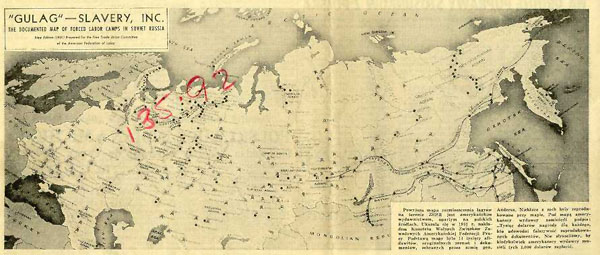
Basically it's just another name for concentration camp, though it has more of a political role. In the early days of the Soviet regime, they set up Gulags in Siberia where they would send their dissidents. Some survived, a lot of them didn't. There was a Russian writer several years ago, Alezander Solzshenytzin (sp?), who wrote the "The Gulag Archipelagos" (sp?) which chronicled his experiences in one he lived in for many years. If you'd like to know what they were like, read his book.
Last edited by Willem on 20-02-2002 at 22:21
|
|
| |
|
|
|
s3d
|
|
Little comment - Gulag is not a concentration camp itself, it was a central department of concentration camps in the internal affairs ministry. It is abbreviation for "glavnoe upravlenie lagerey" - "the central department of camps". Most of Gulag prisoners weren't even dissidents - they were random peoples, captured because Gulag had monthly and yearly norms for prisoners to get. It's difficalt to estimate number of prisoners in Gulag, it was probably from 5 to 15 % of all population. Alexander Solgenitsin indeed a best source of information about Gulag.
Last edited by s3d on 20-02-2002 at 22:47
|
|
| |
|
|
|
Alinestra Covelia
|
 |
I sense the dodgy presence of Bing - a presence I've not felt since...
Feb 2000
time: 00:17
|
|
A more benign version of a gulag (as used in China) might be a cadre center. The cadre (or "gan bu" in Chinese) are low level government officials who are chosen from university students, industrial workers, etc and basically include a broad range of social spectrum. So although the central government is not open to general selection by the people, the lower levels of it are, thus allowing for limited election rights. The cadre are also meant to represent interests and needs of their region or industrial sector. Therefore, populace dissatisfaction has a vent and can (hopefully) lead to improvements.
Just a thought, because gulags are quite obviously negative whereas the cadre in China are rather more constructive. If you want to portray a less brutal socialist state, then this might be more accurate.
Such a building might reduce unhappiness and some corruption. Working in conjunction with courthouses and police stations, this might even produce a nearly corruption-free city, since corruption is evenly spread in Civ3's Communisms.
(Of course, you couldn't really call China a hardcore Communist state these days. Mao must be turning in his mausoleum.)
Last edited by Alinestra Covelia on 21-02-2002 at 07:28
|
|
| |
All times are GMT. The time now is 05:17.
Apolyton Time is 00:17. |
top of page
|
|
|
Forum Rules:
You may not post new threads
You may not post replies
You may not post attachments
You may not edit your posts
|
HTML code is ON
vB code is ON
Smilies are ON
[IMG] code is ON
|
|
|
|
|
|






 14-02-2002 01:32


 Attachment:
 |
|