|

|
Pembleton
|
|
Cyberspace
Apr 1999
time: 23:17
|
|
Never mind. I found the answer using a google search.
Last edited by Pembleton on 17-02-2002 at 03:49
|
|
| |
|
|
|
Pembleton
|
|
Cyberspace
Apr 1999
time: 23:17
|
|
quote:
Originally posted by Immortal Wombat
They finally realised which sport it is the rest of the world gives a damn about, and started investing. |
They tried an American League in the (early 70's?) when Pele was near the end of his career and it failed.
|
|
| |
|
|
|
Pembleton
|
|
Cyberspace
Apr 1999
time: 23:17
|
|
deleted.
|
|
| |
|
|
|
Pembleton
|
|
Cyberspace
Apr 1999
time: 23:17
|
|
Well I just looked it up and it's different from ice hockey's.
|
|
| |
|
|
|
David Floyd
|
|
The bottom of a large bottle of beer
Jan 1970
time: 05:17
|
|
Offsides is when you try to pass to a player and there are no defenders closer to their goal than he is.
Right?
|
|
| |
|
| |
|
|
|
David Floyd
|
|
The bottom of a large bottle of beer
Jan 1970
time: 05:17
|
|
Ah, baseball, that I know about having played (half-decently in fact) for several years.
The point isn't NECESSARILY to hit the ball as far as possible - the point is to get on base. Sometimes, in fact, the point is to hit the ball such that you will be thrown out, but in the process another player advances or scores. This process is known as sacrifice flies, or a sacrifice bunt. In general, you DO want to hit the ball as far as possible, although unless you are hitting a homerun a line drive or "blooper" is better than a high fly ball.
As to the next question, let's take this example.
The batter hits a ground ball down the third base line. The third baseman picks it up and throws to the first baseman. If the first baseman catches the ball before the batter (now the runner) reaches first base, by touching his foot (or hand) on the base, then the batter is out, meaning he retires to the dugout, and his team his penalized one of their three outs for the inning.
However, if the batter/runner reaches 1st base before the 1st baseman catches the ball, he is "safe", meaning he remains on first base. He does not have free reign to travel around the bases.
The only time one gets a free trip around the bases is when one hits a homerun - basically, hits the ball past the fence in the outfield, in between each of the foul poles.
OK, as to score.
Each time a person on base crosses home plate, by touching their foot or hand on home plate, their team scores a run. Whoever has the most runs, wins.
Confused? 
|
|
| |
|
|
|
Goingonit
|
 |
Toronto, Canada - AECCP member
Apr 2001
time: 00:17
|
|
The basic rules of baseball
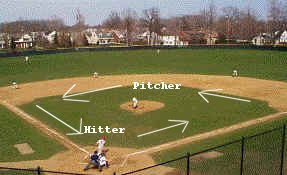
There is a hitter and a pitcher. The pitcher stands on a little hill facing home plate, and the hitter stands looking across home plate holding a bat. There are 8 people on the same team as the pitcher standing in various places around the field. Hitters who have previously gone to bases are standing on or near the bases.
It is the object of the pitcher and his team to get the members of the other team 'out'. 3 'outs' and the teams revers - the hitters team takes the field and the pitcher's team gets to hit.
It is the object of the hitter and his team to get as many people as possible around the bases and back to home plate - to score 'runs'.
The pitcher throws the ball. If the hitter swings the bat, and misses, it is a strike. Three striles and the hitter is out. If the hitter does not swing, and it is far away enough from him, it is a 'ball'. Otherwise it is a 'strike'. 4 balls and the hittergets to go to the first base automatically.
If the hitter hits the ball, there are four things that can happen. If the opposing team catches the ball, the hitter is out. If the ball hits the ground, the hitter becomes a runner, and runs around the bases. If a member of the opposite team touches a base-runner with the ball, and the runner is not standing on a base, that runner is out. Runners cannot pass other runners, nor can two runners be on the same base. If the hitter hits the ball over the wall, it is a home run, and all the runners run home and score runs. If the ball is too far to the left or the right, it is a foul and nothing happens.
When a runner gets back to home plate, without getting out, they score a run. The team with the most runs at the end of the game wins.
It's much less complicated when you actually play the game.
|
|
| |
|
|
|
Bereta_Eder
|
|
ok I got most of it.
1 question
so a runner can stand next to a base and wait right?
when will he be able to move again?
is it when the next hitter hits the ball and the other team tries to catch it and return it to a «baseman»?
Last edited by Bereta_Eder on 17-02-2002 at 09:36
|
|
| |
|
|
|
Pembleton
|
|
Cyberspace
Apr 1999
time: 23:17
|
|
Damn this server is slow...reason for double post.
|
|
| |
|
|
|
Pembleton
|
|
Cyberspace
Apr 1999
time: 23:17
|
|
quote:
Originally posted by Goingonit
If the hitter hits the ball, there are four things that can happen. If the opposing team catches the ball, the hitter is out. If the ball hits the ground, the hitter becomes a runner, and runs around the bases. If a member of the opposite team touches a base-runner with the ball, and the runner is not standing on a base, that runner is out. |
But there are times when you don't have to tag the runner, but only the base. The first example is running to first base.
You can also run to first if you strike out if the catcher drops the ball or lets it go by him.
And if there's a "force out", you don't have to tag the runner either.
|
|
| |
|
| |
All times are GMT. The time now is 05:17.
Apolyton Time is 00:17. |
top of page
|
| archivepost |
|
Forum Rules:
You may not post new threads
You may not post replies
You may not post attachments
You may not edit your posts
|
HTML code is ON
vB code is ON
Smilies are ON
[IMG] code is ON
|
|
|
|
|
|





 17-02-2002 03:42








 there's hope for you lot yet!


 Attachment:
  |
|
 |
|