|
| |
|
| |
|

|
Richard Bruns
|
|
NC, USA
Nov 1999
time: 06:18
|
|
One thing that has been mentioned several times is the possibility of linking the economics GUI, and other types of intreface as well, to the tech system. I think that this can be done now, with one new technology and some applications.
I propose adding a Tier 1 technology called "Organization" to the tech tree. The civ´s knowledge of this technology determines what can be done with the interface. This would be done by applications described in a seperate xml file.
I think that we can test this now, starting with one small change for the next demo: Disable the Build Roads button and the associated fund allocation in the econ GUI until the civ gets an Organization knowledge of 2. Since the knowledge level no longer falls, we don´t have to worry about what happens if orders are disabled.
What do you think? How hard would this be to code?
|
|
| |
|
|
|
Richard Bruns
|
|
NC, USA
Nov 1999
time: 06:18
|
|
quote:
Originally posted by Mark_Everson
I think Ipersonally would find this Very annoying. |
Which part do you find annoying? It seems axiomatic that tech will have to affect the interface at some point. Remember the comment about manipulating mammoth belly futures? If a single Organization tech is the annoying part, we can replace it with something like a Road Building tech that turns on at a Production knowledge of 2 or 3.
|
|
| |
|
|
|
LFS
|
|
I was hoping to have a prototype or screen shots up by now, but work commitments have prevented any real coding. So instead I will quickly say in words what I am currently thinking of (please feel free to criticise, I'm not a GUI expert), I have picked up on several points made previously and tried to incoporate them.
I am looking at providing an initial screen that provides information/input on just a few high level areas - say 'infrastructure', 'research' , 'military'. the info/input would be % allocated to each area and would be altered by the user with sliders (text boxes look to 'spread sheety') the sliders could auto adjust so all areas displayed would be 100%.
Each of these areas could be opened up tree fashion to reveal the detailed areas underneath them ('roads', 'mines' , 'phalanx' ), again sliders would allow input of the % allocated to each of these areas, but it would be by % allocated to the parent category. ie 30% to military -> 50% phalanx would mean half of the 30% in military goes to phalanx (15% of overall).
(Although this may need some extra work) I would expect eventually that setting the lower levels of detail would not be needed unless the player wanted to, I would like to see the player allocate resources at the high level of 'infrastructure' and some sort of minister AI sensibly allocate this budget to lower levels.
I intend on removing all other fields except the readonly field of expected production (ie expected to build 3 phalanx or 250 road for this % allocation). Although eventually the player could see all fields if he desired (some sort of econ view options with check box next to 'display ROI')
Needless to say, no area should be displayed if it not appropiate to the tech or other circumstances.
All comments good  and bad and bad  welcome. welcome.
|
|
| |
|
|
|
LFS
|
|
Another alterntive to a tree structure I was toying with was more !! dialogs - ie clicking on infrastructure would popup the infrastructure only dialog. Other wise it would be the same.
The advantage I considered to this (apart from a tree maybe looking odd) was that made it more apparent that allocation at this level was relative to infrastructure budget and not the overall income.
|
|
| |
|
|
|
vovan
|
|
quote:
Originally posted by LFS
Another alterntive to a tree structure I was toying with was more !! dialogs - ie clicking on infrastructure would popup the infrastructure only dialog. Other wise it would be the same. |
Actually I like that idea. I was thinking along the same lines, also. That would also go nicely with the spirit of the game, which is to allow the player to choose the degree of control over the different aspects of the nation he wants to exert.
|
|
| |
|
|
|
Richard Bruns
|
|
NC, USA
Nov 1999
time: 06:18
|
|
One thing that can get annoying about this game is that I know that there is such an excellent model underneath, but I have no good way of interacting with it. In the current implementation of the game, my economic decisions are limited to blindly throwing money at things with no idea of what I will get. If I want to do more than that, I have to do a frightening amount of work.
For example, consider the very simple question: How much will it cost me to build a Legion?
To get the answer, I first have to dive into the xml files. I look up the Legion unit and see that it is made of 3500 Heavy Spearmen, 1000 Skirmishers, and 500 Engineers. I then look up each of these elements and find the following:
HeavySpear defaults to warrior, and costs 3.3 times as much production and 4 times as much training.
Skirmisher defaults to warrior, and costs 1.66 times as much production and 2 times as much training.
Engineer defaults to warrior, and costs 4 times as much production and 3 times as much training.
Warrior costs 0.004 food, 0.048 production, 0.008 services, and 0.002 training.
This means that, after working at it for a while, I can calculate that my Legion will cost me the following, assuming that I can build themn all in one turn so there is no decay:
Food: 0.004 * (3500 + 1000 + 500) = 20
Production: 0.048 * (3500*3.3 + 1000*1.66 + 500*4) = 730.08
Services: 0.008 * (3500 + 1000 + 500) = 40
Training: 0.002 * (3500*3.3 + 1000*1.66 + 500*4) = 30.42
Now I have to turn these numbers into cash. In the first turn of delenda, the econ stats for the Latum province are as follows:
Food 5655, price 1.48
Production 983, price 1.13
Services 716, price 0.99
I will assume that Training costs Services.
So my Legion, if I build it all this turn, will cost:
20*1.48 + 730.08*1.13 + 70.42* 0.99 = 919.57 gold
Since Warriors had an Upkeep number of 0.1, I will assume that my Legion will also cost about 92 gold per turn in upkeep, but that of course will change if the price of the various things changes. It is also important to note that Latium will not be able to make more than 1.3 legions per turn, no matter how much I spend.
That involved way too much effort on my part. The GUI should take care of this kind of thing for me. I would like to see something like this:
This table automatically tells me how much money it will cost to build something in a certain province. By comparing the unit resource costs and province resource production per turn, I can see how many can be made in a turn at an absolute maximum. If I put in a percentage of the tax rate as the production order, I can quickly look at province taxes and the unit cost see how many will be made per turn, without the GUI having to tell me explicitly.
I know you are already working to make it look better than that, but the html table shows roughly what I want to be able to see and do. The Number: input box is the option to produce a certain amount of something and then stop allocating resources. This would be especially useful for things like walls where only a certain number are needed and extra resources put into that order are basically wasted.
Last edited by Richard Bruns on 27-01-2003 at 22:35
|
|
| |
|
| |
|
|
|
Mark_Everson
|
 |
Canton, MI
Jan 1970
time: 00:18
|
|
Hi gents:
Richard, thanks for the effort that went into creating your post, but I'm with Lee in that I think it would scare off too many players. If we were ever to do such a thing for power players it should be very near the end of developing v1.0 IMO. In the code there's a Cost object that tells how many FPS (food, production, services) are needed to build a unit. So we can easily put that info up if anyone should want it.
I am largely with Lee on this except that I think his 'absolute numbers' prescription is insufficiently flexible. FE entering an order of "build 2 only 2 legions" is pretty worthless in wartime when legions may be chewed up very quickly.
How about this for low MM. At the civ level the player enters the configuration of the entire army. FE 13 Legions, 4 Light Horse, 6 Siege Engines. That high-level interface gives the build and maintenance cost for the entire force (assuming you were starting from scratch) and also the incremental from where you are now. You can also get info on if the build-up were to be performed in 1, 2, 3, whatever turns. The player then picks the target for number of turns.
From then on, the game works to maintain that army at that strength. When we know how to do unit reinforcements that would be the preferred way, with new units being created only when one gets whiped out, or leaves a pre-defined military theater. One could also do this at a Province level to have finer control of what's built where. You could also index army size to the civ tax base size or something so as the empire grows the standing army size could be automatically adjusted.
What do you think? Seems very flexible and low-MM to me.
|
|
| |
|
|
|
Richard Bruns
|
|
NC, USA
Nov 1999
time: 06:18
|
|
quote:
Originally posted by Mark_Everson
Richard, thanks for the effort that went into creating your post, but I'm with Lee in that I think it would scare off too many players. If we were ever to do such a thing for power players it should be very near the end of developing v1.0 IMO.
|
I don't see what is so different about my GUI and what we have now and what is being proposed. We already show the province production and price, I simply put that on the same page as the orders window. The expandable tree structure was already agreed upon.
quote:
In the code there's a Cost object that tells how many FPS (food, production, services) are needed to build a unit. So we can easily put that info up if anyone should want it. |
Yes, that is the main thing I would like to see. But knowing food, production, and services, while useful, is not enough, since I am paying cash for everything and I would like to know what I am getting for my money. Since each province has different FPS prices, there shoudl be something in the province data to indicate how much a thing costs in that province. I don't think that this is trivial information. Players will want to know things like this, and if the game doesn't tell them they will have to resort to manual calculations.
quote:
I am largely with Lee on this except that I think his 'absolute numbers' prescription is insufficiently flexible. FE entering an order of "build 2 only 2 legions" is pretty worthless in wartime when legions may be chewed up very quickly. |
I really like the percentage allocation...for some things. If I am in a big war, it is great to start churning out military. But percentage allocation is pretty bad for things like walls. I have to resort to manual calculation to figure out exactly what percentage to allocate of I only want to build one wall. Otherwise I either don't build the walls fast enough or I get an excess of "Wall Building Funds" that sit around doing nothing except annoying me each turn in the popup.
Also, what if I want to build a single scout to explore the world? With the percentage allcoation, I have to go to teh GUI, allocate the funds, wait until the unit is produced, and then go back to the GUI and turn off allocation. THis means two trips to that screen, and there is always something leftover after the first scout appears and I shut off production. This is a waste of my time and my civilization's resources. With a number allocation, I only have to go to the GUI once, and there are no wasted leftover resources.
I think that number requests should be in the game, and that they should trump percentage requests. Percentage requests are great for long term policy, and are an excellent innovation. But for one-time purchases or short turn requests, they are not very good. I like being able to set policy, but I would also like to be able to say "We need a wall around Seville, and we need it fast. Put your economic plans on hold and make that wall ASAP. Then, after that wall is finished, go back to what you were doing before." This is IMO historically reasonable and actually reduces micromanagement, sonce a one-time order would only take one trip to the GUI instead of two.
The system you propose for the army looks like another good way of setting long-term policy, but it also wouldn't be very good for single requests like walls. IMO it would be a nice feature, but I wouldn't use it that much.
|
|
| |
|
|
|
LDiCesare
|
|
La Ferté sous Jouarre France
Jan 2001
time: 05:18
|
|
I must say I like Richard's proposal, in terms of content.
If you show it in a tree structure, it looks less like an accountant sheet, you would see:
Legion (cost 920) and 2 boxes %age/amount.
I also like Mark's proposal, for military units:I want this amount of stuff in X turns, and the X turns provides feedback on percentage of taxes spent there. I agree about making a whole army repartition window (kind of a unit workshop except it is an army workshop), but think this is not top priority (it won't work if we don't get the other stuff right before IMO).
For wall and road building, when laying out a road or wall, we should have a panel (which you can corss so you won't see it again if you have set your mind forever) asking how much time we should wait before completion and indicating the %age of total spendings that this would require, with a warning if you go into a deficit. This would make the roads/walls costs in the econ panel informative only, reducing both interfaces to a single button/UI: End build would spawn the cost panel, unless you don't want to, in which case it will remember the number of turns you used last time. The dialog could be forced if you go into the main econ panel and say you want to change it.
Thus I'd have two options for every econ order:
%age or amount in number of turns. The %age is always there as information, and there is also the rate of construction amount nearby.
|
|
| |
|
|
|
Richard Bruns
|
|
NC, USA
Nov 1999
time: 06:18
|
|
I really like the idea of the End Build button creating a cost/spending panel for roads and walls that asks how quickly you want what you built. It is IMO a very good way to handle things, since it allows the player to enter the information instantly without going to the econ GUI. That way I can make the decision quickly, right after ordering the build.
It also allows me to be sure that I get that wall up around Marsaglia before Hannibal comes knocking at the door, and also that I don´t ruin the economy or waste any production by building the wall too fast. Very nice.
|
|
| |
|
|
|
Martin the Dane
|
 |
Aarhus, Denmark
Feb 2000
time: 06:18
|
|
OK, I have a few comments.
First to the treeview vs. menu:
Depending on the implementation I prefere a tree-view. But provided its done in a smart way I could live with a menu system.
I think the basic idea behind Richards table is good, but there should be some info available on the higher levels, as well as options to alocate funds on an overall level without expanding the views.
AS to how to decide what to spend on what, how much to build, etc:
I think it should be possible to alocate a certain percentage of the economy to unit building, but it should also be possible to say make X Units over the next Y turns, and make X units each turn untill I say stop.
For roads and walls I think there should be a minimum/default time to build, but also an option to make it a priority matter, and set a maximum resource alocation for the job, but the default should be to automatically alocate the needed resources.
For roads within a given province the province should be able to build a certain stretch each turn, based on the production capacity of that province, and the cost should then be alocate automatically from that provinces economy. But it should be possible to alocate civ funds to speed up road building.
I think the idea of having an optional panel that comes up when you press the End Build, to handle this, would be nice, but the same info and options should be available from the econ GUI.
|
|
| |
|
|
|
Richard Bruns
|
|
NC, USA
Nov 1999
time: 06:18
|
|
I was never suggesting changing the tree-view to a menu. I like the idea of an expandable tree view. In fact, I was trying to simulate a tree view in my example above, but I don´t know how to do that with HTML. The Show/Hide buttons were supposed to correspond to the little arrows that expand and collapse a tree.
Making X things over Y turns is something I agree with, but I think it would be redundant to say to build X things a turn continuously. That is what the percentage numbers are good for.
When you say to allocate funds on an overall level, do you mean something like this:
where if you put funds in the top bar it would automatically split them up among Legions, Siege Weapons, and Cavalry? That would be nice, especially if combined with Mark´s idea for setting a force structure for the civ. The player could go to the GUI and set the preferred composition of a TF. Entering a value in the Number: box would tell the province to make that many TF´s, automatically dividing the funds among the various units needed to make that TF. Selecting the percentage option would continuously build units in the proportion indicated by the force structure the player chose.
|
|
| |
|
|
|
LFS
|
|
quote:
where if you put funds in the top bar it would automatically split them up among Legions, Siege Weapons, and Cavalry? |
That was what i was proposing, each level of the tree would be a subcategory of it's parent (I can see 2 , possibly 3 levels in the tree), allocating resources at the parent level , say 30% to military if left at that would result in the AI (some sort of minister/advisor) allocating that budget to subcategories like pahalanx, siege etc. But if the player opened the tree and allocated resources to phalanx this would over-ride the AI and ensure that phalanx got that resource. The AI may still be left to allocate surplus budget.
eg
would allocate 30% of total budget to Military. Of this half would go to phalanx, the other half would be left to the minister AI to allocate.
(Note i prefer sliders to text fields, I would still have text fields as well, but sliders give less of an Accountants only' feel)
This approach leaves the player with the option of managing the entire economy from a high level set of econ categories (possibly only 3 or 4) or micromanaging as he sees fit.
It has to said though that although the gui for this is fairly easy, it would require the AI to handle it - though this could be left out for the time being.
|
|
| |
|
|
|
LFS
|
|
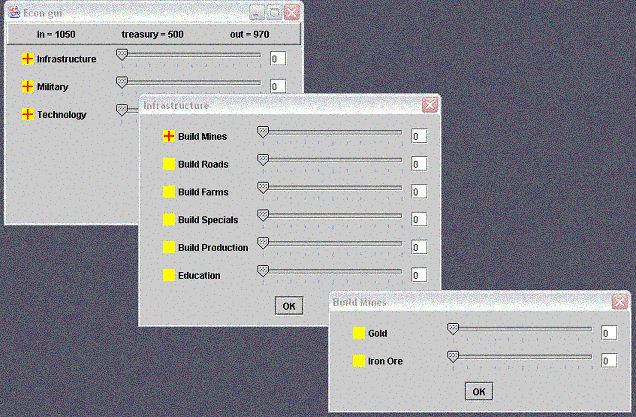
There seems to have been a fair bit of discussion on this gui which made me think about not doing anything yet, but anyway I finished a quick mock up of what I was roughly thinking. Here is a screen shot - It is pretty minimalistic, a label , slider, and text box for value for each item. The fantastic red cross icons are to click on which pops up that area of the economy, and just to show that this can go deeper I put specific mines as a sub category of Mines. The sliders are auto balancing.
ultimately each row could acquire extra fields.
I ditched the tree - it looked horrible.
I quite like the popup idea in the end, plus any one could easily be poped up from other places.
It's probably way to simple for Mark, but is about right for me- what do others think
Oh and the income/treasury bar should have icons but an artist I am not (but do mean red crosses)
 Attachment: sh.gif Attachment: sh.gif
This has been downloaded 73 time(s).
Last edited by LFS on 30-01-2003 at 04:29
|
|
| |
|
|
|
Richard Bruns
|
|
NC, USA
Nov 1999
time: 06:18
|
|
I have no problem with popups instead of a tree, and it is true that the flexibility to bring up the lower level boxes from other places can be good. But we have to be careful that the player knows exactly what each popup is. For example, I should be able to tell which popup box is the Infrastructure orders for the whole civ and which one is the Infrastructure popup box for a certain province. The best way to do this is probably to make the title of each popup should show the whole hierarchy, like "Latium Infrastructure: Mines" instead of just "Mines"
Sliders are nice for setting a percentage, but orders for a specific number of something (2 TF´s in Gaul) need to be given in a text box IMO.
I think it would also be good if the GUI to tell me how many of a certain kind of infrastructure already exists in a square. If there are more mines than farms then I probably need more farms. If the Economics GUI has everything that the Terrain Details box has, then I can get rid of that box on the main playing screen.
Would this be a good time to mention that while I am not specifically an accountant, I am, in fact, a Business major? Business Computer Information Syatems, to be precise. So naturally my idea of a good GUI is lots of numbers and details, and an efficient layout.
|
|
| |
|
|
|
LFS
|
|
I've managed to get a bit more done today (supposed to be in bed recovering from a chest infection but got bored by this afternoon).
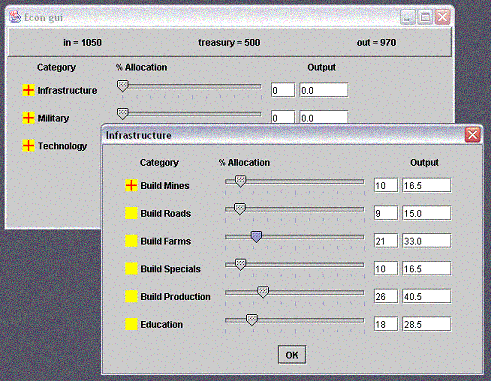
I've put in an output box (ie estimated output) and connected all the fields so altering one adjusts the others. Even output can be typed into and it adjusts the % (in my mock up anyway) - useful for seeing what percentage will x output.
Mark:
There is going to need to be some work on the econ model - namely building up a tree of categories, e.g what top level categorie we have, and what are their subcategories. Also I've started trying to work out how to connect my gui model to the econ model. I believe GovtEconOrder is the class I need to be talking to mainly. I'll mail you the main data class the gui uses, with how I want it to wrap the Order class check it out and make sure I'm calling the right stuff. Also a Factory class to build up the tree. I've started to work out how to get all the possible orders but can you check out, in particular I am still to work out how to get province as oppposed to civ level orders.
quote:
I think it would also be good if the GUI to tell me how many of a certain kind of infrastructure already exists in a square |
I doubt that would be done - The economy at the moment is dealt with at civ/province level, which square would it show.
Would this be a good time to mention I'm not a lawyer. God knows why I did a degree in Law.
quote:
But we have to be careful that the player knows exactly what each popup is. For example, I should be able to tell which popup box is the Infrastructure orders for the whole civ and which one is the Infrastructure popup box for a certain province. The best way to do this is probably to make the title of each popup should show the whole hierarchy, like "Latium Infrastructure: Mines" instead of just "Mines" |
That shouldn't be a problem.
PS I'm still happy to ditch this if there another design out there.
Attachment: sh1.gif
This has been downloaded 61 time(s).
|
|
| |
|
|
|
LDiCesare
|
|
La Ferté sous Jouarre France
Jan 2001
time: 05:18
|
|
One thing I hate in windows explorer is when it opens a directory content in a new window instead of expanding the tree and showing the content in the right pane.
That's how I feel when I see the huge (2, or even 3!!) windows for the orders. Can't we have a two-part window like the windows explorer? Or at least a single window with back/forward buttons instead of several?
|
|
| |
|
|
|
LDiCesare
|
|
La Ferté sous Jouarre France
Jan 2001
time: 05:18
|
|
Now as for the presentation, I think it is good enough, but, when in a province I'd like to see in the same window the amount spent on civ level. So I'd know I already spend 50% of my capital building legions, I will see it and be able to spend accordingly.
This could be done by setting the slider to the civ's position, but then can we slid it backwards (negative spendings) in one province?
|
|
| |
|
|
|
LFS
|
|
quote:
Can't we have a two-part window like the windows explorer? Or at least a single window with back/forward buttons instead of several? |
My original intent was a tree, but it does not really work, neither would SplitPanes, there is to much on each row- and likely to be more for those who want more detail. A back or up one level button so that you can stay on one screen is doable - how do others feel.
quote:
So I'd know I already spend 50% of my capital building legions, I will see it and be able to spend accordingly. |
I havn't got round to actually plugging this in to the real economy- i'm working on that at the moment. But your idea seems reasonable.
|
|
| |
|
|
|
Richard Bruns
|
|
NC, USA
Nov 1999
time: 06:18
|
|
quote:
Originally posted by LDiCesare
Now as for the presentation, I think it is good enough, but, when in a province I'd like to see in the same window the amount spent on civ level. So I'd know I already spend 50% of my capital building legions, I will see it and be able to spend accordingly.
This could be done by setting the slider to the civ's position, but then can we slid it backwards (negative spendings) in one province? |
I have actually found myself wishing for a negative province spending in many cases, so that I can cut province investment to 10% on something while keeping civ investment at 30%. Automatically setting province sliders to the civ spending level would be very nice. That way the province overwrites the civ percentage instead of adding to it. But then, there should be an order on the province screen that resets the province percentages to the default civ values.
About the infrastructure information, I meant to say province, not square. Sorry for the confusion. And I think it is important to have some information about what infrastructure there is. Currently I have no way at all of telling the difference between a province with absolutely nothing and a province with lots of infrastructure. Investing in infrastructure always feels like throwing money down a black hole because I never get any feedback or see any results or changes.
Also, when I take over an enemy province, how am I supposed to know how developed it is? The only current way of telling is to look at the farm and resource sites numbers on the terrain detail, and I have no way of knowing how many of those are natural and how many are the result of improvement, except by memorizing the terrain.xml file.
I think it is very important for players to feel like they have built something, and if they can´t see the things that have been built they lose touch with the economy. At least I do.
|
|
| |
|
|
|
Mark_Everson
|
|
Canton, MI
Jan 1970
time: 00:18
|
|
quote:
Originally posted by Richard Bruns
I have actually found myself wishing for a negative province spending in many cases, so that I can cut province investment to 10% on something while keeping civ investment at 30%. |
I agree that this is probably the best way to go, but it will take a bit of re-working of how orders work to make it possible. I've put it on my To Do list. Everyone else cool with working it this way?
quote:
About the infrastructure information, I meant to say province, not square. Sorry for the confusion. And I think it is important to have some information about what infrastructure there is. Currently I have no way at all of telling the difference between a province with absolutely nothing and a province with lots of infrastructure. Investing in infrastructure always feels like throwing money down a black hole because I never get any feedback or see any results or changes. |
Richard, that's what the econ info screen is for! ("Econ Stats" button on the orders window) You can see the production level to gauge productivity or the growth rate to gauge effects of spending. To that you want to add sites, that seems worthwhile. What else? Production per unit labor maybe? Once the orders is done I think a new version of the info frame is the way to go, so thoughts in the area are very relevenat. Anyone else?
quote:
Also, when I take over an enemy province, how am I supposed to know how developed it is? The only current way of telling is to look at the farm and resource sites numbers on the terrain detail, and I have no way of knowing how many of those are natural and how many are the result of improvement, except by memorizing the terrain.xml file. |
There isn't any site number improvement so far, but we will eventually need it. Also long run it would be good to show "natural" sites vs "created" ones so the player gets a feel for the land development.
quote:
I think it is very important for players to feel like they have built something, and if they can´t see the things that have been built they lose touch with the economy. At least I do. |
Agree Completely! We need to do that well or all is lost. We can't do all of it now, but we definitely should do the easy ones now. Thanks for the comments to push things in the right direction.
|
|
| |
|
| |
All times are GMT. The time now is 05:18.
Apolyton Time is 00:18. |
top of page
|
|
|
Forum Rules:
You may not post new threads
You may not post replies
You may not post attachments
You may not edit your posts
|
HTML code is ON
vB code is ON
Smilies are ON
[IMG] code is ON
|
|
|
|
|
|






 13-01-2003 05:18





 ).
).
 )
) |
|