|

|
Keeper of Hell
|
|
Ok, this really annoys me. I realize that Civ3 was never intended to be extremely realistic, but it seems to me that when one selects "Arid" and "Cold" for the terrain option, vast areas of jungle are probably not going to make a lot of sense. Yet that's just what I get, every single time- vast jungles. Is there any climate setting that Civ3 interprets to mean that it should *not* generate jungles, or is that just a hopeless case?
|
|
| |
|
|
|
Keeper of Hell
|
|
Yes, but early game, jungle is incredibly annoying as it erases whatever population growth you're able to make with disease. Plus, preferences nonwithstanding, I would think that the reason that the option to change the climate existed so that players would have the option of what they wanted. If so, the terrain generator has completely defeated that purpose by constantly generating huge jungle blocks.
|
|
| |
|
|
|
Keeper of Hell
|
|
4 billion, actually, but that's a good thought. I'll set it to 5 billion and see if there's any improvement.
|
|
| |
|
|
|
Coracle
|
|
quote:
Originally posted by Keeper of Hell
Yes, but early game, jungle is incredibly annoying as it erases whatever population growth you're able to make with disease. Plus, preferences nonwithstanding. . . |
Which doesn't prevent the dopey AI from pewking out with its Settler Diarrhea towns right in the middle of those jungles. Crazy.
|
|
| |
|
|
|
Jethro83
|
|
Newcastle, Australia
Mar 2002
time: 15:19
|
|
I don't see much problem at all with the terrain generator. The only idiotic thing about random maps is the civ placement. I'm not all for isolation, but being 6 squares or less away from the closest neighbour is just plain idiotic. As far as I'm concerned, the terrain aspects of map generation is top-notch.
|
|
| |
|
|
|
Purple
|
 |
Austin, TX, US
Apr 1999
time: 23:19
|
|
quote:
Originally posted by Keeper of Hell
Yes, but early game, jungle is incredibly annoying as it erases whatever population growth you're able to make with disease. Plus, preferences nonwithstanding, I would think that the reason that the option to change the climate existed so that players would have the option of what they wanted. If so, the terrain generator has completely defeated that purpose by constantly generating huge jungle blocks. |
I have never been hit with disease for jungle settlement, but it has appeared in floodplain cities--enough to make me now avoid building in a floodplain. Maybe the reason for the my lack of disease in jungles is that I put a high priority on clearing.
In your experience, does disease risk increase over time, as a city ages, or is it completely random?
|
|
| |
|
|
|
Keeper of Hell
|
|
The jungle disease seems to strike the hardest about 10-20 turns after you first build the city, reducing the city's population to one usually. Afterwards, it seems to hit fairly randomly and only for a single population point each time. Note that this is just based on casual observation, and I've in no way run an experiment about jungle disease.
|
|
| |
|
|
|
TheEvilCheater
|
|
Dont be afraid to build on flood plains. Its wroth losing some pop for the gold and pop u will have later on.
|
|
| |
|
|
|
Keeper of Hell
|
|
quote:
Originally posted by Purple
Maybe I will stop avoiding them. It's really nice not to have to build an aqueduct. |
It's excellent, especially early on when you need a city to build a wonder and don't have time to stop and let it build one. Usually, however, I have no shortage of lakes and rivers, so I don't have to go looking for flood plains for that feature.
|
|
| |
|
|
|
heidlejohn
|
|
quote:
Originally posted by Cairo_East
Do you have the planet age set at 3 billion years? I find that you can get a lot of jungles at this time due to the large number of mountain chains which trap the precipitation on one side of the chain.
As a person with a background in geography, I find the terrain generator to be the most improved aspect of the game. Ecosystems are where they are supposed to be, and the effect of mountains accurately effect the surrounding landscape. Even the multi-tile water spaces are an improvement, as they hinder computer triremes/galleys from wandering everywhere. |
I constantly see mountains on coasts. While that is true at a few places in the world, I find it hard to believe that so many ocean coasts have hills and mountains. I can't see this as a good geography lesson.
Also the distinction between ocean and fresh water lake is often bizarre. First there is no graphic distinction that I can note between them. Secondly, I have seen large water areas (10 hexes across) completely surrounded by land that is at least 2 hexes wide, yet the water is considered to be an ocean in the game rather than lakes like the Great Lakes.
Not to mention how many wasted whales or fish hexes I see in my games. The only land hex near them, if any, is too often a mountain hex where one can not build cities.
I can't give the rmg a good grade particlarly due to the poor way it handles water hexes.
|
|
| |
|
|
|
Purple
|
|
Austin, TX, US
Apr 1999
time: 23:19
|
|
quote:
Originally posted by Cairo_East
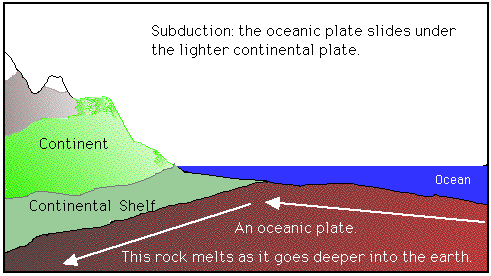
A process known as subduction is largely responsible for the mountain chains forming along coasts. The oceanic plate slides under the continental plate and proceeds to melt into magma. The Sierra Nevada Range and the Andes are good examples of subduction. Interestingly, these areas are also prone to long strings of volanoes. I think it shows good example of geogrpahic processes.
|
Strictly speaking, it is the plate collision, not subduction, that produces mountain folding, often bringing formerly ocean-floor strata to the surface, and this process also applies to continental-continental collisions (the Himalayas being the classic example, but the Urals and Appalachians are also mountains of this type).
The subduction process, with its melting of the subducting plate, produces volcanic mountains as the erupted magma builds up. (Pacific "Ring of Fire").
|
|
| |
|
|
|
Purple
|
|
Austin, TX, US
Apr 1999
time: 23:19
|
|
For the record, I'm in favor of adding adding an events option, which would include volcanoes, tsunamis, hurricanes, river flooding, and other natural catastrophes.
There should also be favorable events, I don't know, like bumper crop harvests, maybe. I think the appearance of new resources fits into this category. 
|
|
| |
|
|
|
Cairo_East
|
 |
Kansas City
Feb 2002
time: 00:19
|
|
quote:
Originally posted by Purple
Strictly speaking, it is the plate collision, not subduction, that produces mountain folding, often bringing formerly ocean-floor strata to the surface, and this process also applies to continental-continental collisions (the Himalayas being the classic example, but the Urals and Appalachians are also mountains of this type).
The subduction process, with its melting of the subducting plate, produces volcanic mountains as the erupted magma builds up. (Pacific "Ring of Fire"). |
You are correct, I was thinking of the process, but not the event.
|
|
| |
All times are GMT. The time now is 05:19.
Apolyton Time is 00:19. |
top of page
|
| archivepost |
|
Forum Rules:
You may not post new threads
You may not post replies
You may not post attachments
You may not edit your posts
|
HTML code is ON
vB code is ON
Smilies are ON
[IMG] code is ON
|
|
|
|
|
|





 30-05-2002 06:39





 Attachment:
 |
|