|

|
Ecthy
|
|
Zhonghuà Rénmín Gònghéguó
Mar 2000
time: 06:20
|
|
War Democracy would be superior. That realistic?
|
|
| |
|
| |
|
|
|
Exile
|
 |
of the Benighted Realms
Sep 2000
time: 23:20
|
|
Case, one of the reasons that German AFV production compared so unfavorably to both Russian and American production levels of similar vehicles during the war years was that the German facilities for tank production were the same used for the production of railroad locomotives, port cranes, and other very heavy equipment. These facilities were not designed for massive output levels in the same way the the American automotive industry and the Russian tank industries were. Moreover, at almost the last minute, the French were actually able to produce more tanks prior to May 1940 than the Germans fielded at the time. AND, several hundred of those tanks used to invade France and the low countries were seized Czech vehicles, not German-produced.
Also, the American production systems had their share of wastage and inefficiency. For example, the reason that the United States produced no tanks heavier than 40 tons during most of the war was because the loading facilities and cranes at most American ports simply couldn't handle anything heavier than that.
On the question of German inefficiency, Albert Speer was able to rationalize and steamline production during the 43-44 period so that its output was substantially increased, in terms of tanks, planes, small arms, and munitions. Yes, some part of this increase was due to the utilization of slave labor, nevertheless, it was efficient. Brutal, inhuman, but efficient. The point; German efficiency fluctuated widely at different times during the course of the conflict.
|
|
| |
|
|
|
Jim Winchell
|
|
Louisville, Kentucky, USA
May 1999
time: 05:20
|
|
Fascism was a bankrupt ideology and in any civ scenario the difference between the democracies and the government of Nazi Germany should be like night and day. I would use Monarchy or even Despotism for Germany. Like a shark, make it so that the Nazi civ will have to keep moving to survive, invading other countries to be able to raise just enough gold to support city improvments in Germany (happiness and factories) which are necessary to build combat units. The further Germany expands, the less effective the conquered cities will be for production, reducing the chance that the German player will be able to build Tiger tanks at Narvik or Rostov. The German player would also have to garrison conquered cities with ground units to offset unhappiness. A large part of the population of conquered cities will have to be set as entertainers (use a secret policeman icon instead of Elvis) to prevent rioting and as tax collectors to raise gold to support the city improvements in Germany. And with the population set as entertainers and tax collectors, then the conquered cities will be less effective to produce units. And the cities would be likely to not be able to raise enough food and suffer starvation, which would also show another evil aspect of Nazi policy towards the conquered nations. Give the Germans the Capitalism improvement and call it Slave Labor and make a house rule that the Germans can only produce gold and caravans in captured cities outside of Poland.
Give Great Britain/US the Michelangelo wonder so the allied-owned cities would always have implied cathedrals. Give all cities in Germany and annexed Austria (not Czech.) cathedrals at start and rename them Party Headquarters or some such and make the maintenance on them expensive. Place the Bach wonder in Berlin. Do not allow any nation to build cathedrals. This way the cities in Germany would not suffer unhappiness as much as the cities in the nations conquered by Germany. With the maintenance on these city improvements so high, the Allies would have an incentive to sell them off, especially since the player would not need the cathedral improvement. And what Allied player would want a Party HQ in his city anyway? The Soviets could keep them because they would become "Communist" Party HQs.
As for oil, place the Hoover Dam and King Richard wonders in a major city in the Ruhr industrial area like Cologne and make them obsolete with an advance received if the Russians capture the Rumanian oil fields. In past WWII scenarios, these wonders have been given to the Russian player to show the Urals or Lend Lease. This is not necessary, just make the Soviet combat units cheaper to build. If you use multiple event and rule files, make the Soviet combat units more expensive to build prior to 1941. When you switch rule files in 1941, make the Soviet units cheaper to build. The Adam Smith wonder can be built by the Russians to simulate Lend Lease.
|
|
| |
|
|
|
Ecthy
|
|
Zhonghuà Rénmín Gònghéguó
Mar 2000
time: 06:20
|
|
If they sucked so bad, how did they achieve all the maniacal slaughter?
|
|
| |
|
|
|
Jim Winchell
|
|
Louisville, Kentucky, USA
May 1999
time: 05:20
|
|
Because Nazi Germany "sucked so bad" it lost the war. Nazi Germany looted and starved the conquered nations. If the occupation policies had been different, perhaps Germany would have greater success than it did.
In civ terms Democracy, Republic, and Fundamentalism are not appropriate to represent the government of Nazi Germany. Despotism, Monarchy, and possibly Communism with high corruption levels would. Any WWII scenario that allows the Germans to easily build tanks and other combat units in Russia, Greece, Norway, Yugoslavia, France, etc. is not an accurate simulation. The production in cities in the conquered nations should be minimal. Combat units should be primarily manufactured in Germany and shipped to the front.
|
|
| |
|
|
|
Ecthy
|
|
Zhonghuà Rénmín Gònghéguó
Mar 2000
time: 06:20
|
|
I'm not convinced by all that.
|
|
| |
|
| |
|
|
|
Jim Winchell
|
|
Louisville, Kentucky, USA
May 1999
time: 05:20
|
|
Democracy is better for Great Britain/US (I assume they are the same civ). The unhappiness caused by units away from cities is a decent restriction on Great Britain prior to the entry of the US--it will limit the size of the army that the Brits can field and provide an incentive to the Brits to build fighters (which don't cause unhappiness). After the US entry, give the Brits/US the Suffrage wonder and perhaps another happiness wonder so the Western Allies and field a larger army.
Start the Soviets with Communism and then give them or allow them to research the Fundamentalism advance (I'm not sure what you would call this--"Wartime Communism?") after the Germans invade. Use a Soviet guard unit in the fanatic slot.
Use Despotism or Monarchy for Nazi Germany instead of Republic. Cities in a police state would not be affected by units marching off to war, but they should suffer unhappiness for failing to garrison cities in occupied nations. Give the Germans a happiness wonder in Berlin and a science wonder or two to offset some of the effects of their form of government.
What year does your civ scenario start and what nations are you showing as separate civs?
|
|
| |
|
|
|
Exile
|
|
of the Benighted Realms
Sep 2000
time: 23:20
|
|
I debated whether or not to respond here, but in the end, boredom won me over.
In the spring of '98, I was asked to guest lecture in a Modern Europe survey course while teaching at UCONN. I was to prepare and present 3 lectures on the origins of fascism in 20th century Germany. Rather obviously, the lectures were compartmentalized into the Social, economic, and political origins of the phenomenon.
What I told those 500 students then is the same thing I'll tell you now.
The most frightening aspect of the Nazi regime, and Hitler especially, was that they were not wildly irrational or personally insane. Quite the contrary, both the regime and the man were the products of their culture. The easy way out is simply to define Hitler-as-madman, and thereby to dismiss the entire episode as an aberration, and that is precisely what most Germans want to do. The documents from the period make it clear that Hitler was not a psychotic personality, but, in terms of his culture, just as sane as anyone else. Insane people are NOT capable of mobilizing several million people within a western European nation into a major voting bloc. Insane persons are NOT capable of undertaking the sheer weight of State administration of a country the size of Germany in the 20th century, a nation of 70 million people. Insane men could NOT have found the support of virtually every major German industrialist, the same industrialists who became the financial underpinning of the regime itself throughout its duration.
In Guderian's autobiography, Panzer Leader, the author made it clear that, on the numerous occasions in which, in his capacity as head of procurement for armored troops, he spoke with Hitler, that the leader of the nazi state was a man of surprising, genius-level talents. Moreover, the principal forte displayed by Hitler in these discussions was his encyclopedic grasp of economic matters. Don't take my word for it, however; if you have doubts, read the book and see what the Panzer general said for yourself. In the minutes of the prewar conferences on preparation for war in Germany, Hitler concentrated his efforts on the issue of autarky, perhaps the overriding economic matter of the day, especially considering that, even as late as 1938, the Great Depression was not quite an historical event. The rationalization and revitalization of German industry was certainly assisted by the resumption of arms production. However, one must also look closely at this claim. Keep in mind that the German industries did NOT begin full wartime production until well AFTER the war began, in late 1942. Yet, the claim is that arms production lifted Germany out of depression? This is a contradiction. The German recovery was assisted by military procurement, but arms production was not, by itself, sufficient to enable the complete recovery that contemporaries saw as "miraculous." Hitler's abilities as an administrator were profound, and his dedication to the promotion of his state unparalelled.
I reiterate; it is too easy to dismiss Hitler as an aberation, an insane person. He was not, and that fact makes the entire episode all the more frightening and terrible. That modern, "civilized" persons, leaders of great European states, could enact and execute something like the Holocaust--THAT is what is so terrifying about the Nazi regime. The attempt to mythologize the Nazis and Hitler, in particular, is, IMO, a psycho-social phenomenon whereby humanity collectively tries to heap the responsibility for tragic events onto the shoulders of a scapegoat. Never mind that Hitler was certainly responsible for horrific crimes--he was. But, since the end of that war, the popular effort has been to universally portray Hitler as insane and, more to the point, personally responsible for the whole thing.
We must not do that. It is not factual. And it's important that we all understand that apparently "rational" and "sane" people can, under the right circumstances, commit monstrous deeds, all the while being perfectly convinced about the "right" of it.
[/lecture]
Last edited by Exile on 21-06-2002 at 21:37
|
|
| |
|
| |
|
|
|
winterfritz
|
 |
I'm sailing this thing to Mexico
Jan 2002
time: 05:20
|
|
Interesting comments Exile... are you going to be lecturing in Australia soon? 
I don't think that WW2 was Hitler's fault alone and that he was a complete loon. WW2 is generally accepted as the extension of newly-united Germany's struggle to assume hegemony over Europe, a struggle which began with ww1 or even the Franco-Prussian war. You're absolutely right in syaing he was in many ways a product of his culture; he personified wounded German pride and anger at the Allied victory in 1918. As for anti-semitism, it has plagued defeated European nations in the industrial era (see the Dreyfuss Affair in post Franco-Prussian War France) and its emergence in post-ww1 Germany is in many ways unsurprising.
However, its a fallacy to say that Hitler was a gifted genius. In many ways he was more an idiot savant. He had amazing political instinct, as can be seen through the diplomatic triumphs of Germany prior to 1940 (Munich, Anschluss, 'Re'-Militarization of the Saar, Molotov-Ribbentrop Pact) but when he actually ended up running the army things started to go downhill. Even when he was a political administrator he really didn't know what he was doing when he worked well; it was more a matter of instinct than a thorough knowledge of politics.
Ditto for the economics, but here I think he was even more lucky rather than actually skilled. He didn't have clue what he was doing, as evidenced by his keeping the economy on a peacetime footing through to the end of 1942. He didn't pull Germany out of the depression because he was an economic genius; he was lucky.
Hitler's being in many ways a product of the atmosphere in Germany at the time, along with his charisma (he practised those 'spontaneous' gestures all the time in front of mirrors) are what were responsible for his rise to power. But he and his government were still insane. Look at his most trusted ministers - Goebbels was a pill-popping megalomaniac, Himmler a total psycho, Goebbels a try-hard intellectual with an inferiority complex, Ribbentrop an idiot. Some were gifted, most were not. Look also at the effort and resources they wasted on the 'Final Solution.' Hitler and the Nazis cannot be dismissed as aberrations, its true; but they were quite insane and very inefficient in many ways.
|
|
| |
|
|
|
Case

|
 |
The backlash starts here
Feb 2000
time: 15:20
|
|
Wow, so many great posts! 
quote:
Originally posted by winterfritz
Case, I really like Fundamentalism for War Democracy except for two things. The science penalty is unrealistic, and also, what would there be to stop 'democracies' remaining on a 'war footing' throughout the scen and building up into monstrous superpowers that just go and conquer the world? |
1) You can adjust the science penalty (it's currently set at 20% in the scenario)
2) Players have to reseach the war democracy tech (which comes about halfway though the big tech tree).
As for it being too advantageous, yeah you're right. I'm considering swapping War Democracy with Communism, for the reasons that Jim suggests, but I'll have to play around with this (I don't want the Soviets being too good [though as the map stops at the Urals and Caspian perhaps some help would be justified]). There is an argument that the Western Governments didn't really totally move off war footing untill the 70's (much of the beurocracy of the war economy was easily switched to enacting Keynsian policies). In addition, the size of national militaries has remained at historically high levels since WW2.
Jim: It focuses on Europe and starts in 1936 (after the anexation of Austria). The playable civs are: Germany, Britain, France, Italy and the USSR, and there's also Neutral Democracies and Neutral Dictatorships which aren't playable. I'm intending this to be an AoW style scenario (though I'm using all new rules, units, maps, graphics etc).
Exile: I read your post/lecture to mean that republic would be more suitable then monarchy/despotism
It's often said that if Hitler had died in early 1939, he would have most likely been remembered as a fairly good leader with some unfortunate policies towards certain minority groups...
|
|
| |
|
|
|
Exile
|
|
of the Benighted Realms
Sep 2000
time: 23:20
|
|
On the "insanity" issue.
The Nazi leadership made "good" choices and (abysmally) poor choices throughout its time in control of Germany. But none of them were clinically insane.
As for Hitler's abilities in the realm of economics, again, I'll say this; don't take my word for it, I'm just an historian. Go to the eyewitness report, Guderian's book, and see what he has to say. There is another good text on the subject, The German Generals Speak, edited by Sir B. H. Liddell Hart. This book is a compilation of transcribed and edited conversations with German wartime generals recorded after the end of the war. While Guderian's testimony is consistent, one should always be suspect of a single source. Hart's book contains numerous testimonials from other German general officers, all corroborating Guderian's version. Those who spoke of Hitler (also having met the man), tended to agree unanimously with Guderian in stating that the Fuhrer was a man of stunning talents, prodigious memory, and cogent, incisive analysis. Time and time again, in meetings with the generals, Hitler was repeatedly able to overawe them with his remarkable grasp of industrial production, employment figures, stockpiles of natural resources and comestibles, and transportation statistics.
You cannot be a lunatic and perform in this manner.
Moreover, the German generals had every reason in the world to portray Hitler as a madman--they do unanimously blame him for losing the war. One prime example, Von Mellinthin's book Panzer Battles makes that all too clear and agrees with the conversations recorded in Hart's book. But they DO NOT say that Hitler was insane. Instead, even after his death, and the destruction wrought upon Germany in 1944-45, they were still in awe of his abilities.
IMO, it is too easy, once again, to assume that where the Nazi regime was successful, it was due to "luck," and where they were not, it was due to some inherent moral/ethical failing. The period where political and military successes became rare was marked by the total and unflagging opposition of the three greatest industrial powers the world has ever known; Great Britain, the U.S.S.R. and the United States of America. It would be very surprising, given those circumstances, if Germany had had any kind of strategic success in the post-1942 phase of the war. And, having said that, the Wehrmacht did still manage to achieve some rather stunning tactical successes.
No, I have no plans at present to lecture in Oz.
|
|
| |
|
|
|
Chris 62
|
 |
But I'm feeling MUCH better now
Jan 2001
time: 00:20
|
|
Not to object overmuch on your fine lecture and follow up, but as to the matter of Hitler and Reich economics I have to say a few words (I'll let Exile inform the members of my credentials to speak on this subject ).
First, Hitler had an a poor grasp on the correlation between economic raw materials and the actual finsihed products that came from the materials.
He would insist, for example, that mines producing Nickel must be held "at all costs", yet make zero provision for actual minning or transport of any minned material!
This is not an isolated phenomenon, he did this repeatedly as the war continued (It must be remembered that Hitler suffered from Parkinson's desease, and was being treated by a quack named Dr Morrell, and that Hitler's late war decisions were effected by both factors).
Case, it is true, if Hitler had died in 1939 or late 1940 he would have been remembered as one of the greatest statemen in German history, despite the vile racial views of nazism.
As for economics, Helmut Schlat, the Reichsbank president and chief economist was of the opinion that Germany would have been bankrupt by 1944 if war (and the influx of captured specie and gold reserves) had not boosted the German economy, as well as massive slave labor (ineffient, yet more cost effective then paid workers).
Hitler's pre-war strengths were a remarkable memory, a love of innovative machines, and an intuitive grasp on military strategy coupled with his tremendous gift of public speaking (He was perhaps the most dynamic public speaker ever, no man has ever been able to so many spellbound so easily, even his opponets remarked on his ability to sway people with his public speaking).
Hitler also was able to recognize a good plan, and made some fine choices in subordinates (and some REALLY BAD ones as well).
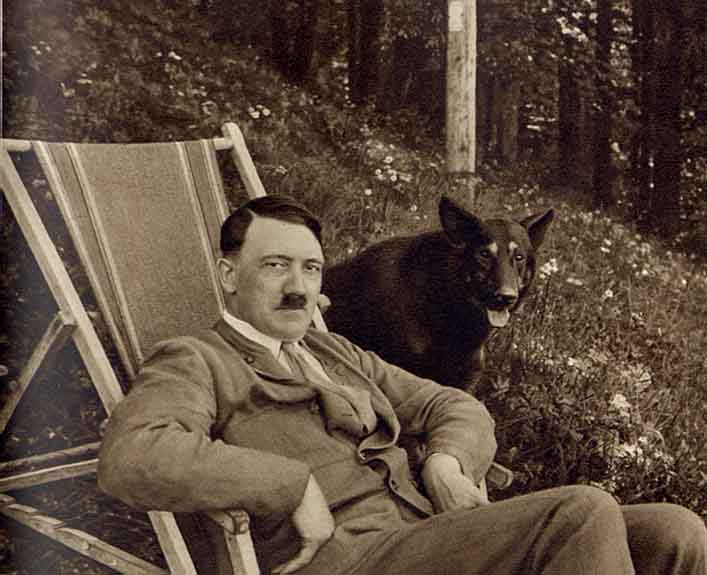
Oddly enough, he was a conservationist, he enacted some of the earlist wildlife and evironmental protection laws Europe ever saw, and yet this same man concieved and carried out the Holocaust.
Amad man in some ways, truly evil, yet a clever statesmen and formidable opponent in other matters, I'm of the opinion that his failing heath and his overall military idiocy combined with the tremendous strain of trying to micro-mange the German war effort gradually drove him further and further into insanity.
|
|
| |
|
|
|
winterfritz
|
|
I'm sailing this thing to Mexico
Jan 2002
time: 05:20
|
|
Yeah, what Chris said
But seriously, I'm not saying that Hitler and his administration were unconditionally insane. It is undeniable that he had many talents. But he was really more the idiot savant than the cunning statesman. He did so well until 1942 due to a combination of factors; one being his undeniable talents (like Chris said, his knack for public speaking, charisma, political intuition and love for new military toys). But luck and the unreadiness of his opposition were also major influences. Hitler could easily have been stopped from absorbing the Sudetenland in 1938; the Czechoslovakian army alone could likely have beat the Germans at that stage. And had the French crossed their frontiers while Germany was subduing Poland in 1939, they would have encountered little opposition - practically the entire Werhmacht was in the east - and likely ended WW2 before it really even began. That the Nazis weren't stopped at this early date is due only to their good fortune and Allied idiocy (see, the democracies were inefficient too )
Similar incidents abound throughout the history of the war. Much of the BEF was saved at Dunkirk due to Hitler's meddling in the direction of the war; Barbarossa had good chances of taking Moscow before the end of 1941 had Hitler not dallied and shifted armour from the central drive, to the wings, and back again.
I don't deny he had an encyclopedic memory for economic minutae; I do question whether this made him a good administrator. Chris's example is a good one, and demonstrates that having information is one thing; doing something with it is another. Just because Hitler remembered that so-and-so produced this-and-that in such-and-such a time, didn't mean that he then automatically went on to make the correct decisions to increase production etc. When things worked, they only did because he had blundered into the solution via his simplistic views on the subject. (His military strategy is a good example. He got lucky with Plan Gelb; Barbarossa next year is what could have happened if he hadn't been lucky that time.) Germany did so well (production-wise) against the combined might of the USSR, USA and Britain for so long more due to the inherent strength of the German economy than the Nazi economic policies. Back then, Germany had a better economy than both the British and the Soviets, and even post-WW2, soon after the ravages of total war, enemy occupation and the loss of around half of its territory, West Germany soon had the 3rd highest GNP in the world after the US and Japan. It is Europe's economic powerhouse, and its production would reflect this even had a two-year old been in charge.
And as for the insanity issue, I really think that this is one example in history where the crazy people were in power. Hitler could stay vegetarian because he couldn't stand cruelty to animals at the same time as ordering the deaths of millions of Jews, Slavs and assorted minorities. He was plagued with emotional problems due to his difficult childhood and early adulthood. After his dreams of being an artist were dashed, he managed to find a new mission thanks to his service in WW1 and the truculently nationalistic German atmosphere of the times: the restoration of the glory of the Fatherland. This goal and his paranoia about the racial minorities consumed him in his later years. Despite what his generals say, I think Mein Kampf is more indicative of the man's true nature. Once read, one realises that there was no cunning second agenda behind the charisma and occaisional flash of administrative insight; here was a man who believed every word of his diatribes. This makes him clinically insane in my book. Most of his administration was the same; some talented as well, but they were crazy. That they got into power at all reflects the crazy atmosphere of post WW1-Germany; they managed to keep their position through some good decisions but mostly luck and the fact that they unwittingly pandered to the psychosis of the masses. Nazi Germany was a bad dream; there is nothing inherently evil about the German people, and the fact that they allowed such a government for so long simply indicates that the popular mood, culture and atmosphere of the time was an incredibly strange and dangerous one.
|
|
| |
|
|
|
Case
|
|
The backlash starts here
Feb 2000
time: 15:20
|
|
quote:
Originally posted by Chris 62
Hitler's pre-war strengths were a remarkable memory, a love of innovative machines, and an intuitive grasp on military strategy coupled with his tremendous gift of public speaking (He was perhaps the most dynamic public speaker ever, no man has ever been able to so many spellbound so easily, even his opponets remarked on his ability to sway people with his public speaking).
Hitler also was able to recognize a good plan, and made some fine choices in subordinates (and some REALLY BAD ones as well). |
His ability to handle detail was ironically one of his failings, as it lead him to attempt to micro-manage areas which he shouldn't have even known (or cared) about. As an example, Allan Clark's book 'Barbarossa' has a very lengthy transcipt of Hitler personally worrying about how some SS Panzer Division would move its' tanks from the Eastern Front to Italy.
It's interesting to contrast Hitler's hyper-intense style with FDR's more laid back, and much more effective leadership.
Exile, it's worth mentioning that the Nazi's inherited the (im)famous German beurocracy when they came to power, and which they eventually corupted.
quote:
Originally posted by Chris 62
Oddly enough, he was a conservationist, he enacted some of the earlist wildlife and evironmental protection laws Europe ever saw, and yet this same man concieved and carried out the Holocaust. |
I can't resist posting this picture  (sorry about the size) (sorry about the size)
Last edited by Case on 22-06-2002 at 16:47
|
|
| |
All times are GMT. The time now is 05:20.
Apolyton Time is 00:20. |
top of page
|
| archivepost |
|
Forum Rules:
You may not post new threads
You may not post replies
You may not post attachments
You may not edit your posts
|
HTML code is ON
vB code is ON
Smilies are ON
[IMG] code is ON
|
|
|
|
|
|





 14-06-2002 16:39


 Attachment:


 (I have read that Nazi Germany would have collapsed economically even if WW2 had been avoided).


 |
|