|
| |
|

|
dexters
|
 |
Vancouver, Canada
Nov 2001
time: 05:20
|
|
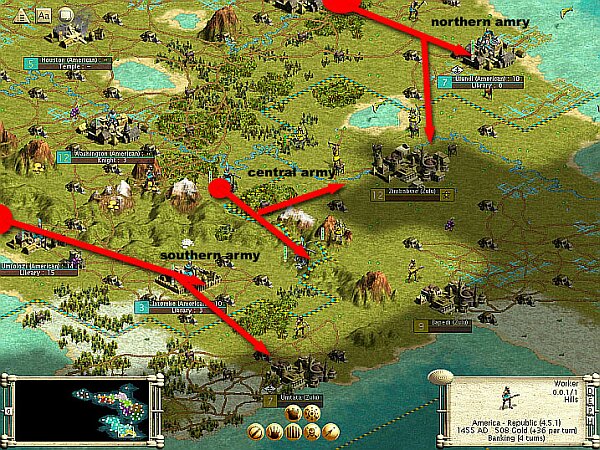
I'm playing American Civ in a Regent game and is sharing the continent with the Zulus, after having wiped out the Germans. The Zulus had declared war on me a few turns after the Germans went under. The Zulus had numerical superiority and I played defensively. Then came peace. But after a tenuous peace, they declared war on me again. As you can guess, I'm not too thrilled with them. When I finally declared war and my Civ went to war with the Zulus for the third time, I immediately moved in 4 stacks into Zulu territory. The Northern army consisted of about 8 or 9 units and 5 catapults. The souther stack had about 10 units. The central stack, had about 6 units and 1 catapult. There is a fourth stack attacking an isolated city, but it's not part of the main assault.
Perhaps it is poor planning on my part, but the relatively stronger Northern and Southern armies were designated for taking the Zulu's northern and southern cities making an arc accross Zulu territory and meeting up with the central army as it makes a drive towards what Intel says is the Zulu's only source of iron. The combined army would then make an arcing move and covervge on the Zulu capital with the plan being to encircle and take the Zulu capital Zimbabwe
As the title of this post would point out, it did not go as planned. When war broke out, The American central army attacked through the forests and made a mad dash for the iron deposits with orders to destroy the roads and cut off supply, and hold it long enough for the southern army to take the neccessary towns so as to put the resource out of Zulu control permanently.
Moving unopposed, I decided to split the central army into two companies. One consisted of 3 pikeman and 1 catapult moved towards Zimbabwe to begin the seige, while the remaining 2 pikeman and 1 swordsman continued on to secure the iron resource one tile away.
And then, all hell broke loose. In what I consider a brilliant tactical maneuver, the AI ignored my massive northern and Souther armies and went straight for my weak central army, attacking both contingents at once.
They sent waves after waves of swordsman and archers. Despite its defensive advantage and superior training, my Pikemen succumed to the assault. The catapult was captured. The company sent to destroy roads to the iron deposits barely made it before being decimated. I have not seen the AI defend its strategic resource with such zeal, and cool calculation. Granted most of you will agree that I likely blundered by splitting my central army into two weak contingents. But the AI is supposed to attack the closest enemy force. What I witnessed was the AI ignoring my two large armies attacking their largest cities, and instead massing troops against me with the sole purpose of denying me a more important strategic objective. --their only resource of Iron It's a move that is not without its flaws as my northern and southern armies were able to attack relatively unopposed. But the move seems strangely human, flaws and all, rather than the random attacks I am accustomed to in Civ2.
As you can see from the screen cap, the southern army and my Knights saved the day. It was able to capture the key city with the iron deposits in its grid and after a cultural expansion, I secured the resource for my Civilization. The plan to take the capital stalled, but I had enough time to sweep in with my knights and destroy the roads and mines around the capital, ensuring the Zulus will spend considerable time getting up to speed when peace comes.
 Attachment: map.jpg Attachment: map.jpg
This has been downloaded 237 time(s).
Last edited by dexters on 15-06-2002 at 01:14
|
|
| |
|
|
|
Coracle
|
|
"Brilliant" is not a term I'd associate with this AI.
It is very predictable at war:
It goes for the weakest stack.
It goes for undefended workers, bombardment, or resources.
It sends a naval unit or two sneaking behind my lines on a pathetic and futile raid.
It can't use bombardment offensively - so why it wants mine I don't know!
It can be easily drawn into killing zones by proper placement of fortified units on hills and fortresses. I have smashed countless invading AI forces on grassland or plains as I attacked them as they approached my hills or towns.
It does mass large stacks better than Civ 2, but I expected after over five years a Civ 3 AI alot better.
Last edited by Coracle on 17-06-2002 at 05:18
|
|
| |
|
|
|
dexters
|
|
Vancouver, Canada
Nov 2001
time: 05:20
|
|
I have to disagree abit with Coracle. I tend to dislike moving unweildy and overly large super-stacks. When I invade foreign continents, I tend to spread my invading forces over several stacks on 2 or 3 tiles by the shore usually in a straight line to protect my supply lines --dying units going back to ships to return home and heal, workers, and cannons (moving to and fro)-- from being picked off by the AI.
And from what I've seen, the AI doesn't always attack the weakest stack. It might, and I have some evidence that suggest it may be part of the equation, but from experience, the AI does have the ability to asses its environment and go the most threatening stack, even if it is not the weakest.
In my current game, I landed some troops in a war with Japan. They were spread over 2 hill tiles and 1 mountain tile. I had attacks coming from behind me against the units on the mountain tile and attacks coming from the city adjacent to stack on a hill.
|
|
| |
|
|
|
Radiation Zero
|
|
Canada
Jun 2002
time: 21:20
|
|
1.) How did you take that screenshot?
2.) how'd you add the arrows?
|
|
| |
All times are GMT. The time now is 05:20.
Apolyton Time is 00:20. |
top of page
|
| archivepost |
|
Forum Rules:
You may not post new threads
You may not post replies
You may not post attachments
You may not edit your posts
|
HTML code is ON
vB code is ON
Smilies are ON
[IMG] code is ON
|
|
|
|
|
|





 15-06-2002 01:08



 |
|