|
| |
|

|
Coracle
|
|
quote:
Originally posted by Theseus
. . .I will say that a lacking point in Civ3 is not just the overall weakness of naval issues, but the absence of trade routes, whether from actual trading (I miss the caravans), or from the RL impacts of seasons, prevailing winds and currents, etc. |
Indeed.
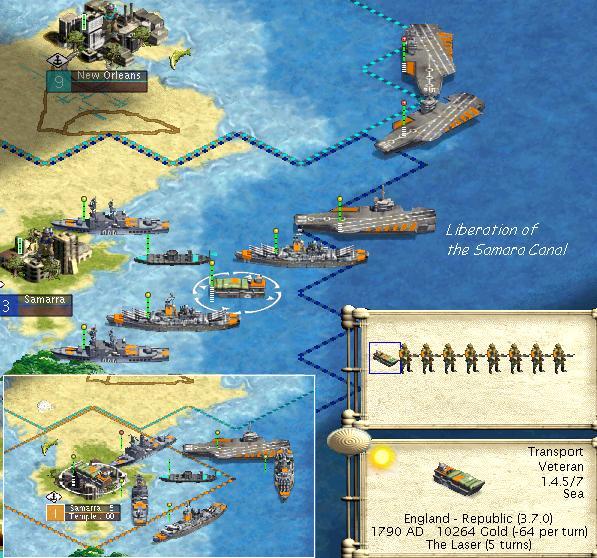
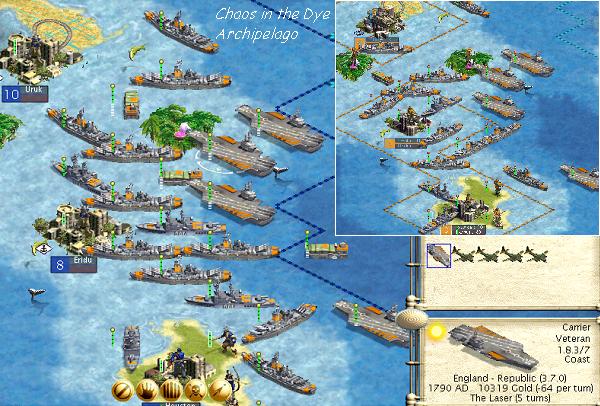
The TRUE purpose of navies is the CONTROL OF THE SEAS and the INTERDICTION OF YOUR ENEMY'S TRADE ROUTES, while you protect your own trade routes.
That is NOT reflected in the game, and Firaxis won't fix it.
The REAL purpose of subs and privateers is to attack merchant shipping on those trade routes, not to attack enemy warships, nor to blockade ports. That is entirely non-historical.
There is, for example, NO way to depict an actual WW I or WW II scenario as in both cases German SUBS almost won the wars by cutting off Allied trade, and we can't do that in Civ 3. 
Hey, Firaxis guys. . . FIX IT.
|
|
| |
|
| |
|
| |
|
| |
|
|
|
Catt
|
 |
California - SF Bay Area
May 2002
time: 21:21
|
|
Tourist Tina began her empire in a lovely starting spot. On a river, next to a cow, with forest, mountains and hills nearby for production, and with a plentiful supply of wine for all her subjects. Tina was pleased; little did she know that London would forevermore be the most powerful, productive, largest city in Tina’s empire. Blast you, alexman  . .
Tina first commissioned an additional English scout. Together with the initial scout from Tina’s retinue, this first scout explored the entire home continent. Tina, suspecting a water world start, set her scientists to researching Map Making in the hopes of fielding an early naval force. The home continent initially looked promising – a fair amount of grassland and hills, with some fresh water sources for early growth. London, a coastal city, began building a Great Lighthouse – all the better for expansive naval exploration. Tina, in an effort to avoid the mistakes of her boyfriend Hippie Sam, decided that the English would not enjoy a golden age while Tina ruled with an iron fist – only a representative government would be suitable for a true Tourista Golden Age. Tina’s scientists studied advanced governance concepts and began working towards a new political institution they deemed the Republic.
In 490 BC, Joan of Arc of the French completed the world’s first great wonder, the Colossus. Shortly thereafter, in 470 BC, Abraham Lincoln of the Americans to Tina’s west completed a great wonder of the world in Washington, the Pyramids. Caesar of the Romans promptly completed the Oracle. In 330 BC, Tina’s subjects completed the Great Lighthouse, opening much additional exploration to Tina’s growing naval explorers. At this point, Tina had established contact with Abe, Joan, and Hammurabi of the Babylonians, and had purchased maps from each of the three without sharing her own world map. The completion of the Great Lighthouse triggered an English Golden Age, with Tina’s Republican government hitting on all cylinders. Tina was ordering all cities to produce settler teams as quickly as possible in order to settle the island located just north of the home continent, and thence to colonies far off.
By 250 BC, with the English Republic still in the early years of its Golden Age, Tina’s explorers had successfully made contact with both Caesar of Rome and Alexander of Greece. Tina also purchased each leader’s world map, but declined to sell her own map or her own contacts with other world leaders.
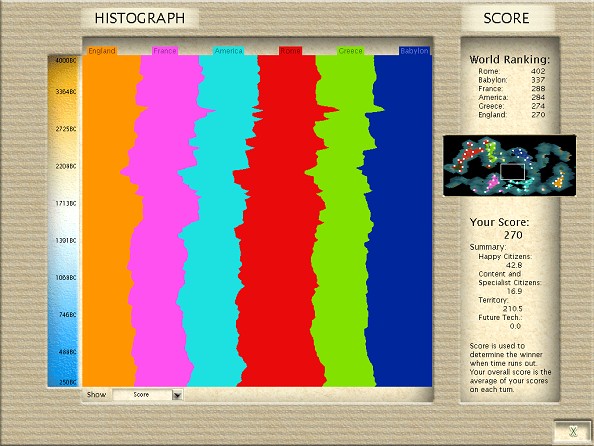
The histograph, with minimap superimposed, at 250 BC was as follows:
 Attachment: first bmp.jpg Attachment: first bmp.jpg
This has been downloaded 123 time(s).
|
|
| |
|
|
|
Catt
|
|
California - SF Bay Area
May 2002
time: 21:21
|
|
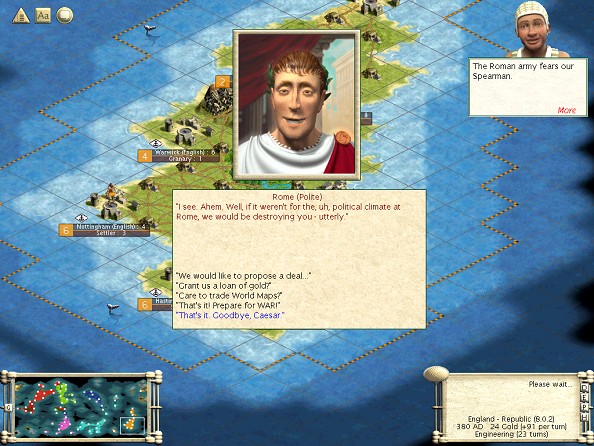
Tina continued with her world exploration, locating two large uninhabited landmasses to the far northeast of the home continent, located west of Caesar’s empire. She set as her goal the colonization of the entire landmasses prior to any colonization by foreign powers. Tina’s home cities focused on building settlers, ships, and the occasional cultural improvement such as temples and libraries. Tina’s military force consisted of almost nothing – a few warriors and a spearman or two. In 130 AD, the citizens of London completed the Great Library, allowing Tina to allow her scientists some much needed time off, and to horde gold for overtime payments to the English workers who were diligently working to create an empire over which the sun would never set. London’s completion of the Great Library was immediately followed by Rome’s completion of the Great Wall. By 380 AD, Tina felt that she had explored the entire world, and mapped the world’s landmasses. Certainly there was a possibility that a very small (one-tile) landmass had yet to be mapped, but Tina doubted it. 380 AD also marked the first of three occasions on which the egomaniacal Caesar would demand tribute from Tina, in the first occasion demanding the secrets of Currency. Tina refused, as she would in the face of all three of Caesar’s demands (made in 380, 760 and 1200 AD), and in each instance Caesar’s impotent response was to bemoan the “political climate” in Rome.
A screenshot from 380 AD follows:
Attachment: second bmp.jpg
This has been downloaded 122 time(s).
|
|
| |
|
|
|
Catt
|
|
California - SF Bay Area
May 2002
time: 21:21
|
|
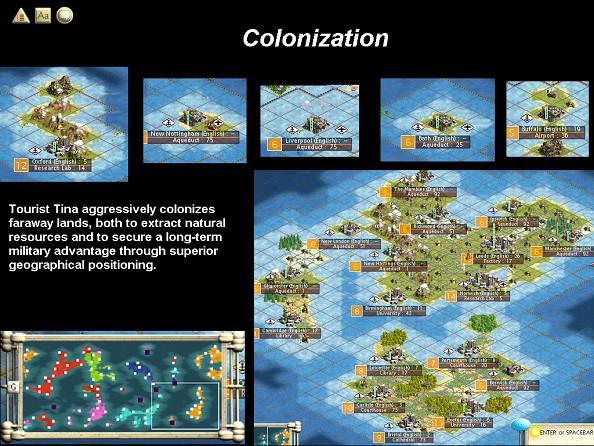
Tina’s empire continued to grow. Galleys, Caravels ,and later Galleons rushed English settlers, often unprotected, to faraway lands. Single-tile islands were especially prized by Tina as she knew that amphibious units, not expected to be available for hundreds and hundreds of years, were the only units capable of capturing such settlements. The English military remained almost nonexistent – had Tina’s rivals decided to invade the home continent, or attack the burgeoning English settlements west of the Roman Empire, Tina’s brave colonialists would have been largely defenseless. Tina, as part of her long-term planning decided that her capitol properly belonged in her northeastern colonies – Tina’s subjects constructed a Forbidden Palace just north of London in anticipation of a future relocation of the English capitol to the far northeast. The world remained peaceful. Having established embassies in each foreign capitol as soon as possible, Tina would have been alerted by her diplomats to foreign wars – no wars were initiated.
In 770 AD the people of London once again celebrated the completion of a project that would thenceforth be known as a wonder of the world – Sistine Chapel. Although virtually none (if any) of Tina’s cities had yet built a cathedral, the Chapel promised to greatly extend the contentedness of English subjects across the whole of the empire. London started building either England’s first cathedral or a new wonder, Magellan’s Voyage – Tina can’t remember precisely since her boyfriend Hippie Sam had friends over frequently at this time and Tina often experienced a contact high. In any event, London added its fourth success to the list of the wonders of the world by completing Magellan’s Voyage in 990 AD. In the intervening years, Joan of Arc had built Sun Tzu’s in 810 AD, Hammurabi had completed Leo’s Workshop (damn!) in 880 AD, and Alexander had completed Copernicus’ Observatory in 960 AD (damn!).
A view of the English empire at approximately 1000 AD follows (Screenshots taken from late game - the colonies are highlighted in purple on the minimap):
Attachment: colonies - draft.jpg
This has been downloaded 122 time(s).
|
|
| |
|
|
|
Catt
|
|
California - SF Bay Area
May 2002
time: 21:21
|
|
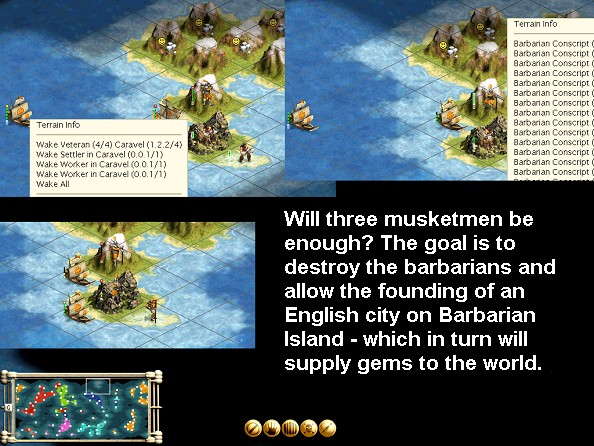
Many years before, Tina’s explorers had discovered a mountainous and volcanic island to the far north, and far east of Tina’s future capitol (fingers crossed). This smallish island presented many dangers – observers from the crow’s nest of English ships identified large numbers of barbaric peoples subsisting (just) off the meager fruits the land provided. But the same English explorers reported wealth of untold amounts in the form of rare gems plainly visible from the coast. Tina, taking into account the large number of barbarians, determined that occupation of the island would be doomed to failure for some time. But by the 1000’s AD, after Tina’s scientists had discovered the power of Gunpowder and Tina’s Generals had taken such research and applied it to efficient military application, Tina judged it was time to secure the treasure for England’s greater glory. A caravel transporting an English settler and two workers had already been dispatched to a remote island north of America and France, but had failed to settle its target island by only a whisker (one turn – see above). This caravel was instructed to proceed north to Barbarian Island, to be joined there by an English ship carrying three of Tina’s new musketmen regiments. A second caravel carrying three additional musketman followed some 6 turns behind.
Tina’s commanders reported that the battle for Barbarian Island would be intense, and that victory was by no means assured. But Tina had faith in her fighting men, and judged that the three regiments of musketmen had a better than average chance of surviving – but heavy casualties were expected. Tina’s forces were aided by Lady Luck when they were able to unload near the Barbarian stronghold but were able to dig in and fortify in mountains before the Barbarian onslaught. Over the course of a decade, 35 primitive Barbarian horsemen divisions and several Barbarian warriors stormed the English garrison. But Tina’s men held! With only a few wounded soldiers surviving, the English settler and two workers disembarked in the newly pacified Barbarian Island.
Attachment: gems fight.jpg
This has been downloaded 117 time(s).
|
|
| |
|
|
|
Catt
|
|
California - SF Bay Area
May 2002
time: 21:21
|
|
Tina continued on her peaceful growth path, but began to worry that a Great Leader would never emerge to assist in building the new English capitol in the northeast. Her empire remained woefully behind in terms of military might, but advanced in terms of naval forces and cultural efforts. The English efforts to expand and colonize much of the world continued into the 900s and even 1000s AD – military preparedness suffered. Nonetheless, after receiving much advice from her boyfriend Hippie Sam, Tina determined that peaceful growth and a largely disarmed empire represented a calculated risk worth taking.
Sometime in the early 1300s, Tina’s England took the histographic lead away from Rome, with the largest and happiest empire. But the northeast territories remained largely undeveloped. The colonists, converted to the ways of laziness and corruption, habitually started building a harbor (ultimately built with significant gold from the home continent), a marketplace (also subject to overtime bills paid by Tina’s treasury, and only then an Aqueduct to allow the growth of these outposts (often with a temple thrown in to secure wider lands). A palace relocation to the colonies would absolutely secure English dominance in the world, but Tina possessed no means by which to relocate her palace.
In 1030 AD, the Americans constructed JS Bach’s Cathedral, a wonder that Tina did not covet due to its continental limitations. In 1230 AD, the city of Dover constructed Adam Smith’s Trading Company – forevermore the English harbors, marketplaces, banks and airports would be maintenance-free, sparing Tina’s treasury significant expenditures. Shortly after Adam Smith’s construction, the American’s completed Shakespeare’s Theater. In 1345 AD, London completed Newton’s University, adding to the scientific knowledge of the English empire. In 1665 AD, suspecting that the game of life was now won, once again the citizens of London completed yet another wonder of the world – the Theory of Evolution. Tina had heard marvelous tales of completing both the ToE and a scientific research project at the same time, allowing a civilization 3 scientific advancements in one term – until now neither Tina nor her colleagues had yet tried this, but Tina was bold and did indeed confirm that completion of ToE and a scientific research project in the same turn results in three research advances during one turn.
With English core cities all producing factories, Tina sold knowledge of Atomic Theory to all other civs of hundreds of gold up front, plus 50 – 150 gpt, always making sure that she didn’t push any leader to exhaust his or her treasury. London completed Hoover Dam in 1620 AD. Notwithstanding the completion of Hoover Dam, the construction of factories, and the railroading of the English countryside, production remained anemic in the English empire. Tina’s subjects of Newcastle (southernmost city on the island just north of the home continent) were able to build the Iron Works – but even after Iron Works, Factory, and a Nuclear Plant, Newcastle produced just 35 total shields (31 after factoring corruption) due to the fact that it could only work three land tiles. London, with a Nuclear Plant, and 19 citizens, was producing only 70 shields per turn.
The English military was still woefully behind the world standard. Many infantry and several cavalry complemented the early English warriors and spearmen; six musketmen, upgraded to infantry, occupied Barbarian Island. Tina decided to focus on military preparedness, even to the detriment of other potential city improvements. By 1650 or so, Tina had trained and transported several infantry and cavalry to her northeastern territories – and a good move too, as Greek transport ships, escorted by warships, were working the coasts on the English colonies.
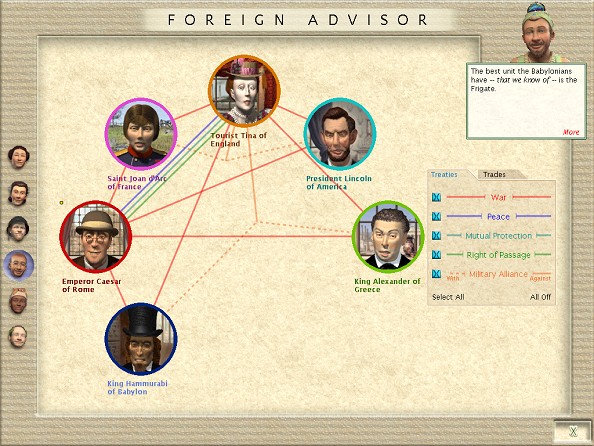
Alexander, despite an existing Right of Passage Agreement, an ongoing luxury trade with England, and the continuing obligation to pay Tina some 75 gpt for a technological advance Alexander had previously coveted (this was less than he was capable of paying), landed military troops in English territory. Tina immediately signed a Mutual Protection Pact with Caesar (he had been requesting one for some time) to counter the MPP in place between Greece and America. In addition, Tina’s newly arrived expeditionary forces arrived in her northeast territories, and deployed to defensive positions should the Greek forces have anything other than a good shore leave in mind.
Alexander’s forces attacked Tina’s colonies, earning the enmity of the world. Caesar declared war on Greece; America declared war on Rome; and Tina was forced to declare war on America shortly thereafter. It was only a matter of time before France and Babylon abandoned their neutrality and declared war against both Rome and England.
Attachment: world war.jpg
This has been downloaded 116 time(s).
|
|
| |
|
|
|
Catt
|
|
California - SF Bay Area
May 2002
time: 21:21
|
|
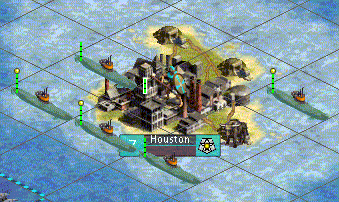
Tina did all she could to both defend her possessions and try to generate a great leader – she still hoped to relocate her palace to the English northeast territories. Her naval forces inflicted serious damage on the aggressors navy, and “privateering” English naval forces both blockaded distant American ports and swarmed on trespassing foreign ships. Foreign forces occasionally landed on distant English lands and the English homeland – all of which were destroyed quickly. English forces – barely adequate to defend the homeland, made one early offensive effort against Houston, but retreated when faced with multiple defending infantry. The war dragged on, Tina’s Republican government counting on the aggressors’ democratic governments to fall – they never did. With the discovery of Flight, Tina was able to provide air support to her naval forces and distant colonies, significantly altering the balance of power. The subsequent discovery of Motorized Transportation inspired the creation of tanks, and the taking of Buffalo from America – America’s sole supply of rubber. Increasing war weariness among the English populace induced Tina to make peace with her enemies (Rome had abandoned the MPP only 8 – 10 turns into the war) some 20 turns into the war. England’s enemies, all democracies, had survived the wars.
The world war set back English scientific research significantly; England, previously a nation that gifted technologies to the world in the interests of world parity, suddenly found herself in a neck-and-neck technology race with others. Those particularly “scientific” civilizations actually acquired a technology lead over England briefly. An unfortunate decision regarding a palace build allowed the Romans to build the United Nations one turn prior to England’s completion of the wonder – Rome never called a vote, however. Tina was then surprised to lose the race to build SETI Program – at least in the chosen city – SETI was built outside of London, in Dover.
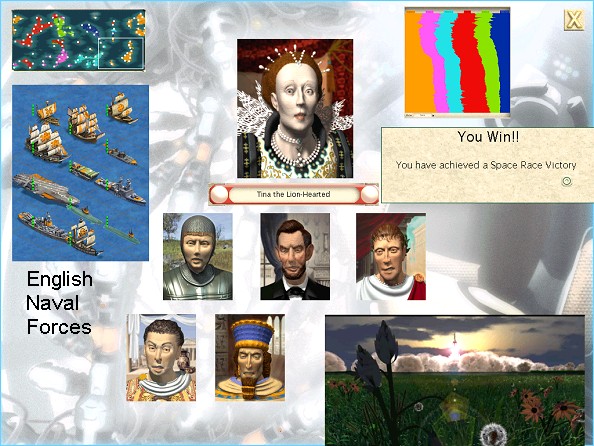
In the mid to late modern age, world war again erupted. Tina managed to remain neutral, and, as the world moved to communist governments, English republicanism triumphed, letting Tina’s subject enjoy the launch to Alpha Centauri in 1900 AD. Tina ended the game having fought in one prolonged world war, and having never generated a great leader. The English capitol remained in London, although small portions of the northeast territories had become productive with the construction of marketplaces, courthouses and police stations. Despite much naval warfare, very little ground combat occurred – Tina’s boyfriend Hippie Sam indicated that the advance of civilization didn’t require warfare and he was correct.
Attachment: final screen.jpg
This has been downloaded 116 time(s).
|
|
| |
|
| |
|
|
|
Mellian
|
|
Okay, i haven't played Civ3 since January as i have been part of a program which keeps me away from the game and my computer. and i never did have enough time to go further then Medieval Age in the few games i ever played.... sad, i know :/ ...
so may as well make it understandable why i would ask this silly question....
what does the Privateer unit actually do other then disguised as an Barbarian White?
-Mellian
|
|
| |
|
|
|
Catt
|
|
California - SF Bay Area
May 2002
time: 21:21
|
|
quote:
Originally posted by alexman
But... first the weird peace negotiations, and now this: are you sure you built the Colossus before your GA? In the editor it's marked Scientific, Expansionist, and Commercial.
PS: LOL @ the screenshot of your floating navy museum!  |
Joan of Arc built the Colossus - I coveted the Lighthouse and was determined to launch my GA in a Republic, so I actually delayed the construction of the GL and caused a revolt only a few turns from its completion -- my anarchy only lasted 2 turns - shortest I can ever remember seeing (as a non-religious civ, of course ).
The naval museum - it was actually a little bit painful to keep (not upgrade) the older ships, especially when racing to colonize. I didn't think about the possibility of the screenshot until ironclads came along. Luckily, I still had a galley and a caravel floating in distant colonial lands. 
quote:
Originally posted by Mellian
what does the Privateer unit actually do other then disguised as an Barbarian White? |
It is a "hidden nationality unit" with a 2 attack value. It follows its owner's commands, but other nations accept them as a non-flagged, independent, outlaw pirate ship - no declarations of war when privateers are used to attack. Great for harrassing your "friends" without the threat of war. Even though it's only a 2-attack unit, a stack of 8 - 10 of them are quite effective at hiding in harbors until a passing "friend" comes along, gang-attacking the "friend," and then returning to port.
In our game, my privateers lost most of their utility upon the advent of battleships - but I was able to use them to sink a couple of wounded destroyers. 7 of my last 8 died trying to sink a 2 HP battleship - the last English privateer stayed in port as part of Tourist Tina's floating museum.
Catt
|
|
| |
|
| |
|
|
|
Catt
|
|
California - SF Bay Area
May 2002
time: 21:21
|
|
quote:
Originally posted by alexman
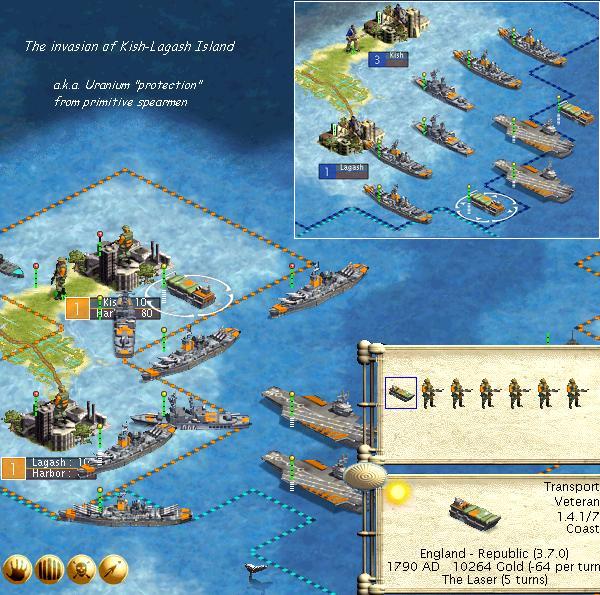
Also, I know you're pleased to finally see someone else use Marines.  This map made them required for some 1-tile islands, but I'm still not so sure I would build them instead of tanks if I wasn't using the AU mod. This map made them required for some 1-tile islands, but I'm still not so sure I would build them instead of tanks if I wasn't using the AU mod.  (10-8-1 vs 8-6-1) (10-8-1 vs 8-6-1) |
Yes, it did warm the cockles of my heart, but I resisted the urge to cheerlead. When I discovered that I had settled all of the one tile islands (other than two dyes which weren't settled but fell under Hammy's cultural border), I toyed with the idea of giving away a city just so I could take it back with marines  . I decided against it . . I decided against it .
quote:
So where's the rest of the class? Sir Ralph? Arrian? Killerdaffy? |
Indeed - would love some more game reports to compare and contrast.
I'll add a few things from my game that didn't make it into my summary (although I don't have screenshots with me at work). I almost managed to settle the 3-tile island in the center of the map (where saltpeter and coal eventually appeared) -- my caravel carrying a settler and two workers was in position - I unloaded one worker on the jungle tile and was about to move my caravel to unload the settler on the hill, and the other worker on the mountain (to prevent any next-turn landings) -- my unloaded worker revelead a Roman settler and spearman standing on the hill - Rome founded a city next turn and I loaded my worker back aboard and headed for Barbarian Island.
I really felt I had the game won after building ToE. I sold a tech or two for obscene amounts of gold-per-turn (but not enough to bankrupt anyone, even in the event of a lot of pollution, or loss of a city (and its commerce) due to a city flip, etc.), and then started gifting techs here and there to keep the AI close. This almost bit me in the ass -- about 10 turns into my tech-for-gpt deals, Greece sneak attacked me. As a Republic, with all others Democracies, and without the ability to build tanks, I figured I'd fight a largely defensive war with lots of naval battles and let war weariness destroy my enemies. The war went on for more than 20 turns, I bumped my luxury spending up a bit and lowered my science slider to generate cash for rush-building units. I was surprised to see that the 4 civs with whom I was at war were not only maintaining their Democracies in a happy state, but hadn't slowed their research in any way -- They had actually passed me in the tech race while at war! I wasn't overly concerned, but was pleasantly surprised . I eventually conquered Buffalo with tanks to deprive America of its sole source of rubber, and ended the wars thereafter.
It was very interesting trying to coax some productivity out of my colonized landmass to my northeast. As I mentioned in my summary, I intended to relocate my palace there, but never generated a GL the entire game. Building it from scratch would have taken into the 21st century, and I had built so many wonders in London there was no way I was going to abandon it in a palace jump. So I played the whole game with my FP located 3 tiles from my Palace. A Middle Ages GL and palace relocation would have made me absolutely unstoppable.
I've played archipelago's a fair amount (on random settings) and it always strikes me how different the game proceeds when compared to other map settings. In Tina's game I struggled to produce any really strong shield-producing cities. I think London was up over 100 shields at the end (with a nuclear plant) - most others were in the 40 - 70 range. I built the Iron Works on the little island just north of Tina's homeland, but the city only had 4 shield-producing tiles (including the city tile) in its entire radius - I think that, with a factory, the Iron Works and a nuclear plant, it was producing something like 35 shields . Getting to Miniturization and the Offshore Platform imrpovement would have helped a bunch, but with the space race a little closer than I had intended, I decided to go ahead and research the techs to launch.
Catt
EDIT: Skimming back through the thread, including my own summary, I see that the above post is largely duplicative to what I already posted. Well, they say that memory is the first thing to go with age . . . or is it something else that's the first to go . . . damn, I can't remember what it is that they say . . .
Last edited by Catt on 15-08-2002 at 02:19
|
|
| |
|
| |
All times are GMT. The time now is 05:21.
Apolyton Time is 00:21. |
top of page
|
|
|
Forum Rules:
You may not post new threads
You may not post replies
You may not post attachments
You may not edit your posts
|
HTML code is ON
vB code is ON
Smilies are ON
[IMG] code is ON
|
|
|
|
|
|






 12-08-2002 02:45





 Attachment:


 |
|