 |
| |
|

|
DanS
|
 |
Kickball Capital of the World
Jan 1970
time: 00:21
|
|
"DanS maybe we should wait for more data, but given the long lead-times on action that are needed to avert a global disaster on the worst-case scenarios we cannot afford to wait too long."
We can afford to wait just as long as it takes to have a clear understanding of the basic variables at play and what we should do to counteract the warming effects, if anything. I'm a really patient man.
Any serious effort before that seems likely a waste at best and harmful at worst.
"How long would you wait for data, and how sure would the scientific community have to be in order for action to be required."
Not knowing the action that would be required makes me supremely unable to know when it would be required.
"Also remember that by not acting now the US takes the risk that if it needs to cut it's CO2 levels later in the century it will have to cut them further and faster than otherwise, a cut or freeze spread across a longer period would cause far less pain as the economy has more time to adjust."
Can you quantify that risk for me?
"It's a bit like saving for your retirement when you are in your early 20's - you may die and never see the money and you could enjoy it now, but evey year you save in your early 20's is worth two in your early 40's."
I can look up on an actuarial table and know within a reasonable margin of error how likely I am to make it to old age and enjoy the fruits of my planning. Further the impact of my death on enjoying these fruits is 100% certain. Lastly, I can redirect that investment to other uses, if the situation warrants.
Such is not the case with global warming.
Last edited by DanS on 16-08-2002 at 08:47
|
|
| |
|
|
|
Verto

|
|
It seems that, simply because the US Senate refused to ratify an unfair treaty, the United States is doing nothing to stop pollution or global warming. In fact, the only reason we have global warming is because we Americans have SUVs.
It also appears that everyone of you reading this thread is contributing to global warming:
*EVIL APOLYTONERS KILL MILLIONS*
quote:
Did you realize that the computer you are using is contributing to global warming? So are the lights in the room. The hot water that you used for your last shower did, too. In fact, anything that uses energy derived from fossil fuels increases greenhouse gas emissions every time it is used. |
Here are just a few things the U.S. is doing to fight pollution.
quote:
The Long Island Power Authority (LIPA) announced on August 7th, 2002 that it will provide a cash rebate of up to $50,000 to each residential or commercial customer who installs solar electric panels. LIPA will be offering $5,000 for each kilowatt of installed photovoltaic (PV) system capacity directly to the customer up to a maximum of 10 kW ($50,000). This rebate level will only be available until a total of 500 kW have been installed. At that point, the LIPA rebate will be reduced to $4,000 per kW |
quote:
The U.S. Department of Energy, through its Regional Offices, focuses its efforts on national, state and local partnerships, made up of the building industry, other federal agencies, local and state governments, utilities, energy service providers, the solar energy industry, financial institutions, and non-governmental organizations to remove market barriers to solar energy use and develop and strengthen local demand for solar energy products and applications.
Announced in June 1997, Million Solar Roofs (MSRI) is an initiative to install solar energy systems on one million U.S. buildings by 2010. The initiative includes two types of solar technology: solar electric systems (or photovoltaics) that produce electricity from sunlight and solar thermal systems that produce heat for domestic hot water, space heating, or heating swimming pools
Reducing emissions associated with power generation. In 2010, with one million solar energy roofs in place, the Initiative could reduce carbon emissions in an amount equivalent to the annual emissions from 850,000 cars.
Creating high-tech jobs. By 2010, approximately 70,000 new jobs could be created as a result of the increased demand for photovoltaic, solar hot water, and related solar energy systems.
Keeping the U.S. solar energy industry competitive. By encouraging a broader domestic market for solar energy, the Initiative could help U.S. companies to regain their competitive edge in the worldwide market. By 2005, the photovoltaic market alone is expected to exceed $1.5 billion worldwide. |
|
|
| |
|
|
|
Ned
|
 |
of Aptos, CA
Oct 1999
time: 21:21
|
|
Verto, I mentioned some time ago that simply allowing people credit for excess power pumped back into the power grid from solar panels would make the panels economically viable. Today, at least in California, if you generate more power than you use, the dial runs backwards on the meter. However, if your net reading month to month shows that you are net generator of power, the power company does not pay you.
Simple changes like this will go a long way to fixing the instutional barriers to solar panels.
On Nuclear - the high cost is due to all those permits and other regulations we have in the US - plus the environmentalists here are totally against Nuclear and will do anything, legal or illegal, to stop one from being built. This is why I suggested building them outside the US.
But you have a point. We could simply provide a subsidy for Nuclear power. At some point, the price becomes reasonable and the plants will be built.
|
|
| |
|
|
|
pchang
|
 |
Cupertino?
Aug 1999
time: 05:21
|
|
Smog will absorb light energy and radiate it out in all directions as infrared (including towards the ground), so no smog will not reduce ground temps (except for small local variations). If you spend more time in the midwest or east you will notice that in summertime, cloudy (but not rainy) days are just as hot and muggy as clear days.
The earth's climate is not a stable system. We know enough to model the climate quite well with static systems (approximations of reality), but not enough to model the climate well with dynamic systems (much better approximations of reality). This is pretty much due to our inability to really handle tough math. Anyway, in the static models, the avg. temp. of the earth is a balance between the energy absorbed from the sun and the energy radiated out into space. This is highly dependent upon the reflectivity of the earth (called the albedo). Surface ice is one of the greatest contributors to this reflectivity. Thus, as it gets warmer and the polar ice caps start to melt, the albedo decreases and the temp. gets even warmer. On the other hand, as it gets colder and the polar ice caps expand, the albedo increases and the temp. gets even colder.
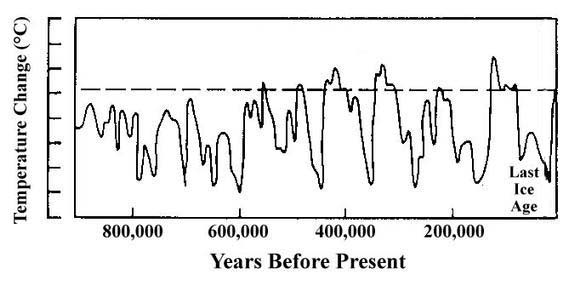
It is not exactly known why, but there appears to be an ice age cycle every 20,000 years or so. The bulk of humanity's development has been during a warm period between ice ages. If the pattern holds, we should be entering into another ice age soon (in geological terms anyway).
|
|
| |
All times are GMT. The time now is 05:21.
Apolyton Time is 00:21. |
top of page
|
| archivepost |
|
Forum Rules:
You may not post new threads
You may not post replies
You may not post attachments
You may not edit your posts
|
HTML code is ON
vB code is ON
Smilies are ON
[IMG] code is ON
|
|
|
|
|
|






 16-08-2002 07:08





 |
|