|
| |
|

|
Catt
|
 |
California - SF Bay Area
May 2002
time: 21:21
|
|
After regaining control of homeland defenses and being in a position to once again produce offensive forces for the counter-attack on England, Gandhi set out to conquer the English Banana Isle Minor. But Gandhi lost one caravel full of war elephants to a marauding Egyptian frigate, and, after pillaging the improvements on English soil and razing a small English city on the easternmost tip of England’s Banana Isle Minor, the Indian forces simply could not defeat the entrenched English defenders fortified in their hill city of Oxford. With war weariness creeping up on the Indian democracy and the Indian scientific research efforts slowed by increased morale spending, Gandhi decided it was best to end the fruitless wars of destruction. [Although Gandhi’s people were religious and could transition governments with little penalty, Gandhi himself was a bit tired of the warfare and would just as soon have made peace without a switch out of democracy.]
Indian society continued to prosper, but the world was distrustful and resentful of Indian power. Trading became quite difficult for the Indians as no foreign power would deal with Gandhi in a manner which he felt to be appropriate. Unusually, on an archipelago-like map, the Indians were somewhat of an isolationist civ. But the Indian people continued to construct great wonders of the world, completing Newton’s University in 1550 AD, Universal Suffrage in 1680 AD and Theory of Evolution in 1690 AD. The Indians missed building JS Bach’s Cathedral by a turn or two, and didn’t pursue Shakespeare’s Theater, both of which were built by the Persians – which of course meant that they would one day be Indian treasures  . .
Just before the age of Combustion, Cleopatra renewed her rivalry with Gandhi and declared war, attempting an invasion of Gandhi’s holdings in former Persian lands. Believe it or not, Gandhi had neglected his navy to some degree while focusing on wonder-building and civilian infrastructure – the Indian navy consisted largely of Galleons, Caravels and a few Ironclads. Even with the Egyptian declaration of war Gandhi elected to hold off on building his navy and instead would wait for combustion and the advent of the Destroyer. Unfortunately, this meant that India’s colonies were forced to deal with numerous invasions of multiple units as well as significant and repeated naval bombardment from the coastlines. Gandhi gritted his teeth and vowed revenge.
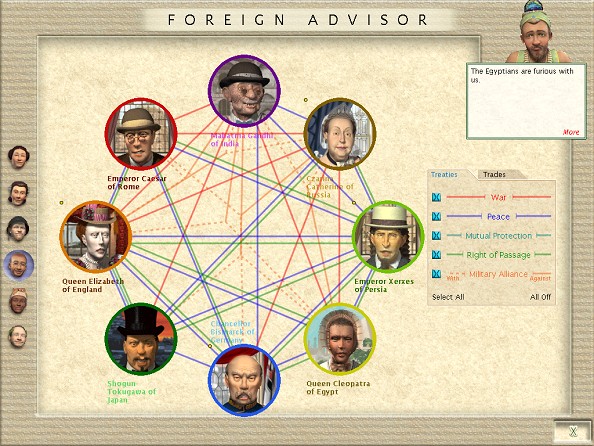
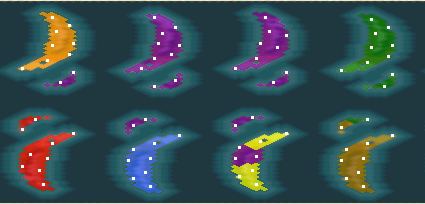
The year 1778 AD brought a tremendous year of change to India. In the 20 years or so since Cleopatra started her war of aggression, the world once again succumbed to a lust for conquest with numerous wars and alliances springing up (see below), and Gandhi mobilized his economy for war. Indian scientists had unraveled the mysteries of both Combustion and Mass Production, and were reporting that they felt close to understanding Motorized Transportation. But Gandhi’s naval forces were not yet a match for all the world’s forces, and a war-time mobilization helped Gandhi’s war-time economy surge.
 Attachment: 1780 ad - alliances.jpg Attachment: 1780 ad - alliances.jpg
This has been downloaded 213 time(s).
|
|
| |
|
|
|
Catt
|
|
California - SF Bay Area
May 2002
time: 21:21
|
|
The Industrial Wars continued on for decades, with some nations making peace only to rejoin the fighting soon afterwards, and yet other nations refusing to discuss peace. With the discovery of tanks, Gandhi’s armies seized the remaining Persian cities and secured a second Banana Isle for greater Indian glory. The English had once again betrayed the Indians, and this time Gandhi vowed that Liz would pay a heavy price indeed. Instead of exacting revenge against Cleo, Gandhi turned his sights on the English heartland. Liz’s capitol, London, contained all 3 of the English Great Wonders (Sun Tzu’s, the Great Wall and the Oracle) – all of which were valuable to Liz but held little interest for Gandhi in these circumstances. In addition, the English city northeast of London controlled two vineyards and a coal mine. Gandhi decided to take and ruthlessly raze both London and its sister city, and build Indian cities in their places in order to teach the English the proper respect for Indian greatness. Numerous transports filled with eager Indian tanks, infantry and artillery landed on a vineyard hill and quickly took the sister city. It was razed to the ground, and the Indian city of Chittagong rose from its ashes. The remaining Indian attack force took up positions in the mountains surrounding London and pillaged improvements and bombarded the city while waiting for reinforcements from the Great Banana. Numerous English naval forces continued to harass Great Banana Isle, bombarding coastal lands and destroying unguarded improvements. And, much to Gandhi’s displeasure, Great Banana Isle’s sole coal mine soon was expended – English bombardment of Indian railways would thenceforth be permanent, or at least semi-permanent until the English coal near Chittagong could be extracted.
London was soon razed, destroying for all time the supposed “Great Wonders” the English had constructed. Punjab arose on London’s ruins. As soon as both Punjab’s and Chittagong’s borders had expanded, providing Gandhi with some comfort against the cultural pressure of nearby English cities, he graciously made peace with the now-hobbled English. They were still fighting numerous enemies, and, having been crippled by the loss of two ancient cities, would never again present a threat to the world.
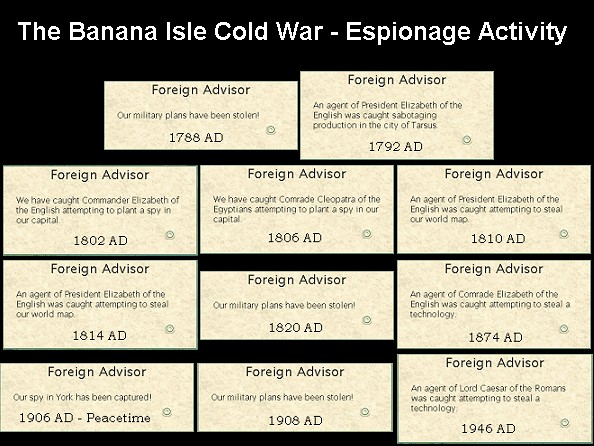
Once again war weariness was being felt in the Indian cities and towns, and once again Gandhi was growing tired of the fighting. Rather than continue to conquer, Gandhi made peace with India’s enemies, in each case extracting appropriate compensation for the unlawful aggression against India. The Industrial Age wars were bloody for the whole world, but the uneasy peace that followed (what might more accurately be called a cold war) had its own victims and aggressors. A seemingly unending stream of international incidents involving foreign espionage continued during the late industrial and early modern ages.
Attachment: espionage compilation.jpg
This has been downloaded 219 time(s).
|
|
| |
|
|
|
Catt
|
|
California - SF Bay Area
May 2002
time: 21:21
|
|
Following a suitable measure of peace in order to allow the Indian population to recover from the war-time tensions and to repair damaged improvements and military forces, Gandhi intended to destroy the treacherous English once and for all, and to inflict extreme punishment, if no t destruction, on Cleopatra’s empire as well. But Gandhi, who personally relied on a modern invention called a “laptop” to help manage his sprawling empire, was suffering from repeated long delays in completing tasks and executing appropriate orders. Gandhi’s scientists had developed this “laptop” for him, but he himself had never bothered to upgrade it, supply it with more memory, etc. – consequently, it was causing quite a bit of distress. Faced with these frustrations, and having built the UN but afraid to call a vote, Gandhi elected to build a spaceship and launch a colonization mission to Alpha Centauri rather than engage in much modern age warfare involving many units.
Before Gandhi could launch the Indian Spaceship “Banana Explorer” however, a former ally of India, Catherine the Great of the Russian empire, impertinently demanded a steady supply of Indian uranium. Gandhi naturally refused (but would have been willing to discuss a trade), and Catherine arrogantly declared war. At the time, the Indians had discovered Satellites and had built several ICBMs – Gandhi briefly considered a nuclear strike on Moscow just to get the world’s attention, but again, bowing to the inefficiencies of his managerial “laptop,” Gandhi opted instead to quickly secure the Russian Banana Island Minor (and its source of Gems) and make peace.
The Banana Explorer was launched amid great fanfare in 1955 AD. Rome and Russia had at that time completed 6 parts each of their spaceships (none in progress) and Germany 4 parts (1 in progress). At the time of the colonization of space, the Indians, having taken Persia’s wonder cities and razed London and therefore all of the English wonders, controlled all but 2 of the Land of Great Bananas’ wonders – the Pyramids were located in Berlin and the Manhattan Project was located in Thebes. The Indian empire was ranked number 1 in most categories, and 4 of the top 5 cities in the world were Indian. A conquest or domination win was undoubtedly available sooner in the game, and if only for ironic historical commentary it would have been fun for India to seize and colonize all of England, but RL commitments and backwards technology compelled Gandhi to end the game quickly (in RL time, that is ).
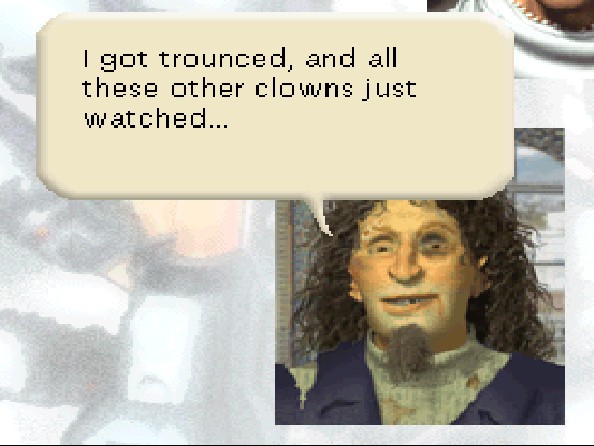
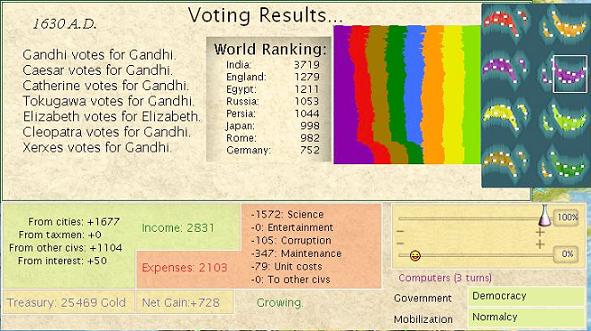
[I haven't gone into the "Diplomacy.txt" files or other text files to see all the possible "comments" that an AI civ can throw at you, but I thought that between the game and the forums I had seen them all. I waited through about 10 "competitor comments" at the end of the game hoping to grab a screenshot of "All your base belong to us" for posterity when I saw the following - I actually hadn;t seen this one before and got a kick out of serious dissension in the AI ranks ]
Attachment: end comments from xerxes.jpg
This has been downloaded 211 time(s).
|
|
| |
|
|
|
Blake
|
 |
Brainfallocatione
Oct 2000
time: 17:21
|
|
Nice write up catt 
My game continues to go well, the persian mini-bannana iron/luxury town flipped to me (hahah! never expected that to happen!) saving me having to declare war on them.
Upon getting Elephants & astronomy I sailed over to english mini-bannana and my 9 elephants easily took it. 20 turns later (after my golden age had expired) I upgraded all my 'phants to calvary and dropped 12 of them on the english coast, taking a large english city, over the next 20 years or so razing another large city and capturing York which I designated my new capital (I had built the FP right next to my capital, in the very center of my bannana).
So I made peace with Lizzy and built York up until it was churning out 50 production with about 7 corruption and built the palace in about 20 turns..
Then I crushed the remaining English empire with a combination of cannons, artillery, calvary and some early infantry, had to get Japan in on the war to take an english city on the Japanese mini-bannana. With the English exterminated and the palace on english-bannana I am in a very strong industrial position.
Now I'm just getting tanks 
Other than Lizzy the others have felt the need to have a go at me, especially Russia and Rome. Persia has remained loyal and because I have their mini-bannana I wont be declaring war for a bit (altough I would like their sistine...) Japan, Germany and Eygept have also remained loyal.
Havn't got all that many wonders, Lizzy got the GL&GL which made her really strong, and that and her constant harrassment with damn man-o-wars (bombarding my roads! and making the AI turns take longer!) is the main reason she was the target of my agression.
|
|
| |
|
| |
|
|
|
alexman
|
 |
Hunt Valley, MD
Jan 1970
time: 00:21
|
|
In the beginning of time, God (a.k.a. Sir Ralph) created a mythical place called Banana Island. A peaceful people named Indians, decided to settle this paradise, and founded the city of Delhi. The only problem with Delhi was that there was no fresh water nearby, so the poor citizens had to carry it in flasks from far away. Fortunately, clever Indian scientists soon discovered how to make pots to hold the water, and the grateful Indians didn’t need to make as many trips to the Great Banana Lake. Even so, many citizens of Delhi were too lazy to keep carrying fresh water back and forth, so they decided to move closer the lake. They founded the city of Bombay farther to the south. The remaining Dehians, using sturdy timber they cut down from nearby forests, constructed a great big pot they called a granary. Many more citizens would be born in Delhi because of the extra food, and soon the beautiful Banana Island landscape would be dotted with prosperous Indian towns.
The Indians already knew how to make neat little symbols they called “the alphabet”, and they wanted to find a use for them, so they quickly discovered Writing. Since they didn’t know of any other civilizations to trade with, they started writing memos to each other. Many towns followed the example of Delhi, and built granaries after their temples were completed. Since Indian engineers knew of nothing else to build, the alternative would have been to build a military. But as we know, the Indians are a peaceful people, and there were no imminent threats. The result of all these granaries was a population boom, and India was quickly running out of room to support all these new citizens.
But Indian technology came to the rescue again. Brilliant scientists discovered mapmaking, and exploring galleys soon discovered a second, smaller banana island to the south. The Indian people immediately started building a Great Lighthouse to help their galleys navigate through the treacherous seas. Unfortunately, an unknown civilization, the English, completed a similar project and the proud Indians refused to have their hard work referred to as an “Indian copy” of English work. They turned their half-built lighthouse into a harbor instead. Soon after that, curious English galleys started appearing on the horizon. They laid claim to part of the resource-rich Indian mini-banana before Indian colonists could do so. (The weak Indian military had not yet managed to convince the native barbarians to join the Indian empire).
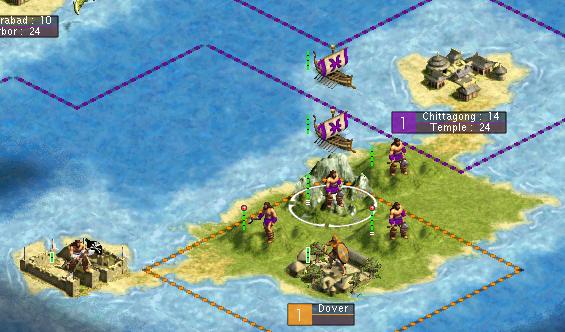
The Indians are a peaceful people, but this situation was not acceptable. Peace was no longer an option. English weapons technology was far superior to anything the Indians had, but the Indians relied on sheer numbers and determination to win the war. Many Indian warriors got speared and died, but in the end, the English were driven away from the Indian bananas.
Attachment: banana1.jpg
This has been downloaded 188 time(s).
|
|
| |
|
|
|
alexman
|
|
Hunt Valley, MD
Jan 1970
time: 00:21
|
|
After the war, the English continued to explore the globe, and the Indians continued to stay home and develop their cities and their knowledge. The English kept selling communications with other civilizations, and soon the entire world was known to everyone. But the English never forgot their defeat in the Indian mini-banana war. They kept harassing the Indians and periodically landed some units on Indian bananas. They succeeded in taking and holding a weakly-defended city in the mini-banana for a few decades, but for the most part their invasion forces were easily defeated by Indian swordsmen. In one such successful homeland defense, Chandragupta rose from the ranks of a swordsman army to become a Great Leader. Chandragupta forgot his military duties, and immediately traveled to the city of Delhi and started lobbying for the relocation of the Indian capital. In the Middle Ages, after the Indians finally tamed the wild elephants on Banana Island and started using them instead of horses, an English defeat in a brief war resulted in an era of boosted Indian production and creativity, known thereafter as the Golden Age of India. The Indian Republic built every single Great Wonder of the Middle Ages, except for Leonardo’s Workshop and J.S. Bach’s Cathedral.
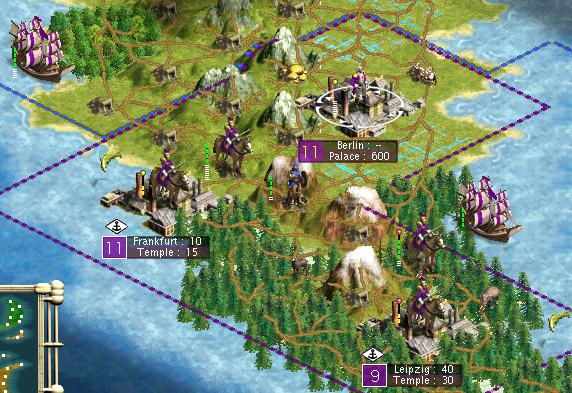
With the coming of a new, Industrial Age, the wise Indian Democracy decided that they had been the victims of foreign aggression for too long. It was time to fight back. Centuries of aggression felt from the evil English was channeled towards the nation least likely to put up a fight: the unfortunate Germans. The German spearmen were no match for the valorous Indian cavalry (who recently realized that elephant taming was too much work and had gone back to using horses). Chandragupta, the leader-turned-politician, came along for the invasion, and finally got his wish to relocate the Indian capital to a new location: Berlin!
Attachment: banana2.jpg
This has been downloaded 190 time(s).
|
|
| |
|
| |
|
| |
|
|
|
alexman
|
|
Hunt Valley, MD
Jan 1970
time: 00:21
|
|
quote:
Originally posted by Catt
What was the turning point in your game (GA?)? I remember from your earlier posts that you found the game a challenge, and I suspect that on Emperor without building the GL it would have been a huge challenge (kudos to Theseus, too!). And yet you built almost all the Middle Age wonders without using a leader!
|
The ancient age was a nightmare. I wanted to get that Lighthouse really bad! I lost a bunch of shields when I missed it. Then the English (of all civs!) found me and they had something like a 6 tech lead even though I was at max research since the beginning of the game. That's when I posted that the game is giving me a hard time.
But then Liz made the mistake of selling communications to me. That made it easy to buy techs for cheap. I also B-lined for Republic, switched immediately, and started catching up to the Despots. I eventually sold the Republic for the last ancient techs and lots of gold. Liz lost more ground during her anarchy. By the Middle Ages I was the tech leader, and with careful pre-builds to break the cascades (thanks to Aeson's thread), and the Golden Age, I got most of the Wonders. The GA came at a perfect time: just as my workers had finished improving all the terrain and I joined them back into the cities that were not already at pop-12! I could have used my leader to break more cascades and get the remaining two Wonders, but given the lack of war (I was lucky to get him in the first place), I decided to save him for the Palace. I think it paid off in the end.
quote:
You're not seriously considering devoting all your honeymoon time to your wife?
|
 If only I had a laptop! If only I had a laptop!
quote:
Originally posted by Theseus
Already cleared a Civ3 honeymoon with my fiance
|
Lucky b*st*rd!
|
|
| |
|
| |
|
|
|
Sir Ralph
|
 |
Long live teh Schwampel!
Dec 2001
time: 06:21
|
|
*Bump* this one, to respond to your games.
Thanks people for your games and great stories. I had a lot of fun to read them. I logged in for a few minutes Sept 2nd in an internet café near Hersonissos and read some spoilers, but €2,00 for 15 minutes was too much to write a response. So I read the rest and write my response only now, after I returned.
Here's a few thoughts why I made this game:
I wanted to see, how different AIs with different (but almost balanced) traits do in exactly the same circumstances. Do they build cities in the same locations or is there a random element in the AI's choice? And I wanted to see a game, where the human player can't take advantage of early conquests, exploiting the AI's REX mode. I did not intentionally hurt Germany, this is a bug.
The mini advantage (or better micro advantage) is: Horses and Iron are on the small bananas, and accessible only after Astronomy. So Knights as first possible forces for a bigger invasion can be built only after Astronomy, at least in the productive cities. But we are the Indians and don't need resources for our Elephants. We can prebuild a good invasion force between Chivalry and Astronomy and attack right after discovering Astronomy and upgrading our Galleys.
I'm glad you enjoyed the game, well, at least some of you . I read Umberto Eco's "Baudolino" during my vacation, lying in the sun and deserving a royal sunburn (Lotion is for sissies ). A really great book. It brought me some ideas for a new challenge. I'm already sitting over the map.
PS: Alexman, I hope all went well with your wedding!
|
|
| |
All times are GMT. The time now is 05:21.
Apolyton Time is 00:21. |
top of page
|
|
|
Forum Rules:
You may not post new threads
You may not post replies
You may not post attachments
You may not edit your posts
|
HTML code is ON
vB code is ON
Smilies are ON
[IMG] code is ON
|
|
|
|
|
|





 30-08-2002 08:59







 |
|