|
| |
|

|
Jawa Jocky
|
 |
Seattle, WA
Dec 2001
time: 21:21
|
|
Something about this game sounded fishy (the 1337 reference in Sir Ralphs post) so I dropped down a level and played Monarchy. I'm glad I did because I'm still doing terrible, and I want to find out if its just bad luck.
I figured it would be an isolation start (banana ISLAND), so I went straight for map making with max science. Before I even started reseaching map making the persians dropped by. They had meet the Japanese already and had a big tech lead. I had nothing to offer (5 gold anyone?).
How the hell did Persia get to Map making so quick???
I was distracted by this and never really focused much for the rest of the day. Once I got galleys I mass produced them and sent them on suicide missions. I made first contact with Rome, Russia, Egypt, and Germany. I was able to get caught up briefly with the tech leaders England and Persia. But through my creative mismanagement I was quickly far behind again.
I missed every wonder and could never get a UU off the island to start my GA (tried in Middle Ages).
I hope my guess is correct concerning our advantage, because I'll never win otherwise.
I'm still haunted by my inability to get to map making and build the G. Lighthouse (I had nothing to pre-build either since I went straight for map making). I should have played Regent, but that's too much pride to swallow for an emperor level guy.
Last edited by Jawa Jocky on 28-08-2002 at 00:31
|
|
| |
|
| |
|
|
|
Jawa Jocky
|
|
Seattle, WA
Dec 2001
time: 21:21
|
|
I got feed up with this game. I set everything to wealth and just pressed enter til the end of the game. Lost SS. I never did find out what the advantage was, but not getting the GL was a huge problem.
Last edited by Jawa Jocky on 28-08-2002 at 00:28
|
|
| |
|
|
|
Catt
|
 |
California - SF Bay Area
May 2002
time: 21:21
|
|
Jawa Jocky - I'm sorry you didn't enjoy the game. I think the map is a great idea! Essentially there will be no credible invasions until after Astronomy, and more realistically until the mid-industrial age. What I liked about ti is the human and every single AI has the exact same terrain / resources / opportunities / challeneges -- it provides for an excellent apples-to-apples comparison of AI civs, and also human skill and luck versus AI skill and luck PLUS the AI advantages on the higher levels.
I play Emperor more often than not (this game Monarchy), but I think Emperor with its 20% production bonuses to the AI would be very tough.
I think the "mini-advantage" that Sir Ralph alluded to is the human ability to "risk the high seas" whereas the AI will not take the chance. Without building the Great Lighthouse, the human player pretty much must launch a number of suicide galleys in search of contact (it would be the only way to keep up in tech against AI bonuses). I am confused as to how the Persians managed to reach you before you even finished Map Making -- they must have built the GL since there is no viable island hopping without the GL or suicide runs.
In my game (also Monarch) I also was beelining to Map Making at maximum science - I researched Writing, Pottery (or whatever the first level tech is that is a pre-req for MM), and then Map Making. I was able to build the GL before anyone else! I think the key to my success may have been researching Writing first - it took 40 turns (Pottery would have been similar - perhaps 32 turns) so even at "max" science (20% and then 10%) I was bringing in surplus cash. By the time I finsihed Writing and could go back for Pottery, I had a substantial treasury (deficit spending!) and many roads ($$ = science) + probably more than a couple of cities. End result is that I researched Pottery in something like 8 turns and MM in something like 12 or 16 turns. Had I gone Pottery (less expensive tech) and then Writing + MM (more expensive techs), I think the aggregate research time would have been much greater.
Building the GL meant contact with all 7 AI civs, while each of them stayed completely isolated from one another (I didn't sell contact until Astronomy came along). Contact with 7 civs meant my research costs were much lower than others' - the only way to build a lead before everyone starts discovering everyone else.
I will post a full summary of my game when I finish it (into the Modern Era now), but my conclusions after this game are different than yours - I think research is valuable, especially on this map and with a commercial civ, and I suffered through some pretty impressive AI seaborne invasions (though not as good as a human invasion, of course  ). ).
Catt 
Last edited by Catt on 28-08-2002 at 00:43
|
|
| |
|
| |
|
|
|
Theseus

|
 |
The warmonger formerly known as rpodos. Gathering Storm! Apolyton Spirit!!
Apr 2002
time: 00:21
|
|
Sorry, posted this in the first thread:
Hey guys.
I haven't had a lot of time on my hands, but I did play through up to Industrialization last night.
I went Emperor, and didn't seem to have it so bad... I built out my two islands in a pretty typical fashion, missed the GL, and therefore burned up a number of Galleys exploring. Even so, I got way out ahead in communications... at one point I even used just comms to get a decent tech from Egypt (I forget which).
Went resource hunting on Germany, using Swords and Galleys... damn it hurts when they sink!!
I don;t know what the secret advantage is, other than the human ability to exploit an artificial distribution of resources, and the AI civs lack of credible resource defenses.
Something weird... prior to astronomy, Rome was able to access her resources!!
By the time all civs knew each other, and I had captured several resource islands... the fit hit the shan!!! I love it when the world goes insane!! Red lines everywhere, military alliance spaghetti... On the other hand, because there was so little early warfare (and in certain cases a lack of strategic resources  ), none of the AI civs had a large standing military, and thus can't get it together to make a decent intercontinental attack. I think that there had only been one AI city capture (whereas I have captured 8). ), none of the AI civs had a large standing military, and thus can't get it together to make a decent intercontinental attack. I think that there had only been one AI city capture (whereas I have captured 8).
I found it interesting that with the sea / ocean spacing so carefully designed, advances in military and naval tech matched each other well... Swords / Galleys, WEs / Caravels, Cavs / Galleons, so far.
It's fun, but also, as Catt said, a hugely-intensive trading and monitoring game. Checking every civ individually on every turn takes forever.
|
|
| |
|
|
|
Fighter
|
 |
Vancouver, BC
Aug 2002
time: 21:21
|
|
Well, I think the advantage is Collosus. I started the game this afternoon (wussed out and started on Regent). Though I almost never build Collosus, I thought I would this time becuase I had nothing else of import and no upcoming wonders that I realy wanted. After getting Bronze Working, I had started to B-line it to Map Making, and When Colossus was done I used my Golden Age to pull Map Making and crank out the Great Lighthouse. Before the wonder, I circumnavigated my island staying only on coast, then did it again on see squares, colonized my side island and started moving.
With the added movement and safe see's I had no need to go suicidal with my fleet, I instead carefuly looked around, got in touch with everyone and thoughtfully kept that contact from anyone else, causing quite a few wars with me in the process. Oh well, the only threat from the wars was me losing my iron to the Germans since my original iron dried up about 3 turns after I built my harbour.
I think the golden age is what saved me, once I was on top and knew everyone I couldnt be knocked down because I had a tech lead.
I just took out the English "colony island", no iron or horses for them! I made peace with England, picking up Monarchy and 25gpt in the process, though it didnt matter since I was already in Republic. Now Im about to pick up Astronomy, it was either run that route or pickup Gunpowder and I basicaly flipped a coin.
The funny thing is looking at the civs that are on top tech wise, its me, then England, then Persia with Japan and Germany sitting at the bottom. Im realy amazed that England is so advanced this time around, which is why I launched my "invasion" force of 4 galley's loaded down with Longbowmen, Pikemen and Catapults.
That GA in the beginning had to have been the advantage,
as a side note, how many cities did you guys cram onto your banana? Onto your little side banana? I only put one on my side banana and 4 on my main one.
|
|
| |
|
|
|
Catt
|
|
California - SF Bay Area
May 2002
time: 21:21
|
|
IIRC, 9 cities on the main banana, 1 on the junior banana.
Did the AI civs all build cities in the exact same locations on their islands in your games? They more or less did in my game which presents a very intersting set of circumstances: one would think that more or less the only reasons one or another AI civ would be jumping ahead or falling behind is: (1) bad luck with barbarians; (2) civ traits (and starting techs), particularly as those relate to scientific research; (3) AI "build often" preferences; (4) wonder success; and (5) different treatment by the human player. [Did you notice that Germany got shortchanged a luxury? But Germany, while behind for much of my game, is now one of the better positioned AI civs, having taken Cleo's resource banana late game].
At the time of Astronomy I was in the histographic lead, with most of the AIs bunched very closely together. I invaded Xerxes' resource island and then his mainland about this time (didn't invade until the time of Astronomy). What I found hilarious is that Elizabeth, as soon as she discovered Astronomy and could pump out a few caravels, launched a pathetic war of aggression against me, violating an RoP and a trade deal, IIRC -- her invasion force of 2 caravels was literally the first of any AI ships to leave their home waters, and she was using them to backstab a neighbor! 
Hopefully a complete report from start to finish tomorrow or Friday.
Catt
|
|
| |
|
|
|
Taian
|
|
Winterpeg
Mar 2000
time: 23:21
|
|
Shoot...just came within 17 turns of getting it. However, I think I'll be able to net the Great Library which might give the edge needed.
|
|
| |
|
| |
|
|
|
Fighter
|
|
Vancouver, BC
Aug 2002
time: 21:21
|
|
I waited until 1000 AD to do any major attacking apart from the occasional scuffle over Englands side island, at that point was when I went after Germany. As soon as my peace treaty is finished with I intend to finish him off.
I decided to try to aim for a culture victory, Delhi is currently producing 36 culture a turn, sitting at 3 thousand and something and Im working on Bach. Im also going to pick up Shakespeare's theater later for that extra 8 culture. I cant wait till I have a moment for Delhi to stop building wonders and build some of those culture producing improvements!
England was second out of the gate with Astronomy, thankfuly I stole her iron and horse supplies so she realy cant invade me with much even if she tries.
Germany, Japan and Russia are all stll in ancient era, though Russia is approaching the my era, Japan and Germany keap begging for Literacy!
Ive also noticed the massive amounts of spending money this game, though its one of the first games where I went for Republic instead of Monarchy, and soon will upgrade to Democracy.
|
|
| |
|
|
|
Catt
|
|
California - SF Bay Area
May 2002
time: 21:21
|
|
quote:
Originally posted by Theseus
I just sold Steel... I have never had finances like this:
Sliders: 1-8-1
Treasury: 13083 gold
GPT: +1045
Refining: 10 turns
And I'm spending as fast as I can... rush buys ever other turn in all disadvantaged / corrupt cities.
The power of Visa, uh, I mean resources. |
quote:
Originally posted by alexman
I'm getting similarly rich in my game. I think it's because the islands prevent the AIs from building loads of units, killing them in wars, and then building more units to replace them. Instead, they build improvements, get rich, and happily buy techs from us with these crazy gpt deals. |
 Wow - my game (monarch) was the opposite. Occasionally England would amass a few thousand gold through selling a tech to others, but a series of industrial and then modern age wars seemed to leave most AI civs financially crippled. Even the Japanese and Egyptians (religious) were hobbled, and seemed to fare poorly in war - the non-religious civs got stuck in Communism or Monarchy and of course that meant fatal stagnation. Wow - my game (monarch) was the opposite. Occasionally England would amass a few thousand gold through selling a tech to others, but a series of industrial and then modern age wars seemed to leave most AI civs financially crippled. Even the Japanese and Egyptians (religious) were hobbled, and seemed to fare poorly in war - the non-religious civs got stuck in Communism or Monarchy and of course that meant fatal stagnation.
I actually did much less trading than I normally would on an archipelago map, and when I did trade, it was usually a series of mass trades to all 7 civs.
Catt
|
|
| |
|
|
|
Catt
|
|
California - SF Bay Area
May 2002
time: 21:21
|
|
A word about memory – I played this game over almost a week’s time, and frankly am having trouble remembering clearly how I played the early game. A wealth of screenshots and reloading some old saves helped crystallize for me how the game proceeded, but some of the history detailed below is very much like RL history – just good guesses at what was actually going on. This game was played on Monarch level.
The Tale of Great Banana Isle
The movement of Indian labor to the grazing cattle did not reveal any nearby fresh water sources so Gandhi settled in his start location, enjoying a nearby herd of cattle, and a good mix of grassland, mountains and forest for production. It was not surprising to find a start location on the coast as the tribulations of Banana Isle would certainly involve an island map?
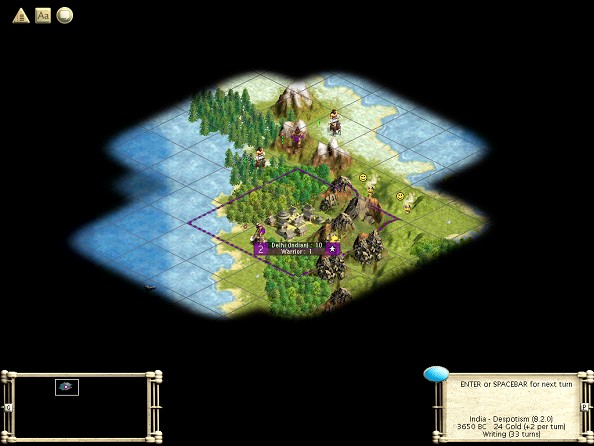
Upon the founding of Delhi the Indian watchmen could discern a faraway village to the north – one of the first tasks for Gandhi’s new city would be to make contact with the village, so Delhi began building a warrior. Expecting a watery world, Gandhi decided that mastering sea travel would be imperative, and set his scientists to work on the secrets of Map Making. Their first research effort would focus on Writing, and would take 2000 years (40 turns). Two hundred fifty years (5 turns) following the founding of Delhi, just as the first Indian warrior unit completed his training, barbarians appeared in the forests north of Delhi. The Indian defensive unit fortified in Delhi and withstood the attack – Gandhi thanked the Good Mother Banana that he had elected to build a warrior first! After the battle with the barbarian, the Indian warrior moved north to reach the first known village in the hopes of securing friendly immigrants, new technologies, maps or gold from the small encampment. Alas, no such luck.
 Attachment: first goody hut 3650 bc.jpg Attachment: first goody hut 3650 bc.jpg
This has been downloaded 290 time(s).
|
|
| |
|
|
|
Catt
|
|
California - SF Bay Area
May 2002
time: 21:21
|
|
Before long, Gandhi’s people had explored and then settled all of Great Banana Isle. After Gandhi’s scientists had discovered Writing, they set to work on Pottery. Having amassed a large treasury (+/- 200 gold) while researching Writing in 40 turns, the Indian scientists were able to discover Pottery very quickly, in perhaps 6 turns. But Gandhi was rapidly running out of potential city improvements – Delhi already had a temple and soon after Pottery would have a granary, so rather than proceed directly to Map-Making, the scientific research effort was focused on Bronze Working – this would allow the construction (or use as a pre-build) of the Colossus. Bronze Working, too, was discoverable in 6 – 8 turns through deficit spending and due to the burgeoning Indian empire’s gold production. In 1200 BC, the Indians erected the Colossus in the port of Delhi and the Indians entered a Golden Age. The Indian Golden Age contributed to rapid early growth and allowed the Delhi to discover and settle Banana Isle Minor and then build the Great Lighthouse in 550 BC – that same year a foreign folk known as the Germans completed a wonder they called the Pyramids, and shortly thereafter, in 530 BC another foreign tribe known as the English completed a wonder called the Oracle.
Gandhi’s scientists, informed that the Indian empire was apparently alone on Banana Isle, ignored technology advances focused on military matters, and instead focused their research efforts on the Arts and Sciences – mastering Literature, Mathematics, and Currency. While the citizens of Bombay labored on a Great Library, the Indian scientists labored to bring Indian society to the point where representative government might flourish. In the meantime, with the maritime skills imbued in Indian galleys through the power of the Great Lighthouse, Indian sailors set forth into the treacherous seas in search of the foreign tribes whose names had only previously been whispered in dreams. Indian galleys first discovered land to the west, and there met the curious English peoples. The Indian explorers also reported back to Gandhi that the English had discovered a Banana Isle Minor of their own, and when Gandhi established an embassy in London, the surrounding terrain began to suggest something to Gandhi – perhaps the English were located on an island not too dissimilar from the Great Banana Isle? Indian galleys continued westbound, and soon discovered the Japanese empire. Additional Indian galleys proceeded eastbound from Great Banana Isle and successfully made contact with the Persians. Around the same time Indian galleys located a sea lane to the southern hemisphere from south of Banana Isle Minor. Discovery of the Roman, German, Egyptian and Russian empires soon followed and by 210 BC Gandhi had met and established embassies with all the world’s peoples.
Gandhi was pleased to discover that no other civilization had yet discovered Literature – the people of Bombay completed the Great Library in 110 BC. The Indian scientists continued their research efforts, albeit at a somewhat slower pace; while doing some research, the Indians were also building a large treasury in order to pay outrageous overtime pay to Indian citizens in order to more quickly build a solid civilian infrastructure. Gandhi’s goal for his people was the building of all of the Great Wonders that he coveted – among the most prized would be the Hanging Gardens, Leo’s Workshop, Sistine Chapel, and Adam Smith’s Trading Company. Gandhi also knew that only he had the benefit of contact with the world’s civilizations, each of the other seven leaders were familiar only with Gandhi, and no other. Gandhi kept it this way, buying world maps but never selling them, and never selling contact with other civilizations.
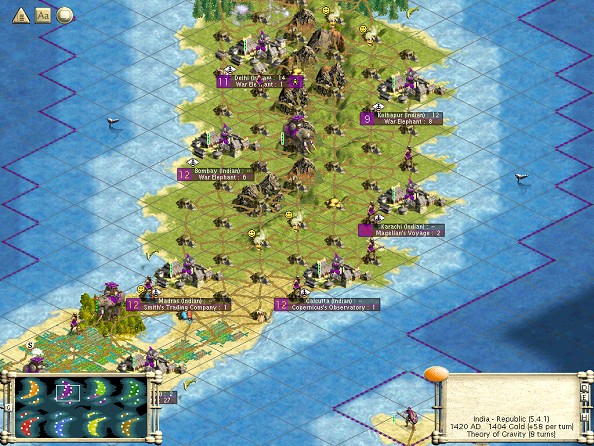
Of the seven competing civilizations, England was consistently the leader, though a far cry from the glorious Indian empire. In addition to building the Oracle, the English built a Great Wall in 500 AD and Sun Tzu’s Art of War in 1080 AD. But the Indians succeeding in building the Hanging Gardens in 650 AD, Leonardo’s Workshop in 1140 AD, the Sistine Chapel in 1200 AD, both Copernicus’s Observatory and Smith’s Trading Company in 1420 AD, Magellan’s Voyage in 1425 AD. But perhaps the Indian cultural dominance was strongly resented by the other empires? As soon as Gandhi’s diplomats determined that Elizabeth of England had discovered Astronomy, in approximately 1300 AD, Gandhi contacted her and every other leader in the world, and methodically sold world maps and diplomatic communications to all comers. This brought tremendous additional gold into Indian coffers, but also highlighted to the world’s leaders the significant “Power” and “Culture” lead of the Indian empire, albeit one enjoying only a smallish “Score” advantage.
A One Civ Wonder Cascade:
Attachment: 1420 ad - wonders a'plenty.jpg
This has been downloaded 289 time(s).
|
|
| |
|
|
|
Catt
|
|
California - SF Bay Area
May 2002
time: 21:21
|
|
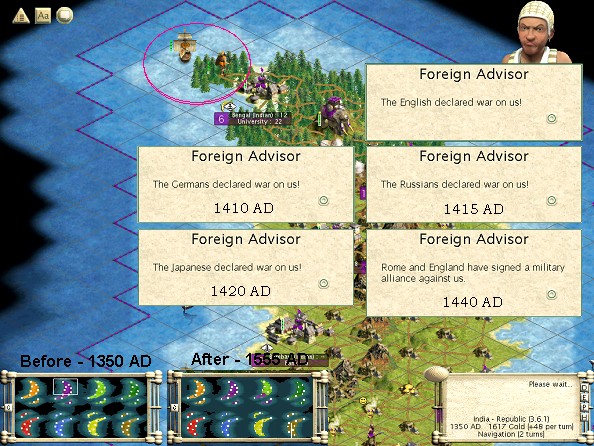
The first of the foreign powers’ naval vessels that Gandhi saw off the coasts of Great Banana Isle were English caravels – England and India had entered into a mutual right of passage agreement some time ago, and the English caravels (about three turns apart) proceed north along the western Indian coastline. Although Elizabeth had always been Polite with Gandhi, the devious wench apparently had secret, devilish plans for India. After landing an attack force of an archer, a spearman and a warrior at the northernmost tip of Great Banana Isle, Elizabeth declared war in 1350 AD, and a turn later landed a musketman and two warriors just north of Great Banana Isle’s southern plains and deserts.
In fairness to Elizabeth, conquest seemed to be the order of the day in the 1300’s and1400’s AD, and an Indian attack force consisting of eight caravels loaded with musketmen and war elephants was just off the coast of Persia’s pale imitation of Banana Isle Minor. Gandhi had determined that Xerxes was mismanaging his own empire, and that the ivory on Persia’s Banana Isle Minor should rightfully be controlled by the wise Indian merchants. In fact, so should the furs located in the south of Persia’s main island. Depriving Xerxes of the iron needed for his beloved (and dangerous) immortals was just a bonus. The Indian offensive went well, and the defensive against the English proceeded well also, but Great Banana Isle was somewhat under-defended as much of the Indian armed forces were fighting in Persia. Elizabeth continued with a surprisingly steady stream of naval assaults and landings on Great Banana Isle, and Gandhi’s home forces held them off, but there were moments of concern, and there were times when Gandhi exhorted his people, every last man, woman, and child to take defensive positions along the coastlines to prevent English forces from landing. Elizabeth also effectively used her slight lead over other rival civilizations to motivate further warfare – but that hardly mattered as bloodlust seemed to be in the air after 5000+ years of enforced peace among the seven rival civs. One after another civ declared war against India, sneak attacked (violating RoPs) and/or allied with England against India. Gandhi had not bothered to seek allies because he preferred to preserve his freedom to make war or peace, and because he was skeptical of his rivals’ abilities to wage effective inter-island warfare. The world degenerated into one declaration of war after another.
Attachment: war compilation.jpg
This has been downloaded 286 time(s).
|
|
| |
|
| |
All times are GMT. The time now is 05:21.
Apolyton Time is 00:21. |
top of page
|
|
|
Forum Rules:
You may not post new threads
You may not post replies
You may not post attachments
You may not edit your posts
|
HTML code is ON
vB code is ON
Smilies are ON
[IMG] code is ON
|
|
|
|
|
|





 27-08-2002 00:35


 So, I lost about 3 galleys trying to find if I could get across anywhere. Once I found the passage to the english, I stockpiled mucho galleys and archers and then moved them all across at once. I lost about 1/2 to 2/3 of them to the treacherous waters. Going to keep losing that many until navigation comes along...


 |
|