|
Jmaster
|
|
quote:
Calculus of Happiness
ASSESSING SUBJECTIVE WELL-BEING ACROSS SOCIETIES BY RODGER DOYLE
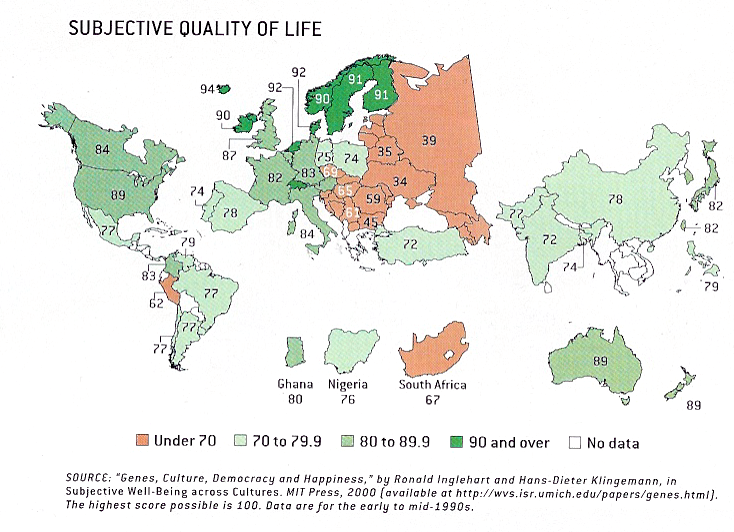
Research beginning in the 1960s has found that among the correlates of happiness across societies are security, gender equality, absence of class inequity, modernity and low militarization. One of the most recent and extensive efforts to explore these links was conducted by political scientists Ronald F. Inglehart of the University of Michigan at Ann Arbor and Hans-Dieter Klingemann of the Social Science Research Center in Berlin. Through personal interviews in which tens of thousands were questioned, they assessed subjective well-being in 64 countries during the 1990s. Their measure of wellbeing is based on answers to two questions: "How satisfied are you with your life as a whole?" and "Taking all things together, would you say that you are very happy, quite happy, not very happy, not at all happy?" The answers are given equal weight in the subjective well-being scores displayed on the map.
The scores show a correlation between subjective well-being and economic development. Above about $13,000 of gross domestic product per capita, however-roughly half the American level-additional income does not seem to enhance reported well-being.
There is a correlation between subjective well-being and democracy. As Inglehart and Klingemann point out, however, democracy does not always make people happy. As examples, they cite Weimar Germany and the former communist countries. In fact, the extraordinarily low level in most ex-communist countries apparently reflects not so much low income as the turmoil following the dissolution of the Soviet empire. The evidence suggests that well-being in these countries was considerably higher before the dissolution.
Inglehart and Klingemann theorize that although democracy contributes to happiness, the primary causal effect is in the other direction: high levels of well-being legitimize democracy and promote its survival. Lack of
democracy does not necessarily lead to unhappiness, as is demonstrated by authoritarian China, which has a higher level of well-being than democracies such as India or South Africa, perhaps because of its rapid economic growth.
Particular religious traditions may playa role just as important as economic development. This proposition is suggested by the higher level of well-being in the historically Protestant cultures of Scandinavia as compared with Catholic countries such as Italy and Spain. Western countries as a group have higher well-being scores than non-Western nations, but to what extent this is influenced by religion is not clear.
Among the correlates of happiness on an individual level are good health, extraversion, and professional or managerial occupation. The divorced and widowed are less happy than the never married, who in turn are less happy than the married. Old and young are equally happy. To judge by the experience of Holocaust survivors, early trauma leads to later unhappiness. Contrary to what some pessimists believe, most people almost everywhere who live above a bare subsistence level are happy.
|
Good stuff here. 
I was going to provide the article as it appeared as a rtf file, but even compressed it was too big.
 Attachment: sciam_map.png Attachment: sciam_map.png
This has been downloaded 102 time(s).
|





 17-10-2002 03:13





 the netherlands comes on second place.........but anyways.....this would make new tactics availible and also some new units and abilities......causing unrest in one base/city of a faction will cause (some) unrest in the other bases with in turn will cause even more unrest etcetc.....
 probing
 |
|