|

|
BRC
|
|
quote:
You're an Emperor player now. Make the leap! |
Here it is.... No more Monarch. Even if I start losing, I'm just gonna suck it up and play Emperor. It's the only way to get better, right. But if I start losing a lot, you guys are gonna hear about it, ok? When's the next AU game? I'm ready.
|
|
| |
|
|
|
ducki
|
|
quote:
Originally posted by Arrian
I miss worker buying, btw. Great tactic using scouts to lure barbs to other civ's capitols. Brilliant, even.
|
I was able to nab a worker from Greece and one from Germany on the same turn for Masonry. Since it was one of my few hut-goodies, it was worth it.
I started out Scout, Scout, Scout, Granary, Settler and am a bit behind, but with settlers popping out of my capitol constantly, it's no biggie.
I was really depressed with my goody huts - so much so that I might try again - I got 3 techs, a warrior, 25 gold, and a bunch of area maps. Blargh!
No settlers, no towns, very little money. Ack.
The Expansionist version of the Spearman from Hell.
Damn the RNG!
|
|
| |
|
|
|
Catt
|
 |
California - SF Bay Area
May 2002
time: 21:24
|
|
I finally finished my second go at AU 202. As I mentioned earlier, the game was pretty much locked up when a war with an "iron-less" Bismarck started shortly before 1000 AD. Rather than end it quickly, I played the game out until a spaceship victory to get a feel for the AU Mod, which I haven'tt played in awhile.
AU 202 - Scout and Expand confirmed for me my general view of the expansionist trait -- (1) it is an early game advantage (exclusively); and (2) its value is highly variable, dependent on what the map and civ generators serve up. Under the right circumstances and with a little bit of luck, it can almost be gamebreaking; under the wrong circumstances, it can be almost (but not quite) worthless.
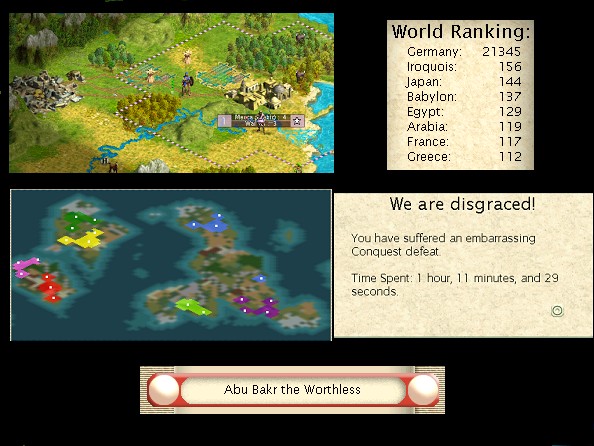
I played AU 202 twice - the first time exiting before 2000 BC under a German rush; the second time winning in 1864 via spaceship (cultural win must have been right around the corner too). Not really a whole lot to share beyond the early game, which I have already detailed in earlier posts in this thread. But I think it probably is worth revisiting my "hut luck" in my two attempts, because they are wildly different and underscore for me the variability in the value of the expansionist trait. In each game I followed the same opening tactic: with my religious civ I decided to hope for many techs from huts and march towards Monarchy to get out from under the despot tile penalty -- to do so I researched Alphabet at a 40-turn pace, closing off a big chunk of the tech table from huts in the hopes of making quick progress to Monarchy.
Game 1 yielded: Warrior Code, Maps, Gold, Warrior, Mysticism, Gold, Horseback Riding, Settler, Polytheism.
Game 2 yielded: Warrior Code, Settler, Maps, Maps, Gold, Maps, Maps, Gold.
My second game hut-luck was terrible compared to the first (although the early settler was great!). In my first attempt, I bypassed a pair of huts very close to my capitol with my first scout, wnating to get out to farther huts and counting on my second scout to pop the close huts. I don't think I'll do this so frequently anymore -- the power of an early settler, very close to the capitol, is too great to delay -- I think I will be more inclined to pop them as I see them from here on out. In my second attempt, I tried to play as if I didn;t know the map -- more or less duplicating what I had done in the first go round. Early contact with an Iroquois scout forced me to pop a close hut (for fear of losing it) earlier than my first attempt - and it just happened to produce a settler.
Since, in my view, expansionist is very much an early gamer trait, and since I have already spent a number of posts talking about my early game, I though I'd just quickly provide a very fast summary of the mid and late game.
I have already detailed an early skirmish with both the Greeks and the Iroquois. I also described my war of aggression against the Iroquois, during which I reduced Hiawatha to an OCC in the far southwest of Greece. In 1040 AD I finally had contact with the other half of the world, and traded for maps at that time. After war with the Iroquois, I expanded into German lands, reducing Bismarck to an OCC off the northwest coast of Germany. The conquest of Germany was largely complete by 1300 AD, just a few turns after Cavalry became available. SHortly thereafter (circa 1350 AD) Hammurabi landed a force of knights and declared war. I repeled invaders and landed a small force of my own just to harrass -- at that point in the game, I felt it was won but didn't want to win and end it - I wanted to experiement with the AU Mod. Hammurabi bought alliances against me again and again, and finally suckered Greece into war. I have described my long infantry and arty war against Greece infantry, which was won in approximately 1700 AD.
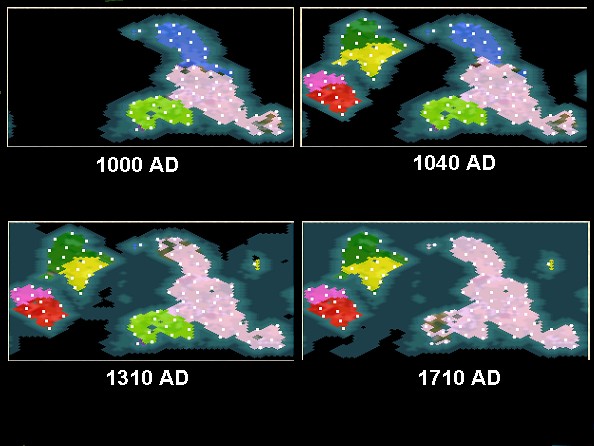
The MiniMap compilation below shows 4 minimaps from points in the game -- (1) 1000 AD - the beginnings of the war with Germany; (2) 1040 AD - first contact with the new world; (3) 1310 AD - the conclusion of the German war; and (4) 1710 AD - the conclusion of the Greek war.
Catt 
 Attachment: minimaps.jpg Attachment: minimaps.jpg
This has been downloaded 95 time(s).
|
|
| |
|
|
|
Catt
|
|
California - SF Bay Area
May 2002
time: 21:24
|
|
From 1710 AD onwards, after making peace with the world, I reverted to Democracy (after experimenting with both Communism and Monarchy), and set about building. Very quickly my research rate swung to a 4 turn-pace. I avoided war for almost the rest of the game -- meanwhile the AI's were going at it against each other. The Egyptians and Japenese were trading cities, fighting a war of stagnation. Babylon reduced France to an OCC (later a 2CC after a culture flip).
Entering the Modern Age, I was able to research Fission in 5 turns, Computers in 5 turns, and Miniturization in 4 turns. With the UN in hand, Seti built, and then the Internet built, the rest of the Modern Age techs were all 4-turn research projects, usually producing a surplus (sometimes a deficit on turn 1 before being able to ratchet it back on turn 2 but still complete in a total of 4 turns). A well-placed Palace and FP, even on a "core-unfriendly" landmass, made the vast bulk of my empire productive. I believe I ended the game with 15,000+ gold and an 800+ per-turn surplus -- I was rushing improvements in tthe very fringes but still maintaining a 2000+ treasury before I grew tires of the micromanaging and stopped rushing improvements (allowing the treasury to wastefully expand).
One interesting note: I never built a land unit after infantry (though I upgraded infantry to MI for coastal city protection)-- no tanks, no MA, no marines, no paratroopers, etc. I wasn't going to go on an offensive war, and I felt comfortable enough with the effects of the AU Mod unit changes in the late game to see no need to experiment extensively with them. I did build modern naval and air units.
Another interesting note: I mentioned in an early post my ridiculous good luck with leaders. The first 5 or 6 of them came without trying too hard -- sure, I'd hold back elites for an easier win, but I wasn't employing any "leader farming" techniques. My leader luck continued, and according to the replay screen I generated a total of 14 leaders. Easily my greatest leader luck of all time -- I've had more in a game, but always (1) after a lot of warfare (in this game I was dependent on landing parties for cannon fodder for much of the time); (2) many such leaders coming from blitz units (which are easy to promote to elite) -- I didn't even build a blitz unit the entire game!; and (3) probably with a militaristic civ. On two separate occassions I generated leaders on back-to-back attacks. Luck pure and simple.
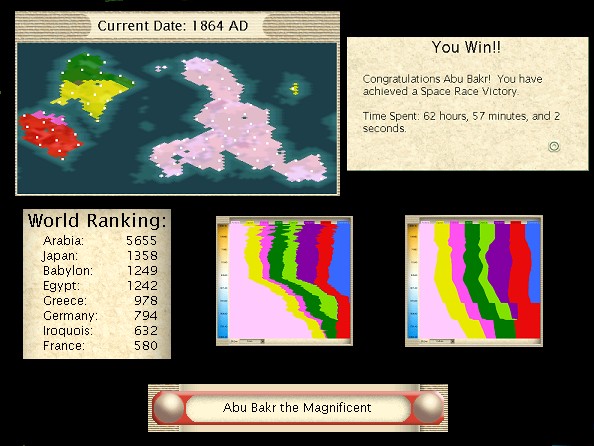
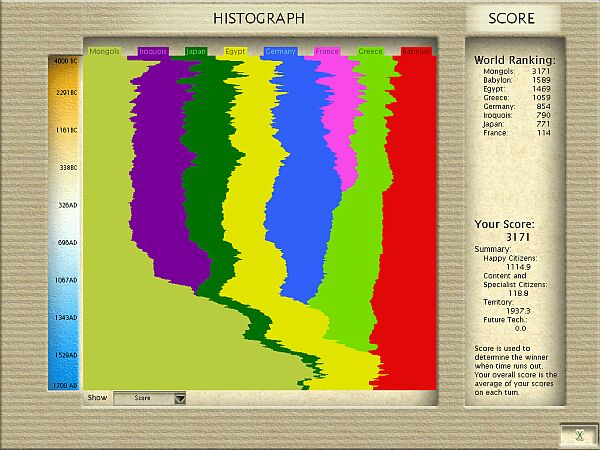
Below is a medley of images from my winning game: thre replay screen minimap; the "time spent" box (ignore the 62 hours - I frequently leave the laptop on for hoiurs and hours while doing other tasks, even while civ runs in the background); the scores; the winning histographs for both score and culture; and finally my "title" as magnificent.
Catt
Attachment: win medley.jpg
This has been downloaded 91 time(s).
|
|
| |
|
| |
|
|
|
BRC
|
|
A question for you Catt:
What was the biggest difference between your two games?? Was it the German attack earlier that did it??
Could you please explain what you could have done (if anything) to win that first game? Thank you. You have shown me the importance of sharing results, no matter what happenes.
|
|
| |
|
|
|
Catt
|
|
California - SF Bay Area
May 2002
time: 21:24
|
|
quote:
Originally posted by BRC
A question for you Catt:
What was the biggest difference between your two games?? Was it the German attack earlier that did it??
Could you please explain what you could have done (if anything) to win that first game? Thank you. You have shown me the importance of sharing results, no matter what happenes. |
After the first attempt (and my visit to the spoilers thread to see that my experience was not unique to AU 202) I counted the number of tiles between Berlin and Medina (the city the Germans attacked). The number of tiles was only 6 or 7 less than the number of turns elapsed before the attack -- meaning that Bismarck's units had to make almost a straight bee-line for my city. I suspect they headed south for huts and barbs, and then decided on the rush.
Generally speaking, there's not a whole lot you can do against an ultra-early rush on Deity. I can often counter it at Emperor, the level at which I played this game. Fact is that the AI starts with a bunch of units and, paired with a very aggressive civ like Germany, it may just come after you because the power imbalance is so great in the very early game. Starting next to Germany is dangerous.
All that said, I definitely screwed up and could have survived if I hadn't made a series of errors. First, a Greek hoplite moved into the mountains just north of Medina 2 turns before the Germans. I moved my two warriors and a conscript in to Medina, expecting a Greek attack. But the hoplite moved west outside of my city borders. The the Germans came into view, following the same path as the hoplite. I was just about to complete a worker and could have changed my production to a warrior or spearman. But I didn't. Bad mistake. I was caught unawares for three principal reasons: (1) this was before embassies, so for all I knew the Germans were at war with the Greeks (I hadn't seen any battles, but my scouts had seen Germans and Greeks heading each other's way); (2) even if the German units weren't "chasing" the Greek hoplite, I naively assumed that the AI civs were innocently following the same path (as they often seem to do, by whatever algoritm determines their movement directions) -- the hoplite had moved into my radius and moved right on out - I believed (hoped?) the Germans would do the same; and (3) once I knew the Germans were on my landmass, I should have prioritized military units - I was sucked into the AU "Scout and Explore" theme and totally under-funded defense. A potential (4) would be: after the declaration of war I could have changed Mecca's production from settler to a spearman and played on and hoped for the best (against 3 archers), but I didn't want to play out the game from such a bad start -- I've played many such games recently and I really wanted to get a feel for the AU Mod, so I took the loss and replayed the game a second time.
Catt
|
|
| |
|
|
|
BRC
|
|
Thanks Catt.
quote:
Fact is that the AI starts with a bunch of units and, paired with a very aggressive civ like Germany, it may just come after you because the power imbalance is so great in the very early game. Starting next to Germany is dangerous. |
What is the best solution to this?? Build units as fast as can to at least pretend that you are well defended??
|
|
| |
|
|
|
Catt
|
|
California - SF Bay Area
May 2002
time: 21:24
|
|
quote:
Originally posted by Jawa Jocky
Another question for Catt:
My culture is horrible compared to yours Did you make any effort to have good culture? Did you make any effort to have good culture?
I apologize if you already mentioned this but this thread is getting to long to re-read. edit: And I would hate to start another religious vs. off-topic arguement. |
When I play a religious civ, I do try and build early temples for a culture boost -- I find anecdotally (i.e., "gut feeling") that it helps me in the late ancient and early middle ages particularly -- resistors and culture flipping in times of war are very minimal. Depending on the start location and food scarcity, I may even pop-rush an early temple or two -- 10 turns and a temple is in place, offsetting the unhappiness caused by the pop-rushing.
I quickly fell behind my religious neighbor the Iroquois, but they were the only real cultural threat. In my middle ages war against them, I would frequently find 10 resistors in a pop 10 city. My advance was considerably slowed since I was forced to (1) garrison very heavily for a few turns at least before moving on, or (2) if employing the IDGAFIYF strategy, leave several Ansars outside each city -- the immediate appearence of a pikeman or even two if a flip occured, particularly in a size 7+ city, and the deep cultural borders the Iroquois enjoyed meant that a bad flip could really stifle the advance significantly. Narrow landmasses, an extensive road network, no Battlefield Medicine (and therefore healing in enemy territory), and a populous and rich foe made for a real risk of the advance team being caught behind enemy lines without reinforcements for some time.
It was only after the Iroquois war, when I had a large territorial lead and only Germany (not a cultural powerhouse) had an empire that even approached mine in size and cities that the cultural lead took off. Later it was again the territory (and the universities built all over the place) that made for the insurmountable lead. Towards the end it was the Internet (and all those free RLs) that produced the dramatic growth - remember I played the AU Mod and so the space race went on through most of the Modern Era, giving those free RL's time to do their magic.
Catt
|
|
| |
|
|
|
DaveMcW
|
|
You could set up a moving wall on your border, similar to the settler block. Bismarck can't sneak attack you if he can't get in!
It would be interesting to try one of those "doomed" games.
|
|
| |
|
|
|
ducki
|
|
What is "IDGAFIYF"?
|
|
| |
|
| |
|
|
|
Dominae
|
|
Nice game Jawa. Don't feel too bad about not "winning", us human players know when a player has won and when he has lost. You've clearly beat the scenario.
Any additional thoughts on the Keshik?
Dominae
|
|
| |
|
|
|
Jawa Jocky
|
 |
Seattle, WA
Dec 2001
time: 21:24
|
|
hard to kill them since they have a defensive bonus.
Keshik Conclusions
This units main benefit is it's cheaper cost. You just end up with more of them. The mountian movements give you some benefit, but the 3 movement bonus some of the other knight replacements offer is better.
Mongol conclusions - They are an all out war-monger civ with the most beautiful leader in the game.
Last edited by Jawa Jocky on 21-12-2002 at 23:18
|
|
| |
|
|
|
Konquest02
|
 |
Somewhere up in the trees
Jun 2002
time: 00:24
|
|
I finally managed to finish AU 202, despite my finals and my lack of time. But overall it was a pretty good game. I will first give a brief AAR and then draw some conclusions.
In the beginning , God created the Americans and gave his good pal Lincoln the tak of guiding them through what he had just created... Since then, the fate of the Americans was in God's hands.
But he gave this people knowledge on how to build roads and mines faster and he created THE unit: the Scout. With the help of these scouts, Lincoln managed to get a good start. Washington was founded right where God chose to put the first American settler.
Soon, a friendly tribe was told by God to join our civilization. Manifest Destiny was under way. This tribe soon founded the great city of new York, near the mountain where they were discovered.
Then, our scouts met the Iroquois, generated by a competing God. But we were too strong. We took a couple of cities then made peace. This gave us room to expand, while crippling the Iroquois.
A conscript warrior from a tribe saw a nice city, Athens. Since there was nobody in it, he decided this would be his town. So he walked into Athens, defeating Alexander the not so Great, whom fled into the jungle. YIPEE! more room to expand. The game was almost over by then...
Soon fell the Iroquois. Greece respawned just between me and the Germans, acting as a nice buffer... I got these to war a lot against each other and when Greece was almost defeated (±1 defender in each city), my newly discovered knights rolled over the land, leaving one desert city for Bismarck. Within 2 turns, there were no more Greece. A couple turns later, I defeated Germany without much trouble, as they did not have access to any Iron. God was smiling looking at the American continent...
My GA was really peaceful. I captured the Pyramids in Berlin and I had already built Copernicus' Observatory. I then built JS Bach's Cathedral and there goes my GA! I spent it building infrastructure in my newly conquered lands.
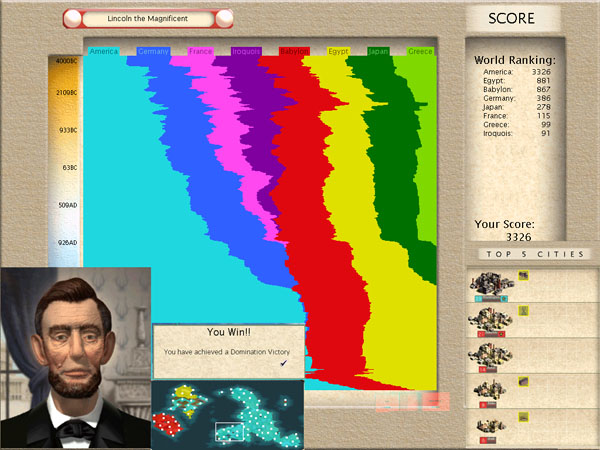
Finally won by Domination in 1810, after a lot of experiments. I wanted to invade Egypt fairly quickly just when I got to Motorized Transportation, but the time I got there, they had discovered Replacable parts. My advance was a lot slower, facing infantry. So my democracy was overthrown and I decided to experience Communism. Eeech...Never to do again. I got 10 turns as a Commie and corruption was near 35%. I thought my FP placement was bad enough to get a so-so corruption rate, but it was awful... I then captured 4 cities and triggered a domination win...
On the seventh day, God sat around his house, drank beer and played bowling with his friends Buddha, Allah and his son JC. He saw that was good, and decided to invite them the next day...
--Kon--
Attachment: lincoln the magnificent.jpg
This has been downloaded 50 time(s).
|
|
| |
|
| |
All times are GMT. The time now is 05:24.
Apolyton Time is 00:24. |
top of page
|
|
|
Forum Rules:
You may not post new threads
You may not post replies
You may not post attachments
You may not edit your posts
|
HTML code is ON
vB code is ON
Smilies are ON
[IMG] code is ON
|
|
|
|
|
|






 17-12-2002 21:44


 ; and my "title" as worthless.


 .
.


 |
|