|
| |
|

|
Rimpy
|
|
Washington, DC
Dec 2001
time: 00:24
|
|
I sent a letter to Christopher Douglas, the author of the Postmodern Culture essay on the Civilization series that is noted in the Apolyton Civ3 news. Here's the link to the article, "You Have Unleashed a Horde of Barbarians!":
http://jefferson.village.virginia.e...3.1douglas.html
And here's what I sent him...
Hi Christopher,
I enjoyed your recent article "You Have Unleashed a Horde of Barbarians!". I just wanted to comment that I think that you may be taking some of Civ's design decisions too seriously. Many design decisions were likely made based on creating an enjoyable gaming experience rather than trying to accurately recreate world history.
For example, the game does not model colonies seeking independence from their colonizer, whether it be through war or polical pressures. Events such as the American revolution or the independence of African nations in the 1960's don't take place in the Civ universe. Needless to say, the outcomes of these events have a very important effect on world history. In the Civ universe, the US would still be part of Britain. Moreover, no new civilization would arrive on the world scene that didn't already exist in 4000 BC.
However, from a gamer's perspective, this would likely create a very frustrating gaming experience. How would you like to play as Britain and spend centuries conquering and developing territory, only to result in the majority of your territory becoming an independent civilization, and you're suddenly stuck with a dinky island in the North Atlantic? Not much fun.
Along those lines, Civ also fails to model religious wars, such as nations going to war over whose god is the one true God. Although religion does play a small role in Civ, nations never go to war over religious beliefs, which is hardly representative of world history.
Gamers like a consistent set of rules and a predictable outcome if you play by the rules. Note that in the Civ3 expansion pack "Play the World", players are giving the option of turning off cities "flipping" to another civilization because too many people complained that it was too unpredictable and thus unfair.
Perhaps by modelling barbarians and minor nations in the manner that Civ's designers did, they were just seeking to create an enjoyable gaming experience. They were seeking a balance between exploring a virgin world and conquering territory only by first overcoming native resistance. I don't think it's meant to be a statement about Western attitudes about "uncivilized" peoples.
In any case, you wrote a very interesting article that I enjoyed very much. I can't begin to imagine what you must think a game like Grand Theft Auto says about Western civilization.
Kind Regards,
Rimpy
|
|
| |
|
|
|
Rimpy
|
|
Washington, DC
Dec 2001
time: 00:24
|
|
quote:
Originally posted by Mad Bomber
Can anyone tell me what the hell the point of that article was? I started to read that and after the second paragraph I was reading Blah, blah, blah..... To me the article was more about showing off his acedemia vocabulary than actually writing an article that would give his reader a sense of what he is trying to communicate. |
I think you summed it up pretty well. I think that the author was just trying to find an excuse for writing an essay about Western attitudes towards "natives" or "uncilvilized" people. He used the treatment of barbarians in Civ as an example that reflected that attitude. That was the main point of the article, although he had a lot of other stuff about video games in there that was only semi-relevant at best, and distracting at worst.
He could've made his point in about 1/10th of the space, but I guess writing such a long essay gave him more of a chance to show off his vocabulary. Conversely, I could've made my point in about four words: "It's only a game."
Rimpy
|
|
| |
|
|
|
Rimpy
|
|
Washington, DC
Dec 2001
time: 00:24
|
|
quote:
Originally posted by punkbass2000
I don't understand why it is that any time someone actually takes the time explain their arguments in great length and detail with a bit of intelligence that people think they're showing off. |
I don't always think that, far from it. But that guy could definitely use a few lessons from Strunk & White, "The Elements of Style". Often, your message will be better understood if you make it as concisely as possible. He could've easily made the same point in much less space, and more people would've actually read the article to the end. And I also got the impression that he used a lot of big words for the sake of using big words. The end result was an article that overwhelms the reader with its length and its complexity.
The point of writing is, after all, to convey a message to your reader. Did his writing style make his message more or less difficult to understand? I think that it made it more difficult to understand, which is why I thought that it was poor writing.
Rimpy
|
|
| |
|
|
|
punkbass2000
|
 |
Waterloo, ON, Canada
Feb 2002
time: 00:24
|
|
quote:
Originally posted by Rimpy
Often, your message will be better understood if you make it as concisely as possible. |
True, but I don't believe that appealing to the lowest common denominator is inherently the best way to go. I don't know if you've ever read anything by Hegel, but it is nearly incomprehensible, and yet incredibly brilliant, IMO. I'm glad he didn't dumb it down.
quote:
He could've easily made the same point in much less space, and more people would've actually read the article to the end. |
Yes, he could have, but I'd rather a longer article with several examples and in depth discussion than a brief stating of the thesis.
quote:
And I also got the impression that he used a lot of big words for the sake of using big words. |
Really? Any examples?
quote:
The point of writing is, after all, to convey a message to your reader. Did his writing style make his message more or less difficult to understand? |
I would say easier, if people took the time to read, digest and reread for comprehension. Is it the fault of the writer for writing too much or the fault of the reader for being too lazy to really get to know the piece?
|
|
| |
|
|
|
MosesPresley
|
|
I can't believe people are discussing an article they didn't read. The excuse of too many big words is distressing. BUY A DICTIONARY! After all it is a college paper and it is written at the 12th grade level.
The man is verbose, and his sentences are a little on the long side, but he is not beyond the realm of understanding and he makes some good points as to the underlying of the attitudes of the game towards indigenous peoples in the game.
What follows is a quote from the article:
"The game also represents the national borders of rival civilizations; in fact, a small city with little culture of its own on the border of a rival civilization with a powerful culture can be swayed to depose its governor and convert to the rival civilization. What's interesting here too, however, is the role that culture plays vis-à-vis the Indians: first, Indian villages don't generate culture, and second, they won't emerge from "empty" land that is within your cultural borders but beyond the reach of your cities. As the manual puts it,
though you might conquer the active tribes in your immediate area, new ones arise in areas that are outside your cultural borders, in areas that are not currently seen. . . . Thus, expanding your network of cities over a continent eventually removes the threat of active tribes, because the entire area has become more or less civilized by your urban presence.
In other words, again repeating traditional American mythology, the Natives don't have culture (because their "villages" don't generate it like your "cities" do), but they can be tamed by it. Or, to put it yet another way, the absence of Native title to the land they squatted on is betrayed by their lack of real cultural formations that might confer tenancy.
In these games, the fact that the Indians are understood not to occupy the land is linked fundamentally to the Native inability to develop technology. That is, they propose that indigenous populations improperly take up space in the empty land precisely because they don't develop technology and therefore aren't nascent civilizations. Conversely, these populations don't develop technology because they don't have a meaningful presence on the land--when they are in their "goody huts" they don't, that is, work the land (as agriculture, mining, trade) as a resource in order to advance along a teleological model of technical progress."
The point I got from the article is this. It reinforces American's attitudes of indifference to its historical policy of Manifest Destiny.
"Civilization II and III construct the indigenous population as another obstacle of the landscape--and one which, like the others, needs to be settled and disciplined. Eradicating the minor tribes and the land's erupting barbarians is not an unfortunate side effect to the march of progress--it is actually constitutive of one's civilization."
Whether or not you agree with this is another matter.
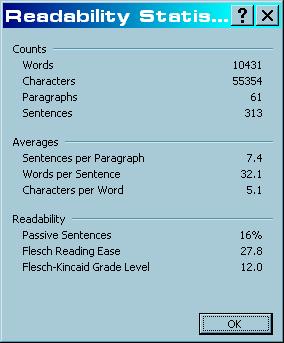
Below is a jpg of the readability statistics of the article.
 Attachment: stats.jpg Attachment: stats.jpg
This has been downloaded 120 time(s).
|
|
| |
|
|
|
Theseus

|
 |
The warmonger formerly known as rpodos. Gathering Storm! Apolyton Spirit!!
Apr 2002
time: 00:24
|
|
MP, did you not read my post?
The dynamics of civ expansion / failure are not specific to the Western European expansion against Amerinds, MEsoamericans, or Aborigines.
They have been played out *countless* times in the Middle East, Africa, India, SE and Central Asia.
To say that this is an American phenomenon, and thus so is the design of the game, is an extremely limited view, and an argument not worth making.
It is the writer's OWN bias and either intellectual laziness or a lack of knowledge that are demonstrated here. The sophistry, acting as a cloak of invisibility, is irrelevant.
To say that a history game has been designed with history in mind is reflexive and rather pointless.
|
|
| |
|
|
|
Rimpy
|
|
Washington, DC
Dec 2001
time: 00:24
|
|
MosleyPresley, thanks for making my point with those readability statistics in your post.
Passive Sentences -- Remember your Egnlish professors telling you to always avoid passive sentences and write in the active voice? 16% of the sentences in that article are passive.
Flesch Reading Ease score -- That article measured 27.8. This is how MS Word says to interpret that score: "Rates text on a 100-point scale; the higher the score, the easier it is to understand the document. For most standard documents, aim for a score of approximately 60 to 70."
Again, like my letter to the author stated, I enjoyed the article. I read all of it, but it took more effort than it needed it. My main point was that the author was overinterpreting an arbitrary game rule, and I think that's still true. As far as his writing style, that's another issue, but for what it's worth, I thought he was unnecessarily wordy.
Rimpy
|
|
| |
|
|
|
Mad Bomber
|
 |
Columbus, Ohio
Nov 2002
time: 00:24
|
|
quote:
Originally posted by Rimpy
I don't always think that, far from it. But that guy could definitely use a few lessons from Strunk & White, "The Elements of Style". Often, your message will be better understood if you make it as concisely as possible. He could've easily made the same point in much less space, and more people would've actually read the article to the end. And I also got the impression that he used a lot of big words for the sake of using big words. The end result was an article that overwhelms the reader with its length and its complexity.
The point of writing is, after all, to convey a message to your reader. Did his writing style make his message more or less difficult to understand? I think that it made it more difficult to understand, which is why I thought that it was poor writing.
Rimpy |
Couldn't have said it better myself. I understand that this is a work of academia, but even by the most elietist universities such as Fordham this would be considered unnecissarily verbose. Worse the author does not even introduce his thesis until paragraph 15 His use of documentation is far in excess of needed and he cites a work before he even bothers to name the work, terrible for even a ninth grade report. To sum up, his writing style is crap, I hope that I am not misunderstood by anyone. His use of documentation is far in excess of needed and he cites a work before he even bothers to name the work, terrible for even a ninth grade report. To sum up, his writing style is crap, I hope that I am not misunderstood by anyone.
|
|
| |
|
|
|
MosesPresley
|
|
quote:
Originally posted by Theseus
MP, did you not read my post?
The dynamics of civ expansion / failure are not specific to the Western European expansion against Amerinds, MEsoamericans, or Aborigines.
They have been played out *countless* times in the Middle East, Africa, India, SE and Central Asia.
To say that this is an American phenomenon, and thus so is the design of the game, is an extremely limited view, and an argument not worth making.
It is the writer's OWN bias and either intellectual laziness or a lack of knowledge that are demonstrated here. The sophistry, acting as a cloak of invisibility, is irrelevant.
To say that a history game has been designed with history in mind is reflexive and rather pointless. |
I don't think his point was this is a history game designed with history in mind. It is more that it is a history game designed from a Western perspective. Especially the Western perspective of the role of indigenous peoples. Read this quote and tell me what you think:
"The best defense against barbarian-Indians is to "settle" the land by extending one's cities. In Civilization II, if all squares of what Bradford called the "hideous and desolate wilderness" come within city radii, the "wild men" he referred to never emerge. In other words, the game imagines the indigenous presence as a kind of wildness in the land that simply disappears when the land has been domesticated. In this way, these games arrive at an ideological solution that echoes the one achieved by early Christian settlers of America. The problem is this: how can the pagan Indian presence be accounted for in this land that is understood to have been given by God's grace to his Christian people? This problem and its resolution are nicely articulated in another early Christian record of settlement, Mary Rowlandson's 1682 account of her capture, enslavement, and eventual ransoming from the Wampanoag nation in what is today Massachusetts. When Rowlandson is captured during a raid on the settler town of Lancaster, she has to try to make sense of her Indian captor's presence and agency in terms of the mythology that was currently governing the northeast colonies. In this "the vast and desolate wilderness," as she calls it (122-23), echoing Bradford, the Indian presence is seen, ultimately, to be a method whereby God tests his people. Why, for Rowlandson, has God seemed to leave His people to themselves? After all, God could annihilate the heathens but chooses not to. The answer Rowlandson comes to is that the Wampanoag are the means by which God teaches His people moral lessons (158-59). This answer takes the agency away from the Indians--it's not their own knowledge about how to feed themselves during a particularly brutal New England winter that gets them through it (they've been there for centuries, after all), but God's will."
Of course his view is biased. All points of view are biased. His appears to biased towards pluralism. That is not the point. He is simply trying to point out the latent narrative of the game. Is he looking too deep? That depends on what you mean. This is just a game of course. But as you are playing it, it reinforces certain concepts and acts on specific assumptions. Might makes right and other such platitudes. His paper is simply trying to articulate those unspoken lessons.
As to whether or not he is a sophist, his argument is logical and appears to be well researched. He obviously has played the game and seems to spend time on these forums. He has a link to the Guns, Germs and Steel forum and he makes a few references as to what the fans expected from the Civ 3.
"The dynamics of civ expansion / failure are not specific to the Western European expansion against Amerinds, MEsoamericans, or Aborigines."
I think I know what you are trying to say with that statement, but would please clarify it somewhat? If I'm not mistaken, (my less than encyclopedic knowledge of history)only Europe colonized the rest of the world. If that is true, it would lend credence to his essay.
Just out of curiousity, what do you think the latent narrative of Civ 3 to be? I'm not asking you to do a report, just a quick synopsis of what the game is about to you.
|
|
| |
|
|
|
MosesPresley
|
|
quote:
Originally posted by Rimpy
MosleyPresley, thanks for making my point with those readability statistics in your post.
Passive Sentences -- Remember your Egnlish professors telling you to always avoid passive sentences and write in the active voice? 16% of the sentences in that article are passive.
Flesch Reading Ease score -- That article measured 27.8. This is how MS Word says to interpret that score: "Rates text on a 100-point scale; the higher the score, the easier it is to understand the document. For most standard documents, aim for a score of approximately 60 to 70."
Again, like my letter to the author stated, I enjoyed the article. I read all of it, but it took more effort than it needed it. My main point was that the author was overinterpreting an arbitrary game rule, and I think that's still true. As far as his writing style, that's another issue, but for what it's worth, I thought he was unnecessarily wordy.
Rimpy |
16% passive sentences isn't too bad. 27.8 for reading ease is pretty bad.
I don't think any of the rules are arbitrary. They are put there for a reason. Obviously, they are put there for specific gaming reason. I think his article was making the claim that our cultural conditioning is what makes us think these rules are just natural or arbitrary and will not or should not be questioned. Any activity, even the most banal, has a purpose or motivation behind it.
|
|
| |
|
|
|
MosesPresley
|
|
quote:
Originally posted by ruby_maser
MP, there is another thread in hear commenting on the article in question. you should perform your readability status on that thread because that is the one most people are referring to.
Though all I've read of this college boy's thesis is the excerpt you have provided (and I will take the time to do so fully when I get home), I can already tell it a significantly better quality of writing. |
I avoided posting in that thread, because it had degenerated into a discussion of patriotism, semantics and the meaning of post-modernist deconstructionism. The thread also seemed to be accusing the author of criticizing the game for being an Amercican biased perspective. When the author is clearly arguing that the game suffers from a Western perspective.
The author is suffering from the current vogue of historical revisionism, but somebody once said that "history is the propaganda of the victors."
|
|
| |
|
|
|
MosesPresley
|
|
Whacchoo tockin bout Willis?
|
|
| |
|
|
|
MiloMilo
|
|
quote:
Originally posted by MosesPresley
I think I know what you are trying to say with that statement, but would please clarify it somewhat? If I'm not mistaken, (my less than encyclopedic knowledge of history)only Europe colonized the rest of the world. If that is true, it would lend credence to his essay.
|
MP, I believe Theseus's point was that your knowledge of history is in fact mistaken, and that Europeans were not the only colonizers. They just happened to have both gunpowder weapons and transoceanic ships when they did it, so the effects were more grievous and more recent. And thus, more well-known.
quote:
Of course his view is biased. All points of view are biased. His appears to biased towards pluralism. That is not the point. He is simply trying to point out the latent narrative of the game. Is he looking too deep? That depends on what you mean. This is just a game of course. But as you are playing it, it reinforces certain concepts and acts on specific assumptions. Might makes right and other such platitudes. His paper is simply trying to articulate those unspoken lessons.
|
The criticism that has been levelled at the article if of two kinds:
1) It read too much into civ3's design decisions; in all likelihood they were made not as reflections of cultural assumptions, but rather to increase playability and fun. For all the author and we know, Firaxis may have made a concerted effort to avoid embodiment of those assumption, and it just didn't turn out to make for a great game.
2) The points made by the article are simply uninteresting, academically or otherwise. Yes, our culture tends to operate with certain underlying assumptions: might to some extent makes right; possession is 9/10ths of the law; manifest destiny; history is written by the victors; biological and cultural darwinism; etc. And yes, the narrative techniques and strictures used in a video game made in this country and by its citizens, who were most likely all educated under the same public education system and watch(ed) the same six television networks after school/work, will to a greater or lesser extent reflect the mores of this culture. My question is, so what? On my reading, the author was basically using civ3 to show the reader that these cultural assumptions exist. Problem is, I already knew that, so the article quickly became boring.
I admit that I'm not well-versed in (post-)modern cultural studies-- I studied classical philosophy in undergrad (that's university to you europeans). So I expect a certain level of deep and interesting analysis, as well as verbal economy, to accompany a given piece of observation. In this article I simply found that both of those things were missing.
|
|
| |
|
|
|
MosesPresley
|
|
quote:
Originally posted by MiloMilo
MP, I believe Theseus's point was that your knowledge of history is in fact mistaken, and that Europeans were not the only colonizers. They just happened to have both gunpowder weapons and transoceanic ships when they did it, so the effects were more grievous and more recent. And thus, more well-known. |
Please provide examples of other colonial nations. The fact that the European nations were so much more powerful than the colonized is why they were colonial nations.
quote:
The criticism that has been levelled at the article if of two kinds:
1) It read too much into civ3's design decisions; in all likelihood they were made not as reflections of cultural assumptions, but rather to increase playability and fun. For all the author and we know, Firaxis may have made a concerted effort to avoid embodiment of those assumption, and it just didn't turn out to make for a great game.
|
Whether these decisions whether unconscious or conscious still reflect a latent cultural perspective.
quote:
2) The points made by the article are simply uninteresting, academically or otherwise. Yes, our culture tends to operate with certain underlying assumptions: might to some extent makes right; possession is 9/10ths of the law; manifest destiny; history is written by the victors; biological and cultural darwinism; etc. And yes, the narrative techniques and strictures used in a video game made in this country and by its citizens, who were most likely all educated under the same public education system and watch(ed) the same six television networks after school/work, will to a greater or lesser extent reflect the mores of this culture. My question is, so what? On my reading, the author was basically using civ3 to show the reader that these cultural assumptions exist. Problem is, I already knew that, so the article quickly became boring.
|
As to whether or not the article is interesting is purely subjective. I found the article to be very interesting, although it was from a revisionist perspective. Kind of like Monday morning quarterbacking.
quote:
I admit that I'm not well-versed in (post-)modern cultural studies-- I studied classical philosophy in undergrad (that's university to you europeans). So I expect a certain level of deep and interesting analysis, as well as verbal economy, to accompany a given piece of observation. In this article I simply found that both of those things were missing. |
Again, this is subjective. I found the article's analysis of the game unique. I had never considered the viewpoint of the barbarians in the game before. Is he looking too deep. Obviously, too deep for simply having fun, but not too deep if you are looking for subconcious undercurrents of thought.
If your only thought as to the game's purpose is that is fun, then you are the one who is being uninteresting. The author of the article was interested in the underlying subtexts and assumptions of the game's rules and mechanics.
|
|
| |
All times are GMT. The time now is 05:24.
Apolyton Time is 00:24. |
top of page
|
| archivepost |
|
Forum Rules:
You may not post new threads
You may not post replies
You may not post attachments
You may not edit your posts
|
HTML code is ON
vB code is ON
Smilies are ON
[IMG] code is ON
|
|
|
|
|
|





 07-12-2002 00:49


 Agreed. If you ever read an academic article about sex, you might not think it was an enjoyable pastime.
 Pure gold!
 |
|