 |

|
Bluefrog
|
 |
Just east of nowhere.
Dec 2001
time: 00:24
|
|
While granaries aren't at the top of my build list, I think I value them slightly more than you do. In the extremely early game, I'll ignore them completely, but they can be handy once you have 4-5 cities under your belt. Drop one in a city that produces 4-5 shields regularly and has a bonus food tile, and use that city as a settler factory. I'm at work, trying to whittle away the minutes, so I don't have any hard numbers handy, but I've had a size 3 city, with a granary and the conditions set above, that could pop out a settler every six or so turns, when it hit pop 5. Have another city pumping out a steady stream of spearmen escorts, and this gives a massive, consistent boon to your REX phase.
|
|
| |
|
|
|
Franses
|
|
I hardly ever build a granary either. Their are some special circumstances that makes me decide differently but that's about once every 10 games or so.
|
|
| |
|
|
|
DaveMcW
|
|
Since I know how much you like math, realpolitic...
A settler requires 30 shields and 40 food. It only requires 20 food in a city with a granary. So let's see how fast we can get them to expand our empire.
Size 3 city with granary working 3 irrigated plains:
+2 food/turn = settler in 10 turns = 0.1 settlers/turn
+4 shields/turn = settler in 7 turns = 0.14 settlers/turn
0.1 settlers/turn (limited by food)
2 size 1 cities with no granary working irrigated plains:
+2 food/turn = settler in 20 turns = 0.05 settlers/turn
+2 shields/turn = settler in 15 turns = 0.07 settlers/turn
0.05 settlers/turn (limited by food)
0.05 * 2 = 0.1 settlers/turn
Tie.
Size 3 city with granary working 3 irrigated plains, including 1 wheat:
+3 food/turn = settler in 8 turns
+4 shields/turn = settler in 7 turns
0.13 settlers/turn (limited by food)
2 size 1 cities again, this time one has the wheat:
+3 food/turn = settler in 14 turns = 0.07 settlers/turn
+2 shields/turn = settler in 15 turns = 0.07 settlers/turn
0.07 settlers/turn (balanced food and shields)
0.07 + 0.05 (from before) = 0.12 settlers/turn
Tiny advantage for granary.
Size 3 city with granary working 3 irrigated plains, including 2 wheats:
+4 food/turn = settler in 6 turns
+4 shields/turn = settler in 7 turns
0.14 settlers/turn (limited by shields)
2 size 1 cities, each with 1 irrigated plains wheat:
0.07 * 2 = 0.14 settlers/turn
Tie, but the granary could do better by increasing population and therefore shield output.
Size 5 city with granary working 5 irrigated plains, including 2 wheats:
+4 food/turn = settler in 6 turns = 0.17 settlers/turn
+6 shields/turn = settler in 5 turns = 0.2 settlers/turn
0.17 settlers/turn (limited by food)
2 size 2 cities, each with 1 irrigated plains wheat and 1 irrigated plains:
+3 food/turn = settler in 14 turns = 0.07 settlers/turn
+3 shields/turn = settler in 10 turns = 0.1 settlers/turn
0.07 settlers/turn (limited by food)
0.07 * 2 = 0.14 settlers/turn
Granary wins.
Size 5 city with granary working 5 irrigated plains, including 3 wheats:
+5 food/turn = settler in 4 turns = 0.25 settlers/turn
+6 shields/turn = settler in 5 turns = 0.2 settlers/turn
0.2 settlers/turn (limited by shields)
2 size 2 cities again, this time one has two wheats:
+4 food/turn = settler in 10 turns = 0.1 settlers/turn
+3 shields/turn = settler in 10 turns = 0.1 settlers/turn
0.1 settlers/turn (balanced food and shields)
0.1 + 0.07 (from before) = 0.17 settlers/turn
Granary wins.
Size 3 city with granary working 3 irrigated plains cattle:
+5 food/turn = settler in 4 turns = 0.25 settlers/turn
+7.5 shields/turn = settler in 4 turns = 0.25 settlers/turn
0.25 settlers/turn (balanced shields and food)
2 size 1 cities working irrigated plains cattle:
+3 food/turn = settler in 14 turns = 0.07 settlers/turn
+3 shields/turn = settler in 10 turns = 0.1 settlers/turn
0.07 settlers/turn (limited by food)
0.07 * 2 = 0.14 settlers/turn
You should be shot if you don't build a granary here.
In conclusion, the effectiveness of a granary is based on the amount of bonus food you have. I always try to start my first or second city around bonus food so I can build one.
|
|
| |
|
| |
|
|
|
Bamspeedy
|
 |
Wisconsin, USA
Sep 2002
time: 23:24
|
|
realpolitic- You are looking at this from a one dimensional point of view. Sure, if you have a choice of only 1 city with a granary or two cities without a granary for the whole game, then yes taking the 2 cities is a no-brainer.
But, why can't you have a granary AND build more cities?
I'm sure you read my response in your similar post over at CFC, but I'll post my study to benefit more people. If you compare two cities (one city with a granary, and one without), by the time the city without a granary reaches size 12, the other city (with the granary) had already been at size 12 for 75 turns! And has produced 400 more shields than the granary-less city.
This will amount to even more shields if you have the city building any settlers/workers, because the city with granary can bounce back up in population faster than the granaryless city (or be able to produce twice as many settlers/workers, depending on how you look at it).
If you don't build a granary in a city until it reaches size 7, then you already lost out on at least 150 shields.
And not to mention the economic aspect that DuncanK pointed out.
I will agree that in some situations, building a granary may not be feasible (high corrupt cities, being pressured by war from other civs, culture needs are more important, etc.), but granaries will pay off more in the long run and this makes the Pyramids so valuable (if you start on a decent sized continent).
If playing tiny-small maps or a very crowded map where you'll only have room for 4-5 cities, then settlers before the granary will be smarter. But on less crowded maps and larger maps, building the granary first will pay off much more. The granary first tactic usually doesn't start outexpanding the settlers only tactic until 2000 B.C., so it depends on whether or not everyone will still be in the expansion phase at 2000 B.C. And after your done having your capital spit out settlers, your population bounces back up in size so quickly to build wonders.
 Attachment: granary tests.zip Attachment: granary tests.zip
This has been downloaded 3 time(s).
|
|
| |
|
|
|
Zachriel
|
 |
U.S.A.
Dec 2001
time: 00:24
|
|
quote:
Originally posted by realpolitic
The Zulu have a lousy UU, and expansionism isn't so hot -- the price of all those techs crash when they are traded for maps, (the more civs have a tech the lower the price)so it's best to buy less important ancient techs then instead of being expantionist
|
Zimbabwe hits pop 4 in 2800 BC and then produces Settlers every 5 turns or so. Though I am admittedly not a "Civ3 numbers expert," DaveMcW's cogent analysis matches my own gaming experience.
By the way, the expansionist trait worked wonders in this position. With the extra cash and techs from exploration, with cash from the sale of maps, with the advantages of the Granary, and most importantly, with knowledge of the local terrain, Zululand's expansion was rapid and decisive.
(I do agree that there are times when delaying the Granary is a good idea, especially on smaller maps, or when there are good tactical reasons for producing an early Settler.)
|
|
| |
|
|
|
Charis
|
 |
Midest, USA
Nov 2002
time: 00:24
|
|
I'll start by saying that I never appreciated granaries and never built them before playing in a succession game with Sirian, where their virtues became *quite* evident.
Since there seem to be some math lovers here, I wanted to toss out an idea that might make sense. Civ 3 is all about growth. Folks on both side of this argument don't argue about that! Those who never use granaries avoid them so they don't slow down their 'growth', while those that use them do so precisely to speed up their 'growth'

The difference is the time frame they're looking at.
Consider this graph:

This is a plot of generic power vs the number of turns.
(It's not meant to give specific numbers, but show a concept!)
Going with a granary is definitely slower, as you delay getting more cities, no units, as you build the granary. But after that you can crank out settlers or grow in pop at twice the rate. So the curve illustrates a higher exponential growth coefficient but with a time delay added in.
In the early stages ('B') the granary approach is far slower, while after a long time ('C') the extra growth from having the granary blows away not using them. Somewhere in the middle is the break-even point, 'A'.
Those centered on short-term, early war, first few cities think of their civs like the curves at 'B' and think 'granaries suck'. 
Granary lovers think in terms of long term expansion, look at not only the difference in y-value but slope at point 'C' and think "Granaries? Only a fool would neglect them!" 
The reason why there is *NOT* a universal answer to 'granary, yes or no' is because it depends on many factors:
- In games with very early war the short term unit count rules, and the advantage at 'B' is quite necessary
- In small games where you only have room for a few cities, the expansion is over before you ever get to 'C', perhaps before you get to 'A'. Getting settlers out quickly is paramount, forsaking the granary
- On a large map with no neighbor close it's hard to imagine not choosing a granary
- In some cases you're not food limited but shield limited, and a granary does not double the growth rate but does keep the delay, and is a poor choice
- If you can capture a builder neighbor who builds the pyramids, you get to follow the no-granary curve at the start then get the granary-curve's slope when you capture the pyramid, for the best of both worlds.
So the question you need to ask yourself is:
Am I going to run out of space to expand, or get in a war with a neighbor, before or after 'A'. Too bad you don't know where 'A' is in a real game. But experience will be a good guide -- *IF* you make the effort to try out and use granaries if that's something you never do now. Otherwise you're stuck on the solid curve forever - good players will have a feel for both curves and know which curve to choose for their game depending on objectives, neighbors, and map conditions.
This curve is the same one of interest when businesses must choose between heavy R&D spending or going for short-term profits. Which gets chosen too often? Let's say that many execs never build granaries! 
I hope this helps, rather than induce folks to... 
Charis
|
|
| |
|
|
|
ducki
|
|
If you are Expansionist and follow Aeson's Scout-Scout-Scout early build queue, I'd imagine an early granary to be a great idea.
If you delay your second and third cities, you should be below the AI average, making you eligible to gain settlers and towns from goody huts while at the same time, gaining the granary-growth factor.
Yes, it's a gamble, but so is the Expansionist trait in general. For non-Exp civs, I usually play it by ear. If I feel I am shield-heavy, I'll knock out a granary to equalize food and shields. If I'm food-heavy, that granary is probably going to take ages to finish and I might be better off just squirting out workers and settlers once I found a productive town.
I used to hate Granaries because I didn't like micromanaging citizen moods, but the more experience I get, the easier it is to know ahead of time what to do. Granaries are just another tool, like temples or libraries or roads or horsemen.
If you need it, build it, otherwise make more troops. (That one's for you, Theseus.  ) )
|
|
| |
|
|
|
DaveMcW
|
|
quote:
Originally posted by joncnunn
In addition, difficulty level plays a factor. On the Emperor level, you don't want cities growing faster than you can build the happiness improvements. |
The luxury slider is a wonderful thing...
In the worst case you can create some entertainers to slow down growth and create happiness. Extra food is never bad.
|
|
| |
|
|
|
joncnunn
|
 |
Maryland Heights, MO
Sep 2002
time: 23:24
|
|
I also build Graneries right after the Hospital so they grow to 18+ faster. (By then I have Temple + Catherdrial + Market Place + access to sufficent luxaries.)
I'm only a warmongler when my rapid expansion didn't give me enough high quality territory. (Most important feature for me is location of the rivers.) I play on the Emperor level.
The 3rd and 4th Settler I built in my most current game were to establish borders with the river on my side of the Irq border. (On tiny maps, 2 cities in most locations close by will create a chock point by the time both cities expand culturally.) The next few settlers were founded in an outside-in pattern.
I still had to build a lot of Jag Warriors in my current game just to keep the peace with my Irq neighbor when they had Mounted Warriors. Some of the Jag Warriors also carefully blocked the AI from sneaking a settler thru my territory. It was a success, the Irq didn't attack me until I had Infentry when Tanks were still a long way off.
Should the Irq make the same mistake now (I just now entered the modern era), they will be exiled to a small island.
In my previous game as the Chinese also on Emperor level I never went to war with the neighboring Japense at all. (5 cities on the river during REX, 8 cities with Harbors. Total of 10 cities, which is sufficent for the FP on tiny maps.)
During my Emperor level game with France though, I fought 2 ancient era and 1 mop up early middle age wars with England to grab the whole landmass. (Closest river was in London and continued in the far side of their starting location from mine.)
Last edited by joncnunn on 03-01-2003 at 23:01
|
|
| |
All times are GMT. The time now is 05:24.
Apolyton Time is 00:24. |
top of page
|
| archivepost |
|
Forum Rules:
You may not post new threads
You may not post replies
You may not post attachments
You may not edit your posts
|
HTML code is ON
vB code is ON
Smilies are ON
[IMG] code is ON
|
|
|
|
|
|






 27-12-2002 00:10


 ACK!
ACK!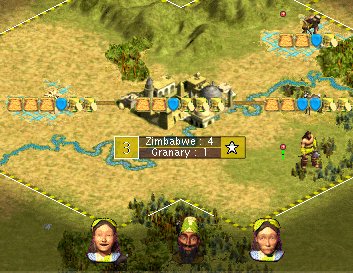





 In your original post you state that you don't use granaries to:
 |
|