|
| |
|
| |
|
| |
|

|
mindseye
|
 |
A Yankee living in Shanghai
Apr 1999
time: 13:24
|
|
quote:
They say it won't be in "normal" operation until later in the year. |
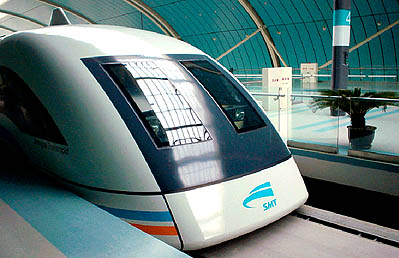
Um, okay, today I know what that means: until March or so, it will only operate on weekends, or at least that's what my best source tells me. At this point my ride has been postponed until Sunday.  Until then, here are excerpts from a Times article about yesterday's opening, plus an image to tide you over until I shoot my own. Until then, here are excerpts from a Times article about yesterday's opening, plus an image to tide you over until I shoot my own.
quote:
Zhu Rongji, the Chinese Prime Minister, and Gerhard Schröder, the German Chancellor, took an inaugural ride yesterday before the start of regular service next year. The German delegation was visibly amazed by the speed with which one of its abiding technological dreams had been realised by the Chinese.
Germany had spent 30 years developing the train, spending billions of public money, only to decide that the superfast and environmentally friendly rail network was too expensive. Then along came officials from the People's Republic, who said that China could not only afford the train but would build it in little more than a year.
Asked if a subway line might not have worked just as well and at much lower cost, Xu Kuangdi, the former Mayor of Shanghai, said: "Oh no. We need something chic."
But the real business logic is anchored in a plan to expand the rail line to neighbouring Hangzhou, more than 100 miles south, passing Jiaxing, the birthplace of the Communist Party.
The city of 14 million people is keen to be regarded as an equal to New York, Tokyo and London. Shanghai businessmen involved in the project insist that it will be profitable. They expect up to ten million passengers a year, a fifth of whom will be non-airport visitors just enjoying the £5 ride.
There are even plans to lay 800 miles of track all the way to Beijing to rival airlines and give China the mobility its expanding economy demands, or the flair for which its vanity cries out.
The speedy planning and execution displayed in Shanghai has struck some observers as hasty and erratic. The city's government decided to buy the new train to cover up an earlier mistake: it forgot to provide public transport to its new airport. Hence an over-ecstatic celebration of the train's inauguration in China's official media.
China's maglev line cost £745 million to build 19 miles - £39 million per mile
Improving Britain's creaking rail network does not cost much less. The cost of upgrading the West Coast Main Line from London to Glasgow has risen from £2.1 billion to £13 billion - £32 million per mile
The 70-mile Channel Tunnel Rail Link will cost £5.2 billion when completed in 2007 - £74 million per mile, nearly twice as much as maglev |
 Attachment: maglev1a.jpg Attachment: maglev1a.jpg
This has been downloaded 128 time(s).
Last edited by mindseye on 02-01-2003 at 09:09
|
|
| |
|
|
|
Tingkai
|
|
To find the Northwest Passage
Aug 2001
time: 13:24
|
|
One of the good things, perhaps the only good thing, about the Chinese leadership is that they all tend to come from an engineering background. I think that's why China's doing this meglev and its space program.
|
|
| |
|
|
|
Jarouik
|
 |
Helsinki, Finland, EU
Dec 2000
time: 07:24
|
|
quote:
Originally posted by SpencerH
What are the health effects of maglev trains do you think? AFAIK no one has proven detrimental effects of strong magnetic fields but personally I'd avoid em. |
Well, the magnetic field is pretty much contained between the track and the train, so any magnetic fields humans are subjected to will be very low... if you go to the site of the German maglev firm, www.transrapid.de, you will actually find out the magnetic field inside the train is much lower than that of many household appliances, such as your computer 
Anyway, the strongest magnetic fields in use today are not to be found in transportation or household appliances... medical equipment or equipment found e.g. in physics laboratories produce much greater fields, so their users would be most at risk, should any effects actually exist. And still, I believe that e.g. MRI (magnetic resonance imaging) devices are safer than for example x-rays, which are also used in medicine even though they are *known* to be a cancer risk.
|
|
| |
|
|
|
SpencerH
|
 |
Co-Ruler of my patch of land south of Birmingham Alabama
Feb 2002
time: 23:24
|
|
quote:
Originally posted by Jarouik
Well, the magnetic field is pretty much contained between the track and the train, so any magnetic fields humans are subjected to will be very low... if you go to the site of the German maglev firm, www.transrapid.de, you will actually find out the magnetic field inside the train is much lower than that of many household appliances, such as your computer
Anyway, the strongest magnetic fields in use today are not to be found in transportation or household appliances... medical equipment or equipment found e.g. in physics laboratories produce much greater fields, so their users would be most at risk, should any effects actually exist. And still, I believe that e.g. MRI (magnetic resonance imaging) devices are safer than for example x-rays, which are also used in medicine even though they are *known* to be a cancer risk. |
Thanks for the link. Unfortunately, I think their figures are crap. A magnetic field strong enough to levitate a train is only twice that of the earths magnetic field? Since a hair dryer produces 10 times the field of the maglev what could it levitate? There is no scale and therefore no way to interpret their deceptive figures (graphs).
MRI does create a strong magnetic field, but you dont spend hours a day everyday in one as you would on a commuter train.
|
|
| |
|
|
|
mindseye
|
|
A Yankee living in Shanghai
Apr 1999
time: 13:24
|
|
Bad news, folks. 
I just discovered that the new maglev line won't be open for public use until "sometime later in the year" (one source says March). In the meantime, the train will operate only on weekends, and only for parties of ten with advance reservations, and at a fare of 150 renminbi each way (once truly open, the fare will be just 50 rmb each way)!
300 rmb roundtrip is really expensive by local standards, the equivalent of something like US$200 to an American. For that reason, it looks like I'll be waiting a few months before taking a ride.
Surprisingly, even at those rates, as of yesterday, January 2, the train is currently booked until January 12!
Why the restrictions? The only reason I can come up with is that the local gov't wants to ramp up publicity so that when the train "really" begins service, there will be high demand. Chinese people can be astonishingly ignorant of local affairs, here in Shanghai most of my students (college-aged and adults) were, as recently as last week, completely oblivious to the train's existance!  Without insured high demand, I suspect the local gov't was wary of the negative publicity of international journalists photographing such an expensive shuttle system whizzing back and forth empty. Without insured high demand, I suspect the local gov't was wary of the negative publicity of international journalists photographing such an expensive shuttle system whizzing back and forth empty.
Maybe there is some other reason for the phased-in opening, this is all I could find out for now. Sometimes basic information (like when the #@%$ maglev opens) is hard to obtain here.
Rest assured, as soon as the thing is running at 50 rmb each way, I will report back with details and photos.
|
|
| |
|
| |
All times are GMT. The time now is 05:24.
Apolyton Time is 00:24. |
top of page
|
| archivepost |
|
Forum Rules:
You may not post new threads
You may not post replies
You may not post attachments
You may not edit your posts
|
HTML code is ON
vB code is ON
Smilies are ON
[IMG] code is ON
|
|
|
|
|
|






 01-01-2003 09:04




 Though I far more support spending the money on maglevs as we need to find ways of making our transportation systems more efficient, both in terms of moving ever-more people AND poluting the environment less.


 |
|