|
| |
|

|
vovan
|
|
OK, so I am still in the process of coding the backbone of the diplmatic system, and have much work to do before I get to the GUI, but I think it would be good to discuss how we imagine the thing working.
According to the Methodology of Contact section of the diplomacy model, there would be several ways to contact an opponent civ. And since nobody ever mentioned that part (in either approving or criticising manner), I assume that people generally agree that system would be good.
What I want you, people, to ponder is what happens after the contact is established. How should the process of discussing a treaty, for instance (or, for more current purposes, the process of discussing the change of diplomatic state) be visually represented? Well, declaring war is easy in some sense - you can attack a player with whom you have peace, and there you have it. But there should be clearly some kind of visual representation of the interaction between the player and the AI civ's for other, more advanced, actions.
There are basically two ways to do that:
1. A sort of bargain-table interface - as in Civ3 (which I happen to like a lot)
2. A sort of dialogue-based interface - more like SMAC. This is a little less streamlined and intuitive, IMO, but some people like it more.
If you happen to like either of those, or maybe have an idea of your own, please express it here. 
|
|
| |
|
|
|
Fosse
|
|
U.S.A.
Mar 2002
time: 23:25
|
|
Table-top.
It may lack the character and "fun" feel of the dialouge trees, but it more than makes up for it in flexibility of deals and ease of use.
|
|
| |
|
|
|
LDiCesare
|
|
La Ferté sous Jouarre France
Jan 2001
time: 05:25
|
|
I like CtP2's way, but know neither SMAC nor Civ3  . (MOM was poor, and civ2 pitiful). . (MOM was poor, and civ2 pitiful).
I'd like to see how GalCiv handles it, someone said their model was nice.
For those who don't know CtP2, you have 3 tabs on the left part of the screen:
Give, request, treaty, you can more or less chose one from each, and the corresponding dialogue appears in the right part of the window.
I'd like something like this, where I can "shop" in a list of options in one part of the interface, and see it clearly in another part (kind of what you do if you go on Amazon.com: you buy a cart of books, I buy a cart of diplomatic options). It could be tabs, or a tree view or whatever else.
The important points are:
I want to be able to adjust any parameter at any time, i.e. no going back to change an attitude from cordial to hostile, then having to select all the options again because I made a mistake in step 1 (including selecting the bad civ).
Another very important point is the bargaining when your opponent refuses.
You should have options easily accessed like change proposal (or make counter proposal), threaten, forget it.
|
|
| |
|
|
|
Simon Loverix
|
|
Tongeren, Belgium
Apr 2001
time: 05:25
|
|
Let the diplomatic status screen be the same as the "bargaining screen". Just make the changes you want, and immediately see the change in relationship for each change you make. If you think the proposal will be accepted, click the button "issue proposal" (which appears as soon as you have made any change). If the proposal is accepted, everything is applied as you have changed it, if it is rejected, everything is reset. Note that some changes, like a declaration of war, cannot be rejected. All the changes would either be accepted or rejected as one.
This allows for negotiating fine-tuned treaties and would be the simplest interface.
|
|
| |
|
|
|
LDiCesare
|
|
La Ferté sous Jouarre France
Jan 2001
time: 05:25
|
|
quote:
and immediately see the change in relationship for each change you make |
I am not sure what you mean. If this is supposed to tell you how the quixotic leader of Mingatopia civ will likely answer your request, I'd rather not have it. I want to know the reaction only when I have actually made a proposal. This gives some thrill to diplomacy. I liked the fact that in civ2 ToT you never knew how the ai would react when you sent an ambassador (makes for really challenging OCC games).
|
|
| |
|
|
|
vovan
|
|
Well, since a lot of you here haven't seen how the bargain table works, I'll providea little screenshot from civ3:

As you can see, there are basically two panes - on the left for what you can request from the other civ, and on the right what you can propose in exchange. The different things are arranged in categories (which can be collapsed so that they don't clutter the space - I have expanded all of them to give you an idea). And you can basically pick and choose whatever you want to put on the table, and click on the different items. Once you do that, they are removed from the lists on the sides (so that you can't select the same tech twice, for instance) and put on the bargain table - the pane in the middle. Once again, the left side is for what you want, and the right side is for what you are willing to offer in exchange. Once you put all the stuff you want, you can click the "Will you accept this deal?" button to offer the deal. If it is accepted, then it is done. Otherwise, the leader (whose protrait is shown above the bargain table - I cut it off, since it is not significant) says the deal is bad, but the table is not reset, so you can either add something on your side, or remove something from what you request to make the deal sweeter for the other civ.
That's basically how it works in civ3. I haven't player CtP2, so I can't really know, but I searched the internet for some screenies, and it seems to me that the idea there is very similar, only that you don't get the instant feedback on whether the deal was accepted or not.
|
|
| |
|
|
|
LDiCesare
|
|
La Ferté sous Jouarre France
Jan 2001
time: 05:25
|
|
Yes, this is very similar to CtP2, except that in CtP2 you can only choose one from each category (i.e. you can offer one tech but not one tech and some gold).
The additional thing in CtP2 is that, when the civ refuses the deal, you can bully them by threatening to destroy a specific city, making an embargo or declaring war. Threatening to decalre war is particularly efficient.
|
|
| |
|
|
|
LDiCesare
|
|
La Ferté sous Jouarre France
Jan 2001
time: 05:25
|
|
quote:
Originally posted by vovansim
Also, I was wondering. You mentioned that in CtP2, one can only select one option from each category. Do you think that is a good rule? It seems a little too limiting to me, and I prefer to be more flexible in the choice of my options. But maybe that rule could still be useful? |
No, that is a bad thing in CtP2. I mentioned it in order that we don't do the same error.
|
|
| |
|
|
|
vovan
|
|
quote:
Originally posted by LDiCesare
No, that is a bad thing in CtP2. I mentioned it in order that we don't do the same error. |
That's what I thought, too. So, then we pretty much follow the model set by Civ3.
Now, to change the topic a little bit.
I was thinking about what graphics I might need specifically for the purposes of diplomatic GUI, and came up with one important thing I would to discuss: In all of the strategy games that I know of (not sure about CtP2, though), when you contact the leader of another nation, you can see some kind of a pictoral representation of its leader. A head, or a figure, or whatever. The question is: do we want graphical representations of leaders in Clash also?
Of course, that might be a little far off from now in the list of concerns, but it would be nice to know, so that when I get to coding the GUI, I could leave a placeholder for the image. Now, if we do want that feature, then that raises a couple of important concerns. Namely, there are no preset civs in the game. The nations are generic and are for the most part defined in the specific scenarios' xml files. So, if we do use that, then the leaderheads should be drawn for specific scenarios, and provided as images in the same folder as the scenario they pertain to, and the name of the images would be mentioned in the xml file. That would also provide great modding ability for the players.
Discuss.
|
|
| |
|
|
|
vovan
|
|
And also, Mark, now that I have described the system of diplomatic interactions in Civ3, do you still like that approach more? Maybe you would like to add some suggestions / thoughts / questions / other input?
|
|
| |
|
|
|
vovan
|
|
quote:
Originally posted by Mark_Everson
We were thinking of making a generic cartoon-like design-a-face system. . . You know, 15 nozes 13 sets of eyes, 20 types of hair, different culturally-specific clothing (shoulders-up only) etc. If you look at the characters model threads you should be able to find it, if you need more details. |
In that case, I suppose that the ethnicity of each nation should be defined in the xml file in order to pick the right set of facial features. (In other words, a zulu leader with greek facial features would look a little odd. Or a roman leader with japanese looks.) And the culture-specific clothing would be provided with each scenario in the scenario folder, and pointed to again by the xml file. Good. I suppose we will leave it at that for now.
Something else I was wondering: I guess for now I will just add the button to bring up the diplomatic options on the top toolbar together with the rest of the generic command buttons, untill we come up with a better interface?
|
|
| |
|
|
|
vovan
|
|
Well, I think the button might fit, though I will also add that to the "Views" menu, together with econ. and tech..
As for forcing the frame to be less than 640x480 with the appropriate command line parameter, the game doesn't even scan for -640x480, it does for 800x600, however. But the function called if you supply that parameter does not seem to do anything...
Any way, yes, it would be nice to rework those buttons into images, but I guess we can do that when we rework the whole gui to get away from the windowsish look.
|
|
| |
|
|
|
Mark_Everson
|
 |
Canton, MI
Jan 1970
time: 00:25
|
|
quote:
Originally posted by vovansim
As for forcing the frame to be less than 640x480 with the appropriate command line parameter, the game doesn't even scan for -640x480, it does for 800x600, however. But the function called if you supply that parameter does not seem to do anything... |
Sorry Vovan, temporary brain malfunction. . . Gary must have turned the switch off at some point, as he did with several others. I think the code to make it work is still in FrameSettings if that's the right name. Just to let you know in case it becomes important. If you search for "480" you should be able to find it at a guess.
quote:
Any way, yes, it would be nice to rework those buttons into images, but I guess we can do that when we rework the whole gui to get away from the windowsish look. |
Yep, definitely not now!
|
|
| |
|
|
|
LDiCesare
|
|
La Ferté sous Jouarre France
Jan 2001
time: 05:25
|
|
quote:
So, if we do use that, then the leaderheads should be drawn for specific scenarios, and provided as images in the same folder as the scenario they pertain to, and the name of the images would be mentioned in the xml file. |
That is currently the case.
Look at the Delenda scenario, there are Hannibal and scipio images in the folder used by the xml. The image must be used by the government stuff.
quote:
We were thinking of making a generic cartoon-like design-a-face system. . . You know, 15 nozes 13 sets of eyes, 20 types of hair, different culturally-specific clothing (shoulders-up only) etc. If you look at the characters model threads you should be able to find it, if you need more details.
|
As a portraitist, I doubt this could be done with nice results, unless you keep the image very cartoonesque, which I believe wouldn't have a good effect. I'd rather have a set of portraits from which you can choose. I could even draw some if you like, but photographs and paintings of statemen would also be fine.
|
|
| |
|
|
|
LDiCesare
|
|
La Ferté sous Jouarre France
Jan 2001
time: 05:25
|
|
Other things that can be traded:
Diplomatic contact with another civ.
Also taxes on imports and such are usually debated at diplomatic levels, so they should probably appear here too.
|
|
| |
|
|
|
Simon Loverix
|
|
Tongeren, Belgium
Apr 2001
time: 05:25
|
|
- Information
- Weapons, rather than troops
- Any kind of infrastructure ( a way of helping without losing your technological lead)
Laurent:
Seeing what effect the changes you make have could be compared with the bargaining proces in diplomacy, where many proposals are considered before a final, official one is actually proposed. You could limit it, though, since messengers need to travel etc. But three views of an opponent's possible reaction in one year of game time would not be too much, or would it?
|
|
| |
|
|
|
LDiCesare
|
|
La Ferté sous Jouarre France
Jan 2001
time: 05:25
|
|
quote:
Originally posted by Simon Loverix
Laurent:
Seeing what effect the changes you make have could be compared with the bargaining proces in diplomacy, where many proposals are considered before a final, official one is actually proposed. You could limit it, though, since messengers need to travel etc. But three views of an opponent's possible reaction in one year of game time would not be too much, or would it? |
That is really a gameplay issue. I think if there is a risk factor while making proposals, like making such a silly proposal that even mentionning it would cause the other party to leave or declare war, then seeing the reaction would be OK.
|
|
| |
|
|
|
vovan
|
|
Well, I kind of think that the player should not be able to see a message saying "The other nation will like this proposal"or such when drafting the treaty. Instead, in my opinion, it would make more sense for the message to estimate the chance of it being accepted. In other words, it would not tell the player the effect of the treaty on the attitude / reputation, but rather how likely it is to be accepted. The player can gauge for himself whether or not a certain treaty will please the other civ. However, the player might not be able to easily see whether a treaty will be acceptable.
For instance, the player wants to propose a mutual-defense pact with the strongest nation in the world. Let us also say that the player is known by the AI to be untrustworthy. Therefore, the other side might want some compensation for allying with a nation with the civ with bad reputation. However, the player might not be able to easily predict just how much compensation might be needed. Will 100 cash suffice? Or maybe he will have to give up some technology lead, and provide the locations of all his forces to the other side (so that it can track the accumulation of the forces near the border to predict possible violations of the treaty by the untrusted player).
For that, the feedback on the likeliness of a treaty being accepted is very helpful. Add the mutual-protection clause. The message says that the treaty will probably not be accepted. Add 100 cash. The message says that the treaty is close to being acceptable, but not good enough. Add voluntary troop location disclosure. The message says that the treaty will be likely acceptable.
On the other hand, I don't see the resulting attitude of the nation being so useful. In fact, it would be a better challenge for the player to not know it.
For instance, the player might give gifts to another civ to please it, and then amass forces near its border while it is thinking he is its friend. He gives one gift. The attitude increases. He gives another one. It increases again. He decides that the AI is stupid, and gives a third gift to make the AI very friendly. However, the AI, having been coded by a selfish dude, feels that since the player is not asking for anything in return and is generally being too kind, something is not clean. It becomes nervous, and masses the troops on the border, just in case. Thus, the player's surprise attack is ruined, because there was no feedback on the likely affect of the treaties (in this case - gifts) on the attitude of the AI.
To sum up the argument: While not providing the feedback on the attitude of the AI after the treaty is signed will provide more strategic challenge, not providing the feedback on the likeliness of the AI to accept the treaty will just piss the players off, because every time a treaty is rejected, they would have to go back, tweak it a little bit, and propose again. Doesn't seem like a big thing at first, but I think that would be annoying, especially for those, who will try to squeeze every penny out of a treaty.
|
|
| |
|
|
|
Mark_Everson
|
|
Canton, MI
Jan 1970
time: 00:25
|
|
quote:
Originally posted by vovansim
To sum up the argument: While not providing the feedback on the attitude of the AI after the treaty is signed will provide more strategic challenge, not providing the feedback on the likeliness of the AI to accept the treaty will just piss the players off, because every time a treaty is rejected, they would have to go back, tweak it a little bit, and propose again. Doesn't seem like a big thing at first, but I think that would be annoying, especially for those, who will try to squeeze every penny out of a treaty. |
HI Vovan. You may well be right on this one. I think for issues like this where the coding changes are fairly trivial to switch between options, its just best left to do one way as a first implementation, and then see what people say. Since you're doing the coding, I'd say start it out the way you like (unless there is a heavy preponderance against your idea) and then see what people say in playtesting.
Sound reasonable to everyone? Its pretty much our standard approach at the moment.
|
|
| |
|
|
|
Lord God Jinnai
|
 |
St. Louis
Sep 1999
time: 23:25
|
|
quote:
Originally posted by vovansim
Well, I kind of think that the player should not be able to see a message saying "The other nation will like this proposal"or such when drafting the treaty. Instead, in my opinion, it would make more sense for the message to estimate the chance of it being accepted. In other words, it would not tell the player the effect of the treaty on the attitude / reputation, but rather how likely it is to be accepted. The player can gauge for himself whether or not a certain treaty will please the other civ. However, the player might not be able to easily see whether a treaty will be acceptable.
|
Sounds interesting, though most every item will need a base coded worth. This can be overridden by the AI say FE if its in a famine, it'll need food a lot more so while default value of food may be 1 (out of 100 FE) its now 80.
quote:
To sum up the argument: While not providing the feedback on the attitude of the AI after the treaty is signed will provide more strategic challenge, not providing the feedback on the likeliness of the AI to accept the treaty will just piss the players off, because every time a treaty is rejected, they would have to go back, tweak it a little bit, and propose again. Doesn't seem like a big thing at first, but I think that would be annoying, especially for those, who will try to squeeze every penny out of a treaty. |
This is a great idea and i'd like to see it put in place, though not every nation should act the same, ie massing their troops.
Also if the AI doesn't like your proposal, it should make its own counter-proposal, then so on until an agreement is reached or one side gets fed up and leaves the table.
|
|
| |
|
|
|
Simon Loverix
|
|
Tongeren, Belgium
Apr 2001
time: 05:25
|
|
Negotiating is a two-way street, and as such there should be an easy way to see what the other party does or doesn't like, in order not to make negotiation a blind and tedious process of trial and error.
It is not necessary to show the actual reaction of the other, a crude estimate (from your diplomacy advisor for example) based on reputation but also cultural differences and current mood is good enough.
|
|
| |
|
|
|
vovan
|
|
Well, I am sorry about the lack of updates lately. I have been trying to juggle college, Clash, and RL job-hunt all at the same time. 
But I have been able to do some coding nonetheless, so don't think I have forgotten about the diplomatic model.  Now that I look over the diplomatic classes folder, I see 58 of them. Now that I look over the diplomatic classes folder, I see 58 of them. 
At any rate, I have gotten some progress done. But to the point of this thread - GUI. That's right, I have started on the GUI, finally.
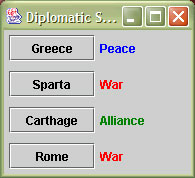
Quite frankly, I haven't much to show - it's all been behind-the-scenes dynamics up till recently, - but in the attachment you can see a sort of rough sketch of the diplomatic relations window. It is hooked up to the diplomatic model already. That's how I think it will essentially look - a little prettier as far as colors, button etc. goes, but the same general outline.
The view lists the civs with which you have established contact already, and the diplomatic status with them. Each of the Civilization names is clickable and allows to contact that civilization for diplomatic interactions (that view is next on my list - it's a little tricky, it seems, but I already have the layout on paper, and will hopefully have time this week to throw it together).
That's pretty much it... I guess I just wanted to let you all know that I am still here, but feel free to contribute more to the discussion. 
 Attachment: clash_diplo_status.jpg Attachment: clash_diplo_status.jpg
This has been downloaded 111 time(s).
|
|
| |
|
| |
All times are GMT. The time now is 05:25.
Apolyton Time is 00:25. |
top of page
|
|
|
Forum Rules:
You may not post new threads
You may not post replies
You may not post attachments
You may not edit your posts
|
HTML code is ON
vB code is ON
Smilies are ON
[IMG] code is ON
|
|
|
|
|
|






 15-01-2003 07:27


 |
|