|
| |
|

|
Gateway103
|
|
My ideas on the subject.
I think black holes should be in the game. However, with the following restrictions:
1) Black Holes are to be treated as rare "Anomalies/Specials".
2) Black holes are not to be used as a "gateway" (pun not intended). The main concern is the idea of "instant" transit across arbitrarily large distance. There can be, however, some other "phenomena" that can be used to speed up space travel.
3) Natural black holes should not be used as power source, however, artificial ones, may be used as a very late game power source.
Now further along, I'll discuss my thoughts on the treatment of "Anomalies/Specials".
a) These "Anomalies/Specials", including but not limited to black holes, can have negative or positive (or both) effects. For example, black holes presents danger in space travel, and may prevent FTL in nearby region. Yet, if you build a research station orbiting it (far enough of course), your scientists can gain some Research Bonus in relevant technology Field (e.g. Physical Science)
b) "Anomalies/Specials" encompasses things in many levels, from space anomalies like Black Holes, to sentient plants or dangerous predators on a planetary scales. Some Anomalies/Specials may be permanent (for the duration of the game), while others may disappear overtime, naturally or artificially (e.g. your citizens "pacified" a world that had some pesky native lifeforms.)
c) The frequency of the occurence of such Anomalies/Special depends on the type of Anomalies/Special (e.g. Black Holes are "rare" whereas say an "unusually rich biosphere" may be slightly more common), as well as the game settings.
d) Anomalies/Specials are mostly generated by the map generator at game start, but some may occur later as the result of "Random Events" or "Semi-Random Events"
Just some thoughts for the moment.
-Gateway103
|
|
| |
|
| |
|
|
|
targon
|
|
Dolgoprudny, Moscow region
Nov 2002
time: 08:25
|
|
"Traditional" black holes represent the last stage of evolution of really big stars (>3-5 solar mass). Thus they aren't especialy frequent event for the habitable area (like corotation zone). In fact, all suspected black holes are somewhat too distant (for eager astronomers, at least). Stars becoming a black hole surely have violent history and will sear nearby systems with constant X-ray bursts. Hence we can't find any massive black holes near planets of colonization interest. StP is empire-building game, isn't it?
On other hand, universe may be filled with so-called "relic black holes", stale remaints of the early stages of high density. Nowdays (and couple billion years in future) this black holes have mass limit of >10^15 g, as any more light already explodes. According to current estimates, this holes may have density of ~billion per parsec cubed (not sure in the exact number, may miss for couple orders). This ones may, in fact, impose some difficulties with space travel if they will act via some very special ways on your FTL (can't grok how FTL works, so can't say more). Due to really low density, this holes aren't any hazard for STL travel, IMHO.
|
|
| |
|
|
|
targon
|
|
Dolgoprudny, Moscow region
Nov 2002
time: 08:25
|
|
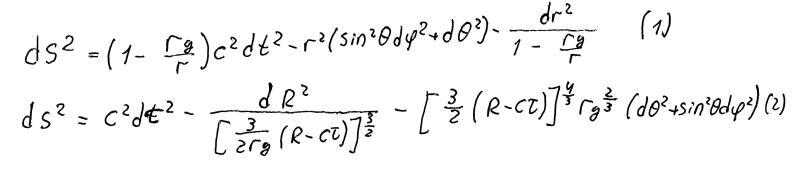
If you'll write a metric for the spherical coordinates in presense of center-symmetry mass, you may find that there is something special for r=rg (gravity radius AKA event horizon) (1). But it isn't 100% true, as if we "move" to so-called sychronized system (moving with free-falling body) you'll see nothing special around event horizon, besides that you can't escape if already there. The true singularity lies at r=0, as you can see from the (2). So even if you FTL will escape event horizon, it will be extremly unhealthy to pass thru black hole center.
BTW, I think that usage of FTL near black holes must be completerly prohibited due to possible reality breaking (like "time mashines" and other dirty things).
 Attachment: formula.jpeg Attachment: formula.jpeg
This has been downloaded 93 time(s).
Last edited by targon on 20-01-2003 at 13:43
|
|
| |
|
|
|
XarXo
|
 |
of the "I agree"
Jul 2000
time: 05:25
|
|
quote:
Originally posted by targon
"Traditional" black holes represent the last stage of evolution of really big stars (>3-5 solar mass). Thus they aren't especialy frequent event for the habitable area (like corotation zone). In fact, all suspected black holes are somewhat too distant (for eager astronomers, at least). Stars becoming a black hole surely have violent history and will sear nearby systems with constant X-ray bursts. Hence we can't find any massive black holes near planets of colonization interest. StP is empire-building game, isn't it?
On other hand, universe may be filled with so-called "relic black holes", stale remaints of the early stages of high density. Nowdays (and couple billion years in future) this black holes have mass limit of >10^15 g, as any more light already explodes. According to current estimates, this holes may have density of ~billion per parsec cubed (not sure in the exact number, may miss for couple orders). This ones may, in fact, impose some difficulties with space travel if they will act via some very special ways on your FTL (can't grok how FTL works, so can't say more). Due to really low density, this holes aren't any hazard for STL travel, IMHO. |
Sorry!! Really!! This is quite off-topic, but just is an inclusion:
Is the fact that bigger mass cases supernova not black-hole ending related to the big bang? So, is this strange explosion effect related to the strange force that makes the universe expansion and is opposed to gravity? Thanks.
Returning to topic.
|
|
| |
|
|
|
targon
|
|
Dolgoprudny, Moscow region
Nov 2002
time: 08:25
|
|
quote:
Originally posted by skywalker
*brain overloads* |
Sorry, but I think that thread named "Black Holes..." would be bad without these formula. In fact, they are black holes (non-rotating, not charged kinds, at least). And if you'll look at the last term of (1) you could see why you can't reach that darned event horizon, BTW. Again, sorry for may be too technical point of view, if it scares you.
|
|
| |
|
|
|
targon
|
|
Dolgoprudny, Moscow region
Nov 2002
time: 08:25
|
|
XarXo,
This strange force is nothing but inertia. Universe got its butt kicked ~16 billions years ago and still running. If your question is about the reasons for such a Big Kick, I can't say you anything: this moment is shadowed by phenomena unkonwn to our science, as it encompasses quantum gravity effects. We can't grok them. But this phenomena are completely absent in modern Universe, IMHO. Even supernova explosions are nothing compared with the Big Bang.
|
|
| |
|
|
|
targon
|
|
Dolgoprudny, Moscow region
Nov 2002
time: 08:25
|
|
Not such a bad. Gravity radius for sun is ~3 km. So you need squize it really hard in order to make it a black hole.
|
|
| |
|
|
|
targon
|
|
Dolgoprudny, Moscow region
Nov 2002
time: 08:25
|
|
I can't agree with you in all your terms other than "young universe". If "young" == "long before death", you're right, IMHO.
But Universe expands not in terms like explostion expansion or any other "commonsence" thing. You see, there isn't any "empty space" for the universe to expand. There isn't anything besides Universe, at least universe can't act on any outside things (in any other case we would see it as flaws in conservation laws). So any forces in the Universe can't do anything with its forms, simply because there isn't any point to exert this forces on.
The only thing that does counts is mass distribution. Local space/time curvature tensor depends only on local energy/momentum tensor. So less dense universe == more flat, larger universe. Hence the Red Shift.
|
|
| |
|
|
|
targon
|
|
Dolgoprudny, Moscow region
Nov 2002
time: 08:25
|
|
Does all this mean that you think Universe has some real 3D "frontier" surface, expanding into something?
|
|
| |
|
|
|
targon
|
|
Dolgoprudny, Moscow region
Nov 2002
time: 08:25
|
|
OK, my vote is "Yes" for black holes: they may be neat story-making device; but don't mess up physics, please.
|
|
| |
|
|
|
Leland
|
|
How about the storyline angle? I was under the impression that the presence of habitable solar systems in close proximity to each other is already stretching the probabilities a little bit, but how do you explain the presence of black holes? Naturally occuring, or a part of fiendish Tal'Shian schemes?
|
|
| |
All times are GMT. The time now is 05:25.
Apolyton Time is 00:25. |
top of page
|
|
|
Forum Rules:
You may not post new threads
You may not post replies
You may not post attachments
You may not edit your posts
|
HTML code is ON
vB code is ON
Smilies are ON
[IMG] code is ON
|
|
|
|
|
|






 17-01-2003 06:35


 |
|