|
| |
|

|
Bereta_Eder
|
|
Maybe I'll keep this up for every Sunday 
The governments of the Balkan countries (with the exception of Bulgaria) proceeded in the period 1933-34 in preliminary talks in order to probe into the possibiliy of their joint-action in a multilateral inter-Balkan agreement.
As basic claim of these acts, the transgression of partial local disputes and the integration of the countries of the penisnsula in a whole was considered. It must be noted that the attitude of the Great Powers towards these activities ranged from absolutely positive (France) to negative (Soviet Union). The initiative for such an understanding belonged to the Greek politician Alexandros Papanastasiou, who had introduced the idea of a federal authority in the Balkan area already since 1929.
This inter-Balkan communication, implemented through four conferences, crystallized in the Balkan Understanding Pact of 9 February 1934, among Romania, Yugoslavia, Turkey and Greece. In its partial articles the desire to secure peace in the Balkans, the maintainance of territorial status and the respect to the principles of international law were stressed. The agreement had a two-year effect with the capacity for renewal.
Nevertheless, the reaction of the "revisionist" Powers (Germany, Italy) but of England as well in the conclusion of agreements of local importance and the gradual polarisation in the field of international relations of the countries of central Europe, undermined the effect of the agreement. The attitude of the leader of the opposition Eleftherios Venizelos, who opposed the general spirit of the agreement, considering that the country was risking becoming involved in wider international conflicts was typical of the Greek political scene of the time.
In the years 1934-39, the disintegration of the status of peace and the deterioration of the international crisis put to the test the system of intra-Balkan guarantees and finally led to an impasse. This, besides, was stressed by the alignment of the Balkan countries with different camps at the outbreak of the Second World War.
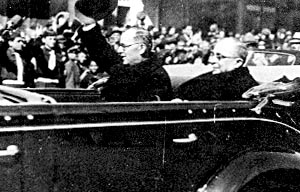
The Greek and Turkish leaders at the signing of the Balkan Friendship Pact.
|
|
| |
|
|
|
Bereta_Eder
|
|
ooops
 Attachment: cth_07.jpg Attachment: cth_07.jpg
This has been downloaded 103 time(s).
|
|
| |
|
|
|
VetLegion
|
|
There is a river a few hundred meters from where I live. For thousands of years the river keeps flowing from higher point (the Alps) to lower point (Danube). Name of the river is Sava and there are songs about her.
Change your nickname will you? May I suggest Potomac or Mississipi?
|
|
| |
|
|
|
VetLegion
|
|
Missouri? Rio Grande?
You dont want to be carry same name as a river in Croatia, do you?
Ok, seriousely. You can't change your name. But you can improve your education. Work on it, and it will show. When you write less mindless propaganda and more facts you will also earn respect.
I can't promise there will be songs about you though.
|
|
| |
|
|
|
VetLegion
|
|
quote:
There hasn't been trouble in the Balkans for some three years now! For your tireless efforts in world peace Greece is awarded a cookie. Way to go Greece! |
In all fairness, Greece has nothing to do with peace in the Balkans. Actually they obstructed it more then once.
|
|
| |
|
|
|
Bereta_Eder
|
|
Well may be it wasn't noticed that there was talk about a Balkan Confederacy.
A while ago me and Mihai from Roumania were discussing about when this idea was first thought etc so I found this text which talks exactly about that.
|
|
| |
|
| |
All times are GMT. The time now is 05:25.
Apolyton Time is 00:25. |
top of page
|
| archivepost |
|
Forum Rules:
You may not post new threads
You may not post replies
You may not post attachments
You may not edit your posts
|
HTML code is ON
vB code is ON
Smilies are ON
[IMG] code is ON
|
|
|
|
|
|






 03-02-2003 23:28


 |
|