|
| |
|

|
Catt
|
 |
California - SF Bay Area
May 2002
time: 21:25
|
|
Part 4 of 11
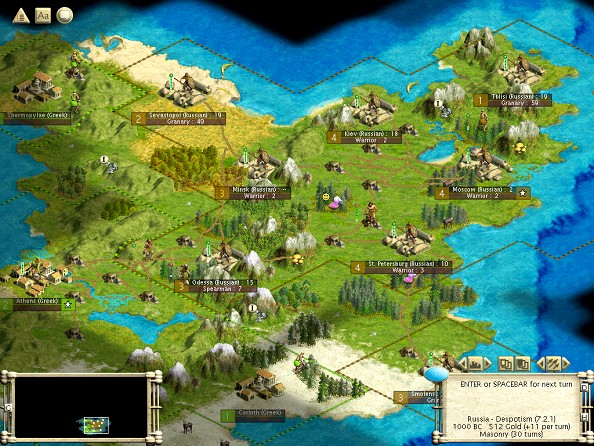
In 825 BC, Russia declared war and moved its forces against Greece. An army of 10 swordsman took Athens the following turn. Corinth was destroyed a few turns later. Casualties were moderate, and after forces healed in Athens (and additional reinforcements arrived) a sizeable force of eight or so swordsmen took Sparta. Greece was reduced to Thermopylae in the far west, which, due to poor city planning by Alexander, was destined to remain no larger than size 2 for centuries. Catherine thirsted for the spoils of war and offered peace to Alexander – but at a cost of all of the remaining Greek treasury, all known Greek technologies, and the lone remaining Greek worker. Alexander complied. The spoils of war included the technologies The Wheel, Warrior Code, Ceremonial Burial, and Writing.
A review of Alexander’s possessions immediately following the peace treaty showed an additional technology not shared with Russia. And the poorly placed Thermopylae blocked access to two building sites that Catherine’s engineers had identified for Russian cities. Finally, although Russia’s actions up to this point were honorable, Catherine’s advisors pressed upon her the dismal view other nations might cast on Russia if her ruthless subjugation of Greece were to become known to the wider world. Catherine weighed the options, and then acceded to her advisors’ insistence that the Greeks be utterly destroyed, and that their destruction should come immediately, before others in the world learned of Russia’s violent past – her advisors spoke of the “Arrian Deception” and extolled its virtues. Several swordsmen assembled in Sevastopol. When the attack was ready, Catherine’s emissary purchased a forgotten technology for a large sum of gold. And then Russia attacked, only a half-dozen turns after making a binding peace agreement with the Greeks. Thermopylae was taken and razed to the ground, and Russia’s gold was returned to her treasury.
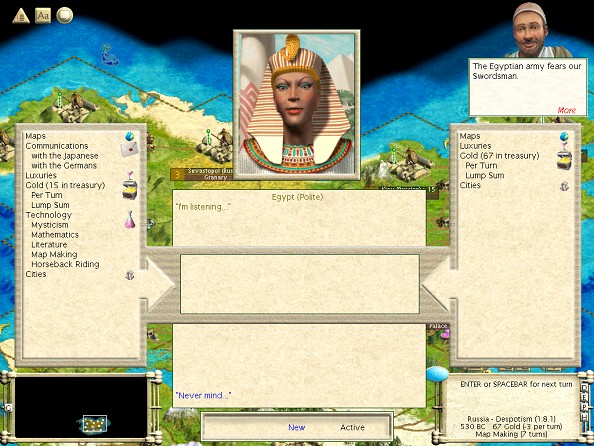
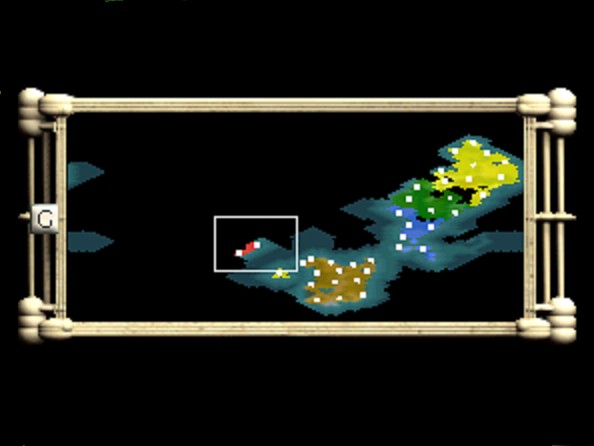
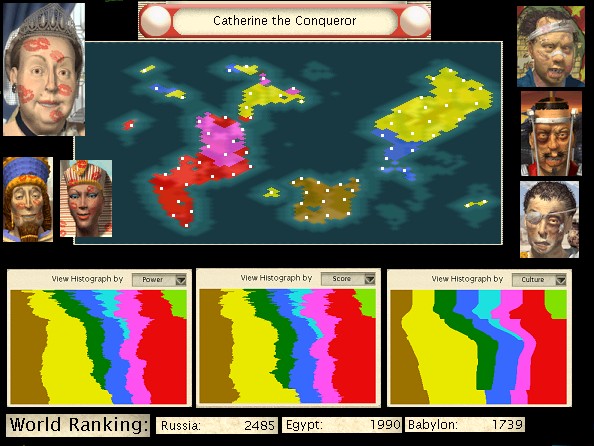
With the whole of the motherland controlled by Catherine, our Russian engineers set about on a construction and scientific binge, setting aside their focus on building barracks and training soldiers. Map Making was researched at a deficit and St. Petersburg was set as a resource (shield) holding pen for an eventual switch to the Great Lighthouse. Catherine envisioned a mad dash to Map Making, construction of the GL, and contact with the outside world. But in 530 BC an Egyptian galley appeared off the coast north of Moscow. Catherine was dismayed to learn of Russia’s technological backwardness. Russia could only purchase the final bit of research needed for Map Making – but had nothing more to offer in exchange for additional Egyptian knowledge or contact with other civilizations.
 Attachment: 530 bc - tech race at first contact.jpg Attachment: 530 bc - tech race at first contact.jpg
This has been downloaded 223 time(s).
|
|
| |
|
|
|
Catt
|
|
California - SF Bay Area
May 2002
time: 21:25
|
|
Part 5 of 11
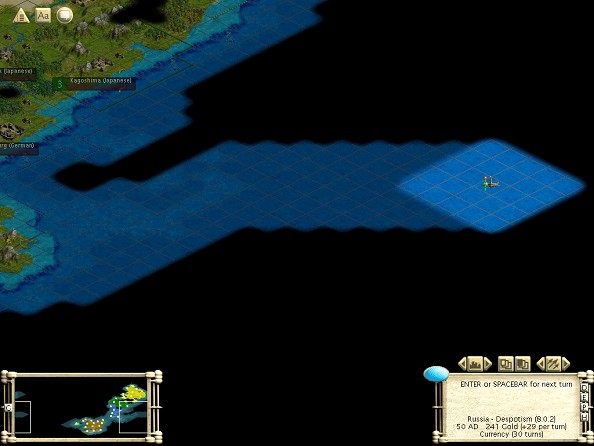
With the discovery of Map Making, Moscow immediately began producing galleys. Athens too switched its production to galleys. As the first Russian galleys left port, a Japanese galley also appeared to the north. Soon Russian galleys had found the Germans to our north. In a series of trades, Catherine traded her territory map for the others’ and enjoyed a view of the larger world. But Russia remained backward. The motherland simply was not fertile or productive enough to allow Russia to compete on the world stage. Regrettably, Catherine informed her scientists that native Russian research was unlikely until at least the construction of numerous universities – hundreds of years away. All efforts and all income would go to the treasury so that Catherine might purchase technologies from one of the three “great powers” to the north.
Odessa eventually completed the Forbidden Palace in circa 300 BC, having narrowly averted building a granary before the FP was an available project and having narrowly avoided chopping nearby forests which would have “poisoned” the accumulated shields for an FP build. Even with the FP built construction was meager – coastal cities were adept at producing income once a harbor was in place, but poor in natural resources – each building project took ages. Russian laborers selectively chopped forests for timber, but without the ability to replant forests the resource was extremely scarce. Russian laborers also constructed the irrigation system that made the western territories more valuable. Cities built harbors. After harbors came marketplaces for tax income, unless expanding borders would bring fish, whales, or land-based bonuses within city range, in which case libraries would be built. Next came (generally) the marketplace or library that hadn’t been built as item two, and finally came aqueducts.
Catherine’s hopes for completion of the Great Lighthouse were dashed when such wonder was built by the Egyptians some 20+ turns before Russia’s expected completion date. Dozens of shields were wasted when St. Petersburg was forced to alter its building plans and construct a harbor.
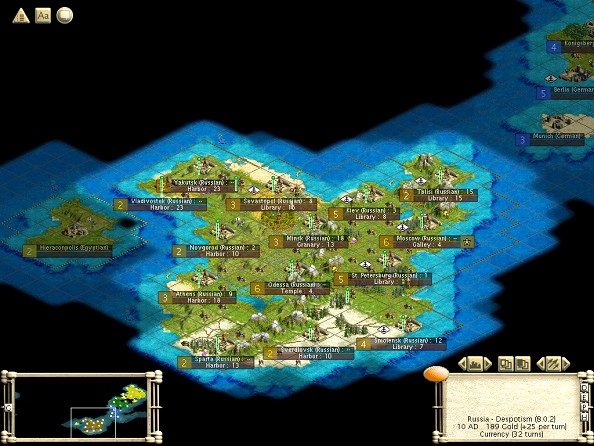
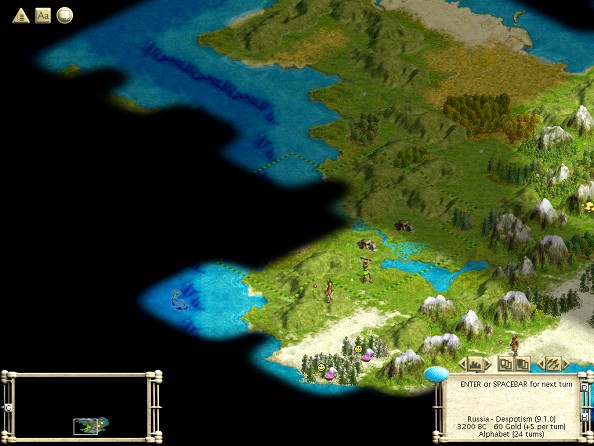
At 10 AD Russia was a backwards, isolated country. The faraway Egyptians had even succeeded, years before, at settling a small island to Russia’s east before even the first Russian galley was completed.
Attachment: 10 ad - state of the world.jpg
This has been downloaded 223 time(s).
|
|
| |
|
|
|
Catt
|
|
California - SF Bay Area
May 2002
time: 21:25
|
|
Part 8 of 11
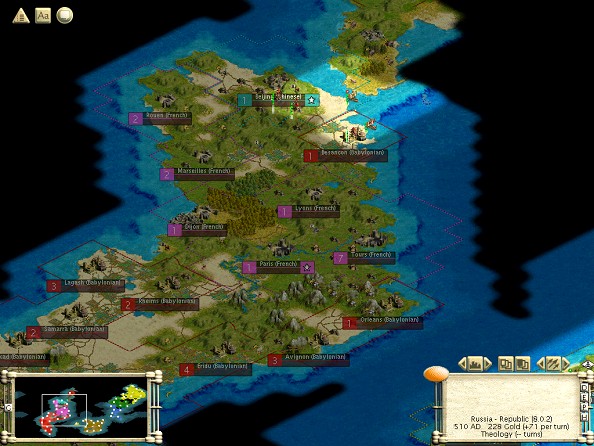
We discovered that the new lands were populated by the Babylonians, the French, and the Chinese, although the Chinese had been reduced to one city and were at war with Babylon. Babylon also appeared to be at war with France, and seemed to be getting the better of Joan’s armies.
Unlike the northern powers, the eastern powers were technologically closer to Russia’s stature than to the others. A few mutually profitable trades of technology were made – we offering Literature for Polytheism and Mathematics (IIRC), but Catherine could already see that, simply based on available terrain, the eastern powers (at least Babylon) would soon surpass Russia’s power, even whilst fighting a long war.
Just before Beijing fell, Catherine traded Literature to Mao for the Chinese world map.
Attachment: 510 ad - world map.jpg
This has been downloaded 213 time(s).
|
|
| |
|
|
|
Catt
|
|
California - SF Bay Area
May 2002
time: 21:25
|
|
Part 9 of 11
Catherine, and all of Russia, faced an important decision regarding the future of the Russian empire: should an assault east or north be made in an effort to acquire more (and better) land? or should Russia seek to be a peaceful trader? Catherine elected to be a peaceful trader. War, and conquest, could come later if necessary. The northern powers were far, far ahead of Russia scientifically; the eastern powers were at rough parity, but had been engaged in warfare for quite some time – the Babylonian military would surely far exceed Russia’s modest force – especially after accounting for expected galley losses in the eastern straits.
But more importantly, Catherine believed that, given time, the plentiful coastal waters of the motherland, combined with both the inexpensive institutions of Russian learning and the abilities of Catherine to effectively trade with other nations, convinced her to bet Russia’s future on securing the technological know how to enable Russia to lead the world, and to fight and win an economic war with Russia’s competitors – the strength of Russia’s economy and its university system would dominate the world, rather than any show of Russian force. One lone scientist toiled away, while all city income was directed to the treasury.
As soon as the enabling knowledge was purchased, Catherine lead the formation of a Russian Republic. Income grew quite nicely.
A look at the history of the world and the standings of the various civilizations showed that Russia was a cultural dwarf, but that, due to the largish size of the empire, Russia was not perceived as powerless. Egypt had become a dominant civilization. The Egyptians pushed south, taking some lands from the Japanese, and had been a phenomenal builder of great wonders. Thebes alone contained the Oracle, the Great Library, and Sistine Chapel – it would later build Leonardo’s Workshop as well. Other Egyptian cities would build the Hanging Gardens, the Great Lighthouse, Sun Tzu’s Art of War, JS Bach’s Cathedral, and Shakespeare’s Theatre. The Egyptians seemed to maintain a two or three tech lead over her neighbors, and a larger lead over Russia and the east. In 630 AD Catherine established an embassy in Thebes – with hardly a temple to Russia’s name, and only a smattering of Russian libraries, Catherine was dismayed to see Thebes had already built a cathedral, a university, and even a coliseum, in addition to the great wonders. Thebes would have to be watched closely to prevent a cultural win.
The Egyptian Great Lighthouse enabled trade between Egypt and Russia -- Catherine traded dyes to Egypt in exchange for wines. The Egyptians and Russians enjoyed cordial relations. We generally acquired technology from either Japan or Germany in an effort to help prop up those civilizations with large sums of cash against the bulwark of a very strong Egypt.
The northern powers would happily accept gold-per-turn from Russia in exchange for technology – the Arrian Deception seemed to have been an unqualified success. Even though Russia could buy technology on a per-turn basis, we didn’t. Catherine’s plans for technological leadership demanded that, at a moment’s notice, with a sufficient university system in place, the Russian budget could be turned full force into scientific research – a sprint forward in technology, with the commensurate new ability to sell such technology to others for a handsome profit, required that Russia not be beholden to streams of outgoing payments for past technology purchases. And Catherine, despite the secret pleasure of betrayal that had come with Greece’s destruction, would guard her reputation for honesty and fair-dealing jealously – sages warned that a diplomatic victory might be necessary at some point in the future, and that destroying such a possibility was too risky a proposition.
Egypt, before the discovery of Astronomy, once demanded contact with the Babylonians. Catherine held her breath and declined – contact with the eastern powers was Russia’s sole advantage. Cleopatra was disappointed, but did not anger. Babylon also demanded contact with the north, but Catherine more easily declined – after all, Babylon had absolutely no method of landing troops in Russian territory. Too soon for Catherine’s tastes, we learned that Egypt had begun construction of Copernicus’ Observatory. Soon an Egyptian caravel passed east along Russia’s northern shore. Russian galleys watched the caravel as it paused at sea, within striking distance of Babylon’s shores. The time had come. Catherine engaged in a massive round of trading Russia’s precious contacts and maps amongst the northern and eastern powers, and Russia acquired a large number of new and interesting technologies. But Russia was not, by any means, in a position of leadership. Collecting tax receipts of approximately 150 gold per turn enabled an effective 5 -7 turn research rate, since middle ages technologies seemed to be commonly available at between 700 and 1,000 gold. But large sums of cash were also deployed to rush universities in Russia’s largest and least corrupt cities. By this time, all of the motherland had been roaded and most tiles improved – gangs of workers were systematically planting and chopping forests to speed city construction projects, particularly in southern Russia.
Russia had also started accumulating shields towards the construction of Adam Smith’s Trading House, in an effort to alleviate the pain of the maintenance obligations of all her harbors and marketplaces (and future banks, stock exchanges and commercial docks). We were able to purchase Banking from Egypt when only one other civilization possessed the knowledge; and subsequent sales of Banking to others, often for other technologies bypassed by Russia, brought Russia to within striking distance of technological parity.
It seemed quite possible that Catherine would reach tech parity in plenty of time to have a chance to construct Newton’s University, and a pre-build was started. Newton’s University, if built, would trigger a Golden Age for Russia (with our possession of Colossus), and would almost surely result in Russia assuming a leadership position. All efforts would be devoted to securing Newton’ University – and to do so, Catherine activated Russian domestic research full steam and directed her efforts towards Economics. Catherine intended to secure Econ, sell it for tech parity with others, and still be able to construct Adam Smith’s before others due to her foresight in storing shields for just such a purpose. Not only would Econ offer tech parity, it would also offer Smith’s. Estimates of research completion were 8 turns – disappointing, but within reach. But two turns shy of Economics, Russian estimates of research time dropped precipitously – as feared, both Egypt and Babylon had just learned the secrets of Economics.
All of Russia felt this a strong blow against our dreams of technological superiority. Nonetheless, Catherine aggressively traded Economics to the lesser nations in exchange for “southern tier” techs which Russia had skipped. With the acquisition of Physics, Catherine could see that only Egypt and Babylon were ahead in the tech race, both with Metallurgy. And then fortune smiled on Russia once again; for Egypt and Babylon went to war with each other. Catherine hoped that each would research Military Tradition (for cavalry) and that each would slow its research rate during the war. But fortune can also frown; Babylon succeeded in building Adam Smith’s Trading Company just before the war – Russia’s efforts were still a dozen turns away. Catherine was forced, on that very same turn, to purchase Navigation at an outrageous price, else lose all the shields accumulated toward Smith’s. The next turn St. Petersburg built Magellan’s Voyage, with an excess of wasted shields. Other civilizations were not so lucky, as Magellan’s broke the wonder cascade and hundreds of shields around the world were undoubtedly wasted.
Much to Catherine’s pleasure, Russia succeeded in being the first to secure the Theory of Gravity, and the Russian completion of Newton’s was only a dozen or so turns away. Confident that the wonder cascade had been broken, and only mildly worried about a leader-induced rush build by others, Russia succeeded in selling ToG to Babylon for a large cash payment and large gpt payments, and then to Egypt for Metallurgy. Catherine intended to slow the Babylonian research engine by taking all available Babylonian gpt – since Babylon was a scientific civilization, it would acquire a free tech soon, and Catherine very much wanted to be the first to enter the Industrial Age and the only empire with a large income to devote to the scientific research once there. Magnetism was researched in 6 turns, and we were launched into the Industrial age.
And then an incredible thing happened – Catherine’s science advisor advised her to research Nationalism. What? In looking over our research options, we learned that our scientists had somehow gained knowledge of Steam Power! What an incredible stroke of good luck! Such luck is rivaled in Russian history only by the famous settler of 3650 BC.
When, a few turns later, Egypt, Babylon and Germany (!) entered the Industrial Age, Catherine was able to make the following trades: Steam to Germany for 235 gold and 195 gpt (!); Steam, 250 gold, and 83 gpt to Babylon for Nationalism; Steam to Egypt for Democracy, Music Theory, World Map, Saltpeter, a luxury and Egypt’s last gold piece.
Catherine then immediately overthrew the Russian Republic in order to institute a Russian Democracy. Why? The AU mod makes corruption much more problematic in a Republic compared to a Democracy; we wanted the free unit support that comes with Democracy under the AU Mod; we wanted the worker speed increase; we figured that, with reduced corruption and a looming Golden Age, even a revolt wouldn’t cost Russia her technology lead; and with the Golden Age and an intelligent workforce RR’ding, we could almost certainly secure Universal Suffrage – that, plus police stations, and our intention to play entirely peacefully (but all the while maintaining a sufficient standing army necessary to defend the homeland), convinced us that Russia needn’t worry about potential war weariness in the future.
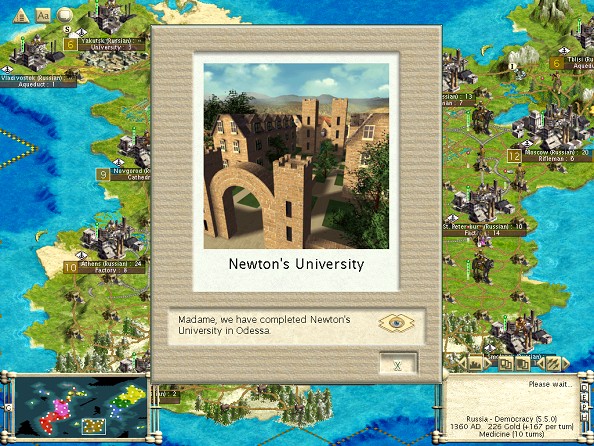
Three turns into the anarchy, Catherine traded Steam Power to Japan for Military Tradition, Monarchy, Free Artistry and 1 gpt. Three turns later, the Russian democracy was born. And a few turns later, in 1360 AD, we completed Newton’s University, triggering our Russian Golden Age.
(I turned down the research rate in the attached screenshot just before the end of the previous turn (and just after having completed research on Industrialization) out of fear that the GA triggered by the Newton’s build would cause me to spend beyond the 4 turn minimum – on reflection, science is accumulated before production, so I needn’t have worried about a GA over-spend).
Attachment: 1360 ad - ga fired.jpg
This has been downloaded 212 time(s).
|
|
| |
|
|
|
Catt
|
|
California - SF Bay Area
May 2002
time: 21:25
|
|
Part 10 of 11
The Russian Golden Age did everything Catherine had hoped. Our research rate dropped to 4 or 5 turns with a healthy surplus. We easily built Universal Suffrage, Longevity, and Theory of Evolution. We sold technologies for huge sums, attempting to stifle competitor science spending. We eventually built Hoover’s Dam in Athens. After the GA our research rate stayed steady at 6 or 7 turns with large surpluses; much excess income was used to rush city improvements whenever available.
During this period, Catherine was a bit befuddled by Germany. Very small but well developed, Germany was consistently able to pay hundreds of gpt for technology. Since Egypt was perpetually broke at this point, Catherine concluded that Germany had exploited its scientific trait to sell Egypt Nationalism for huge gpt, and then managed to renew the deal after 20 turns, this time for communism. So Egyptian gold was routed through Germany to Russia – Catherine had never heard of an AI civ brokering technology quite so effectively – but decided to eliminate the middle man by purposefully giving Egypt a sweetheart deal that prevented Germany from having any technology unknown to the Egyptians when the 20 turns of payments were up. Sure enough, somewhere along the Industrial Corridor, Egypt’s income increased nicely (and was subsequently transferred to the Russian treasury), and Germany started to fall backwards in the technology race.
The whole of the remainder of the Industrial Age was (1) research; (2) renewed tech deals every 20 turns for massive gpt per technology (always two or three technologies behind Russia’s leadership position); and (3) rush-bought city improvements such as stock exchanges, factories and commercial docks in the very fringe cities of the motherland (even if pure hard-headed calculation indicated that rush buying wasn’t particularly optimal play strategy). Eventually Russia raced into the Modern Age three to four technologies ahead of all others (we got Rocketry, as expected).
Odessa built the UN in 1766 AD. But due to the confluence of events, we declined to hold a UN vote. Our reputation was sterling. We had not fought a war (not once!) since destroying the Greeks in circa 500 BC. We had active trade deals with all civs except for France (who had nothing to offer). We were importing 7 luxuries from Germany, Egypt and Babylon, in each case paying cash and/or a luxury of our own. We had RoPs in place with all civs. In fact, since the time when our old pikeman force was sequentially disbanded in favor of new infantry, we had always, always, had RoPs in place with every civ and had active trade deals (importing luxuries and exporting luxuries and technologies). There were five civilizations left (including us) – the Japanese having been eliminated by the Egyptians in the Industrial Age. Every single civilization was either Gracious or Polite with us (most gracious). But just about a half-dozen turns before we built the UN, Babylon invaded France, triggering a Franco-German MPP. Without the inducement of a military alliance or an MPP, Egypt declared war against Babylon four turns later. So, when the UN was built, everyone was on great terms with Russia, but Egypt, Germany, and France were fighting a common foe (though not allied).
We couldn’t tell who would stand for a vote. After looking over the world map for a long time, we decided that either both Babylon and Egypt would stand alongside Russia as candidates, or only Russia and Egypt would vie for election – in any event, we felt pretty certain that Cleopatra would be a candidate. In either case, with only a majority of three needed to win the vote, Catherine decided that the risks were too high – despite Russia’s spotless history (at least, our known history  ) and sterling reputation, a Franco-German vote for Egypt was certainly possible. Even absent alliances, civilizations tend to vote for enemies of their enemy – I had learned this the hard way (very hard way) some time ago, when acting as advisor and historian to another empire in similar circumstances as Russia now found herself. When the UN vote was offered again in 1788, we again declined – the war still raged although the French had made peace. In 1810 AD, Egypt was MPP’d with both France and Germany. By now, Russia was once again three or four technologies ahead of our competitors in the modern age, having built all of the wonders (except the Manhattan Project, by choice) and was on our way to an easy spaceship win. But the spaceship win, in the AU Mod, takes a long time – and I didn’t want to wait (it was 11:00 pm on Sunday night and I wanted to finish the game!). ) and sterling reputation, a Franco-German vote for Egypt was certainly possible. Even absent alliances, civilizations tend to vote for enemies of their enemy – I had learned this the hard way (very hard way) some time ago, when acting as advisor and historian to another empire in similar circumstances as Russia now found herself. When the UN vote was offered again in 1788, we again declined – the war still raged although the French had made peace. In 1810 AD, Egypt was MPP’d with both France and Germany. By now, Russia was once again three or four technologies ahead of our competitors in the modern age, having built all of the wonders (except the Manhattan Project, by choice) and was on our way to an easy spaceship win. But the spaceship win, in the AU Mod, takes a long time – and I didn’t want to wait (it was 11:00 pm on Sunday night and I wanted to finish the game!).
Catherine doesn’t approve of the “dirty trick” of MPP’ing and declaring war in order to secure a UN vote, but she is amenable to allowing nature to take its course. Sometime around 1814 AD or so Russia entered into its first ever alliance of a military nature, offering MPPs to both Germany and France, both of which were accepted. While Catherine would provoke no action, she wouldn’t have been too upset to find Russia dragged into a war and in an MPP with the two smallest of the other four empires when the next UN vote was proffered.
Circa 1820 AD, backed by the might of both Russia and Germany, Joan of Arc rashly declared war on Babylon. Russia and Germany were dragged into the war – we lost one battleship from our extended pickets before pulling back closer to our home shores, and sank two Babylonian battleships that strayed within cruise missile range, but otherwise took no action. In 1832 AD, the nations of the world were asked to vote for a leader – the candidates would be Cleopatra and Catherine.
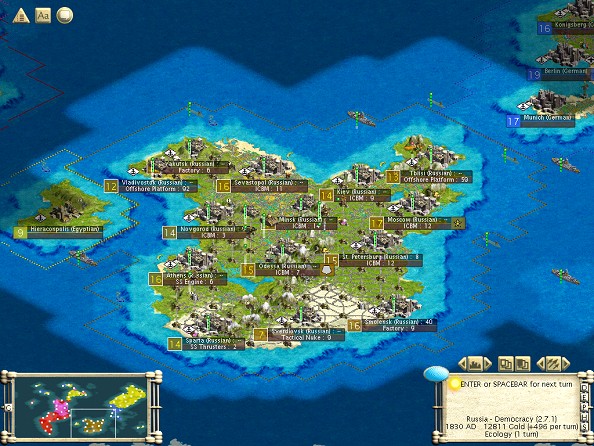
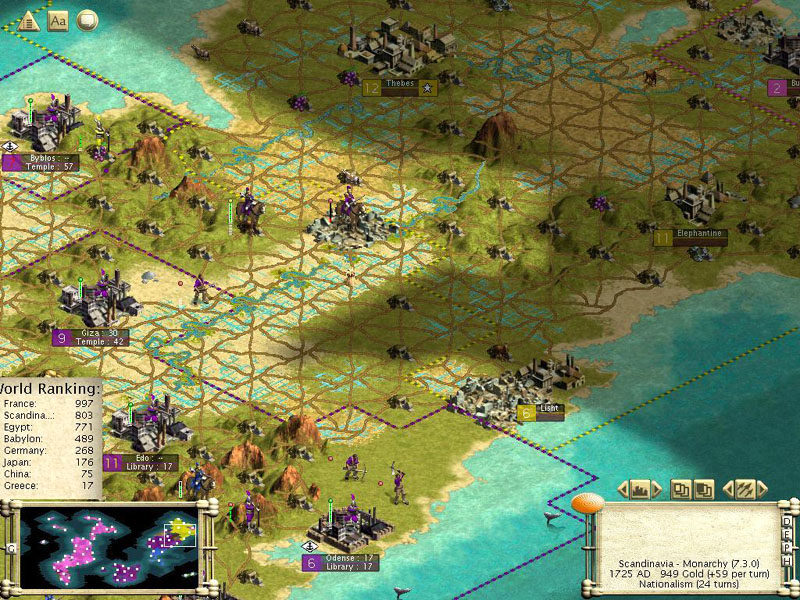
Here is a look at the Russian empire (and the world minimap) in 1830 AD – the UN vote will happen the next turn.
Attachment: 1830 ad - empire at vote.jpg
This has been downloaded 215 time(s).
|
|
| |
|
|
|
Dominae
|
|
Fosse, maybe you chose the PTW 1.14 standard game instead of the AU mod 1.16 version. I just double-checked the latter file and I did remember to import the AU mod rules (phew!).
Catt: holy crap that's a long AAR (sorry for the blasphemy)! I'm going to sit down with my (early) supper right now and read it all at once. Wish me luck!
Dominae
|
|
| |
|
|
|
Fosse
|
|
U.S.A.
Mar 2002
time: 23:25
|
|
Dominae... oops... i thought AU file was ONLY AU 1.16... and that the PTW 1.14 meant "the class, with AU rule changes, for PTW 1.14."
Consider me embarassed.
I'll try to play another game soon, if I get the chance.
|
|
| |
|
|
|
BRC
|
|
Catt: Wow! That was an amazing AAR. It was also nice to see that you could win the game, even with your small amount of land, without fighting. You were able to make the most of your traits, which were not fabolously suited for this game. Good work! It was a well spent half hour of reading.
|
|
| |
|
|
|
DeepO

|
 |
supporting Candle'Bre
Jan 2002
time: 06:25
|
|
quote:
Originally posted by Catt
Upon contacting Alexander, we were regrettably informed that an offer of all our accumulated gold and plus Pottery would be insufficient trade to acquire the Alphabet. We exited talks without making a trade, but intended to try again in the very near future, when our research had progressed further and our treasury grew. |
Catt, that was to be expected. Let's say Alphabet costed 200 beakers to research, you had researched it for 9 turns at 1 beaker/turn. If so, you only decreased the cost of the tech by 9 beakers, which would be hardly noticable. Sure, you might have been nearly 25% done, but for the Greeks, that doesn't mean the tech cost got down 25%, instead it got down 5% because of the collected beakers.
40-turn researching is only good when you're sure that you won't be able to trade it beforehand, if so, you're better of setting 0% research.
Terrific AAR, BTW, and I'm only in the second part 
DeepO
|
|
| |
|
|
|
Dominae
|
|
Very nice game Catt, and even better AAR! Your report should be a "Must Read" here on 'Poly. I'm serious. Very few people put down precisely what is going through their mind in a particular game, and surprisingly in your case it is both informative and entertaining.
Some specific points:
1. I must say you got lucky with Steam Power! I'm still waiting for this to get fixed...You may have seen the poll I posted for this game (who got which civ). Enough people are getting Russians and Koreans on their first try to achieve statistical significance. Maybe something similar to the "list" problem for free techs is at work here? Or maybe it has to do with the set AI civs?
2. The screenshot in Part 6 is just wrong (go back and check it out...and try not to blame me for seeing it first!).
3. You consistently refused to use "dirty tricks". I agree with you on the "MPP to win UN votes" one. But the others I probably would have used, especially the "sacrifice a unit to a UU to blow their GA" trick. People do that all the time in MP.
4. How many Galleys did you lose crossing the ocean?
5. How do you like Cossacks? 
Again, great write-up.
Dominae
Last edited by Dominae on 12-02-2003 at 03:32
|
|
| |
|
|
|
Catt
|
|
California - SF Bay Area
May 2002
time: 21:25
|
|
Additional Game Notes
This was a fun game for me. As I said in trying to get AU 204 started, I happen to enjoy the random civ / random map setting experience -- it makes the early game very interesting for me and also tends to force me into more of a role-playing experience that I enjoy.
That being said, I think this was one of those random games where map features, much more so than civ traits, determine the course of the game. Civ traits definitely played a large role (and I'll explain below), but to my mind's eye, once it became clear that I shared a smallish, somewhat bleak landmass with the Greeks, whatever civ I had been playing I almost surely would have gone the early swordsman conquest route. With the Greeks subdued, the intersting question was (1) prepare to invade or (2) sit tight and trade. So, some points / learnings that I couldn't really weave into my long AAR / story.
* How did expansionist help? Obviously in popping huts -- including the settler in 3650 BC. The trait also allowed me to quickly get my arms around the situation. Without knowledge that we truly were isolated with Greece (and for the longest time I actually though that Athens sat on a chokepoint of a landbridge west -- I could just see land from the northwesternmost portion of our island -- it was the little island but I couldn'tt see that at the time -- and until my scout moved right outside the Athens, I felt it was likely that Athens was on a narrows to a far larger landmass), I might very well have decided to research MM or Literature for the GL instead of IW -- that would have set conquest back a long ways, and would have prevented employing the Arrian Deception.
* How did Scientific help? Coastal cities can really be research powerhouses, but it takes a godawful long time to build universities -- not when you're scientific and have a worker core for planting and clearing forests, though. Between forestry operations and rush-buying, I bet I had 8 or 9 universities up and running only 12 or 15 turns after buying Education. I planted and cleared and replanted forests on every tundra tile, and some of the grassland tiles (I then went back and cleared forest on tundra after RR's just because pollution takes longer to clear from forest vs. mine).
* Someone mentioned in the spoilers that this map reminded them of the "Son of so very cold . . ." AU game awhile back, and I agree with this sentiment. In that game, I (like everyone else) fought my way off that rock to secure some decent terrain -- but that was with the Romans. In this game, I expected I might need to get off our island, and was somewhat preparing to do so -- my FP placement in the center of the island anticipated a leader-powered Palace relocation in the future. But with the scientific Russians, I decided to play it out and see if I could grab and keep a tech lead after universities were up -- I would have played differently if I had drawn the Koreans as my "random" civ.
* I misjudged my potential tech advancement -- I built libraries earlier than they could possibly be needed, mainly because (1) I hoped to suicide-gallley my way to a quick run up the tech tree to Education, and (2) I wasn't building any temples, and felt I needed some culture. It wasn't huge, but I definitely paid several hundred gold in library maintenence costs that I could have avoided.
* A very interesting trading mishap occurred -- but I don't have the saves to replicate it. Sometime late Saturday night (I was up late with a sick kid after having gone to bed earlier) I rebooted the game and played several turns before noticing that I wasn't trading dyes to Egypt for wines. Egypt had declared war against Japan sometime before I had previously turned off the game - severing our trade route through Japanese coastal and sea routes. When the war concluded, I was again able to trade dyes for wines, and could even buy an asset (tech or map) for gpt or my luxury -- in other words, the severing of our trade route apparently didn't cause a rep hit to me. Unfortunately the only previous save I had was from something like 25 turns prior. I couldn't remember clearly and with absolute certainty if I had actually let the previous deal lapse somehow, but I felt pretty sure I hadn't -- the entire game I was making sure to automatically renew all trade deals, every time (and I play with "always renegotiate" on). When I went back and reloaded the earlier save after I finished the game, and I set all my units on fortify and clicked through turns waiting to see if events unfolded in the same vein, Egypt didn't go to war with Japan, so I couldn't verify the broken deal. In any event, it got me to thinking that none of us really knows all the ins-and-outs of reputation and how and to what extent damage is done. Final lesson on this point - it was awfully risky to enter into a trade deal with Egypt before Navigation / Magnetism -- I was risking my reputation on something I absolutely couldn't control, and all for one measly luxury.
* This is the second AU game in a row where I thought I could easily build Smith's and failed miserably. I need to get a better handle on both pre-builds and AI tech paths, particularly under AU Mod rules.
* The map, combined with the AU Mod, convinced me to switch to a Democracy! even though I was not religious and was already a Republic. I wouldn't have done that in a standard game. Anarchy lengths -- 7 turns and 6 turns, respectively.
* After the game, I reloaded to a turn a few turns before I completed the UN, and replayed it from there -- even then, Babylon didn't get to be a candidate (Hammmy controlled more land on the continent north of France at the time, and so was more of a counterweight to Egypt) -- in a two-way race with Egypt I would have lost the vote 3-2! I lost a game like this not too long ago under PTW standard rules, and internalized that even absent MAs or MPPs, AI civs tend to vote for their enemy's enemy.
quote:
Originally posted by DeepO
Catt, that was to be expected. Let's say Alphabet costed 200 beakers to research, you had researched it for 9 turns at 1 beaker/turn. If so, you only decreased the cost of the tech by 9 beakers, which would be hardly noticable. Sure, you might have been nearly 25% done, but for the Greeks, that doesn't mean the tech cost got down 25%, instead it got down 5% because of the collected beakers.
40-turn researching is only good when you're sure that you won't be able to trade it beforehand, if so, you're better of setting 0% research.
|
A good point! and one I muddled considerably in my AAR -- the forty-turn research will rarely affect trade cost to any meaningful degree for exactly the reason you've described -- the much more important factor is the growth of the treasury during those 40 turns -- I met Alex early enough that my measly treasury, combined with Pottery didn't even get a "I doubt they'd accept" -- IIRC, it was "they'd be insulted." On the other hand, 40-turn researching (or some minimum research level) strikes me as a must in the early game -- you simply don't know if you'll be isolated or not, and I would hate to waste 10 or 15 turns at 0% only to find myself on an island. Researching towards MM at 40 turns initially then makes sense -- but after finding the Greeks, I would have been better served to (1) switch my research and forfeit the few accumulated turns, or (2) set it to 0% and counted on buying the tech.
But I have found that even 40-turn research can affect costs in certain circumstances, particularly when there's an inattentive pilot at the controls . More often than I care to admit, I find myself with 10 turns to go on a 40-turn pace and only then notice that my 20% slider is now generating 2 or 3 or even 4 beakers because I've gotten really lucky with early growth -- it's then that it is time to slap the forehead, reduce the slider to 10% and growl to see that the treasury has received a nice spurt while I wonder how many turns of increased cash-flow I've wasted.
quote:
Originally posted by Dominae
1. I must say you got lucky with Steam Power! I'm still waiting for this to get fixed...You may have seen the poll I posted for this game (who got which civ). Enough people are getting Russians and Koreans on their first try to achieve statistical significance. Maybe something similar to the "list" problem for free techs is at work here? Or maybe it has to do with the set AI civs? |
Hugely lucky. I too will be happy to see the bug fixed -- it will make scientific civs a much more interesting play. I'd say the preponderance of Korea's shows that something similar is at work with the "random" civ selector when a scenario is limited to certain playable civs -- I have not seen any anomaly like this in standard rules' random games.
quote:
2. The screenshot in Part 6 is just wrong (go back and check it out...and try not to blame me for seeing it first!). |
I looked at it again. What's wrong with it?
quote:
3. You consistently refused to use "dirty tricks". I agree with you on the "MPP to win UN votes" one. But the others I probably would have used, especially the "sacrifice a unit to a UU to blow their GA" trick. People do that all the time in MP. |
MP is a whole different ball game, and I'd probably use any dirty trick, within the rules of course, in an MP game. The only reason I don't like the ultra-early AI GA trick (i.e. bop a hoplite on sight) is that the AI seems to waste the GA completely -- building settlers that, shield-wise, are done in 5 turns but pop wise are done in 10+ turns. A human would, or course, manage an ultra-early GA much more effectively. BTW - I never thought of this "dirty trick" until Sir Ralph (it was SR, wasn't it?) posted it in your Dirty Tricks thread. It is evil 
quote:
4. How many Galleys did you lose crossing the ocean? |
Don't know -- I didn't keep track -- but it was a lot! I frankly thought I would succeed a lot more quickly than I did -- I'm usually better at guessing where the other land might be.
quote:
5. How do you like Cossacks? |
They sure were pretty, fortifed there in strategic locations around the motherland, just waiting for the invasion that never came.
@BigDork -- don't let bad RNG results get to you -- if you keep up with the berzerkers from caravels or galleons against musketmen, you'll make breakthroughs.
Catt
Edit: grammar and spelling
Last edited by Catt on 12-02-2003 at 08:16
|
|
| |
|
|
|
Dominae
|
|
quote:
Originally posted by Catt
I looked at it again. What's wrong with it?
|
Think dirty.
|
|
| |
|
| |
|
| |
All times are GMT. The time now is 05:25.
Apolyton Time is 00:25. |
top of page
|
|
|
Forum Rules:
You may not post new threads
You may not post replies
You may not post attachments
You may not edit your posts
|
HTML code is ON
vB code is ON
Smilies are ON
[IMG] code is ON
|
|
|
|
|
|





 12-02-2003 01:09


 which conveys more of a story in a much cleaner fashion.


 . They sent in a few towards my more productive cities on their continent. Well I was still a ways away from mil tradition and this was definatly not good. Well I re-enforced my cities and let them grind themselves up against my musketmen.
 . I probably should have made a frigate or two the escort them but I was impatient and it cost me in the end.
 .
.


 |
|