|
| |
|

|
Sava
|
 |
GO GO GO!
Mar 2001
time: 23:26
|
|
I recently read that when calculating the unemployment rate of the US, stay at home mom's and dad's are not counted. That got me thinking, the US cannot even do an accurate census, let alone keep track of income tax evaders, let alone enforce income tax laws on cash-only jobs... so how accurate are these unemployment rates that I see in the papers all the time? Forgive me if this is an easy answer, but I'm retarded and need guidance from more experienced and knowledgable 'Poly members. I know that the US uses a variety of tools to approximate the census, but I think that the unemployment rate estimate might be too inaccurate to base policy on. And when comparing other unemployment rates across the world, do their counting methods differ? It just takes a faulty estimate here, a minor miscalculation there, and we're comparing numbers that are effectively inaccurate to a large degree.
The other thing I was thinking about is that whenever I see arguments between Americans and others about the quality of life for people, I routinely see people presenting the per capita income statistic. Considering the enormous gap between rich and poor, I don't think this statistic can be accurate in effectively estimating the average income of Americans. And considering our diversity, I'm not sure there is such a thing as an average American anyhow.
Since these statistics are inaccurate, I wonder how inaccurate they are. I would also like to see a statistical analysis of the distribution of wealth. Capitalists always tell me that supply and demand dictates prices and wages. But I think that this may be a fallacy. There is essentially infinite high demand for food and health care. I mean, people need to eat. And in this current economy, most people need automobiles, cars, and telecommunications. Could the huge profits that corporations take actually be making our economies and production capacities inefficient? I mean, if we took the money that is wasted on CEO bonuses, corporate fringe benefits and such, I bet it would come to an enormous figure. All things being equal, if that amount of money were put back into the system instead of going into the pockets of the rich, would it make our economy more efficient? I'm not going to speculate on the answer... the usual suspects of lefties and righties will no doubt choose their sides without bothering to think about my questions, but I only hope that some of our more economically minded and statistically gifted 'Poly members put their political views aside and actually think about this.
My gut tells me that capitalism might be more inefficient than it's fans think. But please, don't think in black and white. This isn't a discussion of capitalism vs. communism... both are extremes and IMO, both don't work. In the broadest sense, the total value of wealth in this world is essentially the total amount of labor hours that the population provides. And if the economy is the total amount of wealth, then it would be a relative constant to the number of able-bodied workers. So the notion that all things being equal, the economy goes up and down at will, is false. Would a more equal distribution of wages be more efficient? *** NOTE I am not talking about the state seizing property or progessive taxation policies, or tax cuts... so please don't go down that road. I simply want to better understand currency, statistics, the idea of a market society, and labor in an attempt to improve the quality of life for human civilization.
|
|
| |
|
|
|
David Floyd
|
|
The bottom of a large bottle of beer
Jan 1970
time: 05:26
|
|
quote:
This isn't a discussion of capitalism vs. communism... both are extremes and IMO, both don't work. |
History has proved communism doesn't work, but history has yet to prove the same about capitalism.
|
|
| |
|
|
|
David Floyd
|
|
The bottom of a large bottle of beer
Jan 1970
time: 05:26
|
|
Sorry. Ignore me.
|
|
| |
|
| |
|
| |
|
|
|
HershOstropoler
|
|
The US BLS and Eurostat use the ILO standard for the unemployment rate. So on the standard they are comparable. There are other numbers foating around, like the insured unemployment rate (about 3 % for the US and the UK), or the german national standard (above 10 % vs 8.5 % or so on ILO).
The BLS unemployment rate is based on a household survey. Employment is based on a household and business survey, with an added fudge factor for the problems in that survey. Revisions use especially payroll tax data.
As for comparing income data, the key problem is with currency conversion. As for quality of life, GDP data are only losely related to it.
|
|
| |
|
|
|
Lawrence of Arabia
|
 |
of the Gulag Archipelago
Apr 2001
time: 06:26
|
|
THis is how employmet is calculated across the world
First off, they divide the population into Working Age and non working age. In the US i believe that the working age is greater then or equal to 16 years old.
Then they divide up the Working age pop into two categories. 'In the Labor Force' and 'Not in the Labor Force.' To be considered not in the labor fource, the person must not have worked during the reference period (during the last 4 weeks) for monetary compensation or did not work in the last 15 days w/o monetary compensation)
The 'In the Labor force' is again divided into two categories. 'Employed' and 'Umemployed' The definition of Unemployed is not working, but looking for a job.
The Unemployment rate is calculated by taking the Unemployed and dividing by In the labor force, and multiplying the answer by 100.
Labor force participation rate is equal to the 'Inthe labor force' divided by 'working age population' multiplied by 100
There are four types of Unemployment in a free market system
1. Frictional: this is unemployment when people change jobs or moving from one job to another. This occurs in each free market economy
2. Cyclical: this results from the boom/bust cycle. (this is what we are experienceing now)
3. Seasonal: some jobs, like farming and harvesting, need very few workers during the winter, but need more when harvest time comes. Seasonal unemployment are those farmhands who get laid off after harvest. Can also apply to other industries (like tourism)
4. Structural: this is unemployment due to change in the structure of an economy. THis is when a whole section of the economy gets unemployed. If Bush had not put steel tariffs, the majority of the steel industry would have been laied off, and there would be very few oppertunities for them to get another job in that industry. Their skills are no longer needed.
In a command economy there is no unemployment. The state gives everyone a job.
There are some drawbacks to this system of calculating unemployment in both 3rd world and 1st workd countries
1. Discouraged Worker Syndrome (1st World) During a long recession. a worker may not find a job and may stop looking for it. The worker will then get placed in the 'Not in the Labor Force' category, even though he wants a job.
2. Non monetary compensation (1st World) Housewives/men who don't work are counted in the 'Not in the labor force' even though they increase the productivity of their husband/wife.
3. Underemployment (3rd world countries) 3rd world countires have the unique problem of underemployment. When asking a worker in the 3rd world if he/she has worked in the last 4 weeks, he or she may say yes, even thought he/she may have worked for 4 days on a family farm, or for a friend. That worker is not really employed, but is counted in the employed category. There is a lot of hidden unemployment.
Hope that helps you out.
|
|
| |
|
|
|
Lawrence of Arabia
|
|
of the Gulag Archipelago
Apr 2001
time: 06:26
|
|
quote:
The other thing I was thinking about is that whenever I see arguments between Americans and others about the quality of life for people, I routinely see people presenting the per capita income statistic. Considering the enormous gap between rich and poor, I don't think this statistic can be accurate in effectively estimating the average income of Americans. And considering our diversity, I'm not sure there is such a thing as an average American anyhow. |
Per Capita income is a good measure of how well off a person is in a 1st world country. However, in third world countries, this is a very bad way of measuring growth.
In Less Developed Countries (LDCs) an increase in GDP does not necessairly mean an increase in the standard of living for the people. In these countries especially it is important to remeber that an increase in GDP may only benefit the top .5% of the country. In this case, economists use the Human Development Index (HDI) This is an index which compiles average life expecancy, GDP per capita, rate of infant mortality, rate of literacy, and a bunch of other things. When the HDI increases at an increased rate, economists know that the increase in GDP is helping the standard of living in these 3rd world countries. If a corresponding increase in GDP does not lead to a increase of the HDI, then we know that it is just helping the top few.
Hope that helps.
|
|
| |
|
|
|
Lawrence of Arabia
|
|
of the Gulag Archipelago
Apr 2001
time: 06:26
|
|
quote:
Capitalists always tell me that supply and demand dictates prices and wages. But I think that this may be a fallacy. There is essentially infinite high demand for food and health care. I mean, people need to eat. And in this current economy, most people need automobiles, cars, and telecommunications. Could the huge profits that corporations take actually be making our economies and production capacities inefficient? I mean, if we took the money that is wasted on CEO bonuses, corporate fringe benefits and such, I bet it would come to an enormous figure. All things being equal, if that amount of money were put back into the system instead of going into the pockets of the rich, would it make our economy more efficient? I'm not going to speculate on the answer... the usual suspects of lefties and righties will no doubt choose their sides without bothering to think about my questions, but I only hope that some of our more economically minded and statistically gifted 'Poly members put their political views aside and actually think about this. |
First of all, economics is the study of how unlimited human wants can be supplied to by a finite amount of resources.
First of all, you make a good point. People need to eat to stay alive. (but people do not need healthcare to live - see 3rd world countries) When there are no clear alternative for a good (inthis case there is no clear alternative for food) economists say that the the good is inelastic. This means that an increase in price will not result in a large decrease in consumption. It also means that a decrease in price will not result in a large increase of consumption.
People will eat about the same amount of food weather it is expensive or not.
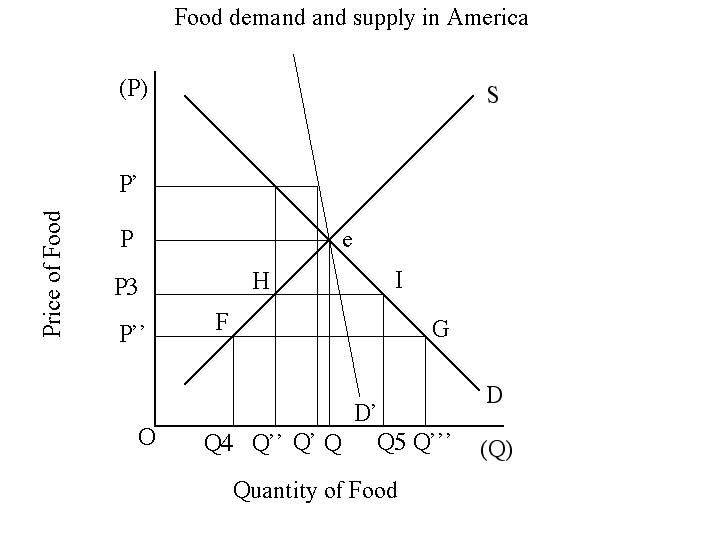
Heres a demand and supply diagram. Q is quantity (or consumption) and P is price. D is a the demand curve of a unit elastic good. This is a good where an increase in price will result in a proportional decrease in quantity bought and visaversa. D' is a demand curve which is inelastic. E is the equilibrium. At this price, the quantity demanded will be equal to the quantity supplied. THis is also known as the market clearning price.
Now look at the unit elastic line D. An increase in price along that curve from P to P' will result in a decrease of quantity from Q to Q''. (look carefully at the difference in distances)
On the inelastic curve D', an increase in price from P to P' will reseult in a drop of quantity from Q to Q'. Notice how a large increase in price has resulted in a small decrease in quantity demanded.
Now, why don't corporations who supply food just jack up the price so they can make a lot. AFter all, a large increase in price means that people will only buy a little less of the good. They will make more money.
There are two reasons for this. One is domestic competition, and the other is international competition. Domestically in the US, the cost of producing food is about the same. Labor costs are about equal, and each farm has lots of capital (machines to help them out)
The beauty of free trade is that if these farmers charge too much, the cheap foreign goods will keep the prices down. In third world countries, labor is very very cheap. There are no machines. The food produced there is a lot cheaper to buy in the US then US produced goods. THis is why BUsh has subsidized the US farmers: to keep their costs lower and to keep them competitive.
Now, using the same graph, and the unit elastic Demand curve (so it doesnt get too clutered along the X axis) we will say that the price of US produced food is P, and the quantity bought is Q. WE will also say that the price of food on the international market (foreign goods) is P'', and the quantity supplied is Q'''. (When these goods flood the US market, it will mean an increase in the supply curve (supply curve shifts right until new e is reached at the intersection of P'' and Q'''. However, in this graph, we will not show an increase in the supply curve because one is not needed to show what happens)
In the US market with foreign goods, the market will now buy P'' - F - Q4 - O of the domestic food, and Q4 - F - G - Q''' of the foreign food. Notice how the foreign section is larger then the domestic section. All US farmers whos costs (thats the supply curve because supply is dependant on costs and number of suppliers and expectations about prices) are above P''' will go out of buisness.
Enter the tariff/ subsidy
The tariff/subsidy means that the price of foreign goods will now be at P3. Using the same method as before, we can see that domestic goods will now be at P3 - H - Q'' - O. This is an increase of american food bought by the market. Foreign foods has decresaed to Q'' - H - I -Q5. There are also more US farmers who can stay in buisness. (up from F to H)
So what has this tariff/subsidy done? It has increased the price for consumers (thus more money for these corporations) and has decreased the supply. (thus more money for these corporations)
Which is why free trade is a good thing. It keeps corporate profits down, espically for the goods we need the most
(graph is coming in the next post)
|
|
| |
All times are GMT. The time now is 05:26.
Apolyton Time is 00:26. |
top of page
|
| archivepost |
|
Forum Rules:
You may not post new threads
You may not post replies
You may not post attachments
You may not edit your posts
|
HTML code is ON
vB code is ON
Smilies are ON
[IMG] code is ON
|
|
|
|
|
|





 19-02-2003 09:47







 .
.


 Attachment:


 |
|