|
| |
|

|
Catt
|
 |
California - SF Bay Area
May 2002
time: 21:26
|
|
Thanks to a toddler banging on my laptop keyboard before I finished a turn (and the resulting reload to replay my turn), I noticed something very interesting - so much so that it almost strikes me as an exploit (not sure yet - the discovery needs a bit more time to sink in).
First, the basics - two key points: (1) fortresses offer a 50% defensive bonus to units garrisoned there, and also offer ZOC ability to any units therein; and (2) PTW incorporated some clear differences in AI behavior (compared to vanilla Civ v1.29) which is particularly evident with the activity of barbarians -- from Firaxian comment, we know that the AI-controlled civs make a calculation regarding the odds of battle before committing troops to any particular engagement -- if the odds are heavily against the AI, it tends to break off an attack and/or look for a weaker target -- there's a lot less of the AI throwing stacks of inferior units against a superior tactical situation.
These two facts, and the intervention of my toddler, lead me to a startling discovery -- where the local geography permits, a maginot line can be far more effective than it was under vanilla Civ. It can seemingly offer real deterrence at very low cost, and enable a technologically advanced civ to maintain a very small standing army but still be secure within its borders.
I was playing an all-random game and drew the Ottomans as my civ. An ineffective Babylon offensive in the BCs secured for me the former Babylonian lands -- I had two decent but small cores established early, and from that point felt I could win in any fashion I chose. I have been experimenting with largely peaceful games, trying to focus a bit on trading and diplomacy, and I let the age of the Sipahi pass without offensive war (sacrilege, I know  ). But my diplomacy was ineffective -- I found the Ottoman empire embroiled in several wars, and even with Universal Suffrage my Republic began to feel the strains. I constructed a longish maginot line before I finally decided to take a Persian city to encourage negotiations and also significantly shorten the needed maginot defenses. ). But my diplomacy was ineffective -- I found the Ottoman empire embroiled in several wars, and even with Universal Suffrage my Republic began to feel the strains. I constructed a longish maginot line before I finally decided to take a Persian city to encourage negotiations and also significantly shorten the needed maginot defenses.
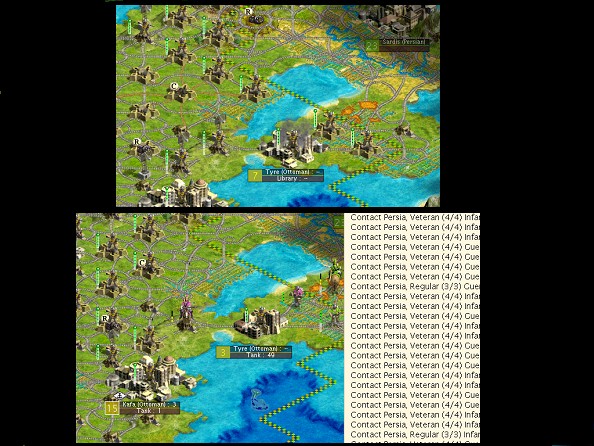
In the age of infantry and tanks, just after entering the Modern Age (I had a 3 - 4 tech lead and no one except the Ottomans yet had tanks) I took Tyre from the Persians. I intended to build fortresses and staff them in the appropriate spots to insulate my new territory from incursions. After taking Tyre, but before I could build the defensive fortifications and attend to some pollution clean-up, I stepped away from the laptop and fate intervened. I returned to find a guilty but happy child and a screen that clearly showed that my turn had ended and the AI had moved -- a good-sized SOD waited outside my new city, and a dozen or so wounded and "retreated" cavalry were nearby -- I had also lost some key assets. I reloaded the turn, played it out as best I could as I had done the first time, but completed my planned fortifications and posturing. When I ended my turn, I was quite surprised to see not one whit of an AI SOD -- I suffered an aerial bombardment or two, but my maginot line was unmolested!
After finishing the game, I recreated the incident as best I could so as to grab some screen shots. Below is a screenshot that shows Tyre and its immediate surroundings on the same turn -- in the top view, my defensive fortifications are complete and unmolested after one turn; and in the bottom view is the situation when no defensive fortifications were erected.
In the "real" game I staffed the fortresses with 4 infantry each -- in the replay shown here, I tried it with only 2 infantry in each fort -- still no attack whatsoever! So . . . 2 infantry, fortified in fortresses on grassland, and within the defensive umbrella of a radar tower (defense of ‘21’ for each infantry), were sufficient to deter an AI SOD that consisted of +/- 10 dead cavalry, 10 wounded and "retreated" cavalry, and +/- 45 infantry and guerillas (mostly infantry). For the cost of some fortresses, a few radar towers, and less than 2 dozen infantry in total, I could have secure borders, no incursion of AI forces other than by sea (  ), and no increase in war weariness. ), and no increase in war weariness.
Interesting? Exploitative?
Catt 
 Attachment: compiled.jpg Attachment: compiled.jpg
This has been downloaded 287 time(s).
|
|
| |
|
| |
|
|
|
Catt
|
|
California - SF Bay Area
May 2002
time: 21:26
|
|
quote:
Originally posted by badams52
Nathan,
Once your infantry upgraded to elite, the AI probably reevaluated it's chances of winning and found them too low so he stopped. Happened with me when the AI was attacking my pikemen on a mountain with his legionary in AU206. The pikeman didn't lose any strength, became elite and that stopped the attacks. He would attack with longbowmen though |
Which suggests that someone could set up a test to try and determine if there are hard-coded break-points - and what those points are.
I did the math quickly on your experiences, and, making some assumptions, my guess is that there is a breakpoint somewhere in the "10% chance of success" range. Legions attacking a veteran pikeman fortified on a mountain have only a 13.6% and 7.7% chance of success for a veteran and regular legion, respectively. Once the pikeman is elite and uninjured, the chances of success drop to 6.5% and 3.3% respectively. By compariosn, a longbowman making the same attack against an elite would have a 23.8% and 14.3% chance of success.
In Nathan's example - with the AU Mod infantry attacking at 8 -- the chances of success against a veteran infantry fortified in a fortress on flat lands is 12.8% and 7.1% respectively. When the defender is elite and uninjured, the odds drop to 6.0% and 3.0%.
My own example (infantry with modified defense of 21 against "6" attackers) offers only a 4.8% chance of success.
The examples imply that with a chance of success at least in the low teens (12.8% or 13.6%, for example), the AI will attack; but when the chance of success drops to the mid-single digits (6.5% or 6.0%, for example) the AI ceases its attack.
Catt
I made a lot of assumptions: (1) that there is a hard-coded breakpoint; (2) assumptions regarding veteran attackers, Nathan's forts on flatlands, and badams52's pikeman without a fort; and, not least of which, (3) the civ combat calculator I used to generate the odds of succes is in working order  . .
|
|
| |
|
|
|
Frank Johnson
|
 |
Houston, TX
Jan 1970
time: 23:26
|
|
I don't think the number of troops is involved in the choice to attack or not, but only in the selection of the target when multiple targets are offered.
The AI is driven by some goal, like attack that city, or pillage that resource. Then if there are units past the thershold limit in the way they will attack them. If there's alot of units in a line denying them from their goal, then first they'll check if the enemy is in the allowable attack range. In this case, tanks will attack fortified infantry on a mountain side, so unless you add a time consuming fort, you can't deter a tank from attacking.
Once its been determined that the targets are in the allowable attack range, the enemy will just attack the square with the least units on it, or if there's a variety of units it will attack weaker ones before stronger ones.
|
|
| |
|
|
|
Catt
|
|
California - SF Bay Area
May 2002
time: 21:26
|
|
quote:
Originally posted by Frank Johnson
The AI will pretty much ignore any heavily fortified location, city or not. If it is a city, they are much more likely to attack it if they can't reach another city however. I've seen the AI willing to attack a single infantry or 2 fortifted on a mountain side with tanks....but before tanks a single infantry on anything past hills is enough to deter entire stacks.
|
quote:
Originally posted by Yahweh Sabaoth
Catt, interesting observation on the AI's threshold for attack. Any thoughts on how # of defenders might affect the decision? |
quote:
Originally posted by Frank Johnson
I don't think the number of troops is involved in the choice to attack or not, but only in the selection of the target when multiple targets are offered.
[. . .] In this case, tanks will attack fortified infantry on a mountain side, so unless you add a time consuming fort, you can't deter a tank from attacking.
|
quote:
Originally posted by Yahweh Sabaoth
Anyone have any idea how many units the enemy must lose before it calls an offensive off? 50%? 75%?
|
Good conversation. First off, from my perspective, the intriguing fact I gleaned from my initial observations (subsequently supported by Nathan's and badams52's posts) was that severe disparity in attack and defense values seems to result in an AI avoiding engagement, even if such avoidance means no fighting at all. We can build a series of fortifications to channel AI attacks into kill zones or simply to control specific, strategic locations (allowing AI attackers to bypass the location), but what was news to me was the ability to absolutely prevent attacks -- think about that -- a technologically equal (or better) human player can completely deter any attacks (except for seaborne invasions which are never a real threat) from a massively numerically superior foe. Imagine the potential strategic benefits of enjoying a 5 or 6 tile land border -- 12 or so defenders, in the right circumstances, can deter an attack by 60+ AI defenders (maybe lots more). With such a strategic position, the human could decide to (1) launch an offensive (if sufficient forces are available); (2) build up forces (without intervening losses) and then launch an offensive; (3) channel AI attackers into kill zones; or (4) do nothing! In the past, I would have believed that it was necessary to actively engage the AI - either defensively or offensively. What is intriguing is the option to do nothing - without losses, growing war weariness, military production needs, etc. Should you choose, for whatever reason, to continue along a path of "peaceful" isolationism, you are free to do so, unmindful of the military strength of your foes (for at least some period of time)!
Absent further examples, I agree with Frank Johnson -- the raw number of AI troops doesn't seem to be involved in the AI engagement calculation (witness my example of 60+ AI troops of "6" attack refusing to engage only 2 infantry). I don't necessarily think losses have anything to do with it either (though I am recalling Nathan's AAR in the AU "no war until communism game" when the AI called off an attack after some losses -- could it have been related to defender promotions?) It seems to me (and this is the principal reason I started the thread) that whether the AI force is hopelessly outnumbered or massively numerically superior, if the disparity between attack and defense values reaches a "break point," the AI will simply not engage.
Catt
|
|
| |
|
|
|
Catt
|
|
California - SF Bay Area
May 2002
time: 21:26
|
|
Cross-posted with you both.
quote:
Originally posted by Yahweh Sabaoth
Hmmm.... interesting... so the implication is that the enemy had 10 knights, they would avoid 2 musketmen and head for 30 spearman instead, right? |
@YS - I don't think the point is 2 musketmen versus 30 spearmen. We know the AI will seek out soft targets where available. And we know that the AI is not great about determining the likely success of an overall force or task group versus an opposing force or task group (Frank Johnson's point re: the few remaining tanks bouncing off a few infantry). What I found interesting is the fact that, even if the AI had 60 cavalry, if the only available target was 2 infantry (because map features cooperated), then the 60 cavalry would sit around unused -- the human could defend, without any losses -- with a force 1/30th the size of the AI force.
The questions for me are: (1) is there a hard-coded "no enegagement" break point based on "A" and "D" values; (2) if so, what is it; and (3) where, along the technology path, do equivalent attackers and defenders match up in such a way that the break point my be exploited (i.e., does a musketman in a fort on flatlands operate as absolute deterrance to knights or not? how about riflemen and cavalry?)
Catt
|
|
| |
|
| |
|
|
|
badams52
|
 |
near the magic kingdom
May 2002
time: 21:26
|
|
quote:
Originally posted by Catt
The questions for me are: (1) is there a hard-coded "no enegagement" break point based on "A" and "D" values; (2) if so, what is it; and (3) where, along the technology path, do equivalent attackers and defenders match up in such a way that the break point my be exploited (i.e., does a musketman in a fort on flatlands operate as absolute deterrance to knights or not? how about riflemen and cavalry?) |
Hmmm, another example I have for you is the cavalry army I had which had 3 cavalry with 13 or 14 hp depending upon which one I was using. I noticed the AI never bothered to attack them through having infantry, so I used them for covering a solo cavalry unit (armies can't pillage  ). Once the AI got tanks, he would attack my 14 hp cavalry army fortified in a forest. ). Once the AI got tanks, he would attack my 14 hp cavalry army fortified in a forest.
Using Civlackey's combat calculator, it seems the tank would have almost 50% in the case stated above, but cavalry would have almost no chance by itself.
Taking this further (and using the calculator again) it seems the AI will never attack an MI army unless it gets below 12 hitpoints and he has elite MAs, or an army of MAs or Tanks. And an army of 3 infantry at 13 hp will be attacked on open terrain by elite tanks. Infantries with higher hp will be left alone till MAs. I would have mentioned armies with 4 units, but Civlackey's calculator doesn't allow that many hitpoints. This just goes to show a very important aspect of armies, they defend without being attacked.
Hmmm, I could be wrong, but I vaguely remember the AI using his cavalry one time to attack my army of tanks. Could have been injured though. I remember hoping it wouldn't be destroyed.
|
|
| |
|
| |
All times are GMT. The time now is 05:26.
Apolyton Time is 00:26. |
top of page
|
| archivepost |
|
Forum Rules:
You may not post new threads
You may not post replies
You may not post attachments
You may not edit your posts
|
HTML code is ON
vB code is ON
Smilies are ON
[IMG] code is ON
|
|
|
|
|
|





 25-02-2003 08:37





 |
|