|
| |
|

|
chegitz guevara
|
 |
Ft. Lauderdale, FL Communist Party of Apolyton
Jun 2000
time: 00:26
|
|
Feb 25, 12:58 PM (ET)
By REBECCA GOMEZ

(AP) Consumers have grown extremely wary as the United States inches closer to war with Iraq.
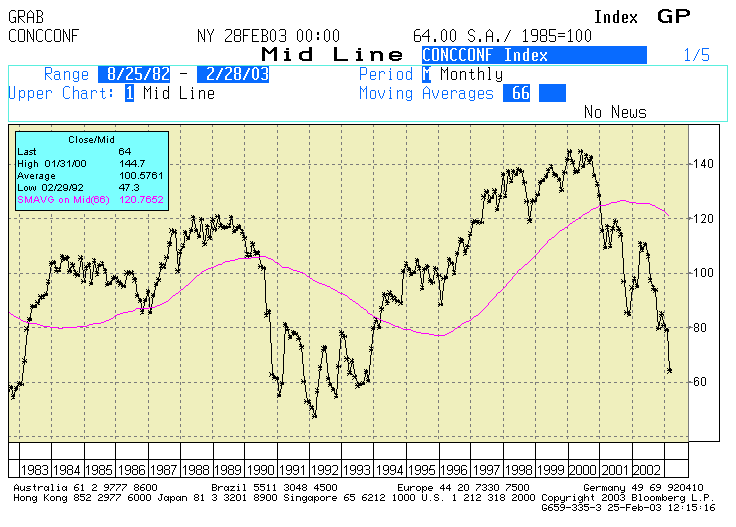
NEW YORK (AP) - Consumers have grown increasingly worried about the economy as the nation inches closer to war with Iraq, driving down their confidence levels to their lowest point in nearly a decade, a private research group said Tuesday.
The Consumer Confidence Index plummeted to 64.0 in February from a revised 78.8 in January - a drop of nearly 15 points, the New York-based Conference Board said. That is the lowest reading since the index hit 60.5 in October 1993 and far below analysts' expectations of 77.0 for February.
"It's a bigger drop than expected and at a pretty low level, pretty miserable both in terms of current conditions and expectations," said Josh Feinman, chief economist for Deutsche Asset Management in New York. "On all fronts, it's jitters about the upcoming war with Iraq. I don't think there's any doubt that's playing a role, as well as higher oil prices."
Lynn Franco, director of the Conference Board's Consumer Research Center, said consumers also grew more bleak about lackluster job and financial markets, rising fuel and the increasing threat of terrorism.
Despite all those concerns, consumers still snatched up homes at a record pace.
The National Association of Realtors reported Tuesday that existing-home sales hit a seasonally adjusted annual rate of 6.09 million - the best month ever. That represented a strong 3 percent increase from December's level.
Consumer spending and the housing market have been the few bright spots in an otherwise lackluster economy. Consumer confidence is closely watched because consumer spending accounts for two-thirds of economic activity.
The Conference Board said its Expectations Index, intended to measure sentiment about conditions in the next six months, fell to 65.6 from 81.1 a month ago, while the Present Situation Index dropped to 61.6 from 75.3.
"This month's confidence readings paint a gloomy picture of current economic conditions, with no apparent rebound on the short-term horizon," Franco said.

(AP) A chart shows the Consumer Price Index. (AP Graphic)
On Wall Street, the markets sank a bit shortly after the report was released, but quickly regained their earlier levels. In midday trading, the Dow Jones industrial average was off 104 points at 7,754, while the Nasdaq composite index was down 23 points at 1,299.
As part of the Present Situation Index, consumers who rated current business conditions as bad rose to 30.7 percent from 26.7 percent. The number who said business conditions are good declined to 13.2 percent from 15.0 percent.
Those surveyed who believe business conditions will turn even more sour over the next six months increased to 19.0 percent from 14.0 percent. The percentage of consumers who believe conditions will improve by midyear dropped to 15.3 percent from 17.7 percent.
The number of consumers who said jobs are hard to get rose to a 9-year high of 30.1 percent from 28.9 percent, while those who said there are plenty of jobs decreased to 11.2 percent from 14.5 percent. Looking six months down the road, consumers were more pessimistic, with the number saying they expect there to be fewer jobs available jumping to 28.4 percent from 21.2 percent. The number expecting more jobs fell to 12.7 percent from 14.2 percent.
The consumer confidence index is based on a survey of 5,000 U.S. households and compares to its base of 100 in 1985.
|
|
| |
|
|
|
MichaeltheGreat

|
|
Apolyton Grand Executioner
|
 |
mooning the house that Ruth built.
Oct 1999
time: 21:26
|
|
Modern war really isn't. In good ol' meatgrinder wars like WW2, there's a huge amount of fairly standard, almost anyone can make them, labor intensive materiel that needs to be made (and gets consumed) on a regular basis.
In WW2, the US made somewhere around 50,000 Sherman tanks, well over 10,000 each P-51s, B-17's and B-24s, and millions of routine items from uniforms to ammunition to web gear. These items were made by thousands of different companies, many of which were either startups, or adaptations from civilian manufacturing plants.
Now, none of that exists, and defense contractor plant and expertise is extremely specialized, and far less labor intensive. Resupplying cruise missiles will employ probably no more than 2-3000 people (many of whom are already employed), for a few years at most - and most of that funded by cuts or deferrals from other defense programs.
I doubt the amount of stimulus to the economy from this war offsets even a couple of months of damage from the current fuel price spike.
|
|
| |
|
|
|
MichaeltheGreat
|
|
Apolyton Grand Executioner
|
|
mooning the house that Ruth built.
Oct 1999
time: 21:26
|
|
quote:
Originally posted by PLATO1003
Okay...so I am a dinosaur on economic theory. Just one question...where does the 40 to 100 billion dollars that this war is going to cost go to? |
A lot of it will go as charges to inventories (smart munitions, etc.), while other parts will go to civilian transport contractors, bribes to our alliance of the paid for, increased personnel pay (hazardous duty and combat pay, etc.), fuel consumption out the wazoo, and chargeoffs for broken or killed items such as trucks, planes, tank engines, etc. Eventually, it all comes out of the taxpayer, but not for several years.
The distribution of the money is pretty much the same as with peacetime military spending, with the exception of a relatively big jump in fuel procurement, and third-party transport costs.
|
|
| |
All times are GMT. The time now is 05:26.
Apolyton Time is 00:26. |
top of page
|
| archivepost |
|
Forum Rules:
You may not post new threads
You may not post replies
You may not post attachments
You may not edit your posts
|
HTML code is ON
vB code is ON
Smilies are ON
[IMG] code is ON
|
|
|
|
|
|






 25-02-2003 23:09





 Attachment:






 |
|