|
| |
|
| |
|
| |
|
| |
|

|
Lancer
|
|
Oregon Coast, USA! or Bohol, Philippines!
Apr 1999
time: 05:26
|
|
The Snowball Earth
Many lines of evidence support a theory that the entire Earth was ice-covered for long periods 600-700 million years ago. Each glacial period lasted for millions of years and ended violently under extreme greenhouse conditions. These climate shocks triggered the evolution of multicellular animal life, and challenge long-held assumptions regarding the limits of global change.
by Paul F. Hoffman and Daniel P. Schrag
August 8, 1999
CONTENTS
Introduction
Frozen and fried
Sea ice at the equator
The acid test
Survival and redemption of life
Snowball episodes and Earth history
Further reading
Illustrations
Introduction
Geology tells us that the Earth's climate is subject to change on various timescales, but what are the limits to climatic variability? Over the last million years that constitute the Pleistocene epoch, the time in which humans evolved, continents bordering the North Atlantic Ocean were periodically glaciated at intervals governed by changes in the Earth's orbit around the Sun. At the height of the last ice age, a mere 21,000 years ago, much of North America and Europe were covered by glaciers over 2 kilometers thick, causing sea level to drop by 120 meters. The chill was global: land and sea ice combined to cover 30 percent of the Earth's surface, more than at any other time in the last 500 million years. Although these are dramatic examples of the variability of Earth's climate, they pale by comparison with climatic events near the end of the Neoproterozoic eon (1000-543 million years ago), events that immediately preceded the first appearance of recognizable animal life around 600 million years ago.
In 1964, Brian Harland at Cambridge University postulated that the Earth had experienced a great Neoproterozoic ice age. He pointed out that Neoproterozoic glacial deposits, similar in type to those of the Pleistocene, are widely distributed on virtually every continent. Harland could only speculate on the positions of continents in Neoproterozoic time and could not rule out the possibility that various continents were glaciated at different times as they drifted close to the poles. Nevertheless, he inferred that ice lines penetrated the tropics from the occurrence of glacial deposits within types of marine sedimentary strata characteristic of low latitudes. What could cause glaciers to reach sea level near the Equator? Climate physicists were just developing mathematical models of the Earth's climate, providing a new perspective on the limits to glaciation. The Earth's climate is fundamentally controlled by the way that solar radiation interacts with the Earth's surface and atmosphere. We receive ~343 watts per square meter of radiation from the Sun. Some of this is reflected back to space by clouds and by the Earth's surface, but approximately two thirds is absorbed by the Earth's surface and atmosphere, increasing the average temperature. Earth's surface emits radiation at longer wavelengths (infrared), balancing the energy of the radiation that has been absorbed. If more of the solar radiation were reflected back to space, then less radiation would be absorbed at the surface and the Earth's temperature would decrease. The surface albedo is a measure of how much radiation is reflected; snow has a high albedo (~0.8), seawater has a low albedo (~0.1), and land surfaces have intermediate values that vary widely depending mainly on the types and distribution of vegetation. When snow falls on land or ice forms at sea, the increase in the albedo causes greater cooling, stabilizing the snow and ice. This is called ice-albedo feedback, and it is an important factor in the waxing (and waning) of ic e sheets.
At the same time that Harland was examining Neoproterozoic glacial deposits, Mikhail Budyko at the Leningrad Geophysical Observatory, working with simple two-dimensional energy-balance climate models, found that the ice-albedo feedback created an instability in the Earth's climate system. Budyko showed that if the Earth's climate were to cool, and ice were to form at lower and lower latitudes, the planetary albedo would rise at a faster and faster rate because there is more surface area per degree of latitude as one approaches the Equator. In his model, once ice formed beyond a critical latitude (around 30 degrees north or south, equivalent to half the Earth's surface area), the positive feedback became so strong that temperatures of the surface plummeted, yielding a completely frozen planet. The relatively small amount of heat escaping from the Earth's interior is sufficient to prevent the oceans from freezing to the bottom, but would still allow a kilometer thick cap of sea ice to form, thicker at the poles and thinner at the Equator.
Frozen and Fried
Budyko's model results helped stimulate interest in the science of climate modeling, but few believed that the Earth had ever actually experienced a runaway ice albedo. First, it was assumed that such a catastrophe would have extinguished all life, contrary to microscopic evidence of extant life forms in rocks as old as 3500 million years. Second, once the Earth became totally ice-covered, the high albedo would drive surface temperatures so low that there seemed no means of escape. Had such a glaciation ever occurred, Budyko reasoned, it would have been permanent. The first of these objections began to fade in the late 1970s with the discovery of remarkable communities of organisms living in deep-sea hydrothermal (hot water) vents, and later in the extremely cold, dry, mountain valleys of East Antarctica. Some of these organisms appeared capable of surviving global glaciation and their existence in the Neoproterozoic was unquestioned—molecular studies showed that they disproportionately represent the oldest branches in the universal tree of life.
The key to the second problem—reversing the ice-albedo feedback—is plate tectonics. Climate scientists have long known that the amount of carbon dioxide in the atmosphere plays an important role in determining the Earth's temperature because it is a "greenhouse" gas, meaning that it absorbs infrared radiation emitted from the Earth's surface. Over time scales of human lifetimes, the amount of atmospheric carbon dioxide can be affected by biological processes such as photosynthesis or respiration, and by human activities such as the burning of tropical forests and fossil fuels. Over time scales of millions of years, the amount of carbon dioxide in the ocean-atmosphere system is adjusted to maintain a balance between its supply by volcanoes, both on land and in the ocean, and its removal by chemical weathering reactions with silicate rocks, which convert the carbon dioxide to calcium carbonate which is then buried in sediments.
In the late 1980s, Joe Kirschvink at the California Institute of Technology pointed out that during a global glaciation, what he termed a "snowball" Earth, the supply of carbon dioxide to the atmosphere and oceans from volcanism would continue because of plate tectonics. However, if the Earth were so cold that there were no liquid water on the continents, weathering reactions would effectively cease, allowing carbon dioxide to build up to incredibly high levels. Eventually, the carbon-dioxide-induced warming would offset the ice albedo, and the glaciation would end. Given that solar luminosity 600-700 million years ago was about six percent lower than today due to stellar evolution, Ken Caldeira and Jim Kasting at The Pennsylvania State University estimated that roughly 0.12 bar of carbon dioxide (about 350 times the present concentration) would have been required to overcome the albedo of a snowball Earth. Assuming current rates of volcanic carbon dioxide emissions, a Neoproterozoic "snowball" Earth would have lasted for millions to tens of million of years before the sea ice would begin to melt at the Equator. A "snowball" Earth would not only be the most severe glaciation conceivable, it would be the most prolonged.
Sea Ice at the Equator
Joe Kirschvink had found the escape route from a "snowball" Earth, but was it a route ever taken? Kirschvink pointed to the results from paleomagnetism, a technique that Harland had employed in attempting to estimate the latitudes of Neoproterozoic glaciation. The latitude at which certain rocks formed can be estimated from the inclination, corrected for subsequent disturbances, of their natural remnant magnetization (NRM), which varies systematically from vertical at the magnetic poles to horizontal at the magnetic equator. Today, the magnetic and geographic poles do not coincide, nor have they at most times in the past. However, the poles do coincide when averaged for the secular "drift" of the magnetic poles on a time scale of 10,000 years. In practice, a large number of rock samples closely separated in age must be measured from each location, in order to eliminate statistically the effects of short-term secular variation of the magnetic field. Harland and coworkers found shallow inclinations for Neoproterozoic glacial deposits at a number of sites, which seemed to confirm that glaciation had occurred at low latitudes.
In the 1960s, it was generally assumed that NRMs were acquired when rocks formed, so long as they had not subsequently been heated above their Curie temperature (580-680 degrees Celsius). However, it was subsequently learned that many rocks, particularly sedimentary rocks, may be chemically remagnetized at much lower temperatures if subjected to prolonged groundwater percolation. Many of the early paleomagnetic measurements were shown to be from remagnetized samples and the rest were suspect. Kirschvink decided to reexamine favorable sites and carry out various tests designed to select only primary NRMs. He reasoned that South Australian Neoproterozoic glacial deposits giving shallow inclinations had the least chance of being remagnetized because South Australia was never at low latitude in the last 400 million years. Furthermore, George Williams at the University of Adelaide had proved that the glacial deposits in South Australia formed close to sea level because of their intimate association with sediments of tidal origin. This was important because glaciers exist in the tropics today, but not below 5000 meters above sea level. Even at the last Pleistocene glacial maximum, equatorial ice lines in the Andes were no lower than 4000 meters above sea level. The tests that Kirschvink carried out, later replicated and extended in other laboratories, were positive and confirmed that the shallow inclinations in South Australia are primary. The paleomagnetic evidence seems irrefutable: Neoproterozoic ice lines reached sea level within a few degrees of the Equator. Recently, Linda Sohl and colleagues at Lamont-Doherty Earth Observatory of Columbia University have documented as many as six polarity reversals in the South Australian glacial deposits. The frequency of polarity reversals of the Earth's magnetic field is such that the glacial deposits must represent a minimum of several 100,000s and more likely millions of years, consistent with the time scale of a "snowball" Earth.
Can the paleomagnetic evidence be explained without recourse to a "snowball" Earth? George Williams, who more than anyone else put the South Australian glacial deposits on the map, had a different but equally imaginative idea. He proposed that the Earth's obliquity—the angle between the spin axis and the axis of the ecliptic plane—was greater than 54 degrees until the end of the Proterozoic eon, when it rapidly changed to relatively low values near today's 23.5 degrees. An obliquity greater than 54 degrees would dramatically alter Proterozoic climate. Williams noted that glaciation would occur preferentially at low latitudes. Mean annual insolation would be higher in the polar regions than in the tropics, due mainly to extremely hot polar summers when the Sun would be perpetually high in the sky. At the Equator, the solstices would be very cold with the Sun bobbing on the polar horizon. Strong surface winds would flow from the winter to the summer hemisphere. But the equinoxes would be hot at the Equator. The Sun would pass daily high overhead, just as it does with low obliquity. At all latitudes, seasonality would be greatly increased and Williams pointed to the presence in South Australia of structures like ice-wedge polygons, produced by seasonal temperature variations in frozen soil. Such structures should not form at the Equator if the Neoprotoerozoic obliquity was low. However, strong seasonality is a double-edged sword because it makes it more difficult for glaciers to develop. Glaciation depends on a net accumulation of winter snow after summer ablation. Strong seasonality increases summer ablation, and also decreases winter snowfall because colder air is drier. Detailed investigations show that summer insolation is the key to the growth and decay of Pleistocene ice sheets. The high-obliquity hypothesis faced an uphbill battle for other reasons as well. To initiate it would seem to require a giant impact on the Earth of a body crossing the ecliptic plane at a high angle. Thi s is incompatible with the orbit of the Moon, unless the widely accepted theory of its origin through a giant impact is abandoned.
Iron is the paleomagnetists’ favorite element, and iron gave Joe Kirschvink another reason to favor the "snowball" Earth. Several examples of Neoproterozoic glacial deposition in marine waters are unusually rich in iron oxides and sulfides. In fact, they were the object of international iron-ore exploration after World War II, and belong to a class of sedimentary ore deposits called banded iron-formation or BIF, which is otherwise restricted to a much earlier time in Earth history. Modern seawater contains less than one part per billion of iron because iron in its oxidized form (Fe3+) is quite insoluble. However, in its reduced form (Fe2+), iron is relatively soluble. Most BIF occurs in rocks older than 1850 million years and is believed to have formed at a time when the atmosphere had little free oxygen, and seawater in the deep ocean contained abundant iron. This iron precipitated in upwelling zones when it encountered more oxidizing surface waters. The transitory return of BIF, invariably associated with glacial deposits, after a hiatus of over a billion years is remarkable. Kirschvink reasoned that during the millions of years of ice-covered oceans, the amount of gas exchange between the ocean and atmosphere would be reduced, and the deep ocean would quickly become anoxic, allowing reduced iron to build up to high concentrations. Once the glaciation ended, the ocean would quickly become oxidized, and the iron would precipitate out in close association with the deposits of sediment-laden icebergs. The high-obliquity hypothesis provides no explanation for the association of glacial deposits in BIF.
The Acid Test
Joe Kirschvink was unaware of two emerging lines of evidence that would strongly support his "snowball" Earth hypothesis. Ironically, both were first highlighted by the intrepid George Williams. All across Australia, Williams reported, from the Kimberleys to the Flinders, Neoproterozoic glacial intervals are blanketed by peculiar "cap" dolostones (equimolar calcium-magnesium carbonate). The transition from glacial deposits to "cap" dolostone is abrupt and lacks evidence of significant hiatus. Williams argued that the "cap" dolostones are primary, or nearly so, and imply high surface temperatures based on laboratory experiments and modern occurrences. He concluded that Neoproterozoic glacial epochs closed with "abrupt climatic warmings". It was soon apparent that Neoproterozoic "cap" dolostones are a world-wide phenomenon, particularly striking in regions where carbonate rocks are otherwise absent. The "paradoxical" association of glacial and warm-water deposits was widely acknowledged.
To appreciate the special significance of "cap" dolostones, recall the transient conditions unique to the end of a "snowball" Earth. An ultra-high carbon dioxide atmosphere is needed to raise temperatures to the melting point at the Equator. Once melting begins, the ice-albedo feedback is reversed and combines with the extreme greenhouse atmosphere to drive surface temperatures upward. The warming proceeds rapidly because the change in albedo begins in the tropics, where insolation and surface area are maximal. With the resumption of evaporation, the addition of water vapor to the atmosphere adds powerfully to the greenhouse effect. Calculations by Raymond Pierrehumbert at the University of Chicago suggests that tropical sea-surface temperatures would reach almost 50 degrees Celsius in the aftermath of a "snowball" Earth, driving an intense hydrologic cycle. Sea ice hundreds of meters thick globally would disappear within a few 100s of years. Intense chemical weathering of silicate rocks and dissolution of carbonate rocks would result from the strong hydrologic cycle, the low pH of carbonic acid rain, and the large surface area of frost-shattered rock and rock "flour" produced by the grinding action of glaciers. The products of chemical weathering reactions, cations and bicarbonate, would be delivered by rivers to the ocean, where they would neutralize the acidity of the surface waters and drive massive precipitation of inorganic carbonate sediment in the rapidly warming surface ocean. Typically, "cap" dolostones pass upward into much thicker, deeper-water clays or limestones, perhaps reflecting a rise in sea level as continental ice sheets melt, and suggesting that the cap carbonates precipitated extremely rapidly, perhaps in only a few hundred years. This idea is supported by textures in the dolostones and limestones such as gas-escape tubes and crystal fans consistent with precipitation from seawater highly supersaturated in calcium carbonate. "Cap" dolostones are no paradox; they are the expected consequence of the "ultra-greenhouse" conditions unique to the transient aftermath of a "snowball" Earth.
The "cap" carbonates contain additional evidence supporting the Snowball Earth hypothesis found in an unusual pattern of variation in the ratio of two naturally occuring, stable (i.e., non-radioactive) isotopes of carbon (carbon-13 and carbon-12). The carbon supplied to the ocean and atmosphere comes from outgassing of carbon dioxide by volcanoes, and contains about 1% carbon-13 and 99% carbon-12. If the removal of carbon from the ocean were accomplished only by burial of calcium carbonate, then the calcium carbonate must have the same fraction of carbon-13 as what comes out of volcanoes (simply because of conservation of mass). However, carbon is also removed from the ocean in the form of organic matter, the soft tissues of algae and bacteria growing in seawater. Most organic carbon is depleted in carbon-13 relative to calcium carbonate by approximately 2.5%. Today (and over most of the last 500 million years), approximately 20% of the carbon entering the ocean is removed as organic matter, which requires that modern calcium carbonate is enriched in carbon-13 by approximately 0.5% relative to the volcanic source.
The Neoproterozoic carbon isotopic record is very different, not only because the amounts of carbon-13 are generally much higher than modern sediments, but also because the rocks immediately surrounding the glacial deposits show huge excursions towards much lower levels of carbon-13. These patterns are observed world-wide, but the most complete records come from northern Namibia....
There is more, it wouldn't fit
|
|
| |
|
| |
|
|
|
Kramerman
|
 |
UT, Austin - The live music capital of the world
Jun 2002
time: 23:26
|
|
quote:
Originally posted by The Andy-Man
The theory of the Big Bang, and the Chaos theory are both derived from Ancient Greek religeous beleifes by my reckoning. Therefore, either science is basing itself of Greek Paganism, or the Greeks really were right and Zues, Aphrodite, Eros etc are real and existent gods.
As for shitty weather, its always rained in Britain... |
I dunno about chaos theory, but IIRC, the big bang theory is based on the observations of Hubble and his discovery of the red shifted universe. Meaning, because of the doppler effect, we can tell from the light spectrum that the universe is expanding. if you were to run this expansion backward (like rewinding a video), the universe would coellesce at a point, due to its mysteriously relative uniformity.
|
|
| |
|
|
|
Berzerker
|
 |
topeka, kansas,USA
May 1999
time: 23:26
|
|
We are in what is called an "interstacial", a time when ice sheets retreat and the globe warms. This began roughly 13-14,000 years ago and will (hopefully) continue a few more thousand years. When this period ends, we'll see the ice sheets advance (technically, we're in an ice age) and once again cover much of N Europe and N America unless we can figure out ways to keep the globe warm, it won't be as easy as one might think. And naturally, during an interstacial, the globe warms with small reversals that may have more to do with reduced sunspot activity (which probably caused the mini-ice age of the 1600's) than anything else, so pointing to temperature increases is meaningless. It's claimed cyclical fluctuations in the Earth's orbit and tilt are a major factor in ice advances and retreats, but another theory posits the rise of the Himalayas altered wind currents (jet stream?) causing the "ice age" over the last ~35 million years.
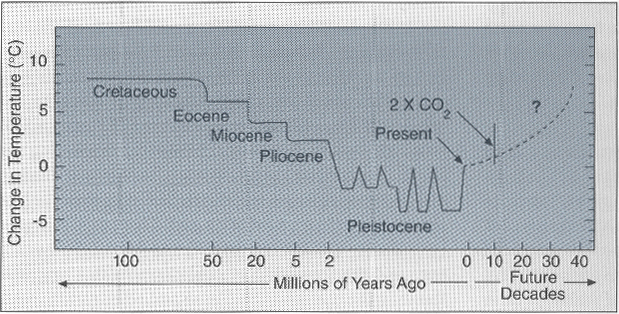
During much of the time of the Dinosaurs, global temperatures were much higher. I suggest anyone concerned with "global warming" track down a temperature graph for the last 100,000 years. You'll see what a joke it is for these "environmentalists" to scream bloody murder about temperature change. They're probably more worried about their operating budgets and donations. The last several thousand years have seen extremely stable temperatures compared to a longer period of time. Temperatures were quite a bit higher during a previous interstacial, so, unless we're going to blame cavemen or the "Atlanteans", man has next to nothing to do with climate.
|
|
| |
|
|
|
Berzerker
|
|
topeka, kansas,USA
May 1999
time: 23:26
|
|
Oh, btw, just to let you know how intellectually corrupt organisations like the Jet Propulsion Laboratory, i.e., government and it's contractors, can be, one of their spokesmen was on a radio show in LA when I lived out there claiming we needed to support the Magellan Project, a plan to map Venus. Why? So we could prevent the runaway "global warming" that has turned Venus into an oven. I challenged this guy with questions designed to show that the only thing Earth and Venus has in common is diameter. Venus is upside down, virtually no magnetic field, and takes longer to rotate once on it's axis than make an orbit of the sun. Something big hit Venus in the past and it's basicly "dead in the water". But this guy was trying to convince Americans to support wasting alot of money studying Venus to "save" the Earth? Puhlease...
|
|
| |
|
|
|
Berzerker
|
|
topeka, kansas,USA
May 1999
time: 23:26
|
|
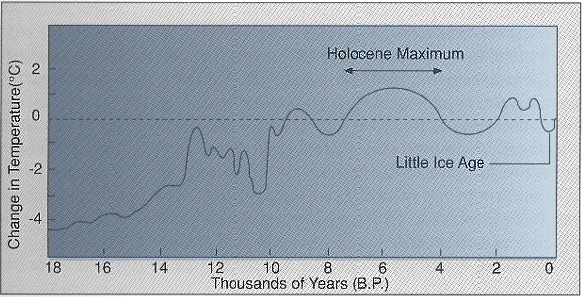
Here's a few graphs:
Figure 2 Variations in regional surface temperatures for the last 18,000 years, estimated from a variety of sources. Shown are changes in ° C, from the value for 1900. Compiled by R. S. Bradley and J. A. Eddy based on J. T. Houghton et al., Climate Change: The IPCC Assessment, Cambridge University Press, Cambridge, 1990 and published in EarthQuest, vol 5, no 1, 1991.
 Attachment: article1-fig2.gif Attachment: article1-fig2.gif
This has been downloaded 40 time(s).
|
|
| |
|
|
|
Berzerker
|
|
topeka, kansas,USA
May 1999
time: 23:26
|
|
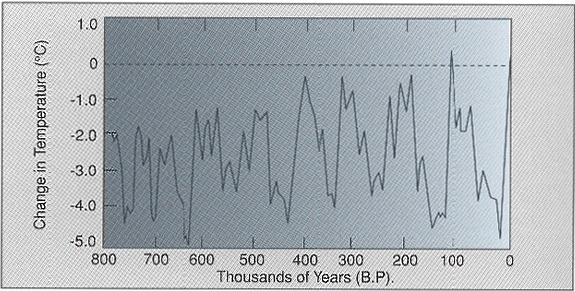
Figure 5 Estimate of surface temperature for the last 800,000 years, inferred from measurements of the ratio of 16O to 18O in fossil plankton that settled to the sea floor. The use of oxygen isotope ratios is based on the assumption that changes in global temperature approximately track changes in the global ice volume. Detailed studies for the last glacial maximum provide the temperature scale. Shown are changes in temperature in °C from the modern value. Based on data from J. Imbrie, J. D. Hays, D.G. Martinson, A. McIntyre, A. C. Mix, J. J. Morley, N. G. Pisias, W. L. Prell, and N. J. Shackleton, in A. Berger, J. Imbrie, J. Hays, G. Kukla, and B. Saltzman, eds., Milankovitch and Climate, Dordrecht, Reidel, pp 269-305, 1984.
Attachment: article1-fig5.gif
This has been downloaded 38 time(s).
|
|
| |
|
|
|
Berzerker
|
|
topeka, kansas,USA
May 1999
time: 23:26
|
|
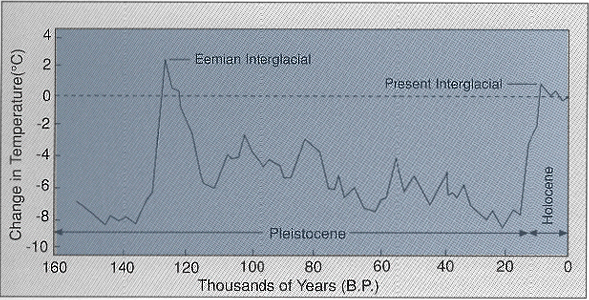
Figure 3 Air temperature near Antarctica for the last 150,000 years. Temperatures given are inferred from hydrogen/deuterium ratios measured in an ice core from the Antarctic Vostok station, with reference to the value for 1900. Compiled by R. S. Bradley and J. A. Eddy based on J. Jouzel et al., Nature vol 329, pp 403-408, 1987 and published in EarthQuest, vol 5, no 1, 1991.
Attachment: article1-fig3.gif
This has been downloaded 37 time(s).
|
|
| |
|
|
|
Lincoln
|
|
quote:
Originally posted by Sir Ralph
So Bush isn't guilty for the current misery, but he'll be responsible for the future one. |
Oh come on! What a cop out. Bush is responsible for ALL the evil in the world. Try reading some of the threads here on Apolyton and that will prove it!
|
|
| |
|
|
|
Lincoln
|
|
Be of good cheer. I don't either. Thankfully there is a life beyond Apolyton.
|
|
| |
All times are GMT. The time now is 05:26.
Apolyton Time is 00:26. |
top of page
|
| archivepost |
|
Forum Rules:
You may not post new threads
You may not post replies
You may not post attachments
You may not edit your posts
|
HTML code is ON
vB code is ON
Smilies are ON
[IMG] code is ON
|
|
|
|
|
|






 14-03-2003 02:01


 :
: 





 |
|