|
| |
|
| |
|
| |
|

|
ranskaldan
|
 |
Beijing ~ Singapore ~ Toronto ~ All hail to the new Rome
Sep 2001
time: 00:26
|
|
quote:
Originally posted by muxec
How many people in China know English? Do they hate foreighners? |
Yes, we do hate foreigners. 
But seriously 
quote:
Korean and Japanese people, do you understand each other? The languages are from the same lingual group but have centures of evolution. As i noticed Ukrainians ofthen understand Bulgarian but not always and not everything.
How many foreighn words are in Korean language? Do you have own words for "democracy", "elecricity", "vodka", "helicopter"? |
As a Chinese, I understand Korean or Japanese about as much as I understand Finnish or Greek. 
Some linguists hypothesize about a link between Korean and Japanese, but this has never been proven. They certain don't understand each other at all (no more than Finns and Greeks, I'd imagine.)
Due to cultural exchange, Korean and Japanese have quite a lot of Chinese loan words - the same way that most European languages are full of Latin and Greek words. I'd imagine that the words for "democracy", "helicopter" etc would be quite similar to Chinese. In return Chinese has borrowed a bit for Japanese too, in the last century.
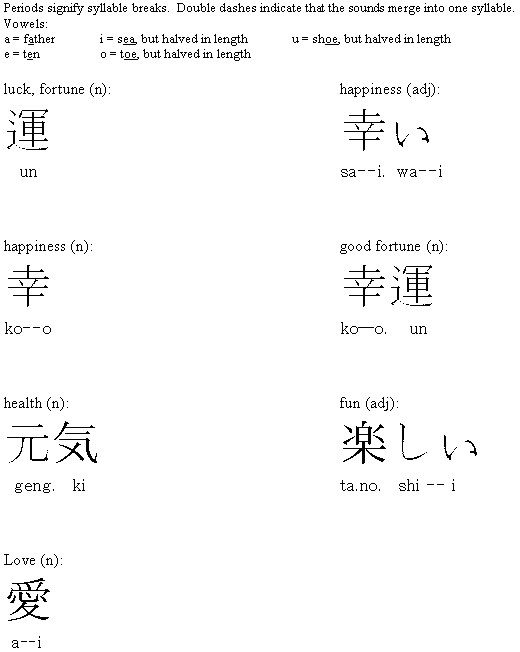
Oh and the words as they're written in Chinese: (I added a few other ones that are very common)

Good Luck (in the sense of abundance)

Good Luck (in the sense of Sheer Chance)

Good Luck (in the sense of the "Good Life")
~ Happiness

Happiness (the more sudden type, as in celebrations)

Good Health (in the sense of Great Strength, Vitality)

Good Health / Good Recovery / A sort of "peaceful health"

Joy / Fun (pronounced as "le")
Music (pronounced as "yue")

Love

Longevity
Last edited by ranskaldan on 19-03-2003 at 02:33
|
|
| |
|
|
|
Wraith
|
 |
Austin, Texas, USA
Aug 1999
time: 23:26
|
|
--"toyama is a valid surname."
I completely missed the post about the names. You're right about Japanese not having a v.
Toyama is a valid name, as would be Tooyama and Touyama.
--"the current literature favors calling them logographs instead"
I always forget that one for some reason.
--"The languages are from the same lingual group but have centures of evolution."
They are not. Chinese, Taiwanese and Japanese all have similar writing systems (at least partially so; Chinese has drifted a bit compared to Taiwanese, and the Japanese have added their own touches, like Kana), but the spoken languages aren't that similar. Japanese is kind of off in it's own branch. There's no clear ancestry there, but a lot of speculation. It doesn't seem to be closely related to anything.
--"Korean and Japanese have quite a lot of Chinese loan words "
Japanese is an interesting case. In order to know the Kanji, you have to know multiple meanings for each logograph. There's the "on" reading (the original Chinese) and the "kun" reading (the Japanese reading). So there's definitely a large amount of loan words there. The Japanese are also borrowing heavily from English, among other Western languages (French seems popular for some reason).
Wraith
"Sore wa.... himitsu desu."
-- Xellos ("Slayers Next")
|
|
| |
|
|
|
ranskaldan
|
|
Beijing ~ Singapore ~ Toronto ~ All hail to the new Rome
Sep 2001
time: 00:26
|
|
quote:
Originally posted by muxec
Maybe due to this the must popular japanese words worldwide are kamikadze and harakiri. The word "origami" is out of ten must popular eastern words (the 10th is Indian word gamasutra). Once i read origami manual with pictures and even learnt to differ betwen warp in and warp out hieroglyphs. |
I am Chinese.
And I believe that I was kidding, as can be seen from the "" smiley. 
quote:
They are not. Chinese, Taiwanese and Japanese all have similar writing systems (at least partially so; Chinese has drifted a bit compared to Taiwanese, and the Japanese have added their own touches, like Kana), but the spoken languages aren't that similar. Japanese is kind of off in it's own branch. There's no clear ancestry there, but a lot of speculation. It doesn't seem to be closely related to anything. |
Taiwanese, together with Mandarin, Shanghainese, and Cantonese, are branches of the Sinitic group of languages, also known as "Chinese". They derive from a common ancestor tongue.
Japanese and Korean are not part of this group, nor can they be remotely shown to be related to it.
quote:
Does the word "hui" exist in Chinese or Japanese? |
In Chinese, yes.
HUI pronounced with a high, level tone means ash, or dust.
HUI pronounced with a mid-high, rising tone means to return. It is also used to refer to the Hui ethnicity, or people of original mixed Chinese/Turkish ancestry who are also Muslim.
HUI pronounced with a low, dipping tone can either mean "to destroy" or "to regret". These are used under different contexts. E.g. HUIMIE means "to destroy", but HOUHUI means "to regret".
HUI pronounced with a high-to-low, falling tone means "to be able to". It can also refer to a meeting, or a coming together.
|
|
| |
|
|
|
Wraith
|
|
Austin, Texas, USA
Aug 1999
time: 23:26
|
|
--"Japanese and Korean are not part of this group, nor can they be remotely shown to be related to it."
Well, I'm sure there's been some cross-polination, but it's probably either very recent or too far back to be traced properly. Japanese and Korean seem to have diverged about 2,000 years ago, too, so I don't think they share much any more.
--"HUI pronounced with a high, level tone means ash, or dust."
I'd love to hear how that sounds, when pronounced. "hai", 灰 , is a word for ash in Japanese (but ash as in the color; gray, charcoal, etc).
--""Tokanawa" though could be a valid surname."
It's a valid combination of syllables, but I've never seen it used. A quick search doesn't show it listed as a name, either.
--"If they use the same characters, they would be the same language, more or less."
It doesn't really work that way, though. Logographs do not fit this assumption. Heck, even in various dialects of Chinese it doesn't work. Mandarin and Cantonese use, as I understand it, the exact same characters, but are spoken very differently.
The Japanese and Koreans have mutated things far beyond that point.
As I mentioned above, you do have to learn the Chinese meanings of the logographs when learning Kanji, so Japanese people can probably read a fair bit of Chinese (one of my coworkers is from Japan, and he can read at least parts of documents in Mandarin, which another of my coworkers speaks), but it won't work the other way around. They won't be able to speak it any, however, unless they've studied the language seperately.
Edit:
--""wa" is closer still"
I believe "bui" is what's usually used. It's about as close to "v" as you can get, as long as you say it quickly.
Wraith
"Baka! Baka! Baka! Baka! Baka! Baka! Baka!"
-- Tomo ("Azumanga Daioh")
Last edited by Wraith on 19-03-2003 at 07:58
|
|
| |
|
|
|
ranskaldan
|
|
Beijing ~ Singapore ~ Toronto ~ All hail to the new Rome
Sep 2001
time: 00:26
|
|
quote:
Originally posted by Urban Ranger
It seems to be a reasonable extension. If they use the same characters, they would be the same language, more or less.
You can draw a parallel with English, e.g. the US, Australia, and Canada. |
Not really.
The parallel is more like English, Finnish, and Turkish.
quote:
I'd love to hear how that sounds, when pronounced. "hai", � , is a word for ash in Japanese (but ash as in the color; gray, charcoal, etc). |
Yep, it's that character.
|
|
| |
All times are GMT. The time now is 05:26.
Apolyton Time is 00:26. |
top of page
|
| archivepost |
|
Forum Rules:
You may not post new threads
You may not post replies
You may not post attachments
You may not edit your posts
|
HTML code is ON
vB code is ON
Smilies are ON
[IMG] code is ON
|
|
|
|
|
|






 18-03-2003 21:48


 Attachment:
  My Japanese vocabulary is rubbish and I know barely any kanji, but now I know the "pronunciation" I could let my Japanese IME + fonts do the job, so I can make JPG now if you need bigger ones.




 |
|