|
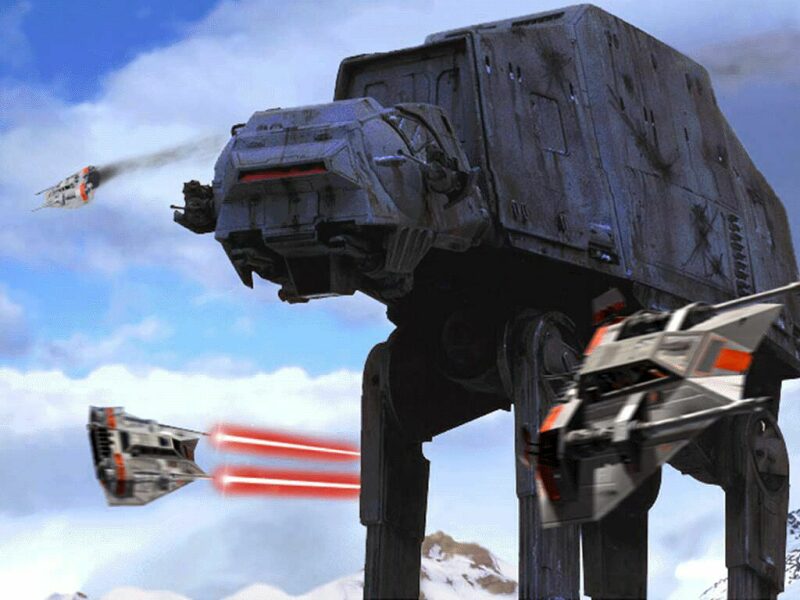
Who shall win?
This poll is closed. |
| The Galactic Empire |
   |
23 |
38.98% |
| The coalition of the willing, Milky Galaxy |
   |
7 |
11.86% |
| Haha! Babylon5 ownz u! |
   |
16 |
27.12% |
| The Banana Collective. |
   |
13 |
22.03% |
| Total: |
59 voters |
100% |
|
| |
|

|
raghar
|
|
I wish somewhere else.
Oct 2002
time: 05:27
|
|
George Lucas is obcessed by WWII. It isn't a western, it is rather fairy tale with WWII battles background.
|
|
| |
|
|
|
Lonestar
|
 |
AECCP Dark Lord of the Sith
Aug 2000
time: 00:27
|
|
quote:
Originally posted by GePap
Here is one quesiton: what kind of power source drives these ships in SW? It has to be something to deliver the amounts of energy people talk about here. |
The official term is "Hypermatter", which can ce taken to mean many things. (from neutron store course to "WTF is Hypermatter?") One of the more accepted possibilities is discussed at stardestroyer.net (which, to be fair, is as realistic as anti-matter being used as fuel)
--------
"The fuel is ultra-dense." This would explain the apparent absence of fuel tanks, but it would require an exotic type of matter such as neutronium or perhaps even a black hole. It should be noted that this is a distinct possibility, and in fact, one might surmise that since matter, antimatter, and energy become indistinguishable inside a black hole, a black hole could potentially be referred to as "hypermatter".
The Death Star's vast supply of energy
The Death Star's lack of fuel tanks
However, the obvious question remains: what happens to this ultra-dense energy source? If it explodes when the Death Star explodes, then one would imagine that the blast should have devastated or destroyed Endor immediately (irrespective of any long-term "nuclear winter" holocaust scenarios). If it continues to move through space after the Death Star explodes, one would tend to imagine that it would have been observed. However, it is important to note that this cannot entirely be ruled out. In fact, the ANH novelization contains the following description of the immediate aftermath of DS1's destruction:
"The collapsed residue of the battle station would continue to consume itself for several days, forming for that brief span of time the most impressive tombstone in this corner of the cosmos."
This suggests that in spite of the violence of the explosion, a significant quantity of the Death Star's mass was gravitationally attracted back to its original location. This is what one might expect if there was an ultra-dense object inside the Death Star, thus lending credence to the theory that a singularity or other ultra-dense object was contained in the Death Star's hypermatter reactor. However, the fate of the Endor sanctuary moon demands explanation, since such a large mass in such a low orbit would have created tremendous tidal forces in the planet's crust. Han Solo's strike team should have felt as if they were a small fraction of their normal weight (if not actually flying up into the air).
This brings us to the fourth theory: the theory that the Death Star is drawing energy from a source external to itself. This theory is certainly not without its flaws: the ZPE theory requires a high cosmological constant, which would be incompatible with the observed expansion rate of the universe. The "hyperspace tap" theory requires that hyperspace is filled with mass/energy, which may or may not be true. The wormhole theory requires that an artificial wormhole can be created which is anchored at one end and moved freely about at the other end, and this may not be strictly impossible but it definitely stretches credibility. However, the theory seems to suffer from fewer flaws than competing theories, and if true, it would explain the following:
The Death Star's vast energy production capabilities
The Death Star's lack of fuel tanks
The absence of side-effects from massive onboard mass/energy storage, such as gravitational effects on the Endor sanctuary moon.
The theory requires that the reactor be capable of drawing as much as 1E38 joules out of its mass/energy source to fire its weapon without having to store the energy beforehand (hence the lack of gravitational effects upon the Endor sanctuary moon), which begs the question of why it requires a long delay between firings. The theory has been advanced, as described in numerous official texts, that it was "recharging". However, this seems bizarre: in what sort of batteries or capacitors is this "charge" being contained? An alternate, and perhaps more realistic possibility is that the refire delay was due to the need to vent enormous amounts of waste heat from reactor subsystems, coolant systems, superlaser subsystems, etc. before firing again. Upper limits on the rate of heat dissipation may have dictated the refire delays rather than any energy generation restriction.
|
|
| |
|
|
|
Static Universe
|
|
quote:
Originally posted by Lonestar
He also did it right below the blind spot of the sensor globe, so? |
Well, if he flew into the blindspot, but didn't fly out again, it should be pretty easy for their computers to pinpoint his position, right? Wrong!
The only person who knew was Boba Fett, and it's his job to know stuff like this...
|
|
| |
|
|
|
Static Universe
|
|
quote:
Originally posted by raghar
George Lucas is obcessed by WWII. It isn't a western, it is rather fairy tale with WWII battles background. |
It's a hot rod movie too.
|
|
| |
|
| |
|
|
|
Boris Godunov
|
 |
Portland, OR
Aug 2001
time: 00:27
|
|
quote:
Originally posted by vee4473
I always thought that the torpedo weapons of star trek , such as the highly advanced quantum torpedos of the Enterprise, would cut a star destroyer in half with one maybe two shots.... |
Not at all...
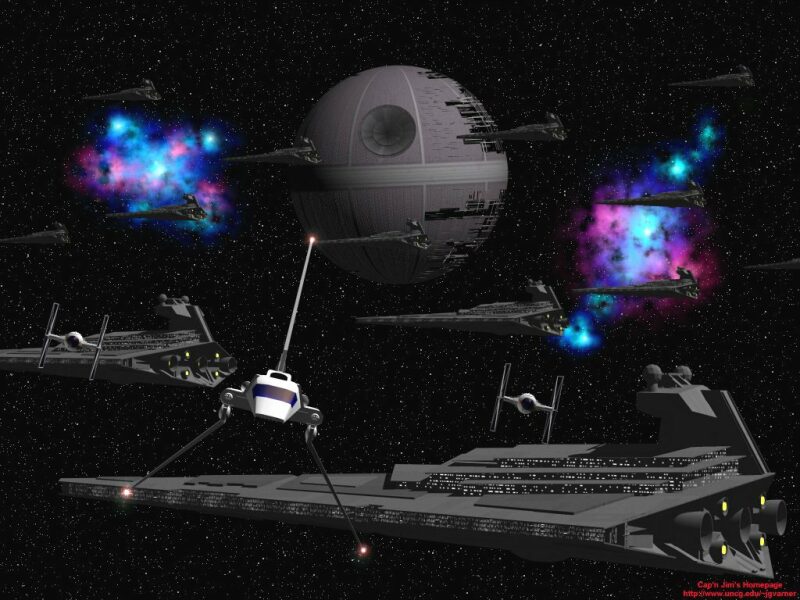
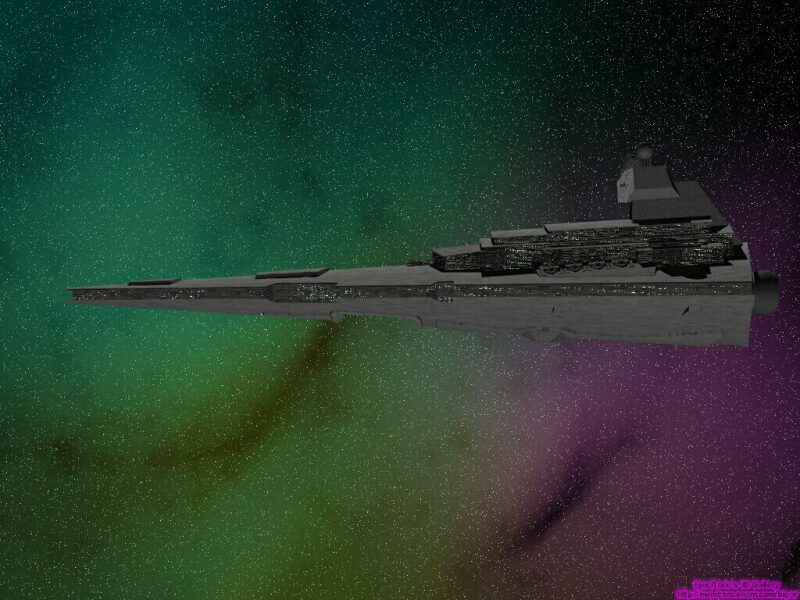
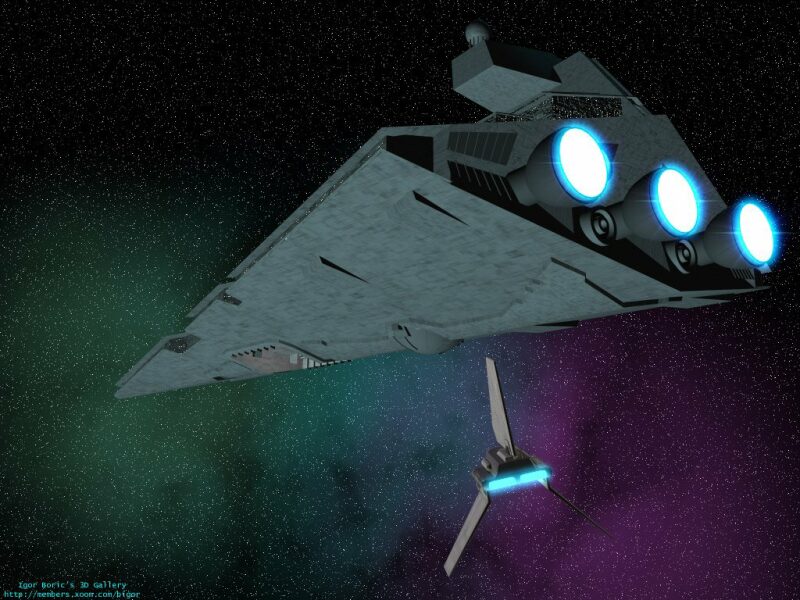
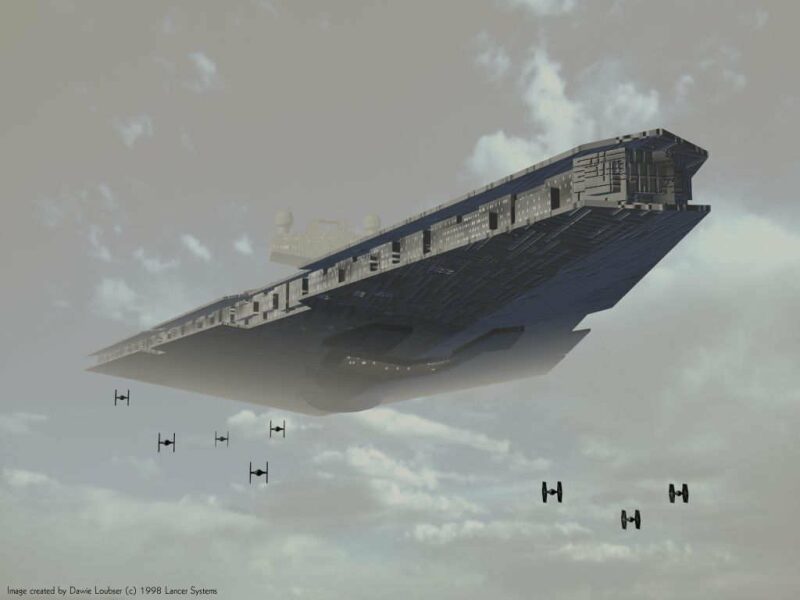
"Photon torpedoes and quantum torpedoes both release energy equal to large nuclear fusion weapons. Star Wars shields have been designed to withstand such weapons- in fact, starfighters routinely fire directed-energy nuclear weapons at capital ships with little or no effect. The ROTJ novelization specifically describes a thermonuclear explosion immediately outside Admiral Ackbar's bridge window in the opening minutes of the Battle of Endor, which was undoubtedly caused by a fighter-launched missile since the capital ships of the two fleets had not yet engaged in battle. This explosion had negligible effect upon Ackbar's vessel, which is of course what one would expect. We project that our Star Destroyers should be able to withstand roughly 1000 photon torpedoes or 370 quantum torpedoes before losing shields. This estimate is based on the ISD shield strength of 1E20 joules determined in the Imperial shield analysis.
However, those torpedoes are almost certain to strike our large Star Destroyers repeatedly in spite of their poor maneuverability, because Star Destroyers have slow turning rates (and are very large targets). Also, we project that our TIE fighters will suffer heavy (but acceptable) losses if the Federation uses proximity-fused photon torpedoes against them."
However, due to the instability of Federation engines, they would be easily destroyed by the Imperial ships:
"It is our belief that the historically short combat lifespan of Federation vessels is due to inherent design flaws in those vessels, primarily their use of metastable power generation technology which is prone to catastrophic failure due to system damage. While their starships have been designed and optimised for very short-duration confrontations, all Star Wars Imperial warships were designed for prolonged survivability in combat. It is this design philosophy that gives us our primary advantage over the Federation- we can simply outlast their vessels by continuing to absorb and release punishment after their vessels succumb. "
quote:
The Empire only had lasers...except of course the death star...that's a different story... |
D'oh!  We've been dealing with this for the past two pages! The Empire's turbolasers are NOT lasers in the sense that exist now in science, it is NOT possible that they are. They don't act at all like lasers MUST behave. We've been dealing with this for the past two pages! The Empire's turbolasers are NOT lasers in the sense that exist now in science, it is NOT possible that they are. They don't act at all like lasers MUST behave.
quote:
Do you think that the most advanced flagship, the Enterprise, could withstand a direct hit from the death Star?
I know it can detroy a planet, but are the shields on the Enterprise strong enough to stop the blow? A planet has no shields... |
Indubitably. Shield or not, the amount of energy required to blow a planet into very small bits with a very short blast is enormous: about 3 million times the power output of the sun.
Considering the ease with which Death Star II anhilated rebel MonCal cruisers in combat, with shields, it's unquestionable that they'd destroy the Enterprise just as easily.
|
|
| |
|
|
|
Boris Godunov
|
|
Portland, OR
Aug 2001
time: 00:27
|
|
quote:
Originally posted by obiwan18
So how can we see a flashlight, Boris?
That depends not on the speed, but the duration of the pulse.
Do you know what a nebula is? An area of space with above average dust grains and particles. The reason they are coloured is because light scatters when it strikes the dust particles.
You don't need that much dust to scatter a laser, although admittedly, most of space would not have enough dust to scatter the light. |
Unless you have powers I do not possess, I doubt that, when you turn on a flashlight, you can see the light begin, exit the flashlight, and then hit whatever object it will reflect off of. That's the point...to our eyes, it is instantaneous. No matter how you changed the duration of the "pulse," you'd never see a flashlight, or a laser, "emerge" from the flashlight and travel as if it were an object. You'd see an instantaneous and continuous beam of light from the bulb of the light.
And no, there wouldn't be near enough dust in space to make a laser beam visible.
|
|
| |
|
| |
|
|
|
Boris Godunov
|
|
Portland, OR
Aug 2001
time: 00:27
|
|
quote:
Originally posted by obiwan18
Suppose you fire a laser for a few seconds...
Could you see the laser beam then? That is what I meant. Seeing a laser has nothing to do with the speed, merely the amount of material in the way. |
Seeing the beam isn't the issue (provided the air was dense enough with dust to enable you to see it). The issue is that a laser beam wouldn't behave as a turbolaser blast does. Turbolaser's fire "bolts," which don't act like lasers at all. The bolt is cleary seen emerging from the cannon, exiting and then terminating, and then the bolt flies through space to hit its target. A laser beam could do no such thing...it would be a continuous stream of light, and when the cannon stopped firing, it would cease to be as well.
quote:
Some areas of space have high concentrations of dust, and do manage to reflect light. |
Of course, but space battles in Star Wars don't take place in such regions (nebulae). They take place in the open void, where the dust concentration is negligible.
|
|
| |
|
|
|
Urban Ranger

|
|
Apolyton Duke of Off-Topic
|
|
quote:
Obviously, turbolasers cannot possibly be lasers...
they are visible in vacuum. |
It's not that they are visible in a vacuum, but they are visible against a background of absolute darkness.
One reason why you can't see the beam of a laser pointer, other than random scattering, is because of the background ambience. A laser is a very coherent beam of photons, so almost all the photons travel in the same direction. Scattering bounces the photons in other directions, giving you a chance to see it. But there is a very small fraction of these photons that travel in other directions, that's why a laser beam will lose coherence after a while. Anyway, against a bright background you can't see these, particularly something as weak as a laser pointer.
If you make the background absolutely black, and increase the energy of the beam by at least millions of times, I am pretty sure you can see it.
|
|
| |
|
|
|
Dr Strangelove
|
|
Speed counts. In the first Star Wars series Han Solo brags that his ship can make "point 5 past light speed". Star Trek ships travel much faster, so they would be able to dart in and fire on the Star Destroyers and move out of range before the Imperials got off a shot. Also Star Trek weapons would presumably pass through Imperial shields without diminishing since phasor beams phase in and out of subspace. Since the empire hasn't discovered subspace then they wouldn't be able to shield their ships against such weapons.
|
|
| |
All times are GMT. The time now is 05:27.
Apolyton Time is 00:27. |
top of page
|
| archivepost |
|
Forum Rules:
You may not post new threads
You may not post replies
You may not post attachments
You may not edit your posts
|
HTML code is ON
vB code is ON
Smilies are ON
[IMG] code is ON
|
|
|
|
|
|





 27-03-2003 03:27


 I viewed that animations as view models generated by FTL sensors for better control of battle. Or for nice efects for bored movie fans.




 For example, he put the output of those weapons in both TW (tetavwalts I reckon) and megatons (of TNT). The thing is TW is a unit of power and megatons is a unit of energy. I don't think a physicist will rather be dead first than be caught with such a boneheaded mistake.

 Attachment:
  |
|