|
| |
|

|
UnOrthOdOx
|
 |
Hello....
Jun 2002
time: 22:27
|
|
|
|
 17-04-2003 04:06 17-04-2003 04:06
|
|
|
|
|
|
|
|


|
#1

|  |
|
City Council: Most effective use of workers, esp non-industrial
|
Support Apolyton
|
|
Since we are going to be the Vikings, I thought I would start this up.
There may well be this information out there already, please link to relevent threads, or post the info here.
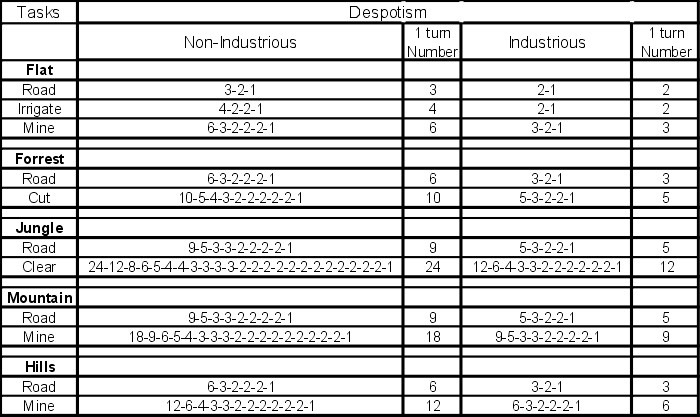
First of all, if someone has a list of base turn required for a non-industrial worker to improve the various types of land, please post it here or link to it.
We all know the value of stacking worker to speed improvements, however, stacks have a diminishing return in terms of # of turns they take off a job. This situation is more prominent with non-industrial workers.
For example: say a non-industrial worker takes 5 turns to road a hill. A second worker would reduce that to 3 turns, a third to 2 turns, and a fourth would still remain 2 turns. It would take a 5th to make the road in one turn. (this is only an example, real times may vary)
In this case, it would be more of a benefit for the 4th worker to start a different improvement instead.
However, the cases can be more complicated:
A road on plains takes 3 turns for a single worker, 2 turns for 2 workers. However, those same two workers seperate could road two seperate tiles in three turns where it would take them 4 together. There are times when this may be beneficial than the single tile in 2 turns.
For discussion:
What is the most beneficial use of workers and stacks?
When is it better to split a stack?
What are the breaking points for the various improvements? (ie, when do adding more workers stop to reduce # of turns on an improvement?)
|
|
| |
|
|
|
UnOrthOdOx
|
|
Hello....
Jun 2002
time: 22:27
|
|
?
This is odd, then.
Road on a Grassland is 3 turns, mine 6, and irrigate 4...
You have 6, 12, 8 listed...
6 and 12 match up with hills, cant irrigat those, though.
Roading a forest is also 6, clearing 10.
Mountain is 9 to road, 18 to mine.
Fields, flood plains and desert match with Grassland.
Now to figure how stacking works...
|
|
| |
|
|
|
badams52
|
 |
near the magic kingdom
May 2002
time: 21:27
|
|
That chart is very nice. We might want to brush up on worker management and cracker's site over on civ fanatics is a great place to start. His basic recomendation is 2 workers for clearing forests, and 3 for clearing jungle (non industrial) and looking at your chart, I would suggest 2 for mining hills and 3 for mining mountains.
One thing I want to point out about worker teams, while I do use them especially for forest and jungle clearing, is that they are more efficient if a road is already put in place. If you are moving both of them to an unimproved tile, you've wasted a worker turn in movement. Let's take an example of using two workers building 2 roads and 2 mines (on grassland in despotism). Each one working separately, it looks like this:
worker 1: worker movement, road, road, road, mine, mine, mine, mine, mine, mine
worker 2: worker movement, road, road, road, mine, mine, mine, mine, mine, mine
Sum: 10 turns, 2 roads (after 4 turns) 2 mines (after 10 turns).
Now if they're together:
worker 1: worker movement, road, road, mine, mine, mine, worker movement, road, mine, mine, mine
worker 2: worker movement, road, mine, mine, mine, worker movment, road, road, mine, mine, mine
Sum: 11 worker turns, 2 roads (1st after 3, 2nd after 8) , 2 mines (1st after 6, 2nd after 11)
So we essentially lose 2 worker turns per team, but gain 1 road 1 turn early and 1 mine 4 turns early while the 2nd road comes 4 turns later, and the second mine comes 1 turn later.
So what I'm saying is that pre-roading, using teams is a trade-off. You get the first road and first mine earlier, but the second ones come later and you lose worker turns moving the stack to unimproved terrain. In this case the question becomes, it is more important to get that 1 extra trade and 4 extra shields, or will the loss of worker turns end up hurting more than we gain.
And we also need to take into account what the city needs.
I'm not sure which way to jump.
Also wanted to point out a little worker management advantage that T-hawk pointed out in this thread.
By building roads using the "build road to" command (ctrl-r) the road being build will be finished during our turn when all the unit movement orders are completed rather than after the end of the turn. So it would be benefecial for us to always use 'ctrl-r' rather than 'r' even when just roading 1 tile.
But there is a question whether this type of use is an exploit or not.
Last edited by badams52 on 17-04-2003 at 19:55
|
|
| |
|
|
|
E_T
|
 |
Orlando, Florida
Mar 2001
time: 00:27
|
|
For flatland, it's more efficient to use 2 workers in separate tiles than to stack them up
Example:
Non-industrious worker takes 3 turns to road a flatland tile. Also 1 turn to move to that unroaded tile, so 4 turns total. If you use 2 workers, it will take 2 turns to road that same tile, plus the 1 turn to move, so that's 3 turns total.
Over 12 turns:
With 2 workers working separately - 6 tiles are roaded.
With 2 workers working together - 4 tiles are roaded.
You should only double up when roading Hills and Forrest, Mining Flat & Hills, Irrigating Flat and Cutting forrest.
You should try to triple up when roading or clearing Jungle and roading and Mining Mountains.
One thing that I have done in the past is to have the 2 workers both road the separate tiles, then both double up and Improve the already roaded tiles.
Another thing that I also do, is to either mine or irrigate a tile that is next to a river before I road it, as it already has the trade bonus available for use.
E_T
|
|
| |
All times are GMT. The time now is 05:27.
Apolyton Time is 00:27. |
top of page
|
| archivepost |
|
Forum Rules:
You may not post new threads
You may not post replies
You may not post attachments
You may not edit your posts
|
HTML code is ON
vB code is ON
Smilies are ON
[IMG] code is ON
|
|
|
|
|
|










 Attachment:


 , or put two on grass/plains , one for the road , the other for the mine , ...
 |
|