 |
| |
|
| |
|

|
Promethus
|
 |
Battle Creek, Michigan
Jan 2002
time: 00:27
|
|
Advanced Micro Issues Challenge to Rivals
By JOHN MARKOFF with STEVE LOHR
SAN FRANCISCO, April 18 — Intel will face its strongest challenge in more than a decade when its archrival, Advanced Micro Devices, formally unveils the Opteron 64-bit microprocessor next week.
Opteron represents a determined attempt by Advanced Micro to undermine Intel's blueprint for dividing the computing universe into two worlds: one represented by its desktop 32-bit Pentium processors; the other by its pricier, corporation-oriented Itanium 64-bit chips. In doing so, Advanced Micro is trying to blur the line between the computing categories, positioning its new processor as a simpler transition for software designers and computer users from the standard 32-bit chip architecture to 64 bits, which shatters the limit on computing memory from 4 billion bytes to what, for all practical purposes, is an unlimited ceiling.
But Advanced Micro, which competes directly against Intel in both microprocessors and in the market for flash memory chips, which are widely used in consumer products like cellphones, faces a big challenge in its attempt to chip away at Intel's powerful status in the industry. Indeed, many industry executives see the Opteron processor and the Athlon 64 — its companion desktop version to be released this fall — as a make-or-break test for Advanced Micro as it tries to carve out a secure, profitable position within Intel's shadow. Last week, A.M.D., while surpassing Wall Street expectations and claiming to have gained market share against Intel, reported a $146 million loss for the quarter on revenue of $715 million. Advanced Micro, which is based in Sunnyvale, Calif., has reported losses in four of the last five years and badly needs to have a hit product in Opteron.
The company is hoping that it can take advantage of the industry transition from 32-bit to 64-bit computing, which will initially be driven by the need for corporations to handle vast databases. But looking forward several years, an even bigger market beckons as desktop computers are expected to support far more powerful graphical applications.
During the last three decades Silicon Valley has gone from what now seem like simple 4-bit designs to the ability to turn out incredibly complex 64-bit processors. Each generation of chips has permitted computers to make use of larger blocks of data while also allowing them to double the amount of information that can be handled with each super-fast tick of the computer clock.
Until now Intel has thoroughly dominated the desktop computing world, while companies like I.B.M., Sun Microsystems and Hewlett-Packard have sold more powerful and more expensive 64-bit computing systems to corporate computer users. Almost a decade ago Intel and Hewlett-Packard joined forces to design the 64-bit Itanium in an effort to blend the increasing computing potential of the more powerful processor with Intel's sophisticated manufacturing capabilities. Their first product was commercially introduced in 2001; it is now in its second generation.
Itanium, however, has been slow to catch on, in part because the chip's performance has been disappointing and in part because software designers and corporate customers have been slow to convert software from other hardware platforms. Moreover, the computer cognoscenti have generally been more enthusiastic about the Advanced Micro chip design, which is expected to offer roughly equal performance at a lower price.
Even more threatening to Intel, the Opteron chip promises to run existing software seamlessly, potentially allowing Advanced Micro to get in the door with corporate users by promising a smoother transition to 64-bit technology. By contrast, Itanium users have faced a penalty in using current 32-bit software, which runs more slowly in a special emulation mode.
Intel is already under the gun, industry executives said, because Microsoft has committed itself to offering its operating system for the Opteron as well as Itanium. If Intel were forced to introduce a similarly compatible processor, which is reportedly in the works at the company's research labs as an insurance policy, it would be forced to either follow Advanced Micro's standard or persuade Microsoft to invest in yet a third 64-bit operating system.
Perhaps more significant, Advanced Micro is pricing the new Opteron chips to compete against Intel's 32-bit Xeon processors, which are now widely used in the market for low-end corporate servers.
Continued
1 | 2 | Next>>
|
|
| |
|
|
|
Promethus
|
|
Battle Creek, Michigan
Jan 2002
time: 00:27
|
|
Advanced Micro Issues Challenge to Rivals
(Page 2 of 2)
If the Opteron lives up to the earlier performance expectations and is widely adopted in corporate applications, it could badly undercut Hewlett-Packard as well as Intel, particularly because corporate spending on information technology has been cut by the recession.
"In many ways this is an excellent time to introduce the Opteron," Hector Ruiz, Advanced Micro's chief executive, said. "It will be possible to make a simpler transition because it will be possible to run the existing 32-bit software without modification."
Hewlett-Packard and Intel executives respond that Opteron faces its own challenges in the marketplace. Bringing application software to new computer designs will be more complex than A.M.D. suggests, they said.
"It is a hard, complex problem that we've been working on for a long time," said Shane V. Robison, chief strategy and technology officer for Hewlett-Packard. "The Opteron guys are going to have to go through the same thing.
"Having the microprocessor is one thing," Mr. Robison added. "Having it ready for the enterprise — all the software, management tools and other expertise you need — is another."
He also asserted that Hewlett and Intel would retain a performance edge because of Intel's manufacturing advantages in building chips with even smaller design features.
Apart from manufacturing, Advanced Micro's biggest challenge is to establish support from industry leaders quickly for its new design.
"It's important for A.M.D. to build a sense of momentum for Opteron," said Jim Turley, publisher of Silicon-Insider, a computer industry newsletter in Pacific Grove, Calif.
Dell, I.B.M. and Sun Microsystems are all potential backers for the new A.M.D. processors but none have publicly announced a commitment yet. Industry executives said it was probable that at least one of the computer makers would announce its support on Tuesday in New York, when the new processor is publicly introduced.
The jockeying inside the industry has been particularly brutal, according to a number of people who have been engaged in the struggle.
"Some of our customers," Mr. Ruiz said, "have woken up to find horses' heads in their beds."
********************************************
Are there a lot fewer Horses in Alberta these days?
|
|
| |
|
|
|
Wraith
|
 |
Austin, Texas, USA
Aug 1999
time: 23:27
|
|
I should have expected this one...
--"The Athlon 64 2800+ runs at a whopping 1.6GHz."
Don't forget that this is an engineering sample. X-Bit labs is breaking an NDA on this, too, which isn't impressive. But, anyway, they've got a very pre-release processor and board.
And that whopping 1.6 Ghz cleans up over the much faster clocked AXP in most cases.
Really, Asher, are you going back to the Mhz is everything line? I mean, where does that leave Intel's Centrino and Itanium?
--"so I've mirrored the interesting benchmarks:"
Leaving aside the synthetic benchmarcks (from the full list, not your list), for performance improvement over the equivalently clocked AXP I see:
60.36%
0.61%
16.35%
11.40%
4.13%
21.51%
19.06%
29.68%
33.78%
37.39%
5.44%
51.96%
3.28%
11.76%
For an average of 21.91%
Not bad for an engineering sample, especially when they're expected to be at a higher clock rate at launch.
--"I wonder what the 3.0GHz with HyperThreading would do to the Athlon 64 2800+. "
You seem to be missing the point of the PR ratings, but it's all rather irrelevant until some actual final hardware reviews come out.
--"AMD looks like it's in trouble still."
Heh. I remember what the previews of the Athlon were like. Apparently, you don't ^_^
--"Question: How can a processor which is thoroughly stomped by a 2.8GHz P4 compete with an Itanium?"
Not the same processor, obviously. The Opterons have a much different memory interface. But don't worry, the NDA on those should be lifting next week, so we should see some real results then.
The early numbers I've seen for Opteron are quite good, btw. Can't trust them much, of course, but it looks like the Xeon line is in trouble. Depending on the final power consumption and processor scaling of the Opteron, the Itaniums could be in trouble too (those things have utterly horrible power density and don't scale nearly as well as a high-end processor meant for multiprocessor use should).
Wraith
"The world is full of idiots."
-- Reki ("Haibane Renmei")
|
|
| |
|
|
|
Asher
|
 |
Calgary, Alberta
Nov 1999
time: 22:27
|
|
quote:
Originally posted by Wraith
Don't forget that this is an engineering sample. X-Bit labs is breaking an NDA on this, too, which isn't impressive. But, anyway, they've got a very pre-release processor and board.
And that whopping 1.6 Ghz cleans up over the much faster clocked AXP in most cases.
Really, Asher, are you going back to the Mhz is everything line? I mean, where does that leave Intel's Centrino and Itanium? |
No, I'm not implyign the P4 is better because it runs at higher MHz. I'm pointing out that the rumours of AMD having troubles hitting high clockspeeds are true -- the Clawhammer runs at a fraction of the speed of the old Athlon XP, and is beaten by the old Athlon XP in several of the benchmarks. Sure, the Clawhammer is slightly faster in some of them, but it should be a helluva lot faster with the "greatly" improved branch prediction, integrated memory controller, 1MB L2 cache, 128KB L1 cache...
The article also mentions how this is the B revision the core, and the A one hit about 800MHz. This is already a very mature core, the core's been running for a long time now, AMD keeps delaying it because they're ****ing it up and can't get it to run competitive even with a 2.8GHz P4. Prescott will bury the Athlon 64.
quote:
Leaving aside the synthetic benchmarcks (from the full list, not your list), for performance improvement over the equivalently clocked AXP I see: |
"equivalently clocked"? That's a semantic, compare AMD's PR ratings because that's what determines price and people's perception.
The Athlon 64 2800+ is quite frequently slower than the Athlon XP 2800+. Whether it's faster per clock (and indeed, it is) is moot if it can't hit the high clock speeds.
quote:
For an average of 21.91%
Not bad for an engineering sample, especially when they're expected to be at a higher clock rate at launch. |
You are putting far too much emphasis on this being an "engineering sample". This is a very mature core, it was supposed to be out quite a while ago. The problem is they can't get it to hit higher frequencies, which is why it was delayed. It's not so much an engineering sample but a oft-delayed commercial sample that they're still trying to tweak for high speed...
I mean, it's a B stepping already. Intel's B-stepping for the Pentium 4 came out a year after it was released publically...
|
|
| |
|
|
|
Wraith
|
|
Austin, Texas, USA
Aug 1999
time: 23:27
|
|
--" I think you were supposed to type "some cases" instead of "most cases"."
Not really. I remember Asher going on about how no-one needed more power in office apps, that games and the like were where it counts, and that certainly looks like where the A64 is headed. Still, he does get on my nerves, so I tend to overract to his idiocies.
I find it more amusing to see what benchmarks they left out. Still, we'll have to wait for the real release to find out.
--"I'm pointing out that the rumours of AMD having troubles hitting high clockspeeds are true "
I'm glad to see you've got contacts at AMD, since there's no way you could possibly draw that conclusion from the preview.
The A rev cores were locked at 800 Mhz, btw, which isn't the same thing as limited to. They were development pre-release machines for the most part and AMD certainly wouldn't want Intel to find out everything about them then.
--" That's a semantic, compare AMD's PR ratings "
Yes, please do. Leaving aside the synthetic benchmarks the A64 2800 does quite well against the AXP 2800.
--"the problem is they can't get it to hit higher frequencies,"
Ah, again, who do you happen to know at AMD? I know you keep saying this, but you really don't have much proof. They're working with SOI, so it's not at all unlikely they had process problems, but scaling problems are much less likely.
You also seem perfectly willing to ignore the market conditions. Barton is doing fine against the P4, spending in the computer sector has slumped anyway, and so on. It makes the best economic sense to hold off on the consumer chips and dedicate the SOI fab space to the higher-margin Opterons for now. More validation required, but more profits would be worth it.
Wraith
"Have you the brain worms?"
- Zim ("Invader Zim")
|
|
| |
|
|
|
Asher
|
|
Calgary, Alberta
Nov 1999
time: 22:27
|
|
quote:
Originally posted by Wraith
I'm glad to see you've got contacts at AMD, since there's no way you could possibly draw that conclusion from the preview. |
Well, let's see the logic behind it and see if it makes sense, shall we?
1) Constant delays, 1.5-2 years in fact
2) Revision A cores "locked" at 800MHz -- you don't think they'd lock them all at 2GHz if they could hit those frequencies?
3) Increased L2 cache to 1MB to help offset lower clockspeeds
4) Last-minute $40M cheque sent to IBM to help them get SOI working on their chips.
5) The fact that the 2800+ chip is nowhere near the performance levels of a 2800MHz P4, and the clockspeeds are nowhere near the levels of an Athlon XP 2800+.
6) The Athlon core's history of clockspeed problems on 0.13 -- remember all of the Thoroughbred cores? It's not like this is unprecedented for AMD.
All signs point to the rumours of delays due to inability of hitting high clockspeeds.
Of course, you're welcome to cover your eyes and shout "There is no proof", but most people are slightly more perceptive than that. 
quote:
Yes, please do. Leaving aside the synthetic benchmarks the A64 2800 does quite well against the AXP 2800. |
If you say so -- the results in these benchmarks are extremely disappointing. The Athlon XP is already having a hard time keeping up with the Pentium 4, and the Athlon 64 doesn't appear to be any faster. So what's going to happen to AMD when Prescott launches, whose entire purpose is simply speed boosts?
quote:
You also seem perfectly willing to ignore the market conditions. Barton is doing fine against the P4, spending in the computer sector has slumped anyway, and so on. |
If Barton is doing "fine", how come AMD's marketshare continues to shrink? How come AMD continues to post losses? How come the performance delta between the Athlon XP and Pentium 4 continues to increase? How come AMD had to rework the performance ratings on the new core to make it look even more competitive (when it clearly is not)?
Barton may be doing "fine" if that's how you want to look at it, but compared to Northwood-B, Barton's pretty pathetic. There's almost no die-size difference between the two cores now, and Intel's got 300mm wafers they're working with, and no-doubt has lower manufacturing costs now.
And Prescott is coming soon.  Prescott will compete with the Athlon 64. And let's face facts, the Athlon 64 looks like a dud in the performance department when you compare them with Intel's current Pentium 4s even. Prescott will compete with the Athlon 64. And let's face facts, the Athlon 64 looks like a dud in the performance department when you compare them with Intel's current Pentium 4s even.
Last edited by Asher on 20-04-2003 at 05:34
|
|
| |
|
|
|
Zopperoni
|
|
quote:
Originally posted by CyberGnu
Not to threadjack too much, but if I want to buy a medium range processor ($100-200) in the next couple of months, is AMD still the best bang for the buck? |
Not really, the P4 2.4 GHz is very good value.
I'm getting one next week, along with an Intel 865G motherboard.
|
|
| |
|
|
|
Zopperoni
|
|
Ehm, according to the guy at the store it's coming to Europe on April 22nd.
I was at his store last Wednesday. He told me that the 865 was launched on that day in the US, and already launched in Japan on Tuesday.
He was receiving a shipment of 875s on that day too (he gets them directly from Intel).
I hope to get a call from him on Tuesday, so I can pick it up Wednesday morning =)
|
|
| |
|
|
|
Urban Ranger

|
|
Apolyton Duke of Off-Topic
|
|
quote:
Originally posted by Asher
1) Constant delays, 1.5-2 years in fact |
I am glad that the Itanic came out on time 
quote:
Originally posted by Asher
2) Revision A cores "locked" at 800MHz -- you don't think they'd lock them all at 2GHz if they could hit those frequencies? |
Yes and no. Engineering samples usually are never set to the highest possible. They are like beta releases with minor bugs to remove.
quote:
Originally posted by Asher
3) Increased L2 cache to 1MB to help offset lower clockspeeds |
I heard the newer P4s will come with bigger caches too
quote:
Originally posted by Asher
4) Last-minute $40M cheque sent to IBM to help them get SOI working on their chips. |
Well? What's the problem here?
quote:
Originally posted by Asher
5) The fact that the 2800+ chip is nowhere near the performance levels of a 2800MHz P4, and the clockspeeds are nowhere near the levels of an Athlon XP 2800+. |
There are engineering samples. I gathered you have never worked with a real engineering project before.
quote:
Originally posted by Asher
6) The Athlon core's history of clockspeed problems on 0.13 -- remember all of the Thoroughbred cores? It's not like this is unprecedented for AMD. |
Don't we all know that clockspeed is a bad indication of processor power?
quote:
Originally posted by Asher
All signs point to the rumours of delays due to inability of hitting high clockspeeds. |
There are, of course, other various rumours. Like waiting for MS releasing a 64-bit version of Windows.
quote:
Originally posted by Asher
If you say so -- the results in these benchmarks are extremely disappointing. The Athlon XP is already having a hard time keeping up with the Pentium 4, and the Athlon 64 doesn't appear to be any faster. So what's going to happen to AMD when Prescott launches, whose entire purpose is simply speed boosts? |
Fast doesn't mean jack. Higher clockspeed is not the same as executing more instructions per second.
Of course, since there is no traces of said "Prescott," it's all FUD so far.
quote:
Originally posted by Asher
If Barton is doing "fine", how come AMD's marketshare continues to shrink? How come AMD continues to post losses? |
Last I heard, the PC market hasn't been doing so well in the last few years.
quote:
Originally posted by Asher
How come the performance delta between the Athlon XP and Pentium 4 continues to increase? |
In what sense?
quote:
Originally posted by Asher
How come AMD had to rework the performance ratings on the new core to make it look even more competitive (when it clearly is not)? |
Clearly, 64-bit processors run differently from 32-bit processors. That should be elementary.
quote:
Originally posted by Asher
And Prescott is coming soon. Prescott will compete with the Athlon 64. And let's face facts, the Athlon 64 looks like a dud in the performance department when you compare them with Intel's current Pentium 4s even. |
If it comes out, then we'll talk. Right now, I haven't any Prescott.
|
|
| |
|
|
|
Asher
|
|
Calgary, Alberta
Nov 1999
time: 22:27
|
|
quote:
Originally posted by Urban Ranger
I am glad that the Itanic came out on time |
I'm not saying there was no problems with the Itanium. But it's not really the same thing.
The Itanium is a radical new design, fundamentally new instruction set, and theoretical new concepts. Clawhammer is an Athlon with more registers, and 64-bit addressing space and integer registers, and an integrated memory controller.
Bit different.
quote:
I heard the newer P4s will come with bigger caches too |
That's true, but the reason the bigger cache will come is because they're moving to 0.09 and have the space to spare. Plus, the P4 design is very sensitive to L2 cache and memory bandwidth.
quote:
Well? What's the problem here? |
They spent ~8 months trying to do it themselves, gave up, called 911.
quote:
There are engineering samples. I gathered you have never worked with a real engineering project before. |
I've already addressed this...
quote:
Don't we all know that clockspeed is a bad indication of processor power? |
Strawman...
It's a bad indictation, but it's also a critical component of processing power.
quote:
There are, of course, other various rumours. Like waiting for MS releasing a 64-bit version of Windows. |
The IA-64 version has been out for quite some time.
quote:
Fast doesn't mean jack. Higher clockspeed is not the same as executing more instructions per second.
Of course, since there is no traces of said "Prescott," it's all FUD so far. |
Prescott has been shown publically, hell there are IMAGES of the core on the internet. It's just not out yet because 0.09 micron isn't ready for mainstream.
About a year ago, the Athlon was faster than the Pentium 4 in general.
Now, the Pentium 4 is faster than the Athlon. With the addition of HT and 800MHz system bus, the gap continues to grow...
quote:
Clearly, 64-bit processors run differently from 32-bit processors. That should be elementary. |
I was referring to Barton. It's still a 32-bit processor, but they adjusted the PR ratings to make it look faster than it actually is so it didn't look like they were falling too far behind.
quote:
If it comes out, then we'll talk. Right now, I haven't any Prescott. |
The Athlon 64 isn't out yet either, so we're supposed to assume it doesn't exist?
There are more details of Prescott known than Athlon 64, physically. Show me the equivalent Athlon 64 shots of the die (these are Prescott):
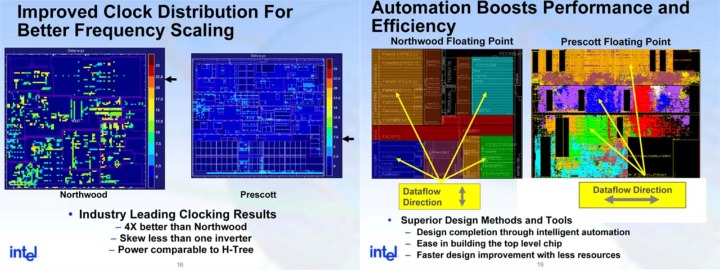
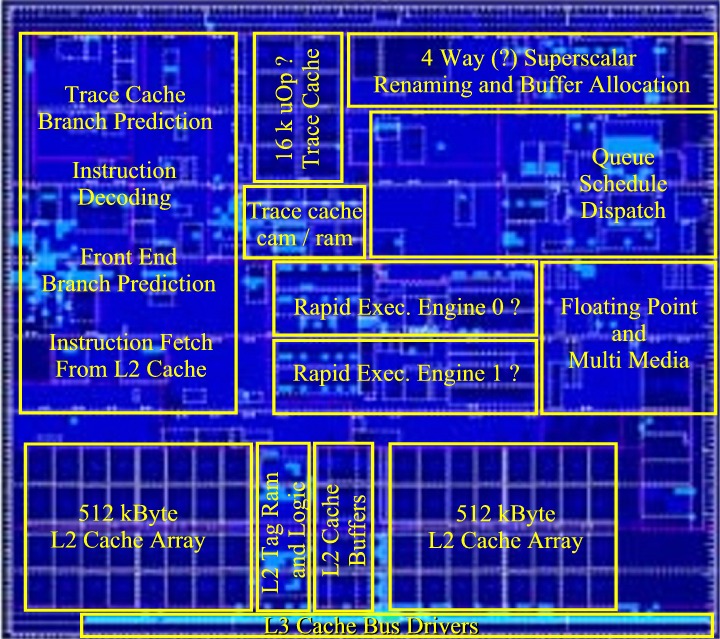
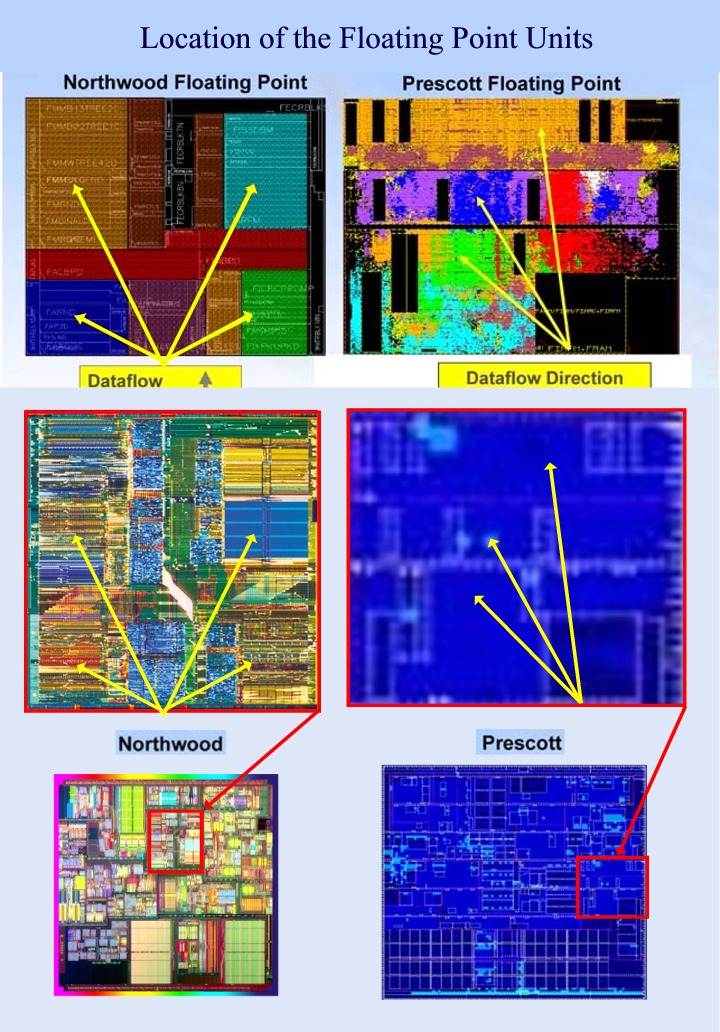
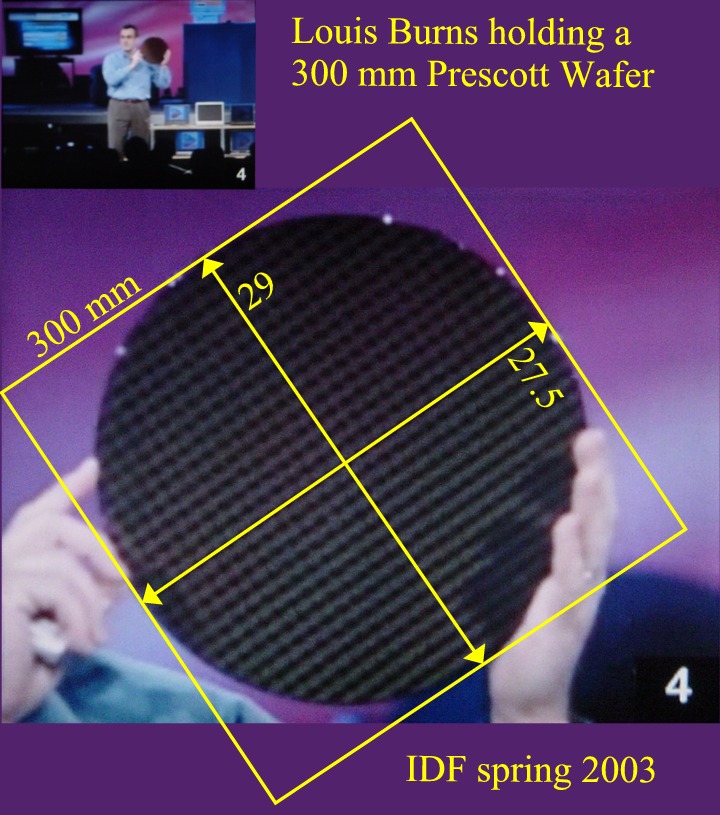
Are you still going to fall behind that argument about Prescott being vapourware?
|
|
| |
|
| |
|
|
|
Wraith
|
|
Austin, Texas, USA
Aug 1999
time: 23:27
|
|
--"Well, let's see the logic behind it and see if it makes sense, shall we?"
Asher and logic don't seem to go well in the same sentence, and I've already talked about a few of your points a bit.
But let's see now.
--"3) Increased L2 cache to 1MB to help offset lower clockspeeds"
Um... were you the one talking about logic? L2 cache doesn't do anything to offset lower clockspeed. It can offset the low clock speed of the connection to memory, but, well, that's not the case here.
--"4) Last-minute $40M cheque sent to IBM to help them get SOI working on their chips."
Yeah. Like I said, process problems. You don't seem to understand what that means.
--"5) The fact that the 2800+ chip is nowhere near the performance levels of a 2800MHz P4,"
Dunno, they don't seem that far off to me.
--"and the clockspeeds are nowhere near the levels of an Athlon XP 2800+."
Well, yeah. That was kind of the point of the design. Higher IPC.
--"6) The Athlon core's history of clockspeed problems on 0.13 -- remember all of the Thoroughbred cores?"
More process issues, for the most part. They happen, but Intel suffers from them too. You forgetting their recent recall already?
--"-- the results in these benchmarks are extremely disappointing."
It runs roughly equal with the AXP of the equivalent PR rating, even beating it in the more important ones like gaming. If you were expencting a whole lot more, then your expectations were too high. Think about the point of the PR ratings for a bit.
--"If Barton is doing "fine", how come AMD's marketshare continues to shrink?"
Well, the entire market is kind of shrinking, so yeah, that could be part of it. Not to mention Intel's long marketing campaign directed at corporations. There's still a "you won't get fired for buying Intel" mentality, and AMD really doesn't know how to market to corporations at all. So it's really not that surprising.
BTW, Intel's reputation for stability and quality is overblown. I don't work on PCs, but doing testing at Dell has let me learn some interesting things about Intel's products.
--"And Prescott is coming soon."
So it is. Shows that Intel's a bit wiser about the market than you are. They wouldn't have been pushing the releases forward if they weren't worried.
--"There's also a good 8-page document on the new SSE instructions (SSE3?) in Prescott here:"
Yeah, more XBit labs. They're pretty pro-Intel, but that's okay. SSE3 really doesn't add a whole lot to the mix. From what I've heard from programmers, there's only a couple of new instructions that will actually get used for much of anything.
BTW, that link barely addresses the new instructions. It's mostly a history lesson about MMX/3DNow/SSE/SSE2.
Wraith
"I'm rattling the cans. People expect it."
-- Garbage Man ("Dilbert")
|
|
| |
|
|
|
Asher
|
|
Calgary, Alberta
Nov 1999
time: 22:27
|
|
quote:
Originally posted by Wraith
Um... were you the one talking about logic? L2 cache doesn't do anything to offset lower clockspeed. It can offset the low clock speed of the connection to memory, but, well, that's not the case here. |
I don't think you're thinking this through well enough -- a higher count of L2 cache increases per-clock performance on average because it has less stalls waiting for system memory. It improves IPC somewhat, which is what you need when your clockspeeds are less than stunning.
quote:
Yeah. Like I said, process problems. You don't seem to understand what that means. |
I don't understand why it's relevant -- why do I care about the source of not hitting the high clockspeeds? The design, the process, they all mesh together to give you a pretty lackluster performing processor.
quote:
Well, yeah. That was kind of the point of the design. Higher IPC. |
So why did they elongate the pipeline if that was the goal of the design?
quote:
Well, the entire market is kind of shrinking, so yeah, that could be part of it. |
Intel's marketshare has increased, and Intel's revenues have either gone up or been flat. If the market is shrinking, it's AMD that's getting the shaft, and not Intel. And either way, that's not a really valid excuse because it doesn't seem to affect Intel.
quote:
So it is. Shows that Intel's a bit wiser about the market than you are. They wouldn't have been pushing the releases forward if they weren't worried. |
Prescott was originally due out in the middle of 2003, now it's near the end -- how is this "pushing it forward"?
And why does it show Intel being a bit wiser about the market than I am? 
|
|
| |
All times are GMT. The time now is 05:27.
Apolyton Time is 00:27. |
top of page
|
| archivepost |
|
Forum Rules:
You may not post new threads
You may not post replies
You may not post attachments
You may not edit your posts
|
HTML code is ON
vB code is ON
Smilies are ON
[IMG] code is ON
|
|
|
|
|
|





 19-04-2003 09:15




 |
|