|

|
Eli
|
|
Israel
Jul 2000
time: 07:27
|
|
Sounds fun.
|
|
| |
|
|
|
yavoon
|
|
the math doesnt' look complicated u just need someone who knows the lingo.
|
|
| |
|
| |
|
|
|
Jules
|
 |
Chairman & CEO, Dallas Oil Company
Jul 2001
time: 00:27
|
|
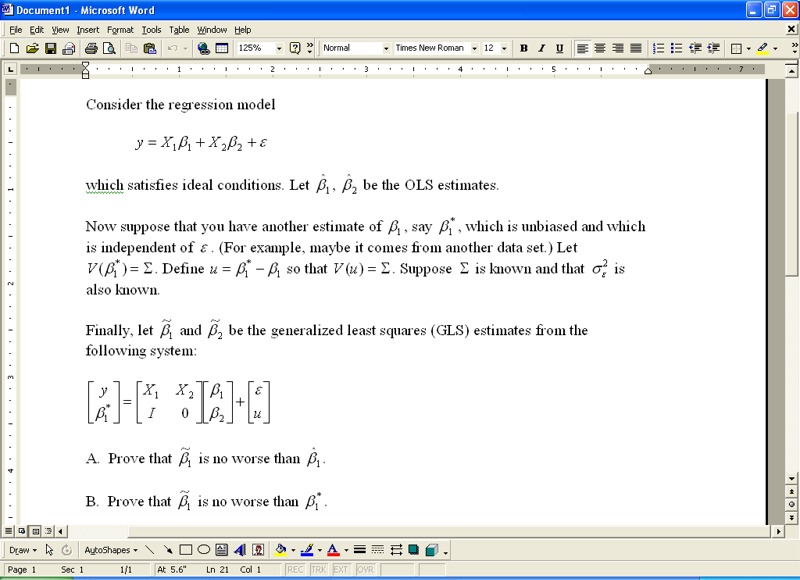
V(.) refers to the variance of the argument in parentheses. Sigma-squared-epsilon is the variance of the error term, epsilon. By "worse then," I'm assuming this means "in the variance." In other words, the variance of the GLS estimates (beta-tildes) are no greater than the variance of the ordinary least squares (OLS) estimates (beta-hats).
Also keep in mind that X1 and X2 are matrices of appropriate dimension. The betas are vectors, y is a vector, epsilon and u are vectors. So think of it this way: we have T observations, K regressor variables (represented by the X's) so that we have K regression parameters (betas) that we are trying to estimate. We partition the T x K matrix of regressors into one set of regressors X1 (T x K1) and another set X2 (T x K2), K1 + K2 = K. So beta-one is a K1 x 1 vector and beta-two is K2 x 1; y is a T x 1 vector of the dependent variable. Sigma-squared-epsilon is scaler, so the regression errors are homoskedastic. Note then that "I" in the partitioned matrix expression is the identity matrix and is K1 x K1.
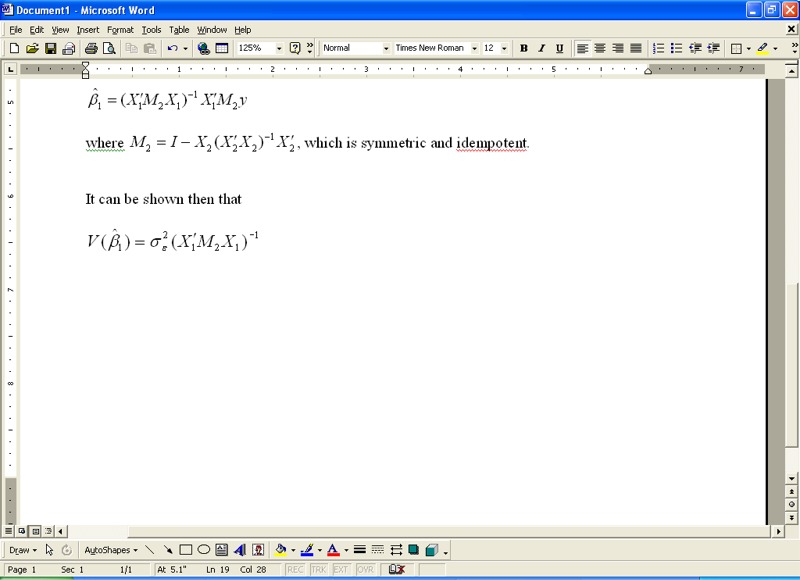
Now by the Frisch-Waugh-Lovell Theorem, the OLS estimate of beta-one (beta-one-hat) in the partitioned regression is given by:
 Attachment: econ_problem3.jpg Attachment: econ_problem3.jpg
This has been downloaded 93 time(s).
|
|
| |
All times are GMT. The time now is 05:27.
Apolyton Time is 00:27. |
top of page
|
| archivepost |
|
Forum Rules:
You may not post new threads
You may not post replies
You may not post attachments
You may not edit your posts
|
HTML code is ON
vB code is ON
Smilies are ON
[IMG] code is ON
|
|
|
|
|
|






 30-04-2003 03:15





 . At the graduate level, we study where these empirical techniques come from, the heavy-duty mathematical theory behind it, and why these techniques have desirable properties. Tough stuff.







 .
.
 |
|