|

|
Nor Me
|
|
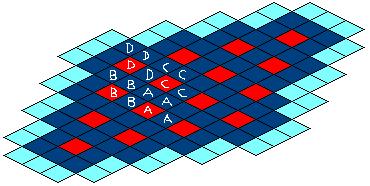
I'd say that ICS might be having more than 2 cities every 21 tiles of territory if all cities had expanded culturally once.
Sometimes the best city spots are close together so I'd define it in terms of density.
That way most 3-spaced (current agreed term for 2 spaces between cities. don't ask why) city patterns would be fine but, say, a NW,SW,NE,SE grid would have 18 squares for 2 cities so be disallowed if it had enough cities. Mixing in 2 spaced cities could put you over the limit but might not do if done sparingly.
Of course having to count is the problem. A more pragmatic and arbitrary definition might be more useful.
|
|
| |
|
|
|
DaveMcW
|
|
ICS is not a killer strategy in civ3, like it was in civ1 and civ2. If you take it to the extreme and build all your cities one tile apart your empire will soon implode from the corruption. There are also tactical problems defending cities one square apart from a stack of doom that walks in between them.
I would draw the line somewhere between 6 and 12 tiles per city and call it ICS. But I really don't think it's something that should be banned.
|
|
| |
|
|
|
Bamspeedy
|
 |
Wisconsin, USA
Sep 2002
time: 23:27
|
|
Everyone has their own definition of ICS. Some call it ICS if each city gets about 15 tiles to itself. That isn't ICS, but rather a dense build. Like Dave, I would have to say that less than 12 tiles/city is where ICS starts. Sometimes, there may be cities that are only 1 tile apart, but terrain would support the reasoning for building like that (wanting 2 cities to share the same inland lake, for example, or peninsulas). As long as other cities around it are spaced further away, so that all cities can still use up to 12 tiles, then I think it should be OK.
An extreme ICS (6 tiles or less/city), is only really good for score if you are milking a game, and even then may not always be the best, if you are sacrificing alot of territory gain to build your cities that close.
|
|
| |
|
|
|
Kirby
|
|
I agree with those that think ICS is not a particularly strong strategy. A dense build is usefull early in the game but it is better to disband some of them as the game progresses, what someone called "ralphing".
|
|
| |
|
|
|
Cartouche Bee
|
|
I consider it ICS anytime you have more than the OCN and have not hit domination.
|
|
| |
|
|
|
Nor Me
|
|
quote:
Originally posted by bongo
About 'ralphing' and other types of city placement. Can anyone recommend some good threads on that subject? |
I think the best one is City placement redux (for the third time) .
There's some more if you'd searched. ,
|
|
| |
|
| |
|
|
|
Capt Dizle
|
|
Building towns with one space between them is certainly not ICS. When you found your capital, terrain permitting, there will be four building sites only two spaces away that do not overlap your capital's 21 tile radius. So that is not ICS.
Building all of your towns with one space between is however ICS, ultimate ICS.
ICS is more than placement, its an attempt to skirt the mechanics of the game by exploiting the free center square, happiness problems due to city size, aqueduct requirements, and includes building of wonders that provide free city improvements.
The mechanics of Civ3 are much more difficult to defeat with ICS than games like Civ2 and SMAC. In fact, I would say that true ICS as we knew it in those games does not exist in Civ3 as a powerful exploit.
|
|
| |
|
| |
All times are GMT. The time now is 05:27.
Apolyton Time is 00:27. |
top of page
|
| archivepost |
|
Forum Rules:
You may not post new threads
You may not post replies
You may not post attachments
You may not edit your posts
|
HTML code is ON
vB code is ON
Smilies are ON
[IMG] code is ON
|
|
|
|
|
|






 30-04-2003 22:41










 Attachment:
  |
|