|
| |
|

|
Sava
|
 |
GO GO GO!
Mar 2001
time: 23:28
|
|
quote:
http://www.chicagotribune.com/busin...sspecials%2Dhed
Special report: Remolding the media
Radio cuts to 2-part harmony
Media giants try to put local touch on their 13 Quad Cities stations, but some listeners find the effort lacking.
By Kathy Bergen
Tribune staff reporter
May 11, 2003
DAVENPORT, Iowa -- The cluster of towns hugging the banks of the Mississippi River on the Illinois-Iowa state line was home to the first commercial radio station west of the Big Muddy.
Ronald Reagan took his first broadcasting job here. And, as in many communities across the country, prominent local citizens once owned the radio stations.
Now, the Quad Cities' 13 commercial radio stations are operated by two media giants. It's just the sort of consolidation that has occurred nationwide since radio was significantly deregulated in 1996. And this concentration is coming under intensified scrutiny now that the government is poised to further relax media ownership rules.
Some people involved in Quad Cities government and advertising say the new station owners, San Antonio-based Clear Channel Radio and Atlanta-based Cumulus Broadcasting Inc., have been good corporate citizens, sensitive to local needs and tastes.
But a different tune plays in these largely blue-collar towns--Davenport and Bettendorf on the Iowa side, and Rock Island and Moline in Illinois. Both broadcasters "tend to use the same formats, and play the same things," said Scott Heisel, a punk rock fan majoring in speech communications at Augustana College in Rock Island.
"They play the hell out of a song--it's the same songs over and over again," said James White, a warehouse worker from Moline who's partial to rap and R&B.
"The deejays are far less entertaining than they used to be ... they can't get away with as much," said Alex Hogg, a coffeehouse barrista who lives in Davenport.
"The stuff aimed at older folks in this market is all conservative; it's all Johnny One Note," said Alan Sivell, a communications instructor at St. Ambrose University in Davenport.
What has happened in the Quad Cities is hardly unique, and that is the problem, critics say. The special touches that made local radio different here than, say, in Peoria, or Pensacola, are shrinking. Instead, the new owners employ a variety of cost-cutting maneuvers, including consolidation of news operations; use of voice-tracking, in which pre-recorded chat is used to make a show appear to be live; and use of syndicated shows.
"You could throw a dart at a map of the country, and what you describe in the Quad Cities is the rule everywhere, or close to it," said Robert McChesney, professor of communications at the University of Illinois at Urbana-Champaign and co-author of "Our Media, Not Theirs."
Clear Channel, which owns or operates 8 of the 13 commercial stations in the Quad Cities, runs a consolidated five-person newsroom that provides news for its local stations.
"What we've been able to do is employ people across a larger number of stations to provide more information, more content, to extend their reach, if you will," said John Hogan, chief executive of Clear Channel Radio, the largest U.S. group with nearly 1,200 stations. The company directed all questions on the Quad Cities market to Hogan.
Cumulus, which owns the five other commercial stations in the market, has no news staff in the Quad Cities but partners with a local television station to provide morning news reports.
"The coverage we provide now is as good as having the resources of a local TV news station," said Jack Swart, Quad Cities market manager for Cumulus, the No. 2 radio company in the country with 268 stations.
A local public radio station owned by Augustana College in Rock Island, WVIK-FM, also runs a local news operation with two full-time staffers and part-time help from students.
Some 20 years ago, "the news competition, even in radio, was relatively strong, and that is no longer the case," said Jennifer Nahra, Davenport's public information officer.
Still, "we are very pleased with the response to stories, to issues in the community," she said. "If we have something positive taking place, they participate. If we need to enlist their help during a crisis, they are there to assist."
Clear Channel's WOC-AM news/talk/sports station employs a number of veterans, she said, "and they are trusted; people listen to them."
Others are less impressed.
"You'll know whether the city's aflame, but if you want to know what's happening at city hall, you'll need to read the paper," said Sivell, the communications teacher at St. Ambrose.
Something of a junkie for local political discourse, Sivell uses a high-quality AM radio late at night to search for meaty local talk around the country.
"If you just listen to national, it sounds like we're all this big McDonald's and all operating under one umbrella," he said.
Both companies make use of voice-tracking to some extent.
In the Quad Cities, Clear Channel uses only local personalities to voice-track, rather than out-of-town talent, as is done in some other markets. Voice-tracking accounts for 25 percent to 30 percent of programming on the firm's stations nationwide, Hogan said.
"There are people in the Quad Cities who do multiple shifts on multiple stations," he said. "The goal behind it is to have the highest quality voice talent on the air at all times."
"One of the complaints is that it eliminates jobs, and I concur," he said. "It has eliminated jobs--the mediocre and worse talent."
Clear Channel also uses syndicated programming for 9 percent of its airtime in the Quad Cities.
Cumulus, which broadcasts from well-worn studios in a former Davenport funeral home, also uses a mixture of live shows, syndicated material and voice-tracked programming. But local management said it strives to provide as much live programming as possible.
"We try to keep a live body in the studio," said Darren Pitra, program director.
And the stations strive in a number of ways to keep content local. For instance, contests always have local winners, and one rock station offers air time on Friday nights for two songs from a local band, said Pitra, who also serves as a host on WXLP-FM, a classic rock station.
And then there's the local color. On Pitra's morning show, for instance, there's a feature called "Amazing Larry's Almost Amazing Fact." The highly eccentric Larry, a neighbor of one of Pitra's friends, shouts out hellos to listeners, shares tales of a friend's wayward spider monkey and dishes up a factual tidbit that is almost amazing.
Still, deejays no longer pick their own music to play but work off play lists generated by their employers. The lists are tailored to fit certain formats. At Cumulus, there's classic rock, current rock, Top 40 and classic country, while at Clear Channel there's modern country, hits from the '70s and '80s, adult contemporary, Top 40, oldies and adult standards.
The mix just doesn't satisfy many in town.
"I wish we had a blues station here," said George Tournear, a recently laid-off laborer who lives in Rock Island.
Heavy-metal fan Robert Chandler, a groundskeeper who lives in Davenport, also says he has a hard time finding what he wants to hear on local radio.
He found a Des Moines alternative rock station he likes but says, "The only place you can get it in, I discovered, is in the Lowe's parking lot in Moline."
Heisel, the fan of underground rock, says the lack of diversity is more of an issue in a small or midsize market.
"When you go to Chicago, the stations are way more cutting edge, even though they still play major labels," he said.
In smaller markets, Heisel said, stations are fighting for pieces of a smaller pie, and so are less likely to veer from the mainstream.
Clear Channel spends millions of dollars researching what music is desired by its audiences, Hogan said.
Music fans searching for an eclectic mix may have to look for that on a college station, he said. The Quad Cities market has two small college stations plus the well-regarded WVIK public station, which runs locally produced news, public affairs and music programming for about half its air time.
"Deejays stopped picking music 35 years ago," Hogan said. "That is the job of the program director, and it's a sophisticated one. This is a commercial business, and playing things that are unpopular or appealing to a narrow target is a pretty quick way to find yourself at the bottom of the ratings."
Many members of the local community are satisfied with the choices.
"I believe the two companies bring a pretty good representation of the available formats out there," said Mike Vondras, a Davenport resident who is president of The Ad Group, a Bettendorf-based ad-buying firm.
He and others who buy radio advertising in the market say the concentration of ownership has not presented a problem.
"The stations are intensely competitive, even within their own groups," he said. "Rates have grown as the market has grown, but there has been no rate shock as a direct result of mega-ownership."
Jennifer Fowler, executive director of The District, a non-profit organization that promotes the redeveloped entertainment district in downtown Rock Island, also noted that Cumulus has been an active partner in promoting events that draw people to the district.
"For example, for our Gumbo Ya Ya, which will be a Mardi Gras in the District, they will do a crawfish-eating contest," she said. "It works for them, gives them an edge, and will be an extra draw to the festival."
Still, some observers are disturbed by how the big players wield their power politically. They cite rallies supporting the Iraq war sponsored by some Clear Channel stations in March, and the two-month ban on the Dixie Chicks by Cumulus.
For others, the disappointment is personal.
"When I graduate, I will work in music somehow," said Augustana student Heisel, who plays drums in the school jazz band and combo and sings in the choir. "It's my life, my passion.
"At one time I wanted to go into radio," he said. "As a kid, I thought it was the greatest job ever. But when I look at what community radio is now, and that deejays are just robots, it sickens me."
Copyright © 2003, Chicago Tribune
|
I'm going to post more articles before my opinions on this matter.
|
|
| |
|
|
|
Sava
|
|
GO GO GO!
Mar 2001
time: 23:28
|
|
quote:
More consolidation of media ownership is bad for the public
Molly Ivins, May 29th, 2003
AUSTIN, Texas -- This is a gross scandal. The Center for Public Integrity has a stunning study out on the concentration of ownership in telecommunications. The even more stunning news is that the Federal Communications Commission, which theoretically represents you and me, is about to make all of it even worse. And behind this betrayal of the public trust is nothing but rotten, old-fashioned corruption. It's the old free-trip-to-Vegas ploy, on a grand scale.
The Public Integrity people examined the travel records of FCC employees and found that they have accepted 2,500 trips, costing nearly $2.8 million over the past eight years, paid for by the telecommunications and broadcast industries, which are, theoretically, "regulated" by the FCC. The industry-paid travel is on top of about $2 million a year in official travel paid for by taxpayers.
According to the center, FCC commissioners and agency staffers attended hundreds of conventions, conferences and other events all over the world, including Paris, Hong Kong and Rio de Janeiro. They were put up at luxury hotels such as the Bellagio in Las Vegas and ferried about by limo. Vegas was the top destination -- 330 trips -- New Orleans second with 173, then New York at 102 and London with 98 trips. Why London, you may ask. Well, do ask.
So here's the result of our regulators getting all these nice freebies where they schmooze with the industry guys. The three largest local phone companies control 83 percent of home telephone lines. The two top long-distance carriers control 67 percent of that market. The four biggest cellular phone companies have 64 percent of the wireless market. The five largest cable companies pipe programming to 74 percent of the cable subscribers nationwide.
The FCC is what is known in government circles as a "captive agency." It has been captured by the industry it is supposed to regulate. Those who work at captive agencies come to identify with their industry and believe their function is to service it, not regulate it.
The center, www.publici.org, also found that the FCC increasingly relies on industry-generated data to justify sweeping deregulation proposals. Great, it doesn't even have its own numbers.
FCC Chairman Michael ("The free market is my religion") Powell is about to pass yet another giveaway to the country's biggest media conglomerates. There will be another enormous wave of media consolidation. On June 2, the FCC will vote to end long-established rules on multiple ownership.
The big players are Rupert Murdoch's News Corp./Fox, General Electric/NBC, Viacom/CBS, Disney/ABC and the Tribune Corp. You will notice that television is not giving this story, with its enormous impact, any coverage at all, and many newspapers have done no better. (William Safire of The New York Times is a noble exception.)
These are public airwaves. They are owned by us, we the people. Neil Hickey reports in "The Gathering Storm Over Media Ownership" that at public hearings all over the country, there has been a huge outpouring of public concern and anxiety about what is happening. More and more people are speaking out, and the FCC's public reaction counts are completely negative, yet it goes right on doing it, as though the citizens are nothing.
You can register your protest before June 2 by going to www.mediareform.net, or phoning or faxing the agency. But why should you bother, especially if they're not going to pay attention anyway?
Look at what's already happened to radio. Many of the stations you listen to will not break into their programming to tell you if a tornado is headed directly for your town, or to warn you if there's a flash flood on the west side or that a toxic chemical truck has turned over near you. That's because there is no one at your radio station.
You think it's a local station because a voice with your local regional accent announces the county fair attractions for next weekend and such. But that voice is an actress in Los Angeles. She reads the announcement there, and then it is inserted digitally into the programming, which is the same across the country -- generic rock, oldies, country, whatever.
When you get this degree of concentration in the news media, the idea of a free press becomes a joke. Liberals and conservatives alike have a common interest in preventing the huge media conglomerates from getting even bigger. We must keep independent voices alive.
This is worth raising hell about. Call your congressperson, too, because, even at captive agencies, when the pols who write the budgets speak, the agencies listen. And the pols listen when the people get stirred up enough. Let's see a little citizenly responsibility from all you patriots out there. You need to do more than sing, "I'm Proud to Be an American" to keep this country free.
To find out more about Molly Ivins and read features by other Creators Syndicate writers and cartoonists, visit the Creators Syndicate web page at www.creators.com. |
|
|
| |
|
| |
|
|
|
Sava
|
|
GO GO GO!
Mar 2001
time: 23:28
|
|
quote:
A changing media landscape
WASHINGTON (CNN) --The Federal Communications Commission is considering new rules that will likely impact what you hear on the radio, read in the newspapers or watch on television. But there's a sharp divide among media watchers on whether these changes are a good thing.
The FCC is expected to approve new rules on June 2 that would ease the current limitations on ownership for newspapers, radio and television stations. The new rules would allow one company to own more than one media outlet in the same market. And the number of U.S. households that can be served by stations owned by a single company would be expanded from 35 percent to 45 percent.
Those in favor of the proposed changes say they are needed to reflect the new realities of the communications market.
Richard Wiley, a former FCC Chairman, said it's time to update the rules on media ownership. "These are old rules that have been outmoded in today's multimedia market," he said on CNN's "Live From." "American consumers have more choices than ever before."
Wiley pointed to the regulation governing newspaper ownership, a rule put into effect in 1975. He said this came at a "time when we didn't have cable, satellite -- and certainly didn't have the Internet."
Jenny Toomey, the executive director of the Future of Music Coalition, also appearing on CNN 's "Live From," said the same arguments about media ownership rules were made when the communications industry was deregulated in 1996. But Toomey insists that study sponsored by her group on the impact on deregulation on the radio industry "proved it has a devastating effect."
Radio is one area where media consolidation has stirred debate about artists' ability to break through with a smaller number of companies owning more and more stations. Toomey cited one statistic from her group's survey showing that four or fewer companies control 70 percent of radio marketplace in most areas, making for greater "homogenization" of programming. Wiley countered that there has been greater diversity in play lists.
AOL Time Warner, the parent company of CNN, and Rupert Murdoch's News Corporation both stand to gain from the proposed changes. One consumer group opposed to the changes, Moveon.org, is targeting Murdoch personally in a series of television and print ads using his picture. The print ad decries the FCC rules noting, "For the public it means higher cable bills, fewer choices, canned programming and reduced coverage of community issues."
There isn't much suspense about the upcoming vote at the FCC. The five-member commission is expected to vote 3-2, with the three Republican members in favor of easing the restrictions and the two Democrats raising concerns and calling for more debate. Opponents like Toomey admit they will likely lose in this round, but predicted this fight is one that will wage on.
Find this article at:
http://www.cnn.com/2003/ALLPOLITICS....fcc/index.html
|
|
|
| |
|
| |
|
|
|
GePap
|
 |
of the Big Apple
Nov 2001
time: 23:28
|
|
Come on Sava! Think of it! Before media conglomeraton was allowed, on Tv you had only 5 sources of national news NBC, CBS, ABC, CNN and PBS (Fox had no national news), and now, you have som many more..I mean, if you want to know about Laci Peterson, or Laci Peterson, or maybe Laci Peterson, and perhaps even Laci Peterson, why, you have so many channels to chose from!
|
|
| |
|
|
|
chegitz guevara
|
 |
Ft. Lauderdale, FL Communist Party of Apolyton
Jun 2000
time: 00:28
|
|
FCC votes to ease media ownership rules
- - - - - - - - - - - -
By David Ho
June 2, 2003 | WASHINGTON (AP) -- Federal regulators relaxed decades-old rules restricting media ownership Monday, permitting companies to buy more television stations and own a newspaper and a broadcast outlet in the same city.
The Republican-controlled Federal Communications Commission voted 3-2 - along party lines - to adopt a series of changes favored by media companies.
These companies argued that existing ownership rules were outmoded on a media landscape that has been substantially altered by cable TV, satellite broadcasts and the Internet.
Critics say the eased restrictions would likely lead to a wave of mergers landing a few giant media companies in control of even more of what the public sees, hears and reads.
The decision was a victory for FCC Chairman Michael Powell, who has faced growing criticism from diverse interests opposed to his move toward deregulation.
"Our actions will advance our goals of diversity and localism," Powell said. He said the old restrictions were too outdated to survive legal challenges and the FCC "wrote rules to match the times."
The FCC said a single company can now own TV stations that reach 45 percent of U.S. households instead of 35 percent. The major networks wanted the cap eliminated, while smaller broadcasters said a higher cap would allow the networks to gobble up stations and take away local control of programming.
The FCC largely ended a ban on joint ownership of a newspaper and a broadcast station in the same city. The provision lifts all "cross-ownership" restrictions in markets with nine or more TV stations. Smaller markets would face some limits and cross-ownership would be banned in markets with three or fewer TV stations.
The agency also eased rules governing local TV ownership so one company can own two television stations in more markets and three stations in the largest cities such as New York and Los Angeles.
"The more you dig into this order the worse things get," said Michael Copps, one of the commission's Democrats. He said the changes empowers "a new media elite" to control news and entertainment.
Fellow Democrat Jonathan Adelstein said the changes are "likely to damage the media landscape for decades to come."
The rule changes are expected to face court challenges from media companies wanting more deregulation and consumer groups seeking stricter restrictions.
The FCC also changed how local radio markets are defined to correct a problem that has allowed companies to exceed ownership limits in some areas.
The government adopted the ownership rules between 1941 and 1975 to encourage competition and prevent monopoly control of the media.
A 1996 law requires the FCC to study ownership rules every two years and repeal or modify regulations determined to be no longer in the public interest. Many previous proposed changes were unfinished or were sent back to the FCC after court challenges.
As the vote approached, opposition intensified. Critics bought television and newspaper ads, wrote letters and e-mails, and demonstrated outside television stations owned by major media companies.
Some ads took on Rupert Murdoch, whose News Corp. owns Fox News Channel, 20th Century Fox TV and film studios, the New York Post and other media properties. Murdoch told a Senate committee last month he has no plan for a media buying spree after the changes, other than his proposed acquisition of DirecTV, the nation's largest satellite television provider.
The critics of eased rules include consumer advocates, civil rights and religious groups, small broadcasters, writers, musicians, academicians and the National Rifle Association. They say most people still get news mainly from television and newspapers, and combining the two is dangerous because those entities will not monitor each other and provide differing opinions.
Large newspaper companies such as Tribune Co. and Gannett Inc. wanted the "cross-ownership" ban lifted.
"Newspaper-owed television stations program more and better news and public affairs than any other stations," said John Sturm, president of the Newspaper Association of America.
News Corp. and Viacom Inc., which owns CBS and UPN, stand to benefit from a higher national TV ownership cap because mergers have left them above the 35 percent level. Those companies, along with NBC, persuaded an appeals court last year to reject that cap and send it back to the FCC for revision.
Lawmakers have split mainly along party lines. Democrats demand more public scrutiny of the changes while Republicans support Powell. Some lawmakers critical of the FCC have proposed legislation to counter relaxed regulations.
|
|
| |
|
|
|
Adam Smith
|
 |
Maryland, USA
Jan 1970
time: 00:28
|
|
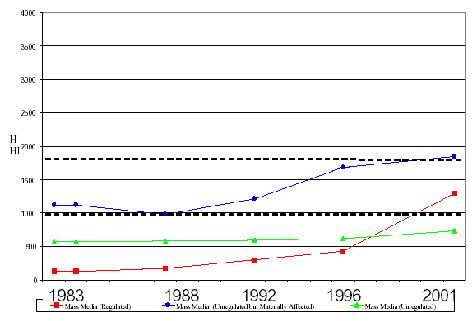
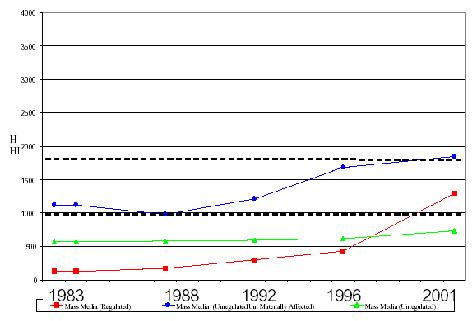
Here are some actual data on the issue. (Source: Eli M. Noan, Columbia Business School, December 2002.) I have no way of verifying this data, so it will have to do in a pinch.
When economists think about collusion, they usually think about price collusion. However, there can also be quality collusion, which includes, for example, restricting the flow of information. The likelihood of collusion is usually measured using a concentration index.
The attached graph shows the concentration of mass-media ownership measured by revenue. The measure used is the Herfindahl-Hirshman Index (HHI) which is the standard used by economists to measure market concentration. The HHI is the sum of the squared market shares of each firm in the market. A completely monopolized market would have HHI = 100^2 = 10,000. The two dashed lines represent different thresholds of concentration. An HHI of less than 1000 is considered by economists to be unconcentrated, I.e., likely to be a competitive market. This corresponds, for example, to 10 firms each with 10 percent of the market. HHI between 1000 and 1800 is considered to be moderately concentrated. HHI above 1800 is considered to be highly concentrated, where collusion might reasonably be expected to occur. For example, a market with five firms each with 20 percent of the market would have HHI = 2000.
In this graph “regulated” basically consists of TV, radio and cable stations; “unregulated but materially affected” includes TV syndication and pay TV; “unregulated” includes just about everything else, such as movies, DVD’s., etc.
The take home message from these graphs is that media concentration is not yet at the level where economists would be very concerned about collusion. It would seem perfectly possible to avoid getting our knickers in a twist and simply treat this as any other industry to which the antitrust laws apply.
There are some qualifications.
First, and most important, concentration is not the only factor which determines the ability to collude. Technology, barriers to entry, potential competition, standardization of product, availability of consumer information, and a number of other factors can make it easier or harder to collude. In this case technology is especially important, making lowering barriers to entry and making it easier for smaller firms to survive in the market.
Second, companies which own outlets across categories would increase the concentration ratios somewhat. [If A and B are market shares, (A+B)^2 is greater than A^2 + B^2 }
Third, these data do not include newspapers or internet sources, and therefore overstate mass media concentration.
Fourth, these data only include US media outlets, and therefore overstate mass media concentration. For example, how many people here get some of their news from the BBC?
Last edited by Adam Smith on 03-06-2003 at 02:36
|
|
| |
|
|
|
gsmoove23
|
|
AS, I can't read a thing on your graph. Are you saying that we shouldn't be worried because concentration hasn't reached a level that some economist thinks should be the benchmark?
|
|
| |
All times are GMT. The time now is 05:28.
Apolyton Time is 00:28. |
top of page
|
| archivepost |
|
Forum Rules:
You may not post new threads
You may not post replies
You may not post attachments
You may not edit your posts
|
HTML code is ON
vB code is ON
Smilies are ON
[IMG] code is ON
|
|
|
|
|
|





 02-06-2003 02:05







 Attachment:


 .
. .
. Attachment:


 |
|
 |
|