|

|
Cruddy
|
|
quote:
Originally posted by Urban Ranger
The big complaint against Traveller is that the game is sterile. Once your character musters out, he or she is fixed. There's no growth whatsoever. It's the first sci-fi RPG, and unfortunately, the worst one. |
I thought they fixed that in Megatrav - oh well, it was a long time ago. I just brought it up for the ship design angle, which was pretty ground breaking at the time.
Anyone recommend a better RPG for ship design? Because it's the only one I've played. Although reading some of the Trek pseudo science books might give a few ideas.
|
|
| |
|
|
|
Sikander
|
 |
Boulder, Colorado, United Snakes of America
Jan 2000
time: 22:28
|
|
quote:
Originally posted by Cruddy
IIRC, Traveller was born out of Marc Miller's Vietnam service. So although it was published later than D&D, the game was being play tested years before "fantasy rules for table top gaming" (D&D) entered Gary Gygax's head. |
That sounds like the exact same development path as Engarde, minus the Marc Miller Vietnam bit.
quote:
Originally posted by Cruddy
Traveller is very hard to referee well. It's much more open ended and flexible than fantasy RPGs, which could explain why it has had zero impact on the online scene. Sensible developers tend to go for the art of the possible, rather than the most imaginative games The solo play Megatrav games of the 90s were - well, average at best.
Wouldn't GDW would sue anybody's arse off if they tried it? |
My only Traveller campaign started in 1976. It was ok, but Mercenary and High Guard and Scout were not out yet, so it was just the basic game. Still, it was popular.
GDW sold their inventory of games when they went out of business. I don't know who owns the rights to Traveller. It wouldn't be illegal to run a campiagn online, as long as you didn't reproduce the tables etc.
|
|
| |
|
|
|
Ecthy
|
|
Zhonghuà Rénmín Gònghéguó
Mar 2000
time: 06:28
|
|
I once heard that all that laser crap is complete nonsense and little steel projectiles would be most effective, since 100% of a spaceship is full of computers and other vital systems, because otherwise the ship would be smaller and back to 100%, if you follow my meaning. maybe in future there will be thicker layers and all that, but as long as the funding is limited and the ship constructed on the surface and the lifting therefore energy intensive, ships will be ultra sensitive and the most effective weapon therefore a projectile, that doesn't even need to explode to do much harm.
|
|
| |
|
|
|
raghar
|
|
I wish somewhere else.
Oct 2002
time: 05:28
|
|
quote:
Originally posted by Japher
I think the best weapon would be some kind of electomagnetic pulse thingy that knocks out all electical circuits. Then, ppl will start developing shields that would protect against all sorts of stuff. Thus, it is not the weapon that I am most curious about, but the defense... RAMMING SPEED!!! |
Then some ship would fire 40MT nukes in selfdefence and then use more efficient weapons to tear your fleet apart.
Seems boys you don't know how is done EMP. It is most effective in high altitude against planet, or low explosions where it has limited area.
To be more clear, it's nearly noneffective in space. You'd have more problems with X rays.
|
|
| |
|
|
|
raghar
|
|
I wish somewhere else.
Oct 2002
time: 05:28
|
|
It depends on armor. If ships would have reflective armor tailored to wavelength of laser it would be very difficult to do major damage. Lasers are easier to aim and could done great damage to CCD optic and vulnerable parts of ship.
|
|
| |
|
|
|
Dr Strangelove
|
|
I think that the primary reason that lasers are so energy intensive to use is their extremely low efficiency. I'm not sure about today, but back a few decades ago lasers were generally less than 5% efficient, i.e., to get 10 watts of laser out of them you had to put more than 200 watts of energy in. If someone could figure out how to improve the efficiency they could make very effective weapons indeed.
X-ray lasers? Is such a beast possible?
|
|
| |
|
|
|
Ecthy
|
|
Zhonghuà Rénmín Gònghéguó
Mar 2000
time: 06:28
|
|
Dr Strangelove, is there a realistic chance we can start spaceships from - you knew it - our deeper mineshafts?
|
|
| |
|
|
|
Whaleboy
|
 |
Please make all cheques payable to Whaleboy
Jan 2003
time: 05:28
|
|
I suspect long range guided missiles, with rockets/ion engine, a nuclear warhead, a radar/IR/UV or other EM sensor, to track down and kill things at long range.
I dont think this will happen for a while, and when it does, it will be like aircraft warfare evolution.
Spy satellites will be the first target, then possibly orbital-ground weapons platforms (make ICMB's much more efficient being launched from space), then battleships to shoot down these modified shuttles, then full scale, but very expensive combat.
I hope it doesnt happen, like Arther C Clarke said (and I paraphrase cos my memory sucks tonight):
quote:
There is hopeful symbolism in the fact that flags do not wave in a vacuum
|
|
|
| |
|
|
|
panag
|
 |
MY WORDS ARE BACKED WITH BIO-CHEMICAL WEAPONS
Oct 2000
time: 07:28
|
|
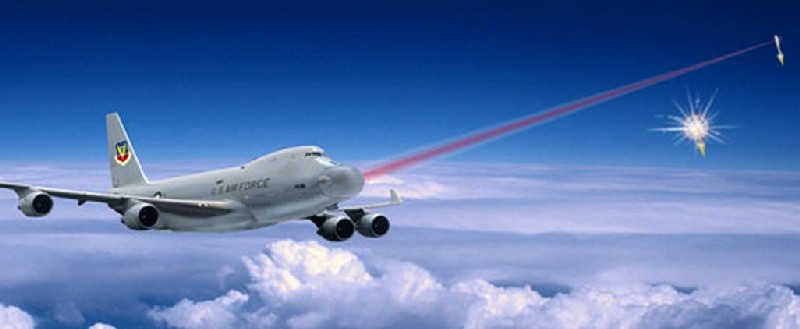
The ABL weapon system consists of a high-energy, chemical oxygen iodine laser (COIL) mounted on a modified 747-400F (freighter) aircraft to shoot down theater ballistic missiles in their boost phase. A crew of four, including pilot and copilot, would be required to operate the airborne laser, which would patrol in pairs at high altitude, about 40,000 feet, flying in orbits over friendly territory, scanning the horizon for the plumes of rising missiles. Capable of autonomous operation, the ABL would acquire and track missiles in the boost phase of flight, illuminating the missile with a tracking laser beam while computers measure the distance and calculate its course and direction. After acquiring and locking onto the target, a second laser - with weapons-class strength - would fire a three- to five-second burst from a turret located in the 747's nose, destroying the missiles over the launch area.
The airborne laser would fire a Chemical Oxygen Iodine Laser, or COIL, invented at Phillips Lab in 1977. The laser's fuel consists of the same chemicals found in hair bleach and Drano - hydrogen peroxide and potassium hydroxide - which are then combined with chlorine gas and water. The laser operates at an infrared wavelength of 1.315 microns, which is invisible to the eye. By recycling chemicals, building with plastics and using a unique cooling process, the COIL team was able to make the laser lighter and more efficient while - at the same time - increasing its power by 400 percent in five years. The flight-weighted ABL module would be similar in performance and power levels to the multi-hundred kilowatt class COIL Baseline Demonstration Laser (BDL-2) module demonstrated by TRW in August 1996. As its name implies, though, it would be lighter and more compact than the earlier version due to the integration of advanced aerospace materials into the design of critical hardware components. For the operational ABL system, several modules would be linked together in series to achieve ABL's required megawatt-class power level.
Atmospheric turbulence, which weakens and scatters the laser's beam, is produced by fluctuations in air temperature [the same phenomenon that causes stars to twinkle]. Adaptive optics rely on a deformable mirror, sometimes called a rubber mirror, to compensate for tilt and phase distortions in the atmosphere. The mirror has 341 actuators that change at a rate of about a 1,000 per second.
The Airborne Laser is a Major Defense Acquisition Program. After the Concept Design Phase is complete, the ABL will enter the Program Definition and Risk Reduction (PDRR) Phase. The objective of the PDRR phase is to develop a cost effective, flexible airborne high energy laser system which provides a credible deterrent and lethal defensive capabilities against boosting theater ballistic missiles.
The ABL PDRR Program is intended to show high confidence system performance scalable to Engineering and Manufacturing Development (EMD) levels. The PDRR Program includes the design, development, integration, and testing of an airborne high-energy laser weapon system.
In May 1994, two contracts were awarded to develop fully operational ABL weapon system concepts and then derive ABL PDRR Program concepts that are fully traceable and scaleable EMD. A single contract team was selected to proceed with the development of the chosen PDRR concept beginning in November 1996. Successful development and testing of the laser module is one of the critical 'exit criteria' that Team ABL must satisfy to pass the program's first 'authority-to-proceed' (ATP-1) milestone, scheduled for June 1998. Testing of the laser module is expected to be completed by April 1998. The PDRR detailed design, integration, and test will culminate in a lethality demonstration in the year 2002. A follow-on Engineering Manufacturing and Development/Production (EMD) effort could then begin in the early 2003 time frame. A fleet of fully operational EMD systems is intended to satisfy Air Combat Command's boost-phase Theater Air Defense requirements. If all goes as planned, a fleet of seven ABLs should be flying operational missions by 2008.
Performance requirements for the Airborne Laser Weapons System are established by the operational scenarios and support requirements defined by the user, Air Combat Command, and by measured target vulnerability characteristics provided by the Air Force lethality and vulnerability community centered at the Phillips Laboratory. The ABL PDRR Program is supported by a robust technology insertion and risk reduction program to provide early confidence that scaling to EMD performance is feasible. The technology and concept design efforts provide key answers to the PDRR design effort in the areas of lethality, atmospheric characterization, beam control, aircraft systems integration, and environmental concerns. These efforts are the source of necessary data applied to exit criteria ensuring higher and higher levels of confidence are progressively reached at key milestones of the PDRR development.
The key issues in the program will be effective range of the laser and systems integration of a Boeing 747 aircraft.
hi ,
talking about lasers , .... 
around 1990-91 there was some talk about a special laser satt , the satt was huge , in two parts to be launched , one part was a huge reactor to provide the energy , the other a huge laser , ......
but then some people at nasa and the gov had some "wake-up call's" , they realised what a disaster it would be when something went wrong with more then +600 kilo's of high quality plutonium , ..... 
have a nice day
 Attachment: abl747b.jpg Attachment: abl747b.jpg
This has been downloaded 21 time(s).
|
|
| |
|
|
|
Eli
|
|
Israel
Jul 2000
time: 07:28
|
|
quote:
X-ray lasers? Is such a beast possible? |
Why not? X-rays are the same waves as light, but more energetic.
|
|
| |
All times are GMT. The time now is 05:28.
Apolyton Time is 00:28. |
top of page
|
| archivepost |
|
Forum Rules:
You may not post new threads
You may not post replies
You may not post attachments
You may not edit your posts
|
HTML code is ON
vB code is ON
Smilies are ON
[IMG] code is ON
|
|
|
|
|
|






 05-06-2003 14:43





 |
|