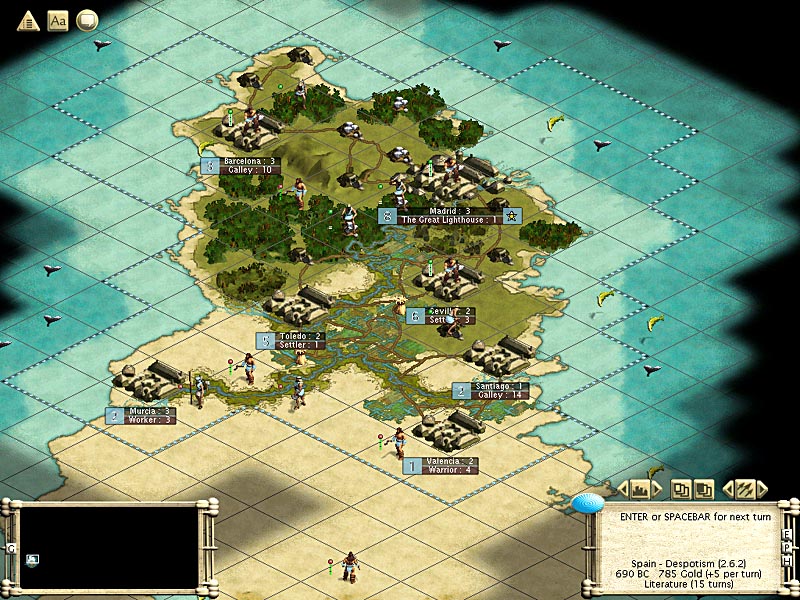
|

|
Dominae
|
|
This is the second "during action report" thread for AU402 - Gargantua, dedicated to years 2150BC to 1000BC.
So, you've figured out that there's a lot of Desert and not a lot of neighbors. What do you do with your time now?
|
|
| |
|
|
|
alexman
|
 |
Hunt Valley, MD
Jan 1970
time: 00:29
|
|
1000 B.C. The centuries following our learning of Writing went quietly. The English people multiplied like rabbits, and filled Britannia’s landscape with towns.
In 1250 B.C. news reached us that the Americans built the Colossus, even though we had no idea what that is or how one builds it. In 1050, rumors about an Oracle, whatever that is, built by the Ottomans reached our island. And in 1025, we learned that Germans built the “Pyramids”. Whatever. We may not know what all these things are now, but we know two things: we are not alone on this planet, and we will soon conquer these Great Wonders.
Our homeland Expansion phase has not quite ended in 1000 B.C. though. The royal empire planners have 5 more cities to go.
After our lazy scientists discover Map Making, I will have them write beautiful poems and store them in Libraries. But they better discover how to do that much faster than they took to discover Writing and Map Making! Our economy is now much stronger, and we can afford to pay them well.
Exploration of our coastline in search of new lands to settle will become our highest priority in the immediate centuries to follow. Perhaps we will meet some of these barbarians who built these “Great Wonders”, and have them teach us how they did it. But just in case, we will start building libraries like mad, to help us gain that knowledge on our own.
|
|
| |
|
|
|
Catt
|
 |
California - SF Bay Area
May 2002
time: 21:29
|
|
Warning - the screenshot below contains a small image of an instance well-beyond 1000 BC -- Don't look at the screenshot if you worry about a potential spoiler.
I choose England for its roleplay aspect; playing Emperor. I've combined my 4000 BC DAR with this second DAR thread.
The view from the start indicated not only the nearby river, but also a smidgen of coast to the east. Queen Elizabeth marched her band of settlers through the jungles and choose to settle alongside the Thames, atop gem mines, in some excellent beachfront property. The English workers decided to move south into jungles rich with gems, and begin the long task of clearing jungle. Elizabeth debated moving the worker party all the way to grasslands south of London, but decided to let it wait until at least one jungle tile -- freeing up river and underlying grassland, was cleared. The Queen's scouting forces moved north onto an adjacent hill hoping to see how far the English jungles extended (English jungles?). From their perch on the hill, the scouts could spy a small village further north.
Moving to take advantage of the river, in one square or another, is almost certainly better than settling in the start spot. I choose to move to coastal access instead of being stuck inland or worse being stuck inland with some city radius covering sea but no ability to build a harbor.
In 3950 BC London was founded. Immediately thereafter, the scouting party entered the northern village and to their surprise, were greeted with loud chants of "God save the Queen!" The villagers agreed to form a new English settlement and submit to the inevitable Rule Brittania -- York was also founded in 3950 BC on the site of the primative village and began work on a worker -- the commoners realized the need to clear jungle and bring producitivity to the nascent empire.
Yea, Expansionist!
London began work on a scout. Elizabeth considered ordering workers to chop nearby forest and to start a granary immediately, but decided against it pending wider exploration of her surrounding lands.
English scientists set to work at unraveling the mysteries of Writing on a 40-turn pace.
The English scouting party turned south and west, following the coastline. Extremely fertile flood plains from the western tributaries of the Thames, aided by vast wheat plains, promised the rapid growth of an English worker force and settler parties that would be necessary to clear the land and settle the countryside. Soon after, a second English scouting party departed London, moving south, intending to stay to the western edge of the landmass.
Many years passed without suspense. The English scouts reported back periodically to the Queen, indicatting that unfortunately the "surrounding countryside" wasn't countryside at all, but instead a vast desert. In 3550 BC the original scouting party reported to have entered a village to the far southwest -- the freindly villages donated 25 gold to the Queen's growing coffers. Shortly thereafter, the secondary scouting party entered a village and was joined by a fearsome, but somewhat undertrained, warrior. The warrior returned north towards London, slated for garrison duty.
After a granary was built in London, the first native settler party set off for the Thames' floodplains. York produced three workers at 10 turns each in an effort to clear some of the surrounding jungle and provide a productive base for the citizenry.
It was at this point, with much if not all of the home island explored, the the Queen set her empire's strategic goals. Elizabeth had always been drawn to the seas, and the bleakness of the home island cemented her decision to proceed as quickly as possible to develop a safe method for sailing the surrounding seas. She designated York to be fully improved as early as possible so that it might begin stockpiling resources for a massive Great Lighthouse. The English scientists were directed to work towards seafaring. Nottingham, in the flodplains, churned out workers, with an occassional settler as well -- but the surrounding terrain, while rich in food, was poor at producing raw materials. Nottingham too would be improved early.
English scouts began reporting sightings of barbarians in the hinterlands. Although the Queen had decided to settle the southern tip of her island, whose land was considerably more hospitable than the vast deserts, she simply didn't have adequate defensive resources to escort settler parties. The scouts provided early warning, but with the appearence of barbarian horsemen, English settlement plans changed, and Elizabeth directed that settlements proceed more slowly, in a creeping fashion along the western and eastern coasts. New settlements produced warriors which set out south the pacify the barbarians.
I think, in retrospect, that it would have been better to brave the barbs and settle the south right away. As it was, I settled several coastal deset towns while my meager warrior force protected a worker building roads south and attempted to wipe out the barbs. With the high OCN of this map size, the southern cities would have been productive pretty early in their development.
With the discovery of Writing, the Queen explored her options. Map Making was 40 turns away regardless of her science budget. But another problem creeped into her thoughts. Although York was becoming productive, it had no adequate raw materials storage option -- improvements like granaries and barracks would be completed far too soon for the Queen's tastes. Elizabeth directed her scientists to research Masonary at the higest possible rate - enabling discovery in approximately 12 turns. Masonry would allow York to begin stockpiling materials in the form of a Palace which could later be converted to the Great Lighthouse. After the discovery of Masonry, English scientists began research on Map Making at 40 turns.
There were few options for a wonder city. And, not knowing the rate of progress of enemy civs and their terrain advantages, I wanted a pre-build going for the GL as quickly as possible. This required dropping back to Masonry for the Palace prebuild.
The English heard rumors of great construction projects elsewhere - the Colosss in Persepolis, the Oracle in Delhi (I think) and the Pyramids in the Zulu lands. At least, thought the Queen, we weren't alone in a world of barbarians.
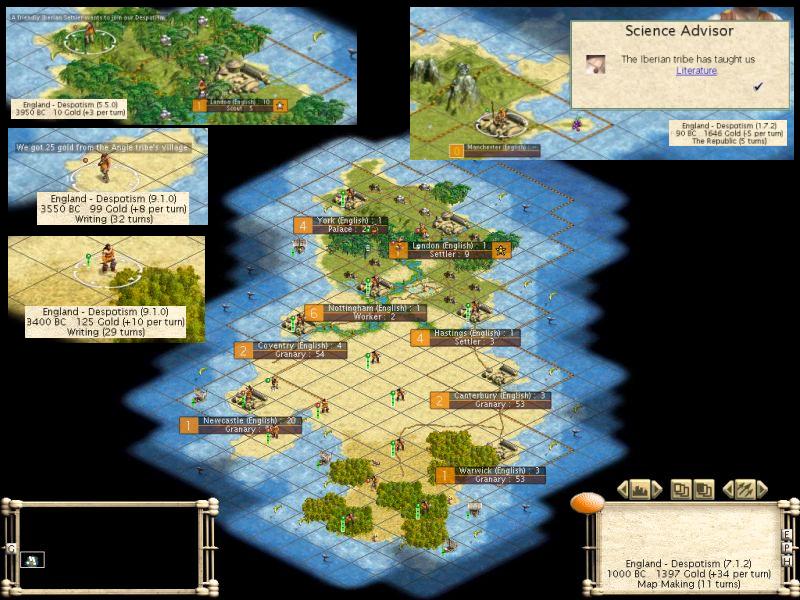
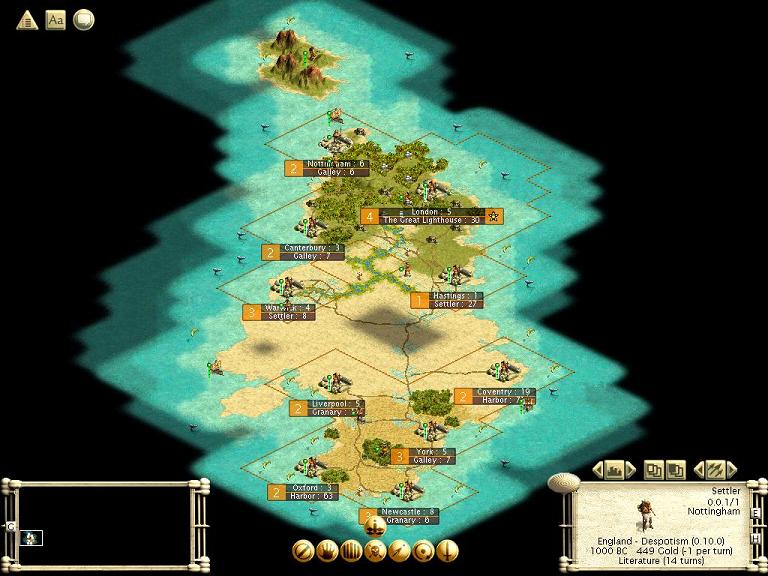
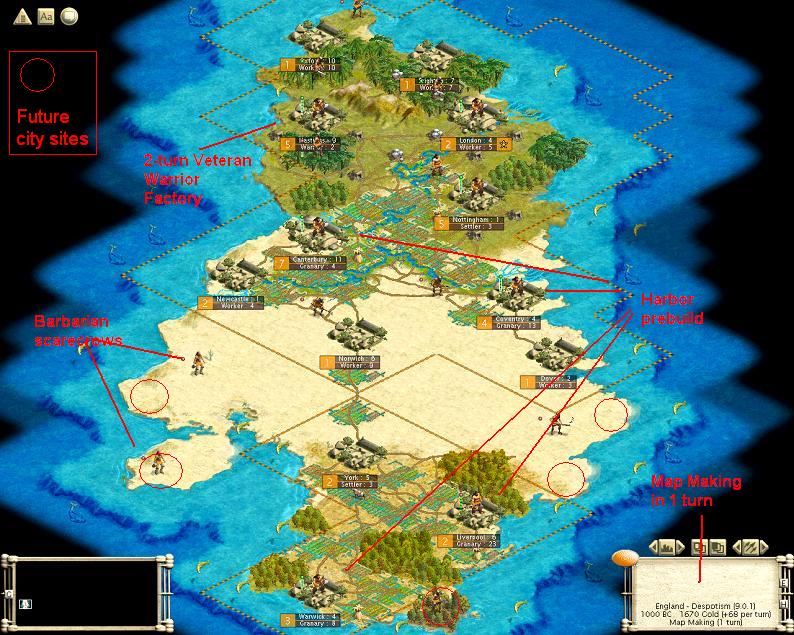
The screenshot below shows the growing English empire at 1000 BC. The continent has been cleared of barbarians, and warriors stand guard against new barbarian encampments. York is well into a Palace prebuild, and Map Making is 11 turns away. The English treasury is huge -- a product of two research projects at 10% and the river and gem rich start locations. Small inserts show the huts popped and outcomes -- included is one final hut, making four total, that we located and popped; the final hut wasn't opened until 90 BC, and we were blessed with Literature. So, four huts: settler, gold, warrior, tech. Yea, Expansionist.
Catt 
 Attachment: empire at 1000 bc - compiled with huts.jpg Attachment: empire at 1000 bc - compiled with huts.jpg
This has been downloaded 254 time(s).
|
|
| |
|
| |
|
|
|
AJ Corp. The FAIR
|
 |
Antwerp (the pearl of Flanders) Belgium
Jan 2002
time: 06:29
|
|
Emperor, Carthage
At 2110 BC my scientists dicover wrting and I aim for literature after that, as I had, as mentioned before, the Great Library in thoughts. Carthage finishes another setteler and Leptis Magna is found to the NE of Carthage. Utica finishes settler at 1700 BC and thereafter builds worker. East of Carthage Theveste is found at 1625 BC. AT 1425 BC Carthage finishes its last settler, preparing for the Great Library by prebuilding Pyramids. 1300 BC Hippo is found and at 1000 BC literature is discovered.
Meanwhile, I have built quite some workers and have several cities connected, all have at least 1 or 2 city tile improvements. Soon however all workers were sent to Carthage, upgrading all its city tile improvements, clearing jungle and mining shielded and not shielded grasslands, as I want the GL for myself! It will become a close race, I figure.
Times to progress take longer than I've ever experienced before, I hope it will be doable later on. I have 1,5 Mhz and 512 Kb Mem.
AJ
|
|
| |
|
| |
|
| |
|
| |
|
|
|
Taian
|
|
Winterpeg
Mar 2000
time: 23:29
|
|
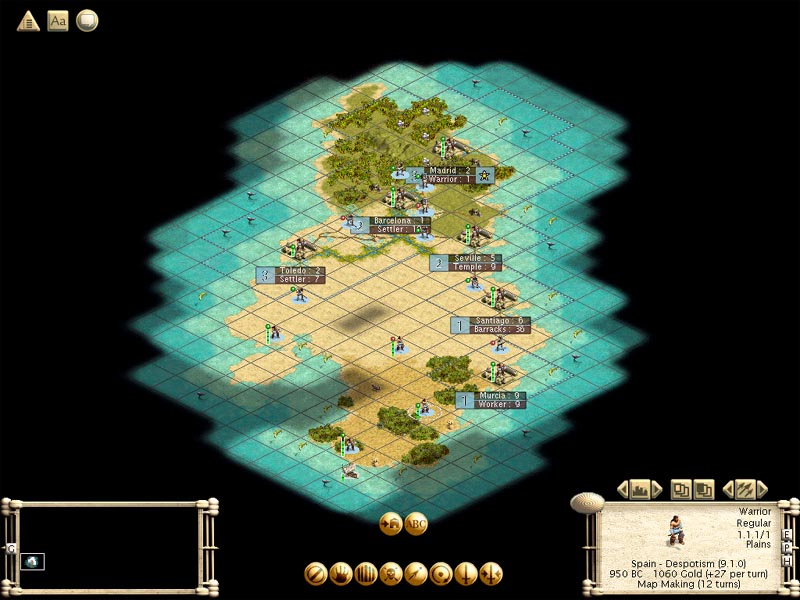
Forgot to include is in DAR1...playing on Emperor. Expansion in this last period wasn't as rapid as I would have liked, but I think I'm still sitting in good position so far. Currently working on Literature and hopefully no one snags the GL in the meantime or I won't have anything to fall back on.
When we left our fledging English, they had established a foothold on their island and were poised for future growth and prosperity. Their saga continues...
2110BC - The city of Coventry is founded northeast of York. Fish can be seen in its immediate radius and just out of reach are 2 more fish and 1 whale. Work is begun on a warrior for garrison. With the great road project from North to South nearly complete, work is begun on the first irrigation in the English empire.
2070BC - Celebrations resound through the streets of London as English scholoars announce the discovery of "Writing". After a few too many beers, a few of the scholars begin to ponder the idea of applying this concept of writing to make "maps". Royal assent is given and, since King Taian is in a generous mood, the royal coffers are opened fully for the scientists to pursue their research. In appreciation, the scholars expect to be finished sooner than anticipated...a mere 33 days instead of the original 40. Canterbury has completed their first garrison unit. Orders are sent to begin construction of a work crew to aid in the projects of the Empire.
1990BC - York completes training of a new band of warriors. New posters go up around York requesting colonists. Irrigation begins to appear in the English empire, promising increased growth and opportunities. Work on the great irrigation project is proceeding on plan and on budget. A new band of colonists set out from London in search of fertile land to found a city on, Planned location is south of Canturbury on the coast with future access to the 2 whales sitting there.
1910BC - Nottingham continues to pump out work crews to aid the expansion plans of the empire.
1870BC - Canturbury also begins to make contribution to the work crews of the English empire. Before beginning another work crew however, orders are given to train a second garrison unit.
1830BC - With all cities contributing to the expansion plans of the empire, the work force of the English has grown to 6, with the latest addition from the city of Hastings. Plans to increase this count are underway.
1750BC - The Great Irrigation Project is placed on hold while the workers move to bring gems from London into Coventry. It is anticipated to be a minor delay and of more benefit to the empire to link all cities through a nationwide road network. The city of Warwick is established to the south of Canturbury. Just out of reach are 2 whales. While the present growth capacity is limited, the people dream of a day when they can access the whales and pursue larger ambitions for their city. Work on a garrison Warrior unit is commenced immediately.
1725BC - Coventry completes work on their first garrison unit. With no method of increasing their borders by culture currently available, the people of Coventry begin training of units to contribute to the workforce of the English empire.
1700BC - A new band of colonists sets out from London. Quickly gaining renown as a center for highly experienced colonists, London continues recruiting from its willing populace. The colonists venture off towards the desert to the south in search of a suitable site to found their city. Canterbury has completed its second military unit. Training begins on workers for the empire while the military unit seeks to meet up with the colonists from London to provide support and protection during their journey.
1675BC - With Covnetry now connected to the English empire via road, construction on the Great Irrigation project may resume.
1650BC - Word reaches King Taian that the culture of London is beginning to be heard past the current borders of the town. In preparation for this expansion, orders are sent to workcrews to begin irrigating the wheat flood plains to the south of London. Once expansion occurs, this wheat will serve the expansion plans of the empire well.
1625BC - The Great Irrigation Project nears completion as the first tile of York begins to be irrigated. The completion of this great work serves as testament to the foresight and aspirations of the English people. The road network that accompanies the irrigation will serve as a backbone of trade, communication and travel within the empire.
1600BC - Workcrews are sent out from Nottingham and Hastings to improve the productivity of the empire.
1575BC - Canterbury concludes training of a second garrison unit. Training begins on a new crew of workers.
1525BC - York sends out a group of colonists to expand the empire. Training begins on a group of warriors to garrison the surrounding cities. Newcastle is founded south of York with access to 2 fish and grain within its immediate city borders. Plans are to found another city to the west of Newcastle with access to 2 fish as well. Although York, Newcastle and this future city will be in close proximity, they will not interfere with eash others' growth until much later in the development of the empire. The benefits at this point in the time are evident to King Taian. With a garrison unit already available, construction begins on a granary in Newcastle. Plans are made to speed the production of the granary with the surrounding forest.
1500BC - Warwick completes its first garrison unit. Orders are sent to begin training work crews for the empire. Current work crews number 8.
1475BC - A year of incredible production for the English empire. In the capital city, a new band of colonists are sent out. As well, it is observed by King Taian that the scientists are approaching discovert of Map Making. His scientific advisor has been dropping hints about an idea for a "Great Lighthouse". This magnificent structure would allow the English ships to travel farther and faster than any known to man. The intial plans for the Lighthouse are completed and the base of it bears a startling resemblance to a barracks. As a result, King Taian orders construction of a barracks in hopes that the final plans of the Lighthouse will become available before final construction of the barracks. Further south in the empire, Hastings and Coventry finish training on work crews, bringing the total number up to 10 for the English empire. In the west, Nottingham has completed training of a warrior unit. Work crew training is initiated in all 3 cities.
1450BC - Canterbury has trained the 11th work crew of the English. The people of Canterbury now enter the race to be the city to complete the 12th work crew of the empire.
1425BC - Oxford is founded to the west of Newcastle. Within immediate access are 3 fish. Early prospects for this city are bright. Another by product of the Map Making currently being researched by the English scientists is a city building known as a "Harbour". Plans for the harbor appear to be similar to a Granary. Granary construction begun in Oxford.
1400BC - York trains a warrior unit. Plans are to transfer the warrior to Oxford to garrison that town. Training on a new warrior unit begins.
1350BC - Nottingham completes warrrior training. With land in sight to the north and map making nearing completion, construction is begun on a Granary in Nottingham. Conveniently enough, the lumber used on the Granary can be re-used for ship construction should the need arise. Current growth track sees Lond complete it's barracks in 6 turns, but English scientists anticipate a breakthrough in Map making in 5 turns. Things look promising...
1325BC - Work crews trained in Hastings and Canterbury bring the English work crew total up to 13. Granary construction begun in Canterbury while recruitment begins in Hastings for a group of colonists. Liverpool is founded north of Oxford with access to 2 fish and extended access to a cow on the plains. Wrok begins on a Granary.
1300BC - Word reaches the English shores of a Great Wonder, The Oracle, being completed by the Mongols in the city of Karakorum.
1275BC - York completes work on a warrior. Work is begun on a Granary. The warrior unit moves to garrison Liverpool to the west.
1250BC - The Jungle near London begins to clear, revealing fertile grassland beneath. King Taian orders further removal of the jungle. Warwick completes a work crew and posts recruitment posters for colonists.
1225BC - English scientists announce the discovery of Map Making. This breakthrough is heralded with joy throughout the empire as new growth opportunites are anticipated overseas. King Taian orders the English Scientists to begin researching Bronze Working to improve the defenses of the English empire. Fortuneately, the plans for the Great Lighthouse are obtained in London before completion of the barracks could be achieved. King Taian orders the royal engineers to begin construction the Great Lighthouse. Nottingham, Canterbury and York are ordered to cease work on their Granaries and use the lumber to construct ships for use in overseas exploration. Oxford receives orders to modify construction from a Granary to a Harbor. Coventry finishes training a work crew and begins construction on a harbor.
1175BC - Word reaches English shores of a Great Wonder constructed in the Indian city of Bombay, The Colossus.
1100BC - English scientists announce the discovery of Bronze Working. In hopes of profiting from the the whales and fish off the coast of the English island, King Taian orders research into Ceremonial Burial. Only 70% of the treasury is needed to obtain this new technology as quickly as possible. The first ship in the English Navy is commissioned at Nottingham. With a warrior and a scout on board, it sets out in search of new and strange lands. North of Nottingham, an island covered in hilly terrain is discovered. While not promising in and of itself, the mountains may be rich in iron deposits. A city is planned for this area and the fish nearby should ensure a good foothold. Hastings has reached size 4 and looks to have an unhappy citizen. Fortuneately, immediate volunteers step forward from the city and facilitate completion of the colonist group 6 turns ahead of schedule.
1075BC - A second ship is commissioned into the English Navy. The captain is commissioned with encircling the island to determine likely lines of expansion to surrounding islands. Colonists from Hastings journey north to board a ship for journey to the hilly island north of Nottingham. Word reaches the shores of England that the Ottoman city of Istanbul has completed a great wonder, The Pyramids. Apprehension begins to build that the work of the English people on the Great Lighthouse may be in vain.
1025BC - The third addition to the English Navy is commissioned at York. The captain pushes off with orders to seek new lines of exploration.
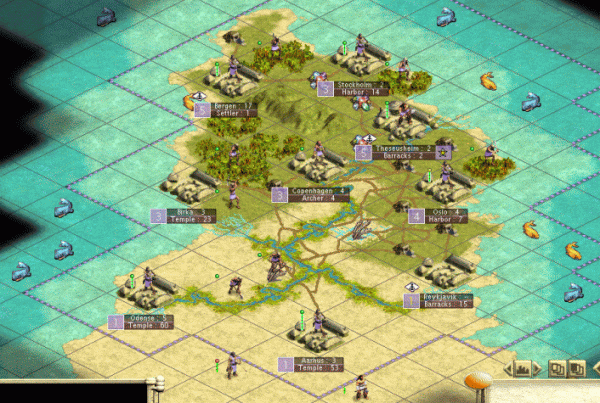
1000BC - English scientists report discovery of Ceremonial Burial. They also report that this technology allows construction of Temples which will permit border expansion to the lucrative sea creatures off the coast of the English mainland. In preparation for the possibility of failing in the bid for the Great Lighthouse, the English Scientists are ordered to research Literature. This technology will allow the Great Library as well as permit the construction of libraries within the empire proper.
Attachment: 1000bc.jpg
This has been downloaded 193 time(s).
|
|
| |
|
| |
|
|
|
nbarclay
|
 |
Huntsville, Alabama
Dec 1999
time: 23:29
|
|
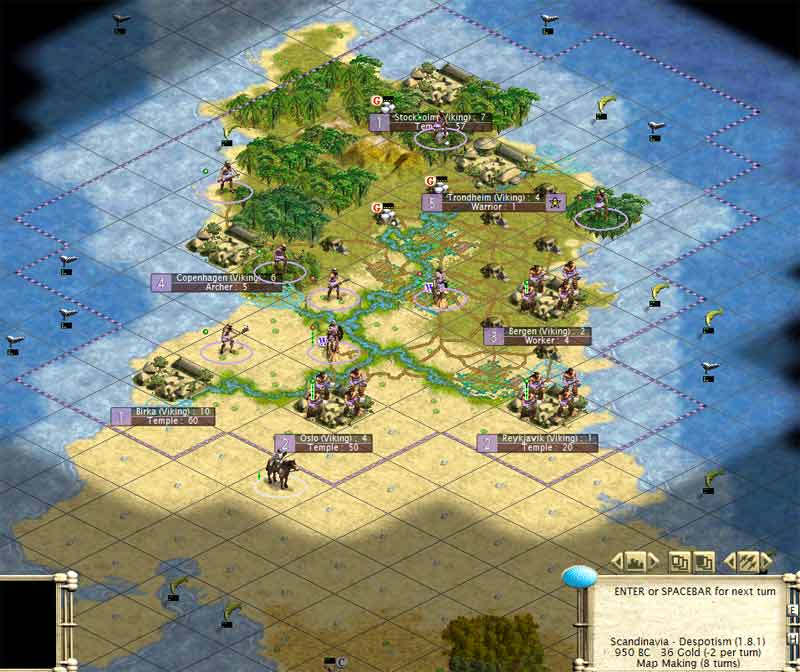
Unfortunately, the next save I can find is from 230 AD. I'd thought I did a save or screenshot sometime in between, but apparently not. So keep in mind that the shot below reflects the status of my cities more than a millennium later.
On seeing how much desert I had to contend with, and with an eye toward getting the most out of my "temporary" pump cities, I started cranking out workers like crazy. I needed to get the size of my good cities up, and even with an industrious civ, having lots of workers is good for such things.
The cities and dates (including the ones from last DAR) are:
3950 BC: Carthage
2510 BC: Utica
2150 BC: Leptis Magna
1525 BC: Theveste
1350 BC: Hippo
1275 BC: Leptis Minor
I still only had six cities, but I was poised for very rapid growth. The jungles were mostly if not completely cleared, and I had swarms of workers descending to do their best to make the desert and southern plains bloom. Fortunately, barbs hadn't caused me any serious headaches.
I did suffer from a serious setback in 1075 BC when the Ottomans built the Pyramids. I'd been hoping to use that as a prebuild for the Great Lighthouse, and ended up with a relatively expensive temple instead (I think forty-someodd shields wasted). [Foreshadow] More importantly, it set the stage for the Ottomans to become a genuine killer AI, one of few that's ever had ne truly scared. [/foreshadow]
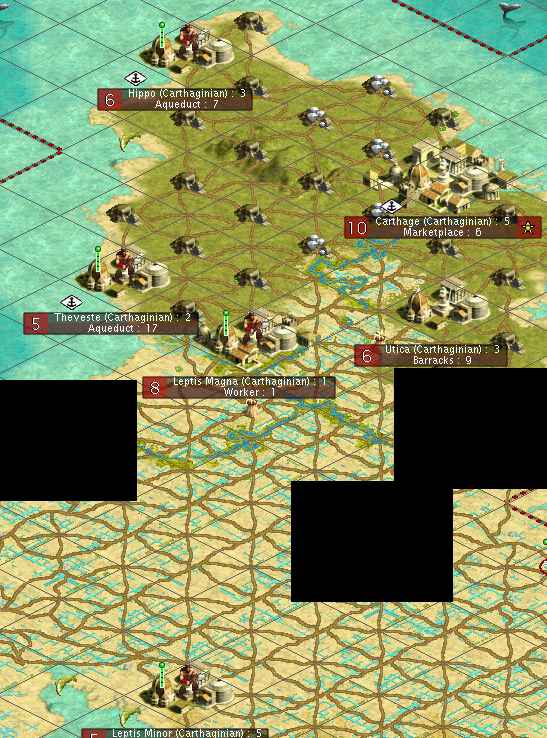
Again, keep in mind that the map below reflects almost an additional millennium and a quarter of growth and terrain improvements. I've blacked out the cities that didn't exist in 1000 BC.
Attachment: ad 230 showing bc 1000.jpg
This has been downloaded 165 time(s).
|
|
| |
|
| |
|
|
|
vulture
|
 |
Leeds, UK
Jun 2001
time: 05:29
|
|
My happy little Carthiginian empire consisted of two cities and four techs at the start of the second DAR. Not an auspicious start. We'd just started researching map making. Around 1500 BC a new city of Heidelberg was added, up in the far north, shortly followed by Cwmcarn, down on the east coast near the wheat. I felt that this was a strong enough base to start building a Lighthouse prebuild in Leeds, leaving my capital (Gloucester) to act as a settler pump.
In 1375 BC I saw my first barb galley, and guessed that we had a barb camp in the south of the island. Only about 10 tiles were in the fog of war, so it wasn't too hard to track it down, although we had to take out two warriors and two horsemen to finish the camp off. We also suffered the first ever combat losses of our empire. As it happens, this was the only barb camp we ever had to deal with on our home continent (I'm expecting more elsewhere).
In 1275 BC rumours reached us that the Germans had built the pyramids, with the Ottomans finishing the Oracle at about the same time. Next turn the Mongols finished the Colossus, ending that wonder cascade, and leading to the globally audible phenomena of the sound of 20 AI's gnashing their teeth at the wasted shields. I hope that this would give me enough of an edge in the Lighthouse race to get it.
In the year 1050 BC we finally managed to sweep the fog of war completely off our continent, removing the barbarian threat forever. At a time when we were pulling in way moer than 25 gpt, it seemed silly to want to farm the camps, particularly since I feared an uprising in the not too distant future if there was some communication between groups of AI civs.
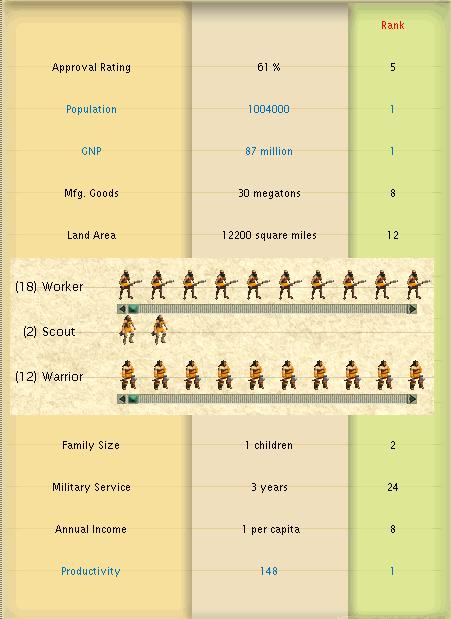
By 1000 BC we'd managed to get up to 12th in population on the demographics screen, which was a surprise given the slow start. Still 23rd in land area though (wait 'till I've settled all my continent). A few more towns had been founded in the desert, and more workers built. While some workers were making good progress clearing jungle, others were building a road and irrigation network across the desert to irrigate the southern plains which looked like a fertile site for more cities. The desert cities too could be moderately useful; with irrigated floodplains supporting workers on mined deserts they could approach the productivity of grassland cities (aside from the disease issue). In 1000 BC we were one turn from map making. A new era was about to dawn...
EDIT forgot to mention - I also noticed I'd dropped to 4th in literacy by 1000 BC, meaning that at 3 civs had started on libraries, so at least 3 civs have got literature. I know I'll be lucky to get the lighthouse at this rate (and indeed, I missed it by a few turns as it, the library and great wall all went in another wonder cascade).
|
|
| |
|
|
|
Mountain Sage
|
|
2150BC – 1000BC
2110BC: we got Writing, we go for Map Making at 40 turns.
2070BC: Roxane birthed its settler and starts its 2nd worker.
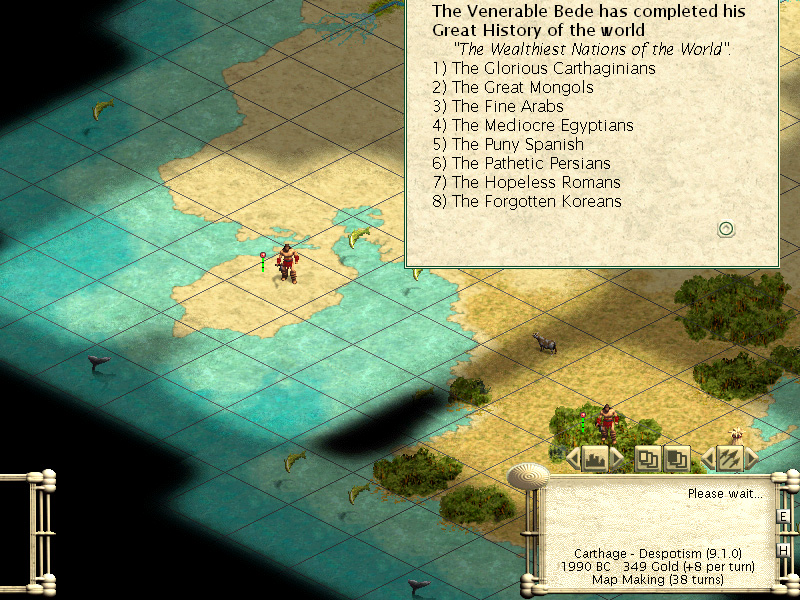
1990BC: Carthage is the wealthiest civ! 349 shiny GP! (see screenshot below).
1950BC: Leptis Magna, our 3rd city, founded (warrior, worker, warrior, settler).
1870BC: after its settler, Roxane starts on the Palace.
1870BC: Roxane’s worker starts on a mine (I will stop boring you with what my workers do!).
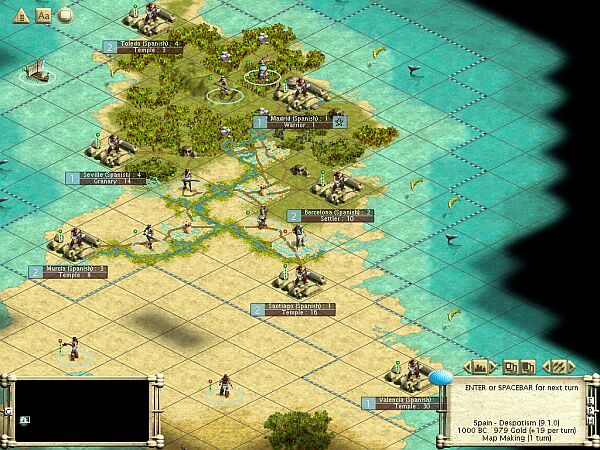
1750BC: Theveste, our 4th city, is born (see screenshot); we cash in 21 gold/turn; same boring building queue: warrior, worker, warrior, settler.
1325BC: now we cash in 25 gold/turn.
1050BC: Hippo is founded; guess the building queue? (see screenshot).
Some comments about the Second Age of the DAR/AAR:
Rexing is going well. No sign of the dreaded Barbarians (were they really set on ‘raging’?). My strategy is now to settle the whole continent before building galleys. A bit risky, but my plan is to send galleys with settlers, unload the settlers and push on, instead of sending galleys, then build more galleys to accommodate the settlers. Time will tell…
|
|
| |
|
|
|
Mountain Sage
|
|
Our wealth in 1990BC
Attachment: 1990bcg.jpg
This has been downloaded 92 time(s).
|
|
| |
All times are GMT. The time now is 05:29.
Apolyton Time is 00:29. |
top of page
|
|
|
Forum Rules:
You may not post new threads
You may not post replies
You may not post attachments
You may not edit your posts
|
HTML code is ON
vB code is ON
Smilies are ON
[IMG] code is ON
|
|
|
|
|
|






 27-06-2003 08:23




 )
)



 ).
).


 Go for it!

 ).
).  Attachment:


 |
|