|
| |
|

|
vmxa1
|
 |
Oviedo, Fl
Nov 2001
time: 21:29
|
|
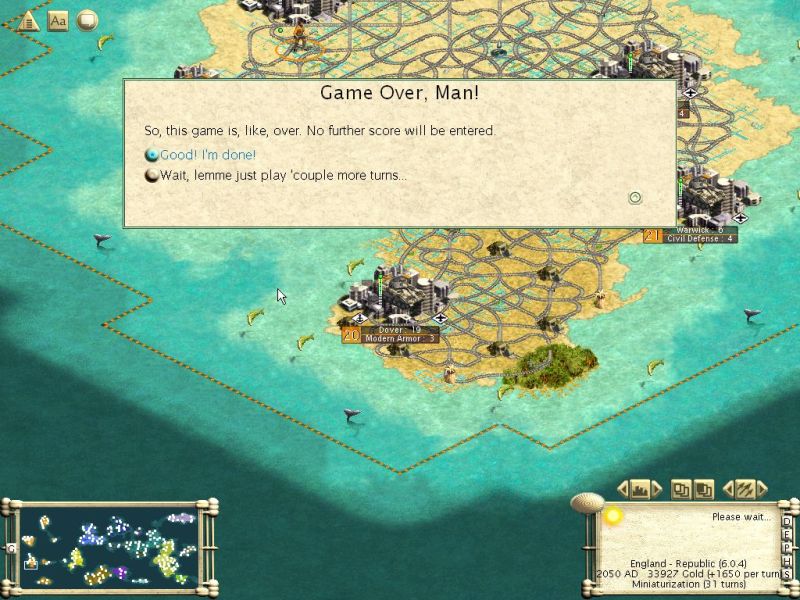
The game had many strange events in it. Many funny one. Well not funny HA HA, so much as strange or crazy.
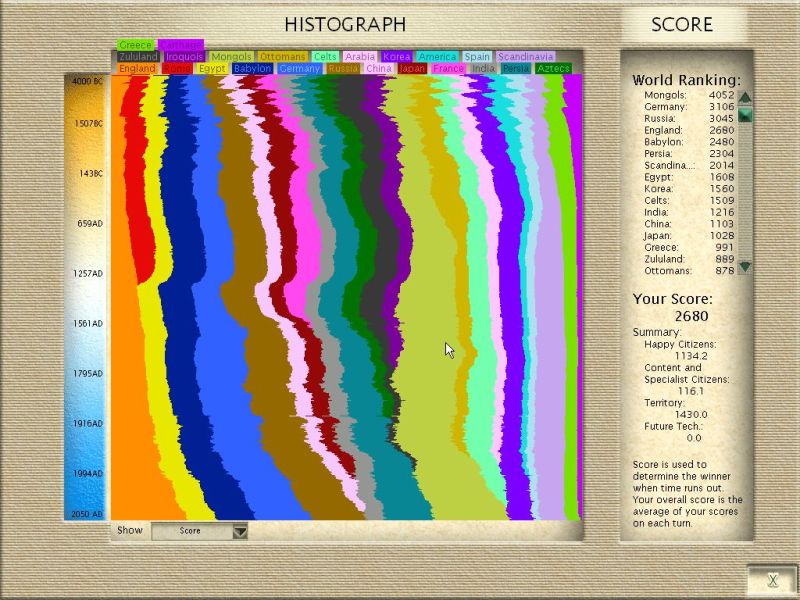
Things like Carthage not being eliminated and it was the lowest score civ in the game and had only three cities nearly all the way. It declared war on the biggest civs. Just before I declared war on India, I went to all the civs, but a few and got an alliance to prevent the loss of any luxs deals. I also gave the big ones a free lux to encourage faithfulness. Anyway I gave Hannibal techs from way back around Electricity. One other small civ was going to war and did not even have Nationalism, but it was not eliminated?
The Mongols asked me for an embargo against Carthageinaround 2047? Mongols must have had 65 cities to Hannies 3 and it was looking for help?
Then Germany wanted one against Carthage as well and Germany is number two?
Other thoughts, why do we need to be asked if we want to continue when we irrigate over a mine or the other way around? I mean 6-8 workers to do the job and I have to respond to all of them? Once I said yes the first time, why ask about the rest?
I made no effort to work the tiles in captured land, just put up roads and rails and clear off pollution.
The whole game I only had the one coal on the Iron island. In fact I never had any resources run out or any new ones appear.
I would go back and play this properly, but that would be sick. This was quite painful at times. On the 1.7 I had wars going on with 20 or more civs. Most had a few hundred units, so time got out to over an hour a few times. None ever got past about 25 minutes on the 3.06.
I can't help thinking I could have avoided all of this if only Arrian had posted the save he promised me from his huge game. I would have seen the times and been happy, but NOOOOOO. 
|
|
| |
|
|
|
nbarclay
|
 |
Huntsville, Alabama
Dec 1999
time: 23:29
|
|
[I've finished the game, but I'm way behind in reporting its progress. This picks up after my last real DAR, from 1500 AD.]
When last we left off the story of the mighty Carthaginian nation, the forces of Carthage had just started operating against Russia. At first, Carthage's troops were content to attack a few small captured Aztec towns and kill vast numbers of Russian troops that had invaded the Aztecs while waiting for imported workers to build roads and rail lines from the coast. The Aztec people marveled at the magnificent new technology our Army Corps of Engineers brought to their lands for the first time. But then our forces were assembled and it was time for the main offensive to begin.
As a preliminary operation, Carthaginian troops occupied the last two significant cities under Russian control on the west side of the mountains. Infantry, supported by artillery, moved into the mountains themselves, but a Russian counterattack never materialized. Apparently, Catherine had not thought to keep any reserve of offensive forces in her homeland in case of such an emergency.
The next phase of the operation was quick, decisive - and abortive. The first Russian city on the far side of the mountains fell exactly as planned, but another Russian city maintained cultural borders strong enough to interfere with the delivery of reinforcements. Cavalry moved in to hold the city but lacked the movement to press the attack farther immediately. Had Russia posessed any significant number of knights in the area, they could have made our forces pay. But they didn't.
The following turn, the Carthaginian blitz started in earnest. The borders blocking rail travel were dealt with, and several cities fell. But Russian musketmen were intent on ensuring that victory would not be nearly as easy or as cheap as it had been in Egypt and Arabia.
Easy and cheap or not, though, the forces of Carthage were determined. Within a few turns, Catherine the Great (as her Russian subjects had called her in more prosperous days), or Catherine the Terminally Stupid (as she had become known in Carthage after her preposterous extortion attempt and even more preposterous declaration of war), took on a new name: Catherine the Exile. Somewhere amidst the world's vast oceans, she still ruled at least one small group of Russian settlers in an endless search for a new home, but her days of power were over.
Surprisingly, courthouses were sufficient (coupled with the Forbidden Palace in southeast Arabia) to bring corruption down to reasonable levels in even the most distant Russian cities. The vast Carthaginian treasury (over 20,000 gold) found a purpose at last, rushing libraries, courthouses, factories, and marketplaces all across the former Russian territories.
|
|
| |
All times are GMT. The time now is 05:29.
Apolyton Time is 00:29. |
top of page
|
|
|
Forum Rules:
You may not post new threads
You may not post replies
You may not post attachments
You may not edit your posts
|
HTML code is ON
vB code is ON
Smilies are ON
[IMG] code is ON
|
|
|
|
|
|





 13-07-2003 11:53


 Attachment:
  |
|
 |
|