|

|
Lancer
|
|
Oregon Coast, USA! or Bohol, Philippines!
Apr 1999
time: 05:29
|
|
Three states would suit, divided along the natural divisions within the Philippines. In the north, those who speak Tagalog, mostly on the island of Luzon, where Manila is located. The central region known as the Visayas, with the state capitol of Cebu. Lastly the southern island of Mindanao, I guess the state capitol would be Cagayan de Oro. Mindanao has 5-6 million moslems fighting a seperatist war. That would be a problem.
|
|
| |
|
|
|
Lancer
|
|
Oregon Coast, USA! or Bohol, Philippines!
Apr 1999
time: 05:29
|
|
Dan, good point, I don't know how they would react. Would it take a referendum in the US to add the Phils? I don't think so.
|
|
| |
|
|
|
Dr Strangelove
|
|
Did it say anywhere in the article that this group was in favor of a reunion with the USA? I thought they just wanted to welcome back our soldiers, sailors and flyboys.
Actually I read an article recently that claimed that 2nd and 3rd generation Mexican-Americans tended to drift away from traditional Catholicism towards evangelical protestant sects.
|
|
| |
|
|
|
DanS
|
 |
Kickball Capital of the World
Jan 1970
time: 00:29
|
|
The organizer of the march, the United States Supporters' Alliance, advocates the largely unpopular idea of the Philippines returning to the U.S. colonial embrace.
There y'are. I guess this would mean to be protectorate of the US, or a commonwealth in free association with the US.
Actually I read an article recently that claimed that 2nd and 3rd generation Mexican-Americans tended to drift away from traditional Catholicism towards evangelical protestant sects.
I wouldn't doubt it. There is a strong hispanic evangelical protestant movement, even in Mexico, IIRC. But I would guess that more stay catholic than change, at least nominally. The %-age of catholics of the US population has grown from 28% or so in 1989 to 37% or so in 2003, IIRC. This trend will probably continue.
Last edited by DanS on 05-07-2003 at 22:02
|
|
| |
|
| |
|
| |
|
|
|
Urban Ranger

|
|
Apolyton Duke of Off-Topic
|
|
quote:
Originally posted by mindseye
quote:
The most famous case is this sign outside of a park, "Chinese and Dogs are not allowed." |
Actually, that cherished chestnut, so often repeated, is not true.
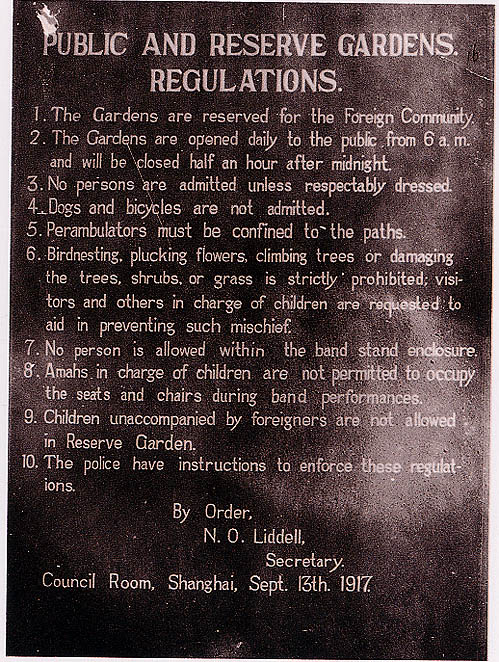
The sign, posted at the entrance to the HuangPu Park on Shanghai's Bund, listed many things that were banned in the park, among them dogs, bicycles, sports, picking flowers, and Chinese who were not servants accompanying westerners. Still offensive, but nothing like the infamous abbreviated "No dogs or Chinese".
It is also worth noting that this was, to my knowledge, the only park with such a restriction, and even it was dropped in 1928.
While it's certainly true that many westerners were not very respectful toward locals, there was never such a sign equating Chinese with dogs. |
I am not sure about this. This webpage (Simplified Chinese) makes a good case of its historicity. IIRC, I saw a photo of it somewhere.
|
|
| |
|
|
|
mindseye
|
 |
A Yankee living in Shanghai
Apr 1999
time: 13:29
|
|
quote:
I am not sure about this. |
Now you can be sure. (see photo below) 
quote:
This webpage (Simplified Chinese) makes a good case of its historicity. |
Hmm, then I guess I just punched a park-sized hole in their case! My Chinese reading skills are pretty shaky. Would you please forward to them the image below, and then translate the response for me? Thank you! I would love to hear their response to photographic proof!
Unfortunately, I realize this cherished urban legend will live on and on despite any number of photos. It fits too nicely with what people want to believe.
Oh, in case they want to know, the source is "The Bund, History and Vicissitudes", Lou Rongmin, Shanghai Pictorial Publishing House. Yes, a Chinese book published in Shanghai. There are other pictures of the sign and the park, too.
quote:
IIRC, I saw a photo of it somewhere. |
Interesting that you remembered it so incorrectly! Cognitive dissonance? 
 Attachment: sign.jpg Attachment: sign.jpg
This has been downloaded 59 time(s).
|
|
| |
|
|
|
mindseye
|
|
A Yankee living in Shanghai
Apr 1999
time: 13:29
|
|
quote:
That's a different sign! The one I was referring to was in Chinese. |
This sign photographed was apparently the "official" one, at least that's what the Chinese authors of the book I sourced claim. It is they who identify the sign in Chinese as "gongyuan yuan gui" and in English as "The rules and regulations of the Park." As I mentioned, they also provide another photo of the sign as it stood in the park.
Any claims about a Chinese language sign would have to address the intent of the foreigners, as their sign in their own language (presumabley the one they accepted as official) never equated Chinese with dogs in the manner so often alluded to. In fact, if you read the English sign carefully, you can clearly see that some Chinese actually were allowed into the park ("amahs", or nannies), casting further doubt on the accuracy or relevance of any other possible sign.
If there really was such a Chinese sign (proof?), I suspect that mistranslation is the culprit, not intent. Even in contemporary Shanghai, all manner of large public signs are mistranslated into wacky English, no one could reasonably blame the original authors for mistakes in meaning due to mistranslations.
quote:
Seeing that most people who provided eyewitness accounts did not speak English at all, it seems highly unlikely that the image linked is the same sign. |
Major issues noted above aside, do you have names, addresses and quotes from those witnesses? If I recall, that is the criteria you required for Tianmen Massacre witnesses ...
Edit: added line about "amahs".
Last edited by mindseye on 07-07-2003 at 13:38
|
|
| |
|
|
|
Urban Ranger
|
|
Apolyton Duke of Off-Topic
|
|
The following is a more detailed description (simplified Chinese characters):
quote:
1960年,有位姓陆的(曾在外滩公园担任三等英文秘书)老员工回忆:在他一二十年代在外滩公园工作时,外滩公园的门口竖有一块大牌子,上面有公园规则(即1917年9月工部局用英文公布的10条规则)。另外还专门做了写有“华人与狗不得入内”的木牌,木牌为长方形白底黑字,插在草地上,由于日晒雨淋,木牌损坏,以后又改用三角铁底架,上有网形块状铁牌。后来,这块牌子被取下,放在公园音乐厅的地下室。最后被当废铜烂铁处理掉。(1960年为筹建上海革命历史纪念馆的调查记录) |
Translation:
In 1960, Mr Lu, an old employee who worked as Grade 3 English Secretary at the park recalled: when he was working at the park during 1910's and 1920's, there's a large sign at the door of the park with regulations of the park (the 10 rules put forth by the Department of Labour in English in September 1917), and there's another specially made wooden sign that said, "Chinese and dogs are not permitted." The sign was rectangular, with black characters on white background, and it was put on the [front] lawn. Later on, the [wooden] sign was damaged by weathering, and a new one was made with corner steel frame with a mesh-like iron sign. Later, the sign was removed and put in the basement of the park's music room. It was eventually disposed as scrap metal. (1960 research records for preparation for the construction of the Shanghai Revolution Museum.)
|
|
| |
|
|
|
mindseye
|
|
A Yankee living in Shanghai
Apr 1999
time: 13:29
|
|
Good research! Thanks for translating. Sounds like there must have been at least two signs.
Open questions: Who wrote the second sign? Was it a translation? A mistranslation? The "main" sign, the large one hung above the park fence, was clear on the matter. But was the Chinese sign intended to have a meaning not easily understandable to foreigners?
Whoever really knew is probably dead, so at this point it's probably impossible to determine. It's beyond question that many foreigners treated the locals badly. I believe wealthy Chinese were little better (still a problem). However, given the clash of evidence, not to mention the prominence and wording of the English language sign, I think it's unfair, based on this sign, to imply that foreigners officially considered Chinese to be the same as dogs. Heaven knows there is no shortage of other better-documented evidence.
An interesting aside, one source I came across claimed that the reason the sign was so offensive was that Han Chinese "had for centuries used the 'dog' radical in characters referring to members of ethnic minorities living in China’s frontier regions" which, if true, means that Chinese claiming racism were simply the victims of their own epithet!
--------------------
Note to those mystified by this exchange: the sign we are discussing is very often cited as one of the most infamous manifestations of western racism during Shanghai's colonial period. Not only were Chinese not permitted to enter a park on Chinese soil, but the sign allegedly implied that they were no better than dogs - quite a strong insult in Chinese (who traditionally see dogs more as livestock or dirty scavengers).
--------------------
Guess we can return to the thread topic now ...
|
|
| |
|
| |
All times are GMT. The time now is 05:29.
Apolyton Time is 00:29. |
top of page
|
| archivepost |
|
Forum Rules:
You may not post new threads
You may not post replies
You may not post attachments
You may not edit your posts
|
HTML code is ON
vB code is ON
Smilies are ON
[IMG] code is ON
|
|
|
|
|
|





 05-07-2003 21:38




 . The rebellion took place in 1899-02. Afterwich, the US ruled in (basically) peace until the US gave the islands their independance on July 4th, 1946 (which was actually planned for 10 years... ie, a transitional period was set up so it would be like other colonizers just picking up and leaving).





 |
|