|
| |
|

|
panag
|
 |
MY WORDS ARE BACKED WITH BIO-CHEMICAL WEAPONS
Oct 2000
time: 07:30
|
|
quote:
Originally posted by 123john321
looks good,  now, about that 2nd city, I'll agree with panag, but try to build it on the coast, get the cattle, and 2 flood plans, if possbily, (I think to do thta, we maybe need to build on the cattle, which can't be good.) now, about that 2nd city, I'll agree with panag, but try to build it on the coast, get the cattle, and 2 flood plans, if possbily, (I think to do thta, we maybe need to build on the cattle, which can't be good.) |
hi ,
thanks for the insight
it shall be one the coast with the one ( 4 ) move , ....
ones a again it shall have ; one wheat , two plains , one cattle and one forest ( thats what we can see now )
since our current capital aint exactly usefull in its location we could use this supercity as our capital later one , ....
there seems to be an other island or con nearby ( unlikely since its near the bottom of the map ) with a wheat on it , as our culture expands so shall our view of that part of the world , ...
hence for all we know it might be a two tile island with one wheat on it , .....
have a nice day
|
|
| |
|
|
|
Madcaptn
|
|
Shippagan, N-B
Dec 2002
time: 01:30
|
|
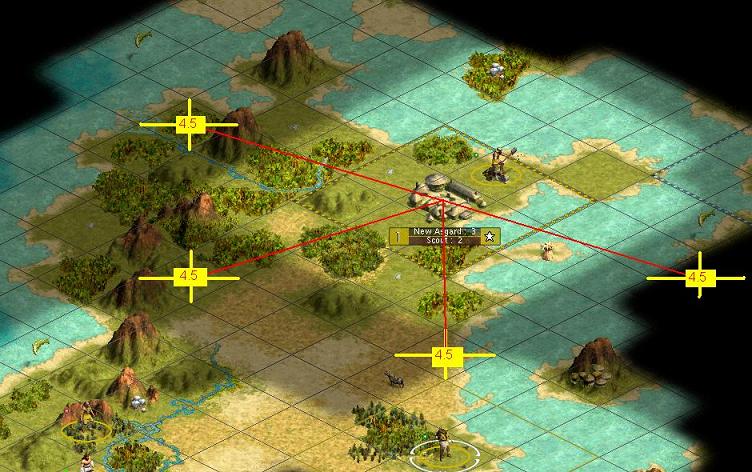
Well I'm sort of a newb and I joined the C3DG with the primary goal of learning. What is that Ring thing you guys are talking about? I see that by placing cities closer to the capital will have less corruption but what are the other main advantages? and what's that 45 number all about.
|
|
| |
|
|
|
ormuzd
|
|
It seems this is the best strategy so far. Because I don't have the time to try it will be interesting to see how it works.
|
|
| |
|
|
|
Madcaptn
|
|
Shippagan, N-B
Dec 2002
time: 01:30
|
|
quote:
Originally posted by MrWhereItsAt
Madcaptn and others who are interested:
there have been some very dedicated peopl here and on Civfanatics who have spent considerable time testing for the equation that governs corruption in Civ3. They have found that equation to the degree of corruption with no more than 2% uncertainty. Corruption is made up of two parts: corruption due to the number of cities you have and corruption due to the distance from the capital/Forbidden Palace.
Part of the distance corruption for a city comes from considering the number of cities that are closer to the Palace than the one you are looking at. If you have several cities all at the same distance from the capital, they all have the same distance corruption. If you place 5 cities all at the same distance from the capital, there is only one city closer than them - the capital itself. If you ahve them at slightly different distances, however, you will have a ranking system - the closest city will have 1 city closer to the capital, then the next 2 cities, the next 3 etc....
In this case each city further out will have more and more distance corruption, whereas if they are all at the same distance they all have the same corruption due to the number-of-cities-closer-to-the-capital-than-this-city effect, and that will be the minimum.
Please note there are more things to consider than just this in calculating corruption for a city, but this is a good start in minimising it. In a few hours I may find the links in the Strategy forum where corruption and the equation that governs it is discussed. |
cool thanks for the info
|
|
| |
|
| |
|
|
|
G'Kar
|
|
St. Louis, USA
Aug 2003
time: 23:30
|
|
I think the RCP as illustrated by Niessuh is best for long term growth and will give us a useful second city quickly. I don't think we should be over concerned with using every available tile right now; we also have to think about expansion.
|
|
| |
|
|
|
MrWhereItsAt
|
 |
New Year's Resolution: 2005 is the year of Where It's At - come get some.
Nov 2001
time: 17:30
|
|
Now here's something that has puzzled me: is it simply that you draw the shortest path between the Capital and the city, counting vertical/horizontal tiles as being = ditstance 1 and diagonals = 1.5, or do you actually calculate the distance?
Example: above we can reach the NW city with 4 tiles NW and one SW, which is equivalent to 3 tiles NW and one W.
If you calculate the exact geometrical distance to this city = SQRT(4^2 + 1^2) = SRT(17) = about 4.12, which is less than 4.5 I know that for a city this close and with as little trade/production as we will have, we need not worry about this, but, for the sake of the perfection of the formula (and my own happiness!) can anyone confirm for certain which of the two methods of calculating distance is the more exact one? This may be important later also - example
A city is located 15 tiles NW and 10 W of the capital. Using the "horiz/vert = 1, diagonals = 1.5" method, the distance is calculated at 30. Using the exact geometry method we find distance is 26.93. Not an enormous difference from the 1 and 1.5 method, but still perhaps enough to be concerned about if we find we are on an island map.
|
|
| |
|
|
|
ormuzd
|
|
usually I'm using the diagonals for moving units. Hitting 4 and 2 means 3 (2*1.5) but it is actually 2 (two times 1).
Alex (IIRC) have put exact math expression using min and max values for calculating the distance.
|
|
| |
|
|
|
ormuzd
|
|
culture means temple wit hthe cost of 3 archers or 6 warriors. Until then the city will grow beyond size 3 we will have problems with the unhappiness. IMO we should not care about the hut right now and focus on expanding.
|
|
| |
|
|
|
binyo66
|
|
Indonesia
Oct 2003
time: 05:30
|
|
What happen with this thread? That are some interesting tactics in the beginning.
|
|
| |
All times are GMT. The time now is 05:30.
Apolyton Time is 00:30. |
top of page
|
|
|
Forum Rules:
You may not post new threads
You may not post replies
You may not post attachments
You may not edit your posts
|
HTML code is ON
vB code is ON
Smilies are ON
[IMG] code is ON
|
|
|
|
|
|






 09-09-2003 01:45


 To the long-term city site.


 Attachment:












 |
|