|

|
Proteus_MST
|
|
And, after all.
If you already have debts, you might think twice about buying something expensive (you don´t ned at once), whereas, if you are free of debt, you might think about buying it, even if you have to raise a credit
|
|
| |
|
|
|
Case

|
 |
The backlash starts here
Feb 2000
time: 15:31
|
|
quote:
Originally posted by el freako
as opposed to low real interest rates - which we don't have at present |
How can you not have low real interest rates?  The real interest rate is the nominal rate minus inflation. Given that both US interest rates and levels of inflation are low, you should have them (if not, blame Bush The real interest rate is the nominal rate minus inflation. Given that both US interest rates and levels of inflation are low, you should have them (if not, blame Bush  ) )
quote:
Saying that current loans are affordable because (nominal) interest rates are low is as wrong as claiming that, because the repayments are lower, a loan repaid over 5 years is cheaper than one repaid over 3. |
Again: I'm not sure what the situation was in the US in the 80s, but in the late 80s interest rates in Australia were almost 20%. These days they're about 6% Ergo, it's a lot cheaper to borrow a set amount of money and repay it in a set period of time then it used to be.
Of course, you still need to repay the same principle, and putting this off doesn't help you, but the costs associated with taking out the loan are lower. All too many economists are operating on an implicit assumption that interest rates are as high as they used to be, and as a result the debt figures are causing more alarm then they really justify.
Last edited by Case on 04-10-2003 at 18:07
|
|
| |
|
| |
|
|
|
el freako
|
 |
Bristol, European Union
Oct 1999
time: 05:31
|
|
quote:
Originally posted by Case
How can you not have low real interest rates? The real interest rate is the nominal rate minus inflation. Given that both US interest rates and levels of inflation are low, you should have them (if not, blame Bush )
|
Real interest rates on medium and long term debt (5+ years) were around 1.5 to 2.5% in the 1960's in the US, they fell to negative values throughout the 1970's, rose to 4% to 6% during the 1980's and fell back to 2% to 3% during the 1990's.
Currently US 10 year bonds yield around 4%, the inflation rate (as measured by the consumption expediture deflator) is 1.8% - so that makes for a current real interest rate of just over 2% - about the average for the 1960's, however it is unlikely to stay that way over the whole of the cycle.
I think you are suffering from a common form of 'money illusion' - i'll show you an example to explain.
Imagine you borrow 3 times your annual income to buy a house over 25 years. In the first scenario the interest rate is 7.5% and inflation is 5%, during the second the rates are 5% and 2.5% respectively - so the real interest rate is the same in both scenarios.
Initially the borrower is much better off during the lower interest rate scenario - to the tune of 7.5% of income - but this advantage decreases with time as the slower growth in incomes take effect, after 10 years they are 4.9% better off, after 15 2.5% better off, after 20 0.5% worse off and after 25 years 1.3% worse off.
You still pay a smaller proportion of your income over the 25 years, but not a huge amount less (11% vs 11.8%)
How long were the interest rates at 20% in Australia, was that a peak short-term (3-month money market) rate or did that rate hold for a significant period (12 months or more) and did it apply to government debt (which is the main determinant of long-term lending rates).
|
|
| |
|
| |
|
|
|
DAVOUT
|
 |
AUERSTADT
Jun 2002
time: 05:31
|
|
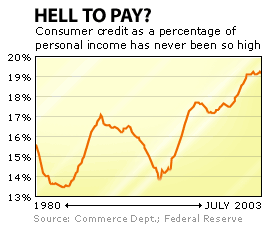
According to figures mentioned by el freako, at the peak of actual interest rates, in the 80s, the debt was around 14% ; and now at the lowest point of actual rates, the debt is around 19% of annual income. So, the effect of the rates on the borrowing behaviour of the Americans would be as big as 5% of annual income. The bad news is that, as we are at the lowest point, we cannot expect the debt to increase (and consequently the consumption will not rise thanks to a growing indebtness), the good news is that when the rates will start increasing the reduction of the debt will not exceed 5%. Also, the increase of the rates will be triggered by a significant growth and the associated fear of inflation, and inflation is good for debtors.
But the idea that the economy could expand under the effect of the consumer debt is wrong, or at least excessive, in that the building up of the debt to its medium size is a one time effect, the circumstantial effect is limited to variations around the midpoint.
|
|
| |
|
| |
All times are GMT. The time now is 05:31.
Apolyton Time is 00:31. |
top of page
|
| archivepost |
|
Forum Rules:
You may not post new threads
You may not post replies
You may not post attachments
You may not edit your posts
|
HTML code is ON
vB code is ON
Smilies are ON
[IMG] code is ON
|
|
|
|
|
|






 03-10-2003 22:48


 Attachment:



 Smiley





 |
|