|
| |
|

|
DaShi
|
 |
The Taste of Japan
Sep 2000
time: 05:31
|
|
http://www.nytimes.com/2003/11/04/i...sia/04CHIN.html
quote:
Foul Water and Air Part of Cost of the Boom in China's Exports
By JOSEPH KAHN
Published: November 4, 2003
AIZHOU, China — The first thing that struck Shen Yunxiang when he descended into the bowels of Hisun Pharmaceutical was the smell, or rather the lack of it. It was as if the sewage system had been scrubbed with ammonia, he said, leaving only a sickly sweet aroma strong enough to overpower the stench of human waste.
In less than a minute, though, he realized that the company had exposed him to something far more noxious than feces. He had been sent, unwittingly, to release chemical runoff that Hisun had collected haphazardly beneath the factory, possibly to avoid paying fees to dispose of toxic waste.
Mr. Shen's chest constricted. His breathing grew labored, his head faint. Then Feng Huaping, his brother-in-law and fellow migrant worker, who had climbed down first, gasped, "Grab my hand, get me out," before collapsing in a puddle of muck.
Mr. Shen was the lucky one. He emerged with migraines and lung congestion, and doctors are still trying to diagnose the illness that is causing them. Mr. Feng died that night. A third migrant worker, Tang Dejun, also died in Hisun's fetid plumbing after he was sent down to finish the job the next day.
Hisun is one of China's leading exporters of pharmaceutical products, certified by the United States Food and Drug Administration and the European drug commission to sell lifesaving antitumor and cardiovascular medications for prices Western manufacturers cannot match.
But the company may pay more attention to fighting cancer in America than to protecting the health of its own workers and neighbors in Taizhou, a seaside industrial city where the air and water bear Hisun's inky signature.
Hisun declined to answer detailed written questions about the incident, as did the police in Taizhou. But a local government official confirmed the deaths, which occurred in August, and said they were the subject of an ongoing criminal investigation. The official said he did not know the cause of the deaths.
Hisun has sprouted quickly, growing from a tiny state-owned drug maker to a pharmaceutical and chemical conglomerate, with shares listed on the Shanghai Stock Exchange and some powerful foreign partners. But company employees and local residents say that it has never stopped dumping untreated chemical waste around Taizhou, and that it has minimized or ignored the harmful effects of poisonous substances on its own workers.
"They were reckless to send us down there without protection," said Mr. Shen, now recuperating in a nearby hospital. "To send another guy down the next day is beyond belief. They have no regard for human life."
Such disregard appears all too common as China booms. The country's economy is growing faster than any other. But the air and water in many of its leading cities rank as the dirtiest in the world, and the number of people who die at work, 11,500 through the first nine months of this year, is far disproportionate to workplace fatalities in other countries.
Much of China's economic boom has stemmed from foreign investment and international partnership. Hisun itself has become partners with the Drug Source Company, a distributor of generic drugs based in Westchester, Ill.
The American company helped Hisun gain regulatory approval to make ingredients for a range of drugs, including the top-selling antitumor medication doxorubicin, used to treat cancer patients. The drugs sold in the United States are Hisun's most profitable product lines and are its fastest growing source of revenue, according to reports it has filed as a publicly listed company.
Drug Source did not answer phone and e-mail messages seeking comment about its relations with the company.
Hisun has undergone seven inspections by the Food and Drug Administration in recent years. They were intended to ensure that the company meets American standards for product safety. Hisun passed the inspections, and it is now certified to sell ingredients for at least eight medicines to the United States, all distributed by Drug Source.
Eli Lilly & Company has also joined with Hisun to produce Lilly's drug capreomycin, used to fight resistant strains of tuberculosis. Similar alliances have helped Hisun crack the European market for pravastatin sodium, which lowers cholesterol levels in heart patients.
A spokesman for Eli Lilly said the company had no knowledge of environmental or safety problems at Hisun. The F.D.A. declined to answer questions about its inspections of Hisun or its certification process.
Hisun's case suggests that the enormous human and environmental toll of China's rapid development is not just an unintended side effect but also an explicit choice of business executives and officials who tolerate deaths and degradation as the inevitable price of progress.
Taizhou's main industrial area, Yantou, where the Jiaojiang River meets the East China Sea, was historically popular among fishermen, who used the river as a sheltered harbor.
In the mid-1980's, the local government renamed the area the Yantou Pharmaceutical Chemical Industry Zone, with state-owned Hisun as the anchor tenant. Authorities built concrete barricades along the beach to protect factories from the tides, rendering parts of the seashore inaccessible.
Hisun initially focused on the Chinese market and produced antiparasite medicines used by veterinarians to treat farm animals. But during the past several years, it has ventured into foreign markets with the help of its North American allies.
Powered by exports, Hisun's sales are on track to hit $150 million this year, and its campus of white-and-blue tiled factories and offices has expanded to cover dozens of acres along the waterfront.
Yet one of Hisun's comparative advantages seems to be that it does not spend much money to treat toxic chemicals that are byproducts of producing these drugs.
Internal reports by local and national environmental investigators have found that each year, Hisun and other nearby companies release 3.6 million tons of water laden with organic and inorganic compounds that receive little or no processing.
Yantou's shoreline is edged with sludge. Inland, the air is sulfureous. Fishermen say river water and seawater causes their hands and legs to become ulcerated, in some extreme cases requiring amputation.
Some 1,700 villagers have left the area around Yantou in recent years, according to one national environmental report, which also showed elevated rates of cancer and respiratory disease among residents.
The effect on some of Hisun's own employees has also been severe.
Until recently Cao Hongshai was a Hisun assembly-line worker who made a deworming medicine that the F.D.A. approved for sale in the United States.
Ms. Cao said she used toluene, a toxic solvent, to produce the active ingredient in the drug. But she wore only a blue cotton uniform and worked in a room that had no special ventilation.
Ms. Cao says she has not suffered health problems except for irregular periods. But two years ago she gave birth to a girl who had stubs where eight of her fingers should have been.
Ms. Cao and her husband, Lin Jianyong, sued Hisun for damages. A report submitted to the court by the government-run Medical Information Institute in Zhejiang Province found a "clear correlation" between the child's defects and the chemicals used at Hisun.
But local courts have consistently supported Hisun, and Mr. Lin and Ms. Cao have nearly exhausted the family's savings fighting the company.
Ms. Cao and Mr. Lin included "Hisun" in their daughter's name, so their daughter would always know that her deformity was the company's fault.
Local government officials have recently taken steps to clean up Yantou. Authorities opened a waste-water treatment facility just a short walk from Hisun's campus, and local companies are now required to channel their runoff there and pay for it to be processed.
Beijing has also expressed alarm. After two reporters for the New China News Agency wrote an unpublished internal report revealing Yantou's environment woes, Prime Minister Wen Jiabao ordered environmental and safety agencies to investigate, according to people who say they were told of the prime minister's intervention.
But by the accounts of Hisun employees and some local officials, the company became adept at fending off such inquiries.
On Aug. 14, word spread at Hisun that a central government inspection team was to arrive from Beijing. Employees said their managers became unusually active in seeking to clean up the facility.
Mr. Shen, the migrant worker who handled construction jobs for Hisun, noticed people bustling about the factory that day. But it was not until night that he and Mr. Feng were recruited to help the company prepare for inspections.
A boss came looking for Mr. Feng at the temporary shacks where he and Mr. Shen lived, together with their wives and young children, all of them migrants from southwestern Sichuan Province. Hisun's plant is nearby, across a foul-smelling canal that provides shipping passage to the sea.
The boss explained that Hisun had a problem that needed immediate attention. Mr. Feng, who led his own construction brigade, was told to pick a colleague and bring flashlights, a sledgehammer and a drill. Mr. Feng roused Mr. Shen, his brother-in-law.
Mr. Shen said the boss told them what to do. They were to knock down barricades that had been built inside Hisun's sewage system to redirect the flow of liquid waste. He did not explain why.
It seems quite likely, some other employees and local residents said, that the company had diverted waste water to avoid paying fees to have it processed, and that pending inspections prompted the company to restore the flow.
Mr. Feng stripped off his shirt and climbed down a manhole. Mr. Shen followed a few steps behind. He said he expected to smell human waste, but instead encountered the light chemical odor. He felt dizzy.
Mr. Feng had just begun working below when he cried out and reached for help. Mr. Shen grabbed his bare arm, wet and slippery, and pulled with all his strength. He tugged so hard that he bit off the tip of his tongue. The shot of pain in his mouth is his last memory that night.
When Mr. Shen regained consciousness two days later, blurry and disoriented in the hospital, he asked for Mr. Feng. He was told his brother-in-law was dead.
So were Mr. Tang, the other migrant construction worker who followed them into the drainage pipes the second night, and a security guard involved in a rescue attempt.
A local government official, Mr. Wang, who declined to provide his full name or have his title used, said a deputy general manager of Hisun and a lower level official in charge of the drainage system were under investigation.
Hisun itself was fined the equivalent of $5,400 for the incident, this official said. Relatives of Mr. Feng said Hisun paid them $20,500 compensation.
The local official said Bai Hua, Hisun's chief executive, was also assessed a personal fine. But neither Mr. Bai nor his company have said anything publicly about the incident.
In October Mr. Bai headed his company's delegation to a major pharmaceutical convention in Frankfurt, where it promoted its line of drugs to fight heart disease, certified safe by the European Union. |
There are more such stories. This is very near where I live. To think that only a month and a half ago, I attended a conference on the future growth and economic development of Zhejiang province. Nothing of abuses were mentioned, of course. Just the usual catch phrases that the Chinese like, "more modern," "cleaner air," "less traffic." Listening to the fanfare that was played in the opening ceremonies, the comparison become obvious. Loud and boisterous, but lacking in any sophistication and sagacity. Both were meant to make the listener overlook the problems and inspire their blinding national pride. No one ever has a chance to think, "we're not modern," "the air is unclean," and "there's bad traffic," despite that they are all aware of this. These meetings are designed to forget about the problems and look to the future of China's "illustrious greatness." Although it's strange that "better working conditions" is never among those phrases. 
|
|
| |
|
| |
|
| |
|
|
|
DinoDoc
|
 |
AECCP loves Democracy
Sep 1999
time: 23:31
|
|
quote:
Rich man, poor man
Sep 25th 2003 | BEIJING
From The Economist print edition
CHINA can be justly proud of having lifted some 400m people out of poverty in the last quarter of a century. But at the same time it has produced income inequalities that are among the fastest-growing in the world. These are not just the natural consequences of China's impressive growth. They are symptomatic of barriers to labour mobility and other legacies of the old planned economy that could put a brake on the country's development in the coming years. For China to reach its target of quadrupling 2000's national product by 2020, it will need bold reforms in a wide range of areas. It is not clear that it has the stamina for them.
At the start of China's move away from central planning in 1978, the average income of urban residents was about 2.5 times that of their rural counterparts. By the mid-1980s, the ratio had narrowed to 1.8, thanks to the breaking up of the people's communes, and other policies aimed at boosting rural incomes. But since then, the countryside has fallen ever further behind. Rural enterprises began to sputter in the 1990s as a result of increasing competition from the cities, bad management and poor investment decisions. Income from farming stagnated. Now urban residents earn on average three times as much as those in the countryside.
The disparity may be worse than it seems. Some Chinese scholars believe that official figures overstate the disposable income of farmers, who have to buy seed and fertiliser and are subject to numerous illegal levies by local governments, and understate that of urban residents, who often have undeclared sources of income. Lin Tai, a social-sciences professor at Beijing's Tsinghua University, has estimated that the urban/rural income ratio is as high as six. A similarly sharp divergence has occurred between the wealthy coastal provinces and the backward interior.
The widening income gap is often described by Chinese officials as a threat to social stability. “A Study of Mass Incidents”, a book circulated last year within China's police force, said that large-scale public disturbances were increasing annually, particularly in the countryside. One of the reasons the study gave for this was the growing gap between rich and poor. But such incidents have had little perceptible impact on China's overall social and political stability. A bigger potential threat is likely to come from the impact on China's economic growth of the factors that have caused China's urban/rural divide to expand at such a pace.
Thanks to what was until recent years a rigid system barring rural dwellers from moving into the cities, China's rural population is unusually large for a country at its stage of development. About two-thirds of the population of 1.3 billion lives in the countryside or in rural townships. Of these, more than 300m have little or nothing to do. To increase returns on agriculture and boost incomes farmers' tiny plots of land need to be merged and surplus labour moved into urban manufacturing.
China has gradually relaxed restrictions on mobility to meet demand for unskilled labour in the cities. But indirect obstacles remain. These include a lack of affordable housing, exclusion from urban welfare provisions, high fees for work and residence permits and the lack of any mechanism for selling or mortgaging land-use rights (the government formally owns all land) to provide the cash to move.
Removing these obstacles will take daring. Officials worry that in the absence of rural pension or unemployment benefits, allowing farmers to trade their land would deprive them of their only security—potentially creating a new source of social instability. Local governments fear that further encouraging the migration of rural labour would put excessive pressure on urban services.
China recognises the need for faster urbanisation. But fearing the development of sprawling shanty towns around big cities, it has focused on developing smaller towns. In a report published in July, a researcher from the Ministry of Labour and Social Security, Guo Yue, argued that by forgoing economies of scale, China's urbanisation policy had led to a colossal waste of resources and had failed to boost growth or employment.
For cities to work better, they will need industries with increasingly skilled labour and higher technology to boost productivity. Yet China's education system is woefully inadequate. Katarina Tomasevski, a UN official responsible for education rights, said in Beijing last week that Uganda was doing better than China in guaranteeing the right to education. She said China spends only 2% of its GDP on education (China says it is 3.4%, but the UN recommends 6%) and the government provides only 53% of school funding, lower than most other countries with compulsory education systems.
China will also need to overhaul its banking sector, so that capital can be deployed where it is needed instead of in unproductive state-owned enterprises or property speculation. This will involve liberalising interest rates and allowing greater private ownership of banks. But for years China's leaders have dithered over these and other essential reforms, such as sorting out the banks' huge portfolios of bad debt, fearful that a wrong move might precipitate an economic or social crisis.
In a critical report, the World Bank says it will take “enormous political will” for China to overcome resistance to needed reforms. Encouragingly, China supported the report's publication. And next month the Communist Party is scheduled to hold a meeting of its Central Committee to discuss, among other things, speeding up reform—with due attention paid to stability. But don't expect much to change. |
|
|
| |
|
|
|
DaShi
|
|
The Taste of Japan
Sep 2000
time: 05:31
|
|
I was planning on posting this one later, but as it brings us a bit back on topic (the fate of migrant workers in an economically prospering China), I will post it here now. This one is truly shocking for me as it occurred in the town that I am now living in. As foreigners, we are not deliberately kept from seeing these kinds of scenes. And the local news will certainly not report it. No, it is America that has such violent crime according to them. I remember when I taught here before and a pair of young girls told me that they were going to study abroad in Australia. I asked them, why not America? They responded that it is too dangerous. There are too many criminals. I guess being relativley well-off and not a minority, it is easy to feel safe in China. I really wouldn't know. I never went looking for trouble in either country, and, fortunately, it never found me.
http://www.nytimes.com/2003/08/26/i...5b24696&ei=5070
quote:
Chinese Economy's Underside: Abuse of Migrants
By JOSEPH KAHN
Published: August 26, 2003
HANGZHOU, China — From his precarious perch 60 feet above morning rush hour, Wang Fulin watched the restless crowd below. Arms were drawing arches in air, he recalled. They wanted a swan dive. People were chanting, "Jump, jump!"
Enraged and afraid, Mr. Wang had scaled the metal frame of a billboard to call attention to his grievances. It was his first day in this bustling east coast city, his first trip outside his home province in southwest China. He had been neglected, robbed and abused. Now they wanted blood.
In the end he does not remember how he slipped. He recalls only waking up in a hospital bed with three cracked ribs, a broken hip and a shattered ego. "I told those people that I'm a good man, not a bad man, that I just needed help," he said. "But I could not believe in anybody, and nobody believed in me."
The six-story plunge was the coda of a two-day cross-country odyssey, a personal tale of desperation emblematic of the gamble every Chinese migrant worker takes, leaving family behind to live on the fringes of urban society with limited access to housing, education, medical care and the courts.
Migrant workers are China's untouchables. They are assumed to be behind every unsolved crime. They are the yokels on the street corners of every city, barely able to speak Mandarin Chinese, wide-eyed with fascination or fear.
They are also the dark underside of China's economic success, which has been marked by annual growth of 8 percent for more than a decade and exports to the United States growing so fast that they have surpassed Japan's. In general these people are vulnerable, pliable, cheap to employ and easy to suppress.
The migrant workers number well over 100 million, staffing the factories of Asia's export powerhouse. They work long hours in dangerous jobs for low salaries and no benefits. They are barred from forming unions — the Communist Party allows just one union, its own — and liable to be fired on a boss's whim.
They would not come to the cities if the opportunities did not outweigh the dangers, and the government has taken steps to stop systematic abuses. Beijing recently abolished a law that allowed the authorities to detain rural workers and send them home without legal proceedings.
Yet even the official news media offer regular examples of their extreme distress. There are migrants who threaten suicide when they are not paid. Some are preyed on by job agents or forced into sex slavery. Migrants say the police often beat them for minor infractions, like forgetting to carry an identity card.
"To them we are nothing," said Wang Xiaozhen, 48, a migrant worker in Hangzhou. "They don't take our lives seriously."
Ms. Wang says she was selling fruit on a sidewalk one day in February when patrolmen approached. She scurried away, knowing officials did not permit vendors there. But she says the patrolmen gave chase and beat her severely, causing nerve damage in her neck and back and making it impossible for her to work.
She now spends her days in a Hangzhou park, lying on a wooden roller bed and begging for change. A Hangzhou police duty officer said he had no knowledge of Ms. Wang or her complaint. He also declined to comment on the case of Wang Fulin, who is not related to Ms. Wang.
It was money that persuaded Mr. Wang to leave his lush but poor mountain village in Guizhou Province and travel 1,250 miles to Hangzhou, near Shanghai. He arranged to take a job making cardboard shipping containers for $72 a month, enough to send cash back to his ailing father and his two young children.
Instead he was caught in a psychological drama worthy of Hitchcock, with clever crooks, derelict police officers and naïve miscalculation. Instead of sending money home, he has relied on relatives to raise $1,500 for his medical care, two years' salary at the box factory.
He seemed hale and steady enough before leaving home, relatives said. His sparkling brown eyes, round cheeks and soft lisp make him appear younger than his 30 years. As an only son with a chronically ill father, he tended the family plots alone. He once recruited volunteers to build a five-mile road that eased the isolation of his mountainside hamlet.
This year, though, Mr. Wang needed cash to pay school fees for his 6-year-old son and buy medicine for his father. Mr. Wang's wife left first. She found a job making light-bulb filaments in Hangzhou. She phoned to say a relative had found a job for Mr. Wang nearby.
The day after summer planting was done, he set out, first by foot along the road he built to Nanlong, then by bus to the provincial capital, Guiyang, where he caught the long-haul K-112 train.
It was trying from the start. His $17 ticket was for standing room on the 36-hour trip, and he could not find a spare seat. He was leaning against the bulkhead of car No. 8, around midnight on the second day, when he heard a fellow passenger whisper, "It's about to get crazy."
A group of men with neatly combed hair and leather shoes had begun working their way through the darkened cabin. Mr. Wang watched them pull down bags from the overhead rack and search the contents, pocketing money and valuables.
Soon they spotted Mr. Wang, awake and afraid. They peppered him with questions about where he was from, how much money he was carrying, where he was going. Mr. Wang said he had answered honestly. He was a country boy with very little money. His cousin was meeting him at the Hangzhou station.
"They accused me of hiding wads of cash, maybe inside my pants," Mr. Wang said. "They said I looked like a sly guy." He said he had stripped off his pants to prove he had nothing strapped to his legs. But a man with a mobile phone, the apparent ringleader, kept harassing him.
"He called someone and told them he had a big catch," Mr. Wang recounted. "He said they should meet me at the station — bring some drugs to knock me out."
If they were trying to frighten him it worked, maybe too well.
When the conductor announced that the train was nearing Hangzhou, Mr. Wang darted from car to car to find a railroad policeman who was aboard. He found him in the cafe car, chatting with two train workers. Mr. Wang hurriedly explained that bad people were plotting to steal his money. He needed an escort off the train.
The policeman, Mr. Wang said, asked just one question, "How much money do you have?"
Mr. Wang said he was a poor man with nothing. The policeman waved his hand to indicate he had heard enough and walked away. But the rail workers stayed. One grabbed him from behind. The other ordered him to turn his pockets inside out. Mr. Wang said he produced a small wad of bills, his travel money, and put it on the table. A worker pocketed the cash. The two then dragged him to the caboose. A door was flung open. He was cast into a rail yard near the Hangzhou station.
His instinct was to flee. He scampered up the rail yard wall, losing his sandals in the climb. Breathless and barefoot, he had arrived in downtown Hangzhou. Mr. Wang said he had thought of going to the factory where his wife worked. But did not have the exact street address, and he had no money. He thought of finding his cousin at the station but worried that the crooks awaited him there.
A shop owner let him use a phone. He dialed the police emergency number, but in his home province, Guizhou. "I couldn't understand what people were saying in Hangzhou," he explained. The operator notified the Hangzhou police.
An hour later officers went to the store. He told them about the robbers, the uncaring policeman, the thieving train workers. He needed help, money, a phone. The police looked at him skeptically. Maybe they did not understand him, with his Guizhou accent. They told him someone else would come to handle his case.
No one came. He wandered the street, wondering what to do. Then he saw a billboard, an ad for Hang- zhou's annual festival on West Lake, hanging prominently over a major boulevard.
"My idea was to go up there and make a scene," Mr. Wang said. "Then I could explain what happened and demand that they contact my family."
He climbed a ladder to the top. To attract attention, he took off his jacket and tossed it down to passers-by. His shirt followed, then his belt. His pants fell to his ankles, so he took them off too. He stood on the billboard in his baby blue skivvies, shouting to people below.
Pedestrians stopped and gawked. Soon, reporters and firefighters were on the scene. "I have parents and children — I don't want to die," he yelled, according to one local report. But one bystander shouted back, "When you dive, make it a pretty one." Others joined in chorus: "Jump, jump!"
Firefighters tried talking him down, offering food and water. But when several rescue workers began climbing toward him at once, Mr. Wang scrambled to an edge, apparently looking for an escape. Then he tumbled. A hanging roll of canvas beneath the billboard checked his fall. He landed on a patch of grass.
Mr. Wang is now back in Guizhou. His wife, who found out about the accident from a newspaper report, moved him closer to home, where the hospital fees are lower.
He says he has decided that he just had bad luck. The next time he goes to the big city it will be different. And there will be a next time, given that his family, once merely strapped for cash, is now deeply in debt.
"For our kind of people," he said, "there's no other choice.'
|
Oh, for those of you who click the link and are lucky enough to get the right Harris Direct ad. Isn't that girl with the pitbull hot? 
|
|
| |
|
|
|
mindseye
|
 |
A Yankee living in Shanghai
Apr 1999
time: 13:31
|
|
quote:
Originally posted by Arrian
I feel it's a bit hypocritical for people of a rich, industrialized nation such as the US to go apeshit over pollution in China, as it tries to catch up. We pollute just as badly if not worse. Our regulations are stricter NOW, but go back 30 or 40 years and they were a total joke. |
Amen to that. Some of China's critics carry on as if the Untied States/the West existed always as it does now. When Chinese workers are described as toiling under "Dickensian" conditions is this not an admission that things were comparable in victorian Britain? Fortunately for the West, there was no highly-developed superpower China around during the West's industrialization to harp on worker's conditions, human rights, pollution, etc.
As yesterday's NY Times noted, in the last two decades China has lifted something like 400 million people from destitute Third World living standards to levels not terribly far from those of the West (and in cities like Shanghai, to near parity). 400 million people. That's a third more than the population of the US. Such a feat is, I suspect, unparalleled in human history.
I share Da Shi's concern over what is happening to China's environment. There can be no doubt that China faces problems that are are enormous in both their scale and complexity. Let's hope that they manage to tackle them with the same gusto that they have shown in the speed of their development. In the meantime, let's not forget where we westerners were not so long ago.
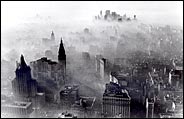
Below: Lower Manhatten, 1966 - a time when many of the city's residents were afflicted with a dry, hacking cough resulting from the levels of noxious air pollution.
 Attachment: lwrmnhttn1966.jpg Attachment: lwrmnhttn1966.jpg
This has been downloaded 56 time(s).
Last edited by mindseye on 06-11-2003 at 16:43
|
|
| |
|
|
|
mindseye
|
|
A Yankee living in Shanghai
Apr 1999
time: 13:31
|
|
quote:
Originally posted by DaShi
I was planning on posting this one later, but as it brings us a bit back on topic (the fate of migrant workers in an economically prospering China) |
The attitude of city dwellers towards the peasants is reprehensible, especially when you consider who is building China's citys (hint: not the urbanites). Sometimes my tolerance wears mighty thin over the crudity and capers of the xiangxia ren (who are truly like lost time travelers from the 1840s), but I try to avoid treating them with the disdain with which their fellow countrymen hold them.
quote:
No, it is America that has such violent crime according to them. (...)I guess being relativley well-off and not a minority, it is easy to feel safe in China. I really wouldn't know. |
Well, I do know.  I spent many years living in San Francisco's Western Addition and Mission districts. Hearing the crack of rifle and handgun fire as I perused the evening paper was not the least bit unusual. The wail of ambulance and police sirens throughout the night was part of life. I spent many years living in San Francisco's Western Addition and Mission districts. Hearing the crack of rifle and handgun fire as I perused the evening paper was not the least bit unusual. The wail of ambulance and police sirens throughout the night was part of life.
China is far, far safer than the US, in virtually every crime category, from vandalism to rape. Here in Shanghai, young women can walk alone through the darkest of alleys in the middle of the night - without a care. I recognize that China's largest city is paradoxically it's safest, yet even the residents of Guangzhou (or other relatively dangerous cities) do not deal with crack houses, drive-by shootings, armed robberies and routine muggings on anything like the scale American urbanites are accustomed to.
|
|
| |
|
| |
|
|
|
mindseye
|
|
A Yankee living in Shanghai
Apr 1999
time: 13:31
|
|
quote:
Originally posted by DinoDoc
quote:
yet even the residents of Guangzhou (or other relatively dangerous cities) do not deal with crack houses, drive-by shootings, armed robberies and routine muggings on anything like the scale American urbanites are accustomed to. |
No ****. If you wish to give the police the power to torture prisoners and whatnot here, we could do the samething. |
 You would be amazed at how far off you are from the truth. You would be amazed at how far off you are from the truth.
There are far fewer cops here, and they are seldom armed (in fact, most are traffic cops). You can argue and scream in a cop's face and they won't touch you (I have seen it many times).
Sure, there are terrible incidents of abuse. But you have to measure those per capita to get the true picture (don't forget you're talking about 1/4 the world's population).
Crimes would be hilariously easy to pull off here, due in large part to the minimal police force. I have been trying to understand why there is not more crime, especially given the growing economic disparity. At this point I believe it is attributable to two major factors:
(1) Cultural differences. The Chinese are simply a less violent people. There's little of that machismo crap which permeates western culture. Fist fights and the like are quite rare. As for vandalism, etc., good luck trying to explain to a Chinese person why city buses in the US don't have padded seats like many do here. It just doesn't occur to most Chinese to destroy public things. I remember my first hour in Shanghai, how astonished I was at the lack of graffiti.
(2) no fvcking guns
Note that absent from the list is "Fear of police." No one I know thinks that way (caveat: I live in Shanghai, not 100% typical). I have had Chinese friends speak openly about drugs over the phone (much to my horror, I would never do that back in the US). During my first year here, Chinese friends laughed at my my nervousness around cops.
I believe the worst crimes here are "white collar" crimes and corruption-related abuses of power. These are both staggeringly huge problems, but at least you can walk the streets safely.
I think that most Americans have no idea how much personal freedom they sacrifice over crime and fear of crime. There are myriads of ways, large and small, in which Americans adjust their lives to deal with crime and safety. We are so accustomed to it we barely notice.
It's hard to describe the feeling of freedom at being able to casually stroll a lonely park or darkened street in the middle of the night, to set something down in a crowded place and not have it vanish in five seconds, to not have three locks on everything, to play with a stranger's child, take public transportation late at night, or not worry about "bad" parts of town. After 2.5+ years, I still marvel at it. It feels like the way life is supposed to be.
Last edited by mindseye on 07-11-2003 at 00:36
|
|
| |
All times are GMT. The time now is 05:31.
Apolyton Time is 00:31. |
top of page
|
| archivepost |
|
Forum Rules:
You may not post new threads
You may not post replies
You may not post attachments
You may not edit your posts
|
HTML code is ON
vB code is ON
Smilies are ON
[IMG] code is ON
|
|
|
|
|
|





 04-11-2003 14:51





 |
|