|
| |
|
| |
|
| |
|
| |
|
| |
|
| |
|
| |
|
| |
|

|
Immortal Wombat
|
 |
in perpetuity
Dec 2000
time: 05:32
|
|
quote:
Originally posted by Peter Triggs
Good to see you back, IW.
C'mon, give us a 'what I did on my hols' essay.  |
Oh, ok then.
Basically we only found out exactly what we were doing once we arrived in country, so I've been way too vague in all my explanations prior to going. The organisation I went with - Frontier - do biodiversity studies in areas that are in need of formal conservation legislation, but which are too remote or understudied for larger projects and groups - like WWF - to invest large amounts of money in.
So what we had to do was survey the area and write lists of all the animals (mammals, reptiles, amphibians, birds and butterflies) that were there. So most of the time we did standard trapsites to do a broad survey of terrestrial creatures. These consisted of 33 buckets dug into the ground and 300m of plastic sheeting connecting them. So all the animals that wandered along the ground then hit the plastic, and walked along until they fell in a bucket, then we came along and took measurements. There was also about 21 (humane) small mammal traps set on the ground and in trees, to catch any arboreal mammals (and lizards) that happened to be wandering past and fancied some peanut butter. And also 6 canopy traps for butterflies, which are cylinders of netting that the butterflies fly into (mmm, fermenting banana) and then fly up and become unable to escape. And these trapsites we checked twice a day for 8 days, then dismantled.
So that got most things; but we also did walks looking for birds and lemurs (and at night, nocturnal snakes, geckoes and chameleons), and we also recorded any snakes and lizards we caught casually around camp, etc, and we also did butterfly sweep netting, which looks ridiculous, but feels like doing work experience with the Grim Reaper.
We were staying near the west coast of Madagascar next to a lake named Lake Ranobe (which in Malagasy means 'Big Lake' or 'Lots of Water') which was on the edge of the Dry Spiny Forest. The DSF in that part of Madagascar is totally unique, and this small strip of habitat is the only place in the world where it exists. So we did a trapsite in the Spiny Hell (nickname gained during ridiculously hot first week), and caught absolutely loads, since it was the wet season, so everything was coming out- lizards, skinks, geckoes, snakes, blind snakes, dry-habitat frogs(!!), hedgehog tenrecs, shrews, etc. (as well as scorpions, spiders, giant bush crickets... which we weren't recording thank goodness.)
After that we spent a couple of weeks further inland on a tiny pocket of savannah which divides the spiny forest from the dry deciduous forest of the central plateau. We were studying a forest corridor to see if the habitat link was complete and a flow of individuals (and thus genes) was possible from one to the other. So we did an exploded trapsite across three habitats and looked at the differences in results. This area was particularly in need of study because an Australian mining company (encouragingly named Exploitation Madagascar - we hope it's the French...) is looking to mine the entire strip of savannah, and the value of these corridors is essentially unknown. We found that the forest corridor was used by many different species which shunned the savannah, but that as ever, further study was needed.
Then we went back to Ranobe and spent a week or so doing casual collections of reptiles and butterflies (as well as bat netting and bird-watching) in the area of gallery forest near the lake. West-Madagascar gallery (water-side) forest is even scarcer than the dry spiny forest, and is amazingly abundant in terms of species diversity. So that was fun.
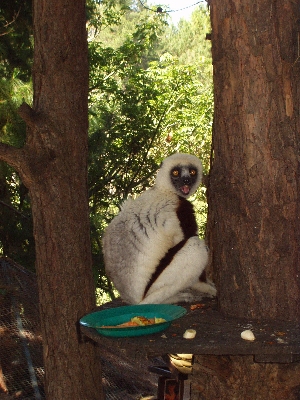
Then we travelled north to the River Manombo to do a trapsite there - quite literally on the edge of habited land. (One day we went for a walk north of the river, and after passing the last houses, we followed the road to the end after which there was almost certainly nothing but forest for the scores of miles to the next river) The gallery forest there was quite different from that at Ranobe, whether because it was riverside not lakeside, or just less disturbed, I don't know. But we saw many different species there, and learned the difference between the greater and lesser hedgehog tenrecs once and for all. We also saw common tenrec here - which presumably had been hunted out of Ranobe, and lemurs - which definately had been hunted out of Ranobe. I say lemurs... one person saw a wild ring-tailed lemur, three of us saw the red-fronted brown lemur. Then our guide brought us this pet ring-tail to see. Which was nice.
Ah, what else. Then we returned to Ranobe in the local public transport- big trucks known as taxi-brousse which only start moving when full, and then take on more passengers as the journey progresses. So I spent a merry hour sitting on 6 inches of steel as we bumped along the National Route 7 (a mud track slightly wider than most) at 40mph, clinging desperately to a greasy rope that was the only thing keeping me from falling out the back.
Back at base camp, we spent the final week of the project doing individual project work (What I will need a level two BTEC in Tropical Habitat Conservation for I can't imagine, but one never knows when it could come in handy). I chose to sit by the lake for 27 hours and watch the waterbirds. This is less exciting than it sounds. It was made all the worse when the local women came down to wash (clothes and themselves) and fish. So the birds flew away, and the children flocked instead- around me. Anyway, that was only six days, and then we struck camp, and moved out.
Before heading for home, we spent a couple of days in Mangily - a beach resort of sorts. There we spent some time snorkelling on the reef, beachcombing, having large and opulent meals, and generally chilling out. Then we departed for Toliara.
Another taxi-brousse journey ([cramped] seats this time, but dripping fish oil too  ) to the town. The following day we did a presentation to a French school in town telling them about the work we do and so forth- to educate them about the wildlife and improve their english. The Malagasy still generally believe chameleons to be dangerous and kill them on sight. When in fact they are completely harmless. Similarly all the snakes - none of which are dangerous to humans, either because they aren't venomous, or the venom is too feeble, or because their teeth are way too small to pierce the skin. So that was good, and I think most of them understood some of what we said, and some of them understood most of what we said. ) to the town. The following day we did a presentation to a French school in town telling them about the work we do and so forth- to educate them about the wildlife and improve their english. The Malagasy still generally believe chameleons to be dangerous and kill them on sight. When in fact they are completely harmless. Similarly all the snakes - none of which are dangerous to humans, either because they aren't venomous, or the venom is too feeble, or because their teeth are way too small to pierce the skin. So that was good, and I think most of them understood some of what we said, and some of them understood most of what we said.
Then we drove back to Antananarivo and spent a couple of days there in the market and the local biological park (third lemur sighting) before coming home.
It was good. I enjoyed myself immensely, and found moments of complete and utter contentment - free from needs and free from being needed to do anything. Everything was new and interesting, everyone was friendly, it was great.
Oh, here's the other lemur.
 Attachment: lemur.jpg Attachment: lemur.jpg
This has been downloaded 114 time(s).
|
|
| |
|
| |
|
| |
|
| |
|
| |
|
|
|
Maquiladora
|
|
quote:
Maquiladora take a look at my site And feel free to steel code ,pics ,etc |
Yep saw your site a while back BigMc, excellent idea, but im not interested in improving the look yet. Maybe when i get more things there to read ill start looking at eye candy.  I also want to keep the backgrounds fast so i can post more pictures of in-game action and things without slowing load times. I also want to keep the backgrounds fast so i can post more pictures of in-game action and things without slowing load times.
quote:
Maq, Are you in the mood to restart a CTP PBEM? |
Sure.
Shall we use Keygen's PBEM ModLite again?
quote:
Features
--------
8 predefined advances: Agriculture, Toolmaking, Mining, Domestication, Bronze Working, Stone Working, Religion and Ship Building.
1 bonus discovery randomly selected between Astronomy, Theocracy, Monarchy, Geometry, Iron Working and Writing.
3 free caravans.
3 settlers with increased movement by 900, totaly 1000, only for the first turn. After that turn the settlers' bonus movement will stop existing.
10.000 gold and 5000 infrastructure (public work).
1st city to be built within the first 5 turns will grand population of 3, bonus good within the city tile, 2 phalanx, 1 mounted archer and 1 settler.
2nd & 3rd cities to be built within the first 5 turns will grand population of 2, 2 phalanx, 1 warrior and 1 settler. |
PM or email reply. 
|
|
| |
|
| |
All times are GMT. The time now is 05:32.
Apolyton Time is 00:32. |
top of page
|
|
|
Forum Rules:
You may not post new threads
You may not post replies
You may not post attachments
You may not edit your posts
|
HTML code is ON
vB code is ON
Smilies are ON
[IMG] code is ON
|
|
|
|
|
|





 26-03-2004 17:21





 .
.



 And it moved way to fast to get on camera. But I did get some pictures of some tame and captive ones.


 |
|