|
| |
|

|
VetLegion
|
|
This is currently discussed in the 'Raise tariffs on America' thread, but there are a couple of topics there and since I am not an economist, I would appreciate if someone would clarify this issue for me separately. I am interested how this developed historically.
Spiffor mentioned South Korea. Is it not true that the relative closeness of their market during their biggest growth had a positive effect on wealth of the country?
Also, from everything I ever read, USA were always one of the most protectionist countries in the world, the trend reversing only after WW II.
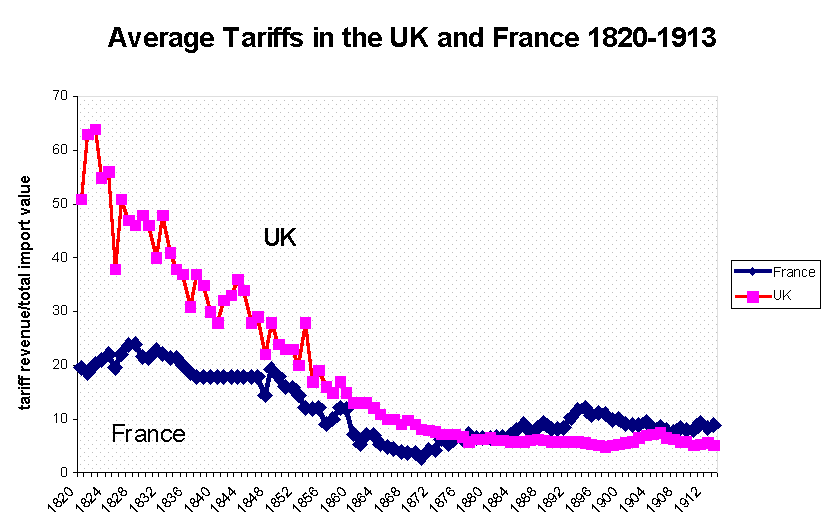
Is it true that most countries that are nowadays economic (industrial) giants and thus proponents of free trade, built up their power behind strong protectionism?
If so, how can someone argue against protectionism, especially in countries that aspire to industrialize, or those that are expiriencing a crisis?
|
|
| |
|
|
|
Ecthy
|
|
Zhonghuà Rénmín Gònghéguó
Mar 2000
time: 06:32
|
|
Too bad a 5% change does a stab hit and is only possible every 10 years...
|
|
| |
|
|
|
DanS
|
 |
Kickball Capital of the World
Jan 1970
time: 00:32
|
|
Bump. This is a good question. A side question is why some countries with the highest per capita GDPs (US, Japan) have only a small part of their economy that is traded.
Last edited by DanS on 03-12-2003 at 10:39
|
|
| |
|
|
|
Bereta_Eder
|
|
I think a sound approach, after the creation of modern nationalism, is to consider each economy as "national" meaning looking out for its own benefit. That way concepts such as free trade or protectionism are easily interchanged according to each particular situation to ensure the benefit of the "national economy". So a nation can have free trade where it knows it suits it (it can overtake the competition or at least have a shot) or protectionist at other times when it knows it cannot compete (the recent steel tarrifs are a good example).
|
|
| |
|
|
|
Bereta_Eder
|
|
Actually in economic terms the EU is a "national economy".
Also to dispell any potential confusion in regard to Imran's post: I said how things are best perceived as, not how "they should be or should not be".
|
|
| |
|
|
|
Bereta_Eder
|
|
Countries like Switzerland with a much higher GDP per capita than either US or Japan (and much more evenly distributed), actually only second in the world to Luxembourg, indeed have traditionally had trade surpluses but also very large domestic savings.
|
|
| |
|
| |
|
| |
|
|
|
Jon Miller
|
|
quote:
Originally posted by paiktis22
I think a sound approach, after the creation of modern nationalism, is to consider each economy as "national" meaning looking out for its own benefit. That way concepts such as free trade or protectionism are easily interchanged according to each particular situation to ensure the benefit of the "national economy". So a nation can have free trade where it knows it suits it (it can overtake the competition or at least have a shot) or protectionist at other times when it knows it cannot compete (the recent steel tarrifs are a good example). |
I agree
at times protectinoism is best, at times free trade is
the always free trade groups are right, wealth almost always increases (like entropy)
but just as with entropy just because total wealth is increasing, does not mean that the wealth of a particular country is increasing
and I think that there is no reason for one country to pauper itself for another country
the whole point of a nation is to look after it's own citizens interests, not the interests of the citizens of other countries
Jon Miller
|
|
| |
|
| |
All times are GMT. The time now is 05:32.
Apolyton Time is 00:32. |
top of page
|
| archivepost |
|
Forum Rules:
You may not post new threads
You may not post replies
You may not post attachments
You may not edit your posts
|
HTML code is ON
vB code is ON
Smilies are ON
[IMG] code is ON
|
|
|
|
|
|





 03-12-2003 04:13






 .
.


 Attachment:

 |
|