|
| |
|

|
Dominae
|
|
Welcome all to the first Conquests Apolyton University course!
No, no, this is not the official thread for the course, because we're still working out a few issues (namely, the finishes touches on the AU mod, and which patch to use). If all goes well, the game should be up this Friday, January 21.
(Are you completely lost? Are you asking questions like: what's AU, why should I play this game, and will the mod mess with my C3C installation? Fear not. All these and more will be answered on Friday in the official thread.)
For now, we can have some fun! As many of you know, the theme for the first Conquests AU course was (undemocratically) decided to be the Seafaring trait. The point of the course is therefore to determine the ins and outs of this wonderful new trait. Here are some other game variables that were (undemocratically) chosen for this scenario:
Civ: Byzantines (see below)
Rules: Default
Victory Conditions: All
Rivals: ?
Difficulty: Any
World Size: Large
Land Form: ?
Climate and Temperature: Standard
Age: 3 billion
Barbarians: ?
The amount of map "tweaking" by the scenario creator is ~5-10%. This means that you can expect a pretty standard game of Civ3, but if you're very familiar with the map generator some things may strike you as fishy. Hopefully this will not detract from your enjoyment.
Below are a few more posts to whet your appetite.
Last edited by Dominae on 21-01-2004 at 23:28
|
|
| |
|
|
|
Dominae
|
|
Byzantines:
Leader: Theodora (she's cute)
Traits: Seafaring, Scientific
Techs: Alphabet, Bronze Working
Unique Unit: Dromon
Seafaring:
Seafaring civs get a bunch of cool abilities:
1. Cities founded adjacent to the coast (i.e. next to a non-inland Coast tile) have a +1 Commerce per turn bonus in the base city tile. Therefore these tiles produce +4cpt under Despotism, and +5cpt without the tile penalty.
2. All naval vessels have a +1 Movement bonus. So Curraghs move 3 tiles, and Galleys (here, Dromons) move 4 tiles.
3. Ships that can sink in Sea/Ocean tiles have a reduced chance of doing so.
Scientific:
We all know what Scientific does from stock rules. However, remember that in Conquests Scientific civs also have a greater chance of getting a SGL from a previously undiscovered tech (from 5% to 7%, although I could be mistaken on this).
Dromon:
1. Replaces the Galley.
2. Stats: 2(2)/1/3, actually 2/1/4 with Seafaring's movement bonus.
2. Transport Capacity: 2.
3. Cost: 30 Shields
4. Tech: Map Making
5. Special: Lethal Sea Bombardment
Last edited by Dominae on 22-01-2004 at 00:57
|
|
| |
|
|
|
Dominae
|
|
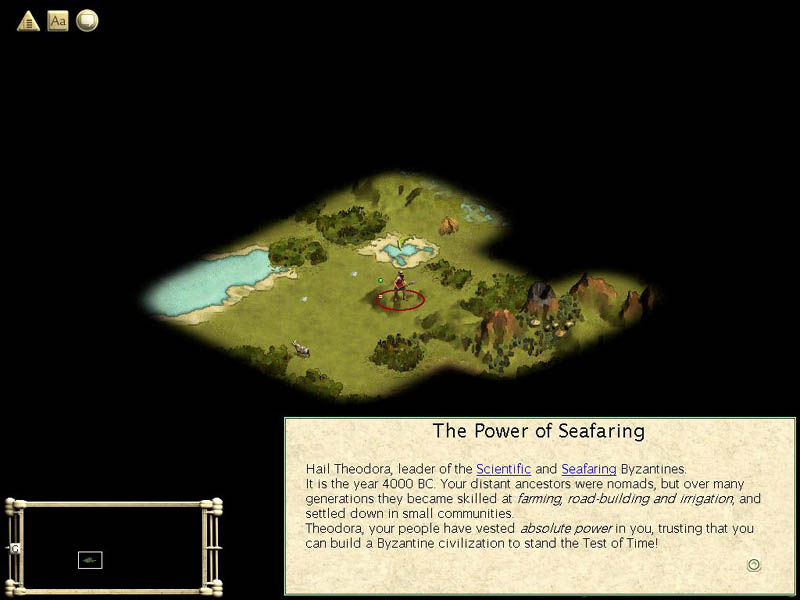
Below is a screenshot of the starting location. Feel free to use this thread to discuss it and any opening moves you feel a worth considering. Remember: the point of AU is to learn communally!
 Attachment: seafaring au - start.jpg Attachment: seafaring au - start.jpg
This has been downloaded 299 time(s).
|
|
| |
|
|
|
ducki
|
|
Did I miss something on the pump?
Grassland is 2f.
Cow is +2f.
Irrigate is +1f.
Despotism is -1f.
+4fpt.
All the other visibles are just 2f except for the fish.
Coast 1f
Fish +2f
Despotism -1f
2fpt.
Is there a bonus I am missing?
There must be, or I wouldn't post this and make myself look silly (again).
Edit: Yep, I look silly. I coulda sworn lake and coast with fish were the same. Turns out lake is not the same as coast. Color me stupid. Thanks alexman.
Last edited by ducki on 21-01-2004 at 23:02
|
|
| |
|
|
|
Fosse
|
|
U.S.A.
Mar 2002
time: 23:33
|
|
I'm excited to finally play a course for Conquests. As for the map tweaking, Dominae... that's one of the major reasons I like playing AU games!
Haven't decided about the start, and won't really think about it hard until I'm in game. Looks good though.
|
|
| |
|
|
|
Thrar
|
|
Sweet start!
i think i'll settle on the starting spot, trading a whole turn for those 7 more food (since you'd get 2 in the one turn you miss) for a non-freshwater spot next to the cow doesn't seem feasible to me.
Moving to the coast would waste a bonus grassland, and the advantage is not that great i'd say. With that settler pump start the colossus won't be a good idea in the capital anyway i think, and a curragh or two can be built in the second or third city just as well.
The volcano may become a nuisance, but that's life i guess...
I'm looking forward to play the game, i hope i'll find enough time to play until the end. Thanks!
|
|
| |
|
| |
|
|
|
Arrian
|
 |
Kneel before Grog!
Jul 2001
time: 00:33
|
|
I'd settle on the spot. You can irrigate through cities built on hills (as I was surprised to discover recently... when was that put in?).
Irr Cow = 4f, 1s.
Mined bgrass = 2f, 2s each.
mined grass = 2f, 1s.
Fishy = 3f, 0s.
City tile = 2f, 1s.
So, at size 5, that baby is at 7spt. With lots of forest tiles available to provide +2shields on growth turns, that's a pretty pump site.
I assume one needs the 1.15 patch for this game? *grumbles about needing to download 1.13 & 1.15, and then install 1.12,1.13, and 1.15.* Heh.
I may get to this one... but probably not until next week.
-Arrian
|
|
| |
|
|
|
Arrian
|
|
Kneel before Grog!
Jul 2001
time: 00:33
|
|
Because I'm feeling like wasting time at work...
T1: build. Worker moves 1. WF to bonus grass. Build warrior.
T2: 2f, 2s. worker roads.
T3: 4f, 4s.
T4: 6f, 6s.
T5: 8f, 8s. Road complete, begin irrigation.
T6: 10f, warrior complete. Another.
T7: 12f, 2s.
T8: 14f, 4s.
T9: 16f, 6s. Irrigation complete. Move to cow.
T10: 18f, 8s. Begin irrigation.
T11: Borders expand. Size2, warrior complete. WF to cow + bgrass. Build another warrior.
T12: 3f, 3s.
T13: 6f, 6s. WF to cow + fish
T14: 11f, 8s. Irrigation complete. Road.
T15: 16f, warrior complete. Build worker. WF to cow + bgrass.
T16: Size3, 4-5s (depending on autoallocation. Forest or bgrass with +4fpt? Probably forest. Assume 5s then). WF to Cow, Fish, and bgrass.
T17: 5f, 8s. WF to Cow, Fish, and Tobacco. Road complete, 1st worker moves8 to bgrass.
T18: 10f, worker complete, size2. WF to cow & fish. 1st worker mines. 2nd worker moves 9. Start granary.
T19: 15f, 2s. 2nd worker chops.
T20: Size 3, 6s. WF to Cow, Fish, and bgrass.
T21: 5f, 9s.
T22: 10f, 12s.
T23: 15f, 25s, chop complete. 2nd worker roads.
T24: Size4, 31s (lots going on here. +2 from forest during growth, plus another shield from the newly completed mine). WF to Cow, Fish, both bgrass. 1st worker roads.
T25: 5f, 36s.
T26: 10f, 41s. Road complete. 2nd worker moves to 2nd bgrass tile (unless the chopped tile is a bgrass tile!)
T27: 15f, 46s. Road complete. 1st worker moves to other bgrass tile. 2nd worker mines.
T28: Size5, 53s. WF to Cow, Fish, 2x bgrass and tobacco tile.
T29: 5f, 58s. WF to cow, fish, and all roaded tiles.
T30: 10f, granary complete.
I could work with that, I think.
-Arrian
|
|
| |
|
|
|
nbarclay
|
 |
Huntsville, Alabama
Dec 1999
time: 23:33
|
|
Spoiler Alert
I decided to set up a test scenario that approximates the important elements of this starting position and test a few different opening sequences. If you want to play the start out for yourself without knowing in advance how different openings work, don't read any farther.
Okay, if you're still reading, I assume you want to know what I came up with. Note that this is offered without any warranty (there might possibly be typos or things I didn't catch right when I wrote it) so use it at your own risk.
In all cases, research is initially set to Pottery at 100%. Making sure new laborers are switched to the right tiles after they appear is important because the governor likes using forests when you have excess food. (Switching the governor to emphasize food would solve the problem, but would give up free shields the turn laborers first appear in the process.) Also, it is important to make sure the luxury slider is always optimized as population changes or changes in which tiles are worked affect income to avoid riots without spending more than is necessary.
Case 1: Settle the starting position; build, worker-warrior-granary
Note that with the hut on top of the volcano, this is somewhat high risk because the warrior isn't completed in time if the hut produces barbs.
(1) Build the capital in the starting position. Build a worker using the grassland with shield one turn and the fish the rest of the time, and irrigate toward the cow. Don't bother roading the first tile on the way to irrigate. The initial worker is finished in seven turns.
(2) With the worker finished, both border expansion and completion of the cow irrigation are in three turns. Working the fish two of those three turns and a grassland with shield the third gives us eight food, which fits well with the 12 food we'll get the three turns after the border expands. A barracks isn't a good enough prebuild for the shields we can get by the time we discover Pottery, so we'll build a warrior first.
(3) After the warrior is finished, we start a barracks as a prebuild for a granary. The warrior can go out exploring. (Alternatively, we can use the warrior as a MP to finish Pottery and start Writing a tad sooner.) As the warrior finishes, we're back up to size 2 and working both the cow and the fish to get four-turn pop growth.
(4) Pottery is discovered in 2900 BC, just one turn before the barracks would complete.
(5) The granary completes in 2710 BC, with the capital at size 5.
Case 2: Move southwest, warrior-warrior-worker-granary.
(1) Move the settler southwest and the worker onto the grassland with shield by the lake. Start research on Pottery at 100%. Settle the cow and start building two warriors, then a worker. The worker irrigates and roads the grassland with shieeld by the lake, then the cow. (Skipping the road on the initial grassland with shield would speed up growth to size 2 by a turn, but the end result down that path is finishing our barracks prebuild before we discover Pottery so the haste does not help get our settler pump going faster. Note that two warriors and two workers are all we can support without delaying our Pottery research with unit support costs.) The warriors need to stick close to home while researching Pottery so they can serve as MPs when needed; we can't afford to spend any more on the luxury slider than we absolutely have to.
(2) When the pop increases while working on the second warrior, make sure the second pop unit works the irrigated, roaded grassland with shield until the city radius expands and then switches to the fish.
(3) When the new worker is finished, he starts mining the irrigated grassland with shield.
(4) Pottery is discovered in 2850 BC. Our warriors can now be released for exploration at the expense of the luxury slider if desired.
(5) Our granary completes in 2670 BC at size 5. We have a second warrior and only lost one turn on our granary compared with Case 1, and we avoided risking disaster if we popped barbs.
Case 3: Build in starting position. Build warrior/warrior/worker/granary.
(1) Build the capital in the starting position. Build a warrior using the grassland with shield one turn and the fish the rest of the time, and then another using a forest three turns (along with the fish) until the borders expand before switching from forest to cow. The starting worker irrigates the tile on the way to the cow without roading and then irrigates the cow. The warriors can either be sent out exploring (with use of the luxury slider) or kept at home as MPs to help research Pottery faster and get an earlier start on Writing. However, a MP benefit is needed briefly (two or three turns of saving a gold, I think) to avoid delaying Pottery research past the end of the barracks prebuild.
(2) Build a worker and use a barracks prebuild for a granary, adjusting the luxury slider as appropriate.
(3) Pottery is completed in 2850 BC, 1 turn before the barracks prebuild can finish, if optimizing for exploraion over fast research.
(4) The granary is completed in 2670 BC at size 5.
This case finishes the granary at the same time Case 2 does, along with the same number of warriors, but produces a lot more gold along the way because it uses the fish tile more (as well as providing an extra turn's gold from the capital).
Case 4: Build in the starting position and build warrior/worker/granary.
(1) Build the capital in the starting position. Build a warrior using the grassland with shield one turn and the fish the rest of the time. The starting worker irrigates the tile on the way to the cow without roading and then irrigates the cow. The warrior needs to stay at home as an MP a good part of the time; releasing him to explore in 3150 worked with a gold or two to spare.
(2) Build a worker using a forest two turns and and a grassland with shield 1 before switching to the cow with the border expansion. After the worker is finished, work the cow two turns to get back up to size 2, at which point working the cow and the fish provides a 4-turn growth pace.
(3) Pottery is discovered in 3950 BC, right before the barracks prebuild would complete.
(4) Using a forest instead of the fish for a turn speeds up the granary by a turn while simultaneously delaying growth to size 5 by a turn (thereby letting the granary provide its extra food for the increase to size 5, with a net gain of food from the delay). The granary completes in 3750 BC at size 4 (ready to kick up to size 5 the next turn, and halfway to size 6 thanks to the granary benefit).
Of these experiments, Case 4 is best for getting a settler/worker pump going as quickly as possible, while Case 3 (with its second warrior) is better for defense and for early exploration. Building the capital in the starting position seems to offer a significant advantage over building it to the southwest because working the fish instead of the cow provides two extra gold per turn - which is very important for researching Pottery in a timely manner.
Last edited by nbarclay on 22-01-2004 at 02:57
|
|
| |
|
|
|
nbarclay
|
|
Huntsville, Alabama
Dec 1999
time: 23:33
|
|
quote:
Originally posted by Dominae
You cannot get Barbs from a Goody Hut if you do not have any military units.  |
Good catch. I think I've seen a counterexample to that rule in a previous version somewhere along the line (although I won't swear to it), but I did some testing and it looks like the rule holds in C3C. (Of course if you pop more than one hut with a cultural expansion and one pops a warrior, others can produce barbs the same turn. It's amazing how many barbs can come in a test scenario popping eleven huts in one turn.)
In other news, I'm pretty sure I remember empty huts in earlier versions of Civ 3, but in popping hundreds in my testing, I didn't notice a single empty one. I'm wondering if Firaxis might have changed things (whether accidentally or on purpose) so that what were once empty huts now produce barbs - and of course so that civs not eligible for barbs always get some kind of goody.
With the hut situation, I'm starting to think my Case 1 may be the best strategy. It's a bit of a gamble since building a worker so early sacrifices a little productivity in the city (albeit giving a head start on worker jobs in exchange), but the improved odds of getting something worthwhile from a hut (and especially, with enough luck, perhaps a settler) if barbs are not a possibility may make it worth it.
|
|
| |
|
|
|
vmxa1
|
 |
Oviedo, Fl
Nov 2001
time: 21:33
|
|
quote:
Originally posted by nbarclay
In other news, I'm pretty sure I remember empty huts in earlier versions of Civ 3, but in popping hundreds in my testing, I didn't notice a single empty one. I'm wondering if Firaxis might have changed things (whether accidentally or on purpose) so that what were once empty huts now produce barbs - and of course so that civs not eligible for barbs always get some kind of goody.
|
Firaxis had stated long ago that getting nothing was always available from a hut. Maybe that changed.
Last edited by vmxa1 on 28-01-2004 at 02:51
|
|
| |
All times are GMT. The time now is 05:33.
Apolyton Time is 00:33. |
top of page
|
|
|
Forum Rules:
You may not post new threads
You may not post replies
You may not post attachments
You may not edit your posts
|
HTML code is ON
vB code is ON
Smilies are ON
[IMG] code is ON
|
|
|
|
|
|






 21-01-2004 22:08













 |
|