|
| |
|
| |
|
| |
|

|
Asher
|
 |
Calgary, Alberta
Nov 1999
time: 22:34
|
|
quote:
Originally posted by Agathon
I see you are splitting hairs again - semantics being the last refuge of the idiot. I presume that if Apple ripped off the look of Windows (which they would never do, since M$ has no taste) you would be in here whining about it like a stuck pig like you usually do. |
I find myself repeating things.
1) Plex is a placeholder, and will not ship with Longhorn
2) That is not brushed steel
3) Apple is not the only company who can use grey in a theme
I'm not splitting hairs, Agathon. It's patently clear to everyone else, I'm sure, that the Plex UI is NOT a ripoff of MacOS' finder. 
quote:
e.g. your countless "Apple ripped off M$ technology" threads (like sub pixel rendering - invented by Steve Wozniak for the Apple II |
Another red-herring -- MS invented sub-pixel font anti-aliasing, as evidenced by their patents on it, and Apple's undisputed license of said patents. Sub-pixel rendering is not the same as sub-pixel font anti-aliasing, just like supersampling rendering is not the same as other primitive forms of font anti-aliasing.
Further, I expect you're one of the zombies who believed that crap article Steve Gibson put out on this, yes?
Apple's "sub-pixel rendering" and subsequent patents from the Apple II are nothing like the techniques used on modern PCs. Apple used a quirk with the NTSC format (color subcarriers) to effective double the horizontal resolution, "creating" pixels that are not there. As you probably know, modern computer monitors and LCDs do not use NTSC...
quote:
or Expose - which M$ supposedly "invented"). |
I never said MS invented Expose. I said Expose is fundamentally not necessary on Windows due to the taskbar. Do you know how few people actually download and install those Expose ripoffs of the PC? Expose is a frill, a useless gimick on the PC -- I have no doubt it's useful on OS X, but only because the Window management on OS X is incomprehensibily stupid, so Expose reduces the negative effects.
This is not saying MS "invented" Expose.
I am not the fraud here, Agathon. 
|
|
| |
|
|
|
Asher
|
|
Calgary, Alberta
Nov 1999
time: 22:34
|
|
By the way, for Agathon's convenience: 
Microsoft Patents on...
Subpixel rendering: 6,188,385; 6,219,025; 6,239,783; 6,307,566
Complex color filtering: 6,225,973; 6,243,070; 6,393,145
Subpixel font hinting and layout: 6,421,054; 6,282,327

|
|
| |
|
|
|
Cruddy
|
|
I wouldn't say FAR clearer - but the MS one does look a bit fuzzy to me.
Maybe all this sub pixel nonsense isn't worth having anyway?
|
|
| |
|
|
|
Q Cubed
|
 |
t3h y3ll0w p3ril
Apr 1999
time: 23:34
|
|
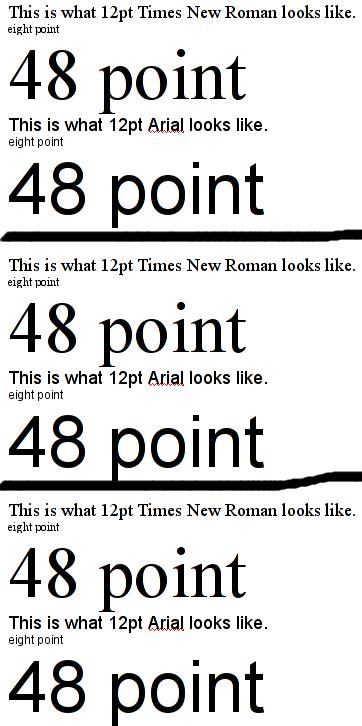
in order, how it looks in:
windows xp/office 2003 + cleartype
mac osx 10.3/office 2001 + quartz
kde 3.2.1/abiword 2.0.5 + sub-pixel hinting anti-aliasing for fonts.
Last edited by Q Cubed on 15-03-2004 at 23:28
|
|
| |
|
|
|
Asher
|
|
Calgary, Alberta
Nov 1999
time: 22:34
|
|
quote:
Originally posted by Agathon
So MS took someone else's idea and used it for fonts. |
It is not somebody else's idea. Sub-pixel rendering was not mentioned anywhere in Apple's patent, nor is it in any way similar to the RGB techniques used in ClearType.
This whole "Apple did it first" crap comes from Steve Gibson, the notorious moron and attention whore. What Apple did was **** with a specific NTSC quirk to effectively double horizontal resolution, and that's IT. Are you saying that any time somebody creates an optical illusion on a PC monitor they stole the idea from Apple...?
quote:
You're a joke Asher. Of course you are a fraud. One need only remind oneself of your Fitts' Law flip flops among other things. I'm guessing you still believe it's a mathematical law?  |
Fitts' law is undeniably a mathematical law, given that it is a formula...
quote:
And you ****ing did say that M$ invented Expose, or at least that Expose was a "ripoff" of M$ technology. You started a thread on it, in which it was pointed out to you that your "evidence" wasn't sufficient to justify your claim. |
I certainly did not -- though I did mention some of the functionality introduced in Expose existed since Windows 95 (namely, minimize all windows). And similar "zoomable windows" and whatnot have existed since the late 90s at research.microsoft.com
quote:
NB: that pic of Apple's font antialiasing is of a Carbon app (Word) - true native OS X apps (Cocoa) seem slightly better than that to me. In any case, the Apple font smoothing is clearly superior in your example. |
Carbon and Cocoa have nothing to do with font anti-aliasing. This is clear example of psychology affecting your perception.
I would definitely disagree that Apple's seems clearer -- they've bolded the fonts to make the font edges larger, and they've blurred it adding an upper "halo" to the font which annoys me. MS' technique doesn't bold it, nor does it blur it, which makes it superior IMO.
Font anti-aliasing is about accurately reproducing the original font, minus the jaggies. Apple changes it to a bolder font and adds a halo.
quote:
+ M$'s font smoothing when it does work well tends to distort the fonts so as to fail to provide true WYSIWYG when it comes to printing. |
This doesn't even make sense? All font anti-aliasing using sub-pixel rendering has no bearing on printed quality. Further, since Apple uses a slight blurring and bolding technique, I'd imagine it's the other way around if anything -- that Apple's fonts appear more bold on the screen than when printed.
|
|
| |
|
|
|
Asher
|
|
Calgary, Alberta
Nov 1999
time: 22:34
|
|
Zoomed in images of Apple's bluring (left) vs ClearType (right):
 
quote:
Generally, Quartz seems to raster fonts unnecessarily thick so it can apply what looks like a pseudo-sloppy, Gaussian blur filter resulting in fuzzy "halo" looking text. Now at larger sizes, this may make some sense, but on the smaller fonts (14 Point and smaller) it seems to decrease legibility. Fonts at small sizes particularly benefit from increased resolution, and ClearType seems to excel beyond Quartz in "creating" usable sub-pixel resolution by applying anti-aliasing more discriminately and not over-blurring the results. Perhaps a pseudo MultipleMaster's approach to sub-pixel rastering might be more optimal, where the "halo" effect is reduced for fonts at smaller sizes and increased at larger sizes.
So why did Apple implement a "halo" anti-aliasing model (when ClearType and Adobe's Acrobat text anti-aliasing seem more exacting)? The answer may lie in patents over the technology. If Apple cannot obtain a license on Microsoft's low resolution (i.e., small font size) sub-pixel rendering techniques, then we may simply have to wait until April 10, 2020 (when Microsoft's patent runs out). |
|
|
| |
|
| |
All times are GMT. The time now is 05:34.
Apolyton Time is 00:34. |
top of page
|
| archivepost |
|
Forum Rules:
You may not post new threads
You may not post replies
You may not post attachments
You may not edit your posts
|
HTML code is ON
vB code is ON
Smilies are ON
[IMG] code is ON
|
|
|
|
|
|





 15-03-2004 13:40







 Attachment:


 |
|