|

|
ErikM
|
|
quote:
Originally posted by Lefty Scaevola
No, through sloppy work and brazen failure of following safty procedures, they blew one up on the pad while screwing around with the fuel, killing hundreds of personel, the largest space exploration disaster, a majarity of thoses killed in the filed |
N1s blew up, yes.
The launching pad was destroyed on the 2nd launch, yes.
Killed personnel, no.
The largest space exploration disasters would be Challenger/Columbia.
|
|
| |
|
|
|
asleepathewheel
|
|
listening too long to one song
Mar 2002
time: 00:35
|
|
probably right. by the time I went, it was a well oiled machine, operating year round.
|
|
| |
|
|
|
DanS
|
 |
Kickball Capital of the World
Jan 1970
time: 00:35
|
|
All you computer nerds will love this...
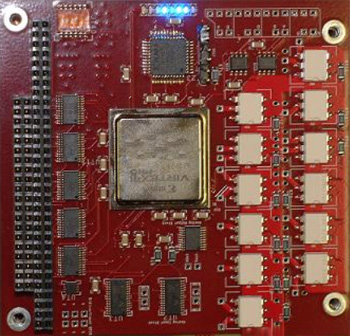
Regarding flight computers, take a look at this PCB, which is the flight computer for the Falcon I. Looks to me like a 4 inch x 4 inch board.
This flight computer has much more power than the Saturn V flight computer, which was as big as a house!
Falcon I's flight computer contains a Xilinx FPGA -- a generic programmable chip (the biggest chip on the board) -- so that they can make changes on the fly with no chance of a blue screen of death.  Dual PowerPC CPUs are embedded on the FPGA. Dual PowerPC CPUs are embedded on the FPGA.
The total hardware cost on this was probably about $500 dollars, including fabrication of the PCB and assembly with all of the chips and other parts. I can only imagine how many tens of millions of dollars the flight computer for Saturn V cost and they used one up on each launch.
Communication and control in the Falcon I are through standard ethernet.
 Attachment: control_board.jpg Attachment: control_board.jpg
This has been downloaded 72 time(s).
Last edited by DanS on 07-04-2004 at 09:24
|
|
| |
All times are GMT. The time now is 05:35.
Apolyton Time is 00:35. |
top of page
|
| archivepost |
|
Forum Rules:
You may not post new threads
You may not post replies
You may not post attachments
You may not edit your posts
|
HTML code is ON
vB code is ON
Smilies are ON
[IMG] code is ON
|
|
|
|
|
|






 07-04-2004 02:11








 |
|