|
| |
|

|
Krill
|
 |
On a cold wet rock, in the middle of the Atlantic Ocean.
Dec 2003
time: 05:35
|
|
OK, these are the first 43 turns:
1) Settler 1, worker road
2) Settler Apolyton, build warrior (5), Growth in 7, research pottery (12)
3)
4) Road complete, worker-> cattle
5) Worker irrigate
6)
7) Warrior built, moves 3. Build worker
8)
9) Irrigation complete, road. Pop 2, cow + forest worked 20% lux
10) worker complete, build settler. Worker -> dyes
11) W(orker) 2 road
12) W1 road complete, mine BG
13)
14)
15) pop 2, BG and Cow worked. +4fpt, +3spt, +7bpt.
16)
17)
18) Mine complete, W1 -> BG
19) Settler complete moves 22. Dyes roaded. Build worker
20) Off Topic founded, build Spear WF forest for 3 turns, then Grass. W2 deforest
21) English contacted.
22) Egypt find me, BW+CB+Masonry+8g = Alpha+WC,
23) Spear built, fortify, build warrior. Deforest complete, Road.
24) Worker3 built -> 4, build granary
25)
26)
27) W2: road complete, mine. W1: mine complete, ->3
28) W1 road, warrior built (explore), build warrior
29) W3 deforest complete, road.
30)
31) W1 road complete, mine.
32) W3 road complete, mine.
33) W2 mine complete, -> 9. Warrior complete->Apolyton, build warrior
34) W2 road
35)
36) warrior complete (explore), build warrior.
37) W2 road complete, mine. W1 and W2 mine complete. Granary complete, build settler.
38) W3 mine complete->7.
39) W3 deforest. Lux 10%
40) warrior complete build warrior, W1+2 mine complete, W1->2 W3->896
41) Settler built, moves 996 (takes 2 turns). W1 deforest, W2 road.
42)
43) W3 deforest complete, road. The University built 996 of ‘Poly Build Curragh. Warrior built, build barracks. Research Philo @13 turns @ 100%
I have tech parity with both known civs, and several exploring warriors. Another settler will be built next turn. I have an iron source 774 of OT, and will build a city near there to hook it up.
Could you strat forum veterans out the point out my flaws in the opening sequence, please. All advice (and critizisms) is appriciated.
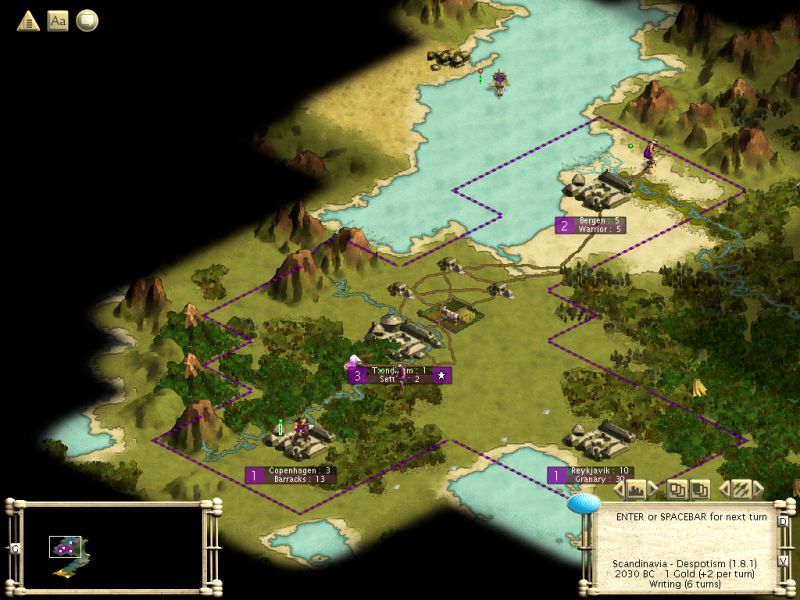
 Attachment: decent scandi, 2030 bc.sav Attachment: decent scandi, 2030 bc.sav
This has been downloaded 2 time(s).
Last edited by Krill on 24-04-2004 at 13:15
|
|
| |
|
|
|
Krill
|
|
On a cold wet rock, in the middle of the Atlantic Ocean.
Dec 2003
time: 05:35
|
|
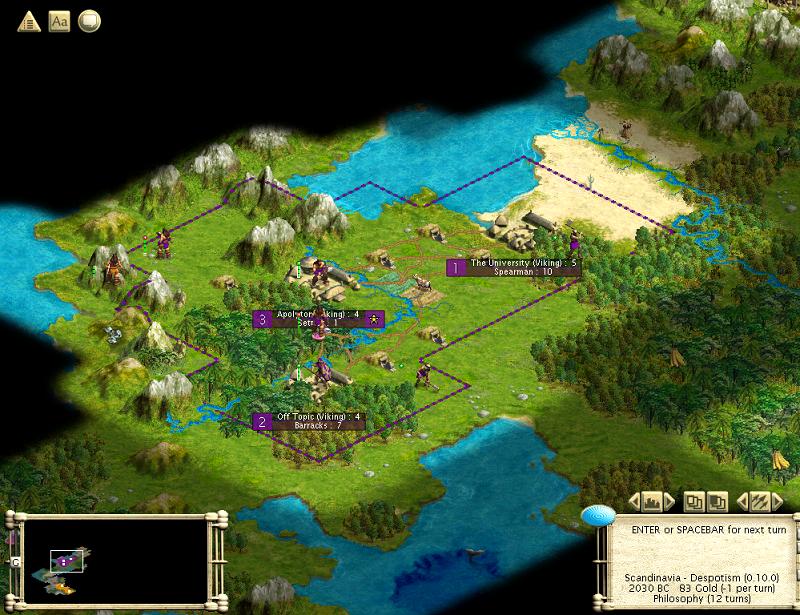
UnO, If I had settled immediately, it would have been on a BG. The reason I road the original tile was that it was going to be used, but you do have a point. It would not have made much difference though. If you look I went Pottery->writing, I built a granary, and that helped me setup the start (see below)
 Attachment: scandi.jpg Attachment: scandi.jpg
This has been downloaded 79 time(s).
Last edited by Krill on 23-04-2004 at 02:29
|
|
| |
|
|
|
UnOrthOdOx
|
 |
Hello....
Jun 2002
time: 22:35
|
|
quote:
Originally posted by Krill
UnO, If I had settled, it woyld have been on a BG. The reason I road the original tile was that it was going to be used, but you do have a point. It would not have made much difference though. If you look I went POttery->writing, I built a granary |
Well, yes, you have to move off bonus grass IMO.
I still would say 2 is a better location than 1.
I'm still learning this whole granary so damn early concept of you builderers, so I can see why you would do that.
Last edited by UnOrthOdOx on 23-04-2004 at 00:10
|
|
| |
|
| |
|
|
|
Goethe80
|
 |
Leicester, UK
Jul 2003
time: 05:35
|
|
Ok, I'm feeling quite bad that someone else has played my start and I've not written anything about it!
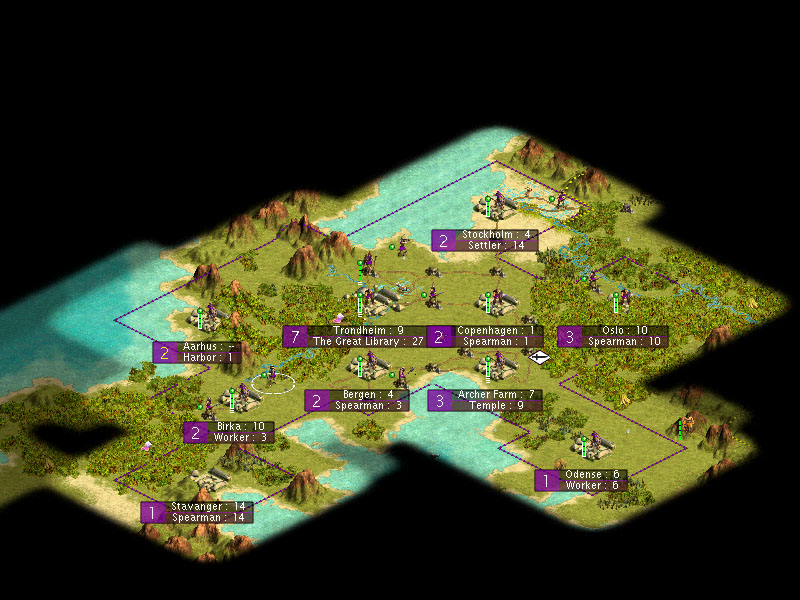
So here's me at 1000BC
Brief history of whats happened.
Initial start -
1. moved Settler 2, founded city, irrigated then roaded cow, which allows the city to build warrior, settler w/o any delay while waiting for population growth.
2. Settler moves to form 2nd city 2,2 from city. worker starts working on bonus grassland. 1st city starts worker, then starts on granary. Send 2nd worker to road dyes.
3. Expand expand. City 3 designated Archer Farm. Gets warrior MP, barracks, then begins to build archers (plus 1 spearman thrown in for good measure). City 1, 3 and 4 have graneries and help to pump out settlers.
4. Manage to get Philosophy free-tech, pick Map. Capital city has temple and 2xMP and begins to build Pyramids as a pre-build for GL. I know it's risky as there's the possibilty that someone will complete some wonder and start a wonder cascade leaving me with a very expensive library. Am working on Literature
5. Am found by my 2 neighbours. English and Egyptians. Rounds of trade equals out all of our techs less Philosophy plus leaves me with some gold.
6. Get Literature, switch over from Pyramids. Also begin sending suicide galley to the west. Amazingly I survive 2 rounds out in the open ocean and meet India and Sumeria. They're pretty much on tech parity with myself, just with different techs. Trade all my techs less Literature. Am now only short of Currency, Code of Laws and Construction for the next era. I should get Currency before my GL, and hopefully the GL will yield at least one of these 2 techs.
Comments-
So far so good. Reasonable expansion so far. I seem to be plagued by jungles everywhere, but not to an extreme. Good amount of forests and bonus grassland has helped to keep production at good levels. In fact, I'm 2nd right now in mfg goods, which is nice. Only 1 lux, which is alright, but not brilliant. Would make life much easier if I can find at least 1 more lux somewhere. I also agree with Krill that having a seafaring / commercial civ does help alot with being able to squeeze in a tech before making the philosophy beeline.
Attachment: scandi 1000bc.jpg
This has been downloaded 69 time(s).
Last edited by Goethe80 on 23-04-2004 at 04:41
|
|
| |
|
| |
|
|
|
Dominae
|
|
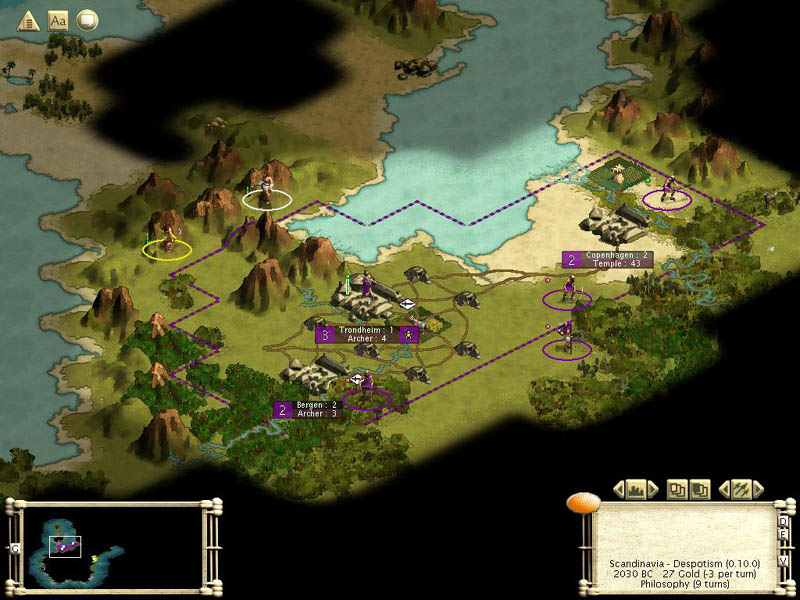
Loaded up Conquests for the first time in a while to try this start out.
I settled on the starting location, because IMO Curraghs (especially Seafaring ones) are worth the lost Bonus Grassland. Also the Food production works out nicely: the box reaches 12 Food at +3fpt just in time for the Worker to finish irrigation on the Cattle to provide +4fpt for the final 8.
I built a Curragh first, then 2 Workers (for a total of three), then proceeded to the Granary. Since the capital cannot support better than a 6-turn pump, I built a Barracks and went for 7-turn Archer/Settler (could do better, I'm not sure).
First Settler founded a city on the Dyes only two tiles from the capital, to access the Luxury (duh) but also to maximize use of the Cattle; this city is now set to produce Archers. Second Settler chased down the Wheat Flood Plains; this city is slowly being turned into a Worker-pump (requires Granary and Temple...I might throw some poprushing into there somewhere).
Research went (as usual) Pottery, Writing, Philosophy. I traded techs with England and Egypt at a loss just to get their Gold reserves to keep my tech rate up.
"The plan" is to Archer-rush either England or Egypt, then take care of the other through whatever means available (Horsemen maybe?), then fill the island with cities. After that, if the timing is right, I would of course use Berzerks to conquer some more. With the size of the home landmass, the Berzerk stage would not be that exciting (I imagine) since the game would be all but over. I'll play it through to then to see what happens.
Attachment: goethe1.jpg
This has been downloaded 58 time(s).
|
|
| |
|
|
|
Dominae
|
|
quote:
Originally posted by Krill
All advice (abd critizisms) is appriciated. |
Ok. 
quote:
1) Settler 1, Worker road
|
Like I pointed out in my report above, I think it's best to found your capital immediately.
quote:
10) Worker complete, build Settler.
|
Why Settler before Granary?
quote:
19) Settler complete moves 22. Dyes roaded.
|
If you build your second city on the Dyes, there's no need to spend 9 Worker-turns hooking them up. Of course, since you moved your Settler on the first turn, this option is not open to you...
quote:
28) Warrior built (explore), build Warrior
|
I think Archers are the better option for the Vikings on Emperor level and below. Use Curraghs to contact everyone and get an idea of the land form, and Archers to slowly explore inland and rush your nearest neighbor. On Demigod Warriors are a bit more necessary.
quote:
W2 road complete, mine. W1 mine complete, join W2.
|
I'm not a big fan of joining Workers to produce Settlers in the early-game; 10 Shields wasted in the first 60 turns is not trivial. You'll have a lot of cities, but they will be working unimproved tiles.
---
Hope this is helpful.
|
|
| |
|
|
|
Krill
|
|
On a cold wet rock, in the middle of the Atlantic Ocean.
Dec 2003
time: 05:35
|
|
1) Actually Dominae, the last point is not that clear. I meant that W2 worked the same tile as W1, not that I joined it to the city.
I'll edit the post to make it clearer.
quote:
Why Settler before Granary? |
2) I built the settler before the granary since I was not sure about the amount of barbs, and did not want to go with out a military for long. The settler built enough warriors for MP and exploration while it grew. If you compare you minimap to mine, I can see where my next settlers are going, but you have to risk the settlers on that. The side effect is that you may either place some cities badly, or waste time exploring, and not producing any thing.
I do understand that while I don't have the opurtunity to archer rush anybody, but I can quickly chnage production to swordsmen for self defense, or archers for upgrade.
quote:
If you build your second city on the Dyes, there's no need to spend 9 Worker-turns hooking them up. Of course, since you moved your Settler on the first turn, this option is not open to you... |
True, so I'll take note of that.
quote:
I think Archers are the better option for the Vikings on Emperor level and below. Use Curraghs to contact everyone and get an idea of the land form, and Archers to slowly explore inland and rush your nearest neighbor. On Demigod Warriors are a bit more necessary. |
See above. Another point is that I play a longer game, hoping to beat the AI to tanks by ~30 turns. This is long term, so I do indulge in bullying the AI, but only if I nead the space or a resource/lux.
quote:
Hope this is helpful. |
It is, so thank you
|
|
| |
|
|
|
Goethe80
|
|
Leicester, UK
Jul 2003
time: 05:35
|
|
Hi guys, I've not had much time to play (the presence of continued sunny days in april in England is too rare to pass up!).
As per my previous post, I had just finished the GL, and am probably about to jump to monarchy (to minimise the negative impact of anarchy on research) then zero research, horde gold, pre-build Leo Workshop.
Good news, I've discovered a patch of 4 gems to the SW, in unclaimed land between myself and the English. Bad news is that it's in a mountain range, with a couple of hills to the north and 4-5 squares of desert beyond that. Not much hope for any city there developing at all. Perhaps just a border fort town vs. the English.
Speaking of deserts, I've also noticed that I've got virtually no deserts within my territory. Doesn't bode too well for saltpeter later in the game. That said, contact has been made with all Civs, and I'm ranked #3 in score. With the Egyptians ranked 1st, followed by the Sumerians. The civs on the other continent seem to be heavily dominated by the Sumerians, who have at least 50% more cities than their nearest rivals, so I have to work fast to beat up on either the Egyptians or the English to catch up. The Egyptians control a reasonable patch of desert just off my SE border, with their capital about 5-6 squares to the north of that desert, so that's an interesting option. Maybe I should start building a FP at the SE edge of my territory in preparation of an assault in that direction.
I've also noticed a small lake (about 6x6) in the middle of my continent which is border by all 3 civs. Should be interesting to use that for amphibious assault when Berzerkers arrive, helping me to establish a quick buffer zone, preventing the enemy (whichever I chose to beat up on) from harassing my workers and pillaging my improvements.
Ok, question time
*QUESTIONS*
1. Suggestions for strategy post GL. As mentioned, my current inclination is to swiftly initiate a government change, followed by gold hording while preparing for a proper military campaign.
2. I figure I'll be getting Chiv. and Knights from the GL reasonably soon. When composing my army, would you go for Knights, leaving the Berzerkers just purely for amphibious strikes, or go with the high attack of the Berzerkers.
3. Initiation of a GA. I figure once I goto war, a GA is more or less inevitable. I can delay it slightly by not using the Berzerkers and rely on Knights, but the flexibility of an amphibious assault is too good to pass up. I can see several interesting options for using the GA.
(A) to prepare my cities to be competitive in research post education. Courthouses, Libraries, Marketplaces, etc.
(B) to amass an even larger army.
(C) to hold off the GA until education, to give me a 20 turn window of staying competitive in research.
- right now, I'm tempted to use the GA to get certain improvements which are difficult to get under normal circumstances (esp. Courthouses. High cost, difficult to build with corruption), then improve my core cities research wise, while using my external cities to build more military units. I'd probably also initiate a pre-build somewhere to pick up the next wonder (I figure it'll be Copernicus or maybe even JS Bach if I trade for music theory. The JS Bach might be interesting as I don't think I'm going for Sistine's).
|
|
| |
|
|
|
Dominae
|
|
quote:
Originally posted by Krill
2) I built the settler before the granary since I was not sure about the amount of barbs, and did not want to go with out a military for long. The settler built enough warriors for MP and exploration while it grew. If you compare you minimap to mine, I can see where my next settlers are going, but you have to risk the settlers on that. The side effect is that you may either place some cities badly, or waste time exploring, and not producing any thing.
|
With 3-tile spacing, it's very rare that you place cities badly in your inner core; you usually see all that you need to see via "border sight". In my screenshot, my third Settler is ready to found my fourth city the next turn. It's not really "exploring". I almost never send Settlers into the darkness.
In your game, it's true that you've explored a lot of land around your capital with Warriors. But does this really help your city placement all that much? You'll still want to place your initial cities close to home, so that exploration is only useful in chasing down a Strategic resource you might be missing (not a problem in this game).
In any case, this is a question about "Settler before Granary", not early exploration. Normally I build a few Warriors, too, but for obtaining contacts; geographic exploration is a nice side-effect. Economically, though, it makes more sense in this game to build your Granary before your first Settler.
|
|
| |
|
|
|
Dominae
|
|
quote:
Originally posted by Krill
While i did not need the warriors, what if some barbs had popped up? What if they destroyed the work on the granary? With no military, alot of damage could have been done.
|
This rarely happens in the timeframe of your first Granary. If you want to play it safe you can build a Warrior or two in your capital before the Granary, but a whole second city dedicated for Warrior production is overkill.
By the way, Settler before Granary is not always a bad thing. If your second city-site also has very high Food potential (or if your Agricultural along a River), you can actually grow faster this way.
|
|
| |
|
|
|
Dominae
|
|
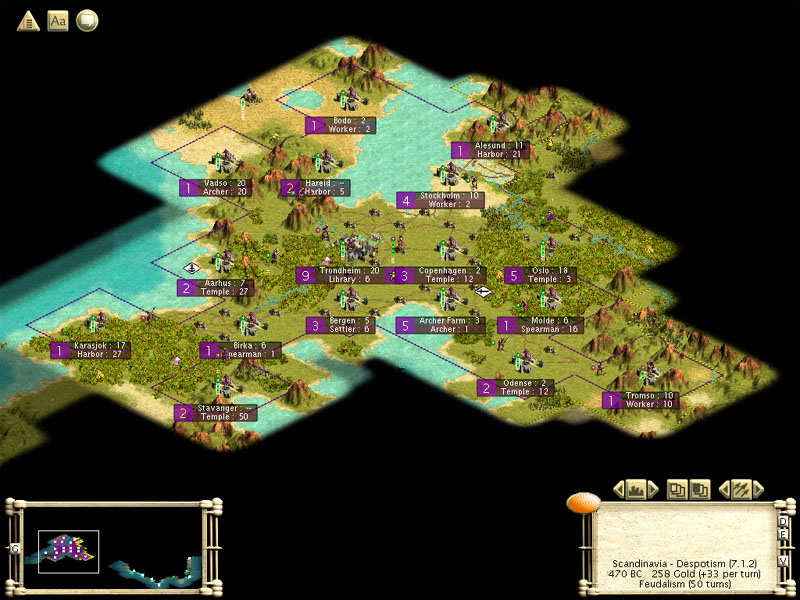
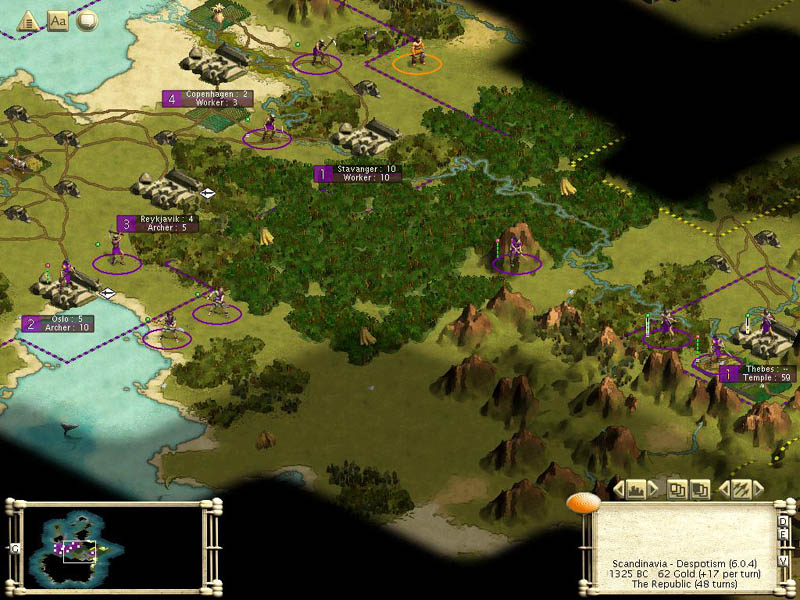
Here's my game at 1325BC.
As you can see, I conquered Thebes a couple of turns ago, so Egypt is more or less taken care of (her other cities should offer little in the way of resistance beyond the standard 2 Spearmen).
I might have enough momentum to Archer-rush England too. After that it's smooth sailing.
Attachment: goethe2.jpg
This has been downloaded 50 time(s).
|
|
| |
|
|
|
Dominae
|
|
quote:
Originally posted by Krill
But how are you supposed to know what the next cit site is like if you don't build a/some warrior/s to explore?
|
Well, in this game I knew I wanted my second city on the Dyes. I figured that city would probably be a military producer, so that takes care of my exploration "problem". I built an early Curragh, which discovered the Wheat Flood Plains along the coast, so I knew I wanted my third city to be placed there.
I typically do not plan more than three cities ahead in the early-game. If I have too much land to expand into my head starts to hurt. Joking aside, in your game your Warrior exploration is far beyond what you are capable of expanding into in the short-term. It's no use surveying the land 10 tiles from your capital when you know that your inner ring will be (maximum) distance 5.
Again, this is not a hard rule (i.e. exploration versus not). What is a hard rule, for me at least, is that building a Settler before a Granary in medium-Food start like this is inefficient.
|
|
| |
|
|
|
Goethe80
|
|
Leicester, UK
Jul 2003
time: 05:35
|
|
Dominae,
I'm not entirely sure if building the 1st settler before your granary is altogether that bad. Afterall, a quick settler = double the number of cities and resources being harvested.
I'm generally an advocate for the early granary, and have even tried pre-building a granary (ie. via barracks or something similiar). My start for this scenario involved moving 2 and founding the capital, irrigating the cow, which lets me build my settler immediately after my 1st warrior, followed by a worker and a granary. The irrigated cow, plus the worked BG (no need for mines) after pop growth allows a complete settler on the same turn as growth to size 3. My 2nd worker then commenced work on the dyes (1 turn movement, 9 turns road), neatly completing the road as the capital city hits size 3, so I don't need to use the lux slider at all (including the 1st warrior being garrisoned as MP).
I also noticed that you built 2 workers before commencing on your granary. Isn't this a similar cost (in terms of populations at least) to the settler?
Anyway, this is not meant as criticism. I'm only recently beginning to minutely analyse my starts on a turn-by-turn basis, and I'm trying to figure out how to run the first 50 odd turns as smoothly as possible. So similarly, I would be glad to have comments on my warrior-settler choice for starting.
|
|
| |
|
|
|
Aqualung71
|
 |
Lord Desolator of the Desolation Row, C3CDG
Oct 2002
time: 12:35
|
|
Some early comments:
Looks like I’ve founded my first 3 towns in roughly the same places as Krill and Dom, though there are some subtle differences in strategy that you guys have already debated.
I can’t fault Dom’s arguments for capital placement, but I don’t usually like to found my capital on the coast – preferring it to develop into a super-shield city later on. I may well suffer because of that. Like Dom, I went for the wheat flood plains, while Krill founded a town south of that. I intend to fill that gap with another town later. I almost founded the town further northeast to get the benefit of that forest game, but I couldn’t delay the Curragh build any longer. As you can see from the minimaps, Dom’s coastal start and curragh build enabled him to explore a good part of the map in this early stage, though it doesn’t seem to have yielded any extra civ’s yet (?) – the luck of the draw I guess.
I am a little behind tech-wise with you guys. I suspect that’s because I bought all of Egypt’s early techs and paid them 3gpt extra, which slowed my research rate a little. As you can see, that has a compounding effect over time such that I am still reaching for Writing while you guys are researching Philosophy. Dom – did you hold back on some tech trades?
I will pretty much always build a granary before the first settler – I think dropping those 2 pop points before you have the granary drops you back too far in production and research, and it’s quite difficult to catch up. On the other hand, building that second town a little later is not difficult to recover from, as the third and fourth towns will follow much more quickly than you otherwise could. The only debatable point is whether to build one or two warriors to guard against barbs and/or to send out exploring – this I normally will do while waiting for the granary charged pop to get to 4 or 5.
Speaking of granaries - after my capital I'm always uncertain how many to build. I usually get around to another 1 or 2 in good production cities reasonably early, but they taper off after that. Any thoughts?
|
|
| |
|
|
|
Dominae
|
|
quote:
Originally posted by Goethe80
I'm not entirely sure if building the 1st settler before your granary is altogether that bad. Afterall, a quick settler = double the number of cities and resources being harvested.
|
Then why build a Granary at all? Why not just keep going with a bunch of "quick Settlers"?
The earlier you build a Granary in your capital, the better (i.e. the more Food you save). So, only in special circumstances should you not build a Granary right away in your capital:
1. When there's better Food potential at another city-site close to the capital. In this case you want your second city up ASAP because it's going to be your main pump.
2. When there's high Food potential at another city-site close to the capital. By this I mean +4 Food or more. Here, Settler-Granary working bonus Food resources actually out-expands Granary-Settler, because of the high growth in the secondary site.
3. When you want a military base up immediately. This is a common strategy in MP, where you look silly if you're building up a 4-turn pump and your nearest neighbor appears at your doorstep with 3 Warriors. Against the AI, however, there is little danger of this ever happening before your second city is built (thus my comments to Krill).
quote:
I also noticed that you built 2 workers before commencing on your granary. Isn't this a similar cost (in terms of populations at least) to the settler?
|
I could have gotten away with only one before the Granary, but was happy with two. The thing about Workers and Settlers is that if you focus on the latter, you'll have a lot of cities but they will not be worth anything due to lack of tiles improvements. You always want your cities to work improved tiles. Because of my focus on Workers, I was able to set up a Worker-pump and two military camps (with I leveraged into an Archer-rush of the Egyptians) much faster than the other games posted here.
|
|
| |
|
|
|
Dominae
|
|
quote:
Originally posted by Aqualung71
I can’t fault Dom’s arguments for capital placement, but I don’t usually like to found my capital on the coast – preferring it to develop into a super-shield city later on.
|
You mean after Sanitation? Before that, both our capitals would be approximately equivalent in terms of Shield production (I have one extra Mountains tile, you have the possibility of more Bonus Grasslands). Personally I believe the benefits of Curragh exploration outweigh the benefits of a super-strong capital come the Industrial era. Contacts are simply that important. Plus, I got to benefit from a "free" 1cpt from the Seafaring trait.
quote:
As you can see from the minimaps, Dom’s coastal start and curragh build enabled him to explore a good part of the map in this early stage, though it doesn’t seem to have yielded any extra civ’s yet (?) – the luck of the draw I guess.
|
Yup. With a landmass this big, there would normally be 1-2 other civs on the continent, which my Curragh would have made contact with by 2030BC.
quote:
I am a little behind tech-wise with you guys. I suspect that’s because I bought all of Egypt’s early techs and paid them 3gpt extra, which slowed my research rate a little.
|
I used to do this too, but have found it's rarely a good idea. With smart tech choices you can get juicy ones before the AI does, and trade for everything you need later on. If you know what you're doing it's pretty hard to fail the Philosophy beeline on Emperor.
quote:
Dom – did you hold back on some tech trades?
|
I traded for all the AI's Gold whenever possible, and nothing else (well, if they gave me a tech with the Gold, I did not refuse!). I was running something like 5gpt deficit all the way to Philosophy.
quote:
Speaking of granaries - after my capital I'm always uncertain how many to build. I usually get around to another 1 or 2 in good production cities reasonably early, but they taper off after that. Any thoughts? |
On this map, with so few opponents on the home continent, I would build about 3-4 (one in the capital, two around the Flood Plains, maybe another). It all depends on how much land you have to expand into.
|
|
| |
|
|
|
Dominae
|
|
Aqualung71, a couple more comments on your game:
1. I think you should have placed Bergen one tile SE like I did. As you have it, the city has horrible Shield production, even after border expansion. With +5fpt available, you're looking to grab as many Shields as possible to turn that city into a pump. Unless that one Forest reveals a Bonus Grassland, I believe you can only form a 3-turn Worker-pump (and forget about an efficient Settler-pump).
2. You've got a Worker shortage problem. In particular, your city of Reykjavik is not going to be working improved tiles anytime soon. Similarly with Copenhagen. Getting as many cities down as quickly as possible only makes sense on Deity and Sid (sometimes Demigod) where you have to "fight" for every inch of land you want to claim. On Demigod and below, you can afford to be more efficient and slow down your expansion a bit in favor of Workers and hence better cities.
|
|
| |
|
|
|
Aqualung71
|
|
Lord Desolator of the Desolation Row, C3CDG
Oct 2002
time: 12:35
|
|
Yep, you're right on both counts.
I was always concerned about the shield shortage for Bergen, and should have place it SE as you suggest, which still would have given me enough room to drop a city in the middle later. So now I'm irrigating the flood plains and mining the rest of the desert - it will be a mediocre city for quite some time.
I was definitely short on workers and pumped several out in my next period of play (although you only seemed to have one more than I did at that time).
You've got it spot on as usual - I've been playing demigod mostly lately which generally requires spitting out the settlers for the landgrab. Emperor provides a slower expansion pace, so you can build more workers and military. I didn't build enough military police either, so lost quite a bit of efficiency by having to use the luxury slider more than I should have.
Last edited by Aqualung71 on 25-04-2004 at 13:05
|
|
| |
|
|
|
Aqualung71
|
|
Lord Desolator of the Desolation Row, C3CDG
Oct 2002
time: 12:35
|
|
quote:
Originally posted by Dominae
You mean after Sanitation? Before that, both our capitals would be approximately equivalent in terms of Shield production (I have one extra Mountains tile, you have the possibility of more Bonus Grasslands). Personally I believe the benefits of Curragh exploration outweigh the benefits of a super-strong capital come the Industrial era. Contacts are simply that important. Plus, I got to benefit from a "free" 1cpt from the Seafaring trait. |
I've been spacing my cities lately so that they max out at 10-12 pop by the late middle-ages. Making the capital a coastal city with this spacing would generally make it shield-poor as the city to its south would probably be moved a tile closer and so the capital would not have enough landed tiles available for decent production from a negligible corruption city (though nice commerce and research from the water tiles).
quote:
I used to do this too, but have found it's rarely a good idea. With smart tech choices you can get juicy ones before the AI does, and trade for everything you need later on. If you know what you're doing it's pretty hard to fail the Philosophy beeline on Emperor. |
After seeing the difference in this game I would have to agree. Lesson learned. I still got to Philosophy first though.
quote:
On this map, with so few opponents on the home continent, I would build about 3-4 (one in the capital, two around the Flood Plains, maybe another). It all depends on how much land you have to expand into. |
Yeh, I tend to build about 3 or 4 and then stop, since by the time you get that many Granaries up, the ones that don't have them are approaching size 6 anyway. Once most towns are at size 6 I've usually got a couple of worker camps (with Granaries mind you) pumping out workers, and the excess are used to add pop, which is an efficient way to grow while saving the maintenance costs of too many Granaries.
Last edited by Aqualung71 on 25-04-2004 at 13:25
|
|
| |
|
| |
All times are GMT. The time now is 05:35.
Apolyton Time is 00:35. |
top of page
|
|
|
Forum Rules:
You may not post new threads
You may not post replies
You may not post attachments
You may not edit your posts
|
HTML code is ON
vB code is ON
Smilies are ON
[IMG] code is ON
|
|
|
|
|
|





 22-04-2004 23:49







 |
|