|
| |
|

|
rmsharpe
|
 |
Minneapolis
Aug 2001
time: 23:17
|
|
Praise from Caeser. 
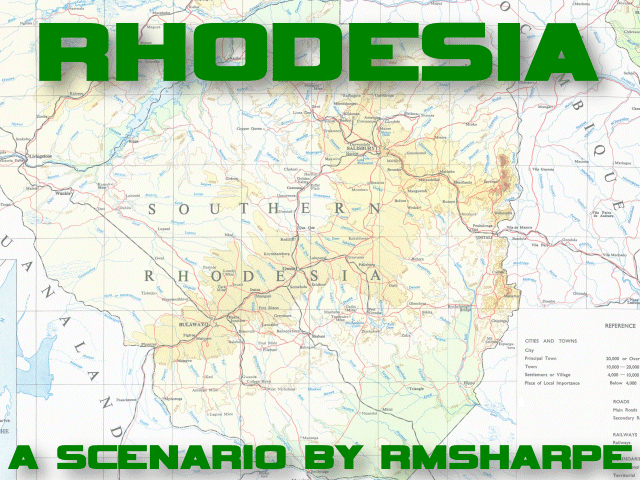
Right now, I'm searching for good topographic and climate maps for Southern Africa, unless someone has already created (or is interested in creating) a giga Southern Africa map.
As well, I am looking for new units to replace some of the old ones, all shown in the attachment at the bottom of this message.
A white infantryman in khaki uniform,
A Selous Scouts armored vehicle,
A Hawker Hunter fighter jet,
And a reece.
Also, some of the other units I'm looking for are a black farmer, a white engineer, a black guerilla infantry type unit. (I don't know if Curt's black Vendetta infantryman would fit the bill as being guerilla, as it looks like he has a pretty well-tailored uniform  ) )
I hope you all don't mind, I'm going to be asking for a lot of unique graphics here, since (black) African conflicts are not frequently done over in Civ2.
Placing units will be my last priority. Right now, I need to find a good Civ map to start terraforming and placing cities on.
 Attachment: replace.gif Attachment: replace.gif
This has been downloaded 191 time(s).
|
|
| |
|
| |
|
| |
|
| |
|
|
|
Case

|
 |
The backlash starts here
Feb 2000
time: 15:17
|
|
quote:
Originally posted by rmsharpe
The question I've got is: how badly were they defeated and how so? I really fail to see the logic behind how the Rhodesians would be defeated by the ZANU guerillas. |
By the end of the war the Rhodesian government had lost control of most of the countryside, and the guerillas were preparing to go for Harare/Sailsbury. The white population of Rhodesia was only about 100,000 compared to over 5 million blacks and they had very little industry, meaning that they were totally dependant on South African support, especially after the Portugese pulled out of Mozambique in the mid 70s
In contrast, the guerillas and the neigbouring African states enjoyed the full, and generous, support of the Soviet Union. IMO the Soviets support for the Rhodesian liberation movement was probably the best international intervention the Soviet Union made. While Mugabe is doubtlessly a hideous scumbag, in his day he was quite moderate, and he certainly beats the white government he replaced.
When the South Africans recognised Rhodesia as being a lost cause in the late 70s and pulled their 10,000 man 'police' force out of the country and greatly reduced the flow of economic and military aid into the country, the game was up for Ian Smith and his cronies. Not only were the Rhodesian security forces were on the brink of destruction in the field at the hands of the guerillas but Zambia was preparing a conventional invasion which the Rhodesians had no hope of stopping.
However, what you find in Rhodesian websites are claims that 'we' were winning at the time of the hand over to majority rule. Except that the country was on the brink of economic collapse. And 'we' couldn't keep any of the roads open. And 'our' secuity forces were taking totally unacceptable losses.* And even the South Africans found our racial theories unattractive and 'our' government crazy.
*You'll find that the websites and books tend to obsess over the actions of the Rhodesian SAS and Seleus Scouts. While those units performed quite well, the vast majority of the white Rhodesian security forces were part time conscripts and appear to have performed poorly and took very high casualties (there's a sobering site which lists the names of the literally thousands of white Rhodesians who were killed).
|
|
| |
|
|
|
Case
|
|
The backlash starts here
Feb 2000
time: 15:17
|
|
Before you get too excited about the Rhodesian arms industry and it's products, have a look at this article: http://ccrweb.ccr.uct.ac.za/defence...efdigest02.html
The most important section reading:
Zimbabwe's post Second World War history is dominated by two events: the Federation of Rhodesia and Nyasaland, 1953 - 1963; and Ian Smith's Unilateral Declaration of Independence (UDI), 1965 - 1980. The federal period saw a complete break in the manufacture of armaments. Federal defence and foreign policies were dictated directly from London and therefore dependence on the United Kingdom was total. All arms and ammunition were imported and the United Kingdom provided all military hardware including aircraft, pilots and technicians. Between 1951 and 1963 Southern Rhodesia received several tonnes of small arms and ammunition from the United Kingdom. It also received more than 150 aeroplanes, 30 Armoured Fighting Vehicles and 8 helicopters. 5 The net effect of the presence of this formidable Imperial arsenal was that Southern Rhodesia did not have to worry about arms production, for it was only required to provide the infrastructure for the assembly, maintenance and use of Imperial armaments.
3. Arms Production During U.D.I.
After 1965 the economy of Rhodesia was subjected to United Nations sanctions, and an arms embargo. When the guerrilla war started in 1966, the Rhodesians were forced to improvise. Claims were made that Rhodesian industry was capable of manufacturing all the war materiel vital to sustain a protracted guerrilla war. 6 These claims underplayed the real drama of the daring smuggling escapades of military hardware, of sanctions busting and of the dis-implementation of the arms embargo by sympathetic governments like apartheid South Africa, Israel and the United States of America.
A good example is the Israeli arms connection. In 1976, Israel supplied large quantities of the UZI submachine gun to Rhodesia. The Rhodesians were later granted a licence to assemble the UZI which the local press claimed was 100 percent made in Rhodesia and which was locally called the LPD/RHUZI. 7 In 1978 eleven Bell 205 helicopters which had been sold to Israel by the United States were shipped to Rhodesia via South Africa. Also, it was an Israeli corporation which built Rhodesia's notorious 500 mile landmine belt along the country's north eastern border. 8 Furthermore, the armoured fighting vehicles and the landmine protected vehicles that Peter Stiff attributes to the Rhodesian engineering genius were not manufactured in Rhodesia. The Rhodesians had no facilities to manufacture any type of vehicle chassis even for small cars. 9 What they managed to do with the help of South Africa's Armscor, was to bend iron sheets to provide a V shape to smuggled British Bedford lorries to deflect mineblast. Their "greatest" achievement was the manufacture and the spreading of anthrax, cholera and other poisons in the Rhodesian version of chemical and biological warfare. But even though these substances were produced in a small laboratory at the University of Rhodesia, they could not manage industrial production. 10
|
|
| |
All times are GMT. The time now is 05:17.
Apolyton Time is 00:17. |
top of page
|
|
|
Forum Rules:
You may not post new threads
You may not post replies
You may not post attachments
You may not edit your posts
|
HTML code is ON
vB code is ON
Smilies are ON
[IMG] code is ON
|
|
|
|
|
|






 23-04-2004 23:38


 |
|