|
| |
|

|
fender
|
 |
Welland
Apr 2004
time: 00:33
|
|
I have changed my ICS type game from four tiles between bases to two. So far I’ve had great success with this. What used to be very hard, winning on Transcend, is now a bit to easy.
Maybe what I do to win is a sell out. You tell me if what I’m doing is considered to be somewhat less than proficient.
Early in the game I give in to all demands whether it be credits or tech. I run default SE, as to not get anyone upset, until I have an impact rover in all bases. When I reach this point, I’ll run whatever I want SE wise and no longer give in to anything. I find that you either go war and win, or everyone leaves you alone. Sometimes I can just hold them off until I get air power, in which case they can rarely get even one unit across my borders.
I still like to concentrate on building and do as much of this as possible.
I’m also finding that one faction is very dominant in the Transcend level. It’s either the Hive, or Sparta. Sometimes Miriam. They usually take out everyone else but me, and factions that I have a pact with if any.
By the time they get around to me, which they always do, I can wipe them out in a turn or two. In the screen shot below I was doing just that with Clean Drop Hovertanks.
Anyway, your input is welcome.

|
|
| |
|
|
|
Natalinasmpf
|
|
Why would you need to crawl your boreholes with 16 population?!
|
|
| |
|
| |
|
|
|
Nabvrimn
|
|
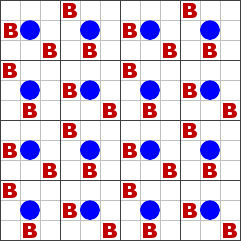
If you consider your bases as a checkerboard with corners at the cardinal directions and build boreholes northeast and southwest in the "red squares" and northwest and southeast in the "black squares" you fit 32 boreholes in a 12 by 12 region as opposed to the 36 max you can fit in that region.
Each base recieves two boreholes and occupies a nine square footprint instead of recieving one borehole and occupying an eight square footprint. Base size maxes at 16.5* if all non borehole squares are farmed, enriched, and condensed, but unbonused, as opposed to 6.5 for tight packed bases. This gives 14.5 specialists per base as opposed to the 5.5 you can get out of tight packed bases. This ratio favors the larger base size for max specialists per unit area. Of course, things like nutrient specials, hydroponics labs, the monsoon jungle, and pop limits will favor the smaller tight packed bases.
* food production will support 16 or 6, but will have one nut left over causing unsupportable growth
|
|
| |
|
|
|
Mead
|
|
quote:
Originally posted by Natalinasmpf
Why would you need to crawl your boreholes with 16 population?! |
It does look more scenic with the crawlers covering the ugly looking boreholes. Nice forest.
Mead
PS
I suppose he could just park the crawlers (or some other more attractive looking unit) there but let the base workers work the square for the 6Energy, 6Mineral.
|
|
| |
|
|
|
Nabvrimn
|
|
I was talking about something functionally identical to Logic_error's proposal. There are cosmetic differences. If you want that spacing and have coastlines to worry about there may be a difference.
If you have 33 or more nutsats. You could then field 31 mid-level* specialists per base and work two boreholesand the base square for 138 energy per base or 2016 total energy.
The tight spacing uses only 13 nutsats and can field 12 specialists per base plus one borehole worker. This produces 54 energy per base or 2016 total energy.
Your income is identical, but your infrastructure support costs for tight spacing will be 12.5% higher than for the looser spacing. Loose spacing has the additional advantage of each base producing more than 10 minerals per turn. I understand that 10 minerals in the box is an important threshold for rush build pricing, though I may be misunderstanding archive posts. Total mineral output, though, is lower.
The advantage of tight spacing is a total of 56 minerals over the 12 by 12 region.
Another potential advantage of loose spacing is that city positioning** has some flexability, allowing you to avoid wasting energy or mineral specials underneath crawled condensor farms.
* engineers, thinkers, and empaths
** cities can go in any of five squares in a cross in the 3 by 3 cells of a 2 space grid and be able to acess all squares in the region directly. They can go in a corner if the corner opposite is a crawled condensor farm and not a borehole.
|
|
| |
|
|
|
Whoha
|
 |
The TOC is supposed to be classified guys...
Dec 2001
time: 23:33
|
|
quote:
Originally posted by Nabvrimn
I was talking about something functionally identical to Logic_error's proposal. There are cosmetic differences. If you want that spacing and have coastlines to worry about there may be a difference.
If you have 33 or more nutsats. You could then field 31 mid-level* specialists per base and work two boreholesand the base square for 138 energy per base or 2016 total energy.
The tight spacing uses only 13 nutsats and can field 12 specialists per base plus one borehole worker. This produces 54 energy per base or 2016 total energy.
Your income is identical, but your infrastructure support costs for tight spacing will be 12.5% higher than for the looser spacing. Loose spacing has the additional advantage of each base producing more than 10 minerals per turn. I understand that 10 minerals in the box is an important threshold for rush build pricing, though I may be misunderstanding archive posts. Total mineral output, though, is lower.
The advantage of tight spacing is a total of 56 minerals over the 12 by 12 region.
Another potential advantage of loose spacing is that city positioning** has some flexability, allowing you to avoid wasting energy or mineral specials underneath crawled condensor farms.
* engineers, thinkers, and empaths
** cities can go in any of five squares in a cross in the 3 by 3 cells of a 2 space grid and be able to acess all squares in the region directly. They can go in a corner if the corner opposite is a crawled condensor farm and not a borehole. |
Yes a looser spacing will ultimately yield better resources, but the tighter spacing needs less terraforming time, less orbitals, gives you more cities to build formers,units,and orbitals, and with GeneJack factories and rec tanks you can get above the magic 10 minerals per turn which means that you can rush something in every base every turn if you have the cash, and later on(when your setup really shines) there will be that cash..
There are a couple of ways you can choose your grid for the tightest spacing, so I generally look and see how the specials are set up before deciding how to place the grid, and its not that big a loss.
|
|
| |
|
|
|
Nabvrimn
|
|
Actually, come to that, since tight packed cities can rush every two turns you can rush 18 items a turn in the 12 by 12 reference space as opposed to 16 items per turn with the looser spacing. Loose packed is probably easier to manage, and you can do more in the early stages before you start chopping down all the forests and installing boreholes and condensors. You can also get up to 12 minerals per turn by building a factory of some sort in the tight packed cities.
Correction to previous maths: I just noticed that engineers produce five energy per turn, so that benefits loose spacing,
Assuming you need one empath per worker and the rest are engineers loose packing gives 2416 energy excluding psych. Tight spacing gives 2124 energy excluding psych.
|
|
| |
|
|
|
Nabvrimn
|
|
At pop (2N-1) you are producing 2N food from surface sources and 2N-1 food from sats for a total of 3N-1 food, which will support 2N-1 citizens with one food left over you will therefore grow to size 2N at which point you will be able to support 2N citizens with no food left over.
|
|
| |
All times are GMT. The time now is 05:33.
Apolyton Time is 00:33. |
top of page
|
|
|
Forum Rules:
You may not post new threads
You may not post replies
You may not post attachments
You may not edit your posts
|
HTML code is ON
vB code is ON
Smilies are ON
[IMG] code is ON
|
|
|
|
|
|





 31-07-2004 11:02










 Attachment:


 |
|