|
| |
|

|
Gamecube64
|
 |
of Persia
Apr 2004
time: 23:21
|
|
Well CTP is what brought me to 'poly and later Civ3. I never really got what the heck I was doing when playing Call to Power because it is not exactly the most noob friendly game around, but I am determined that if I can figure out what I am doing I will be able to fully enjoy it. As far as interface goes CTP is dwarfed by Civ3. Civ3 is much easier to get right into, and you can see how many turns till production/growth right on the map, with having to go to any menus or check each city individually. Anyway, I have always thought during CTP that I am not getting enough done in a turn, in civ3 I never experianced this. This thinking may come from my first game where I accidently chose deity and got it handed to me by the huge Zulus (darn them...).
Anyway I come here to run through a game and get advice from the good people here. I am going to patch it up right now, it just got done with the installation.
Oh yes BTW, some opening questions. How would you recomend going about improving the land and what happens to a unit if it is just produced in a city that already has 9 units in it?
Hmmm... download is being dumb and saying it is done half-way through. More questions! What are (if any) the benefits of settling right on top of a river, and how do city growth/granaries work?
Finally got it downloaded, and I remembered another question. Why do I have the option to I research a tech, but after I discover a different one I can't research it anymore but it might come back the next time I discover something?
Just remembered a question, what is good city spacing? is it something like
CxxxxC
CxxxC
or what?
Last edited by Gamecube64 on 18-10-2004 at 02:04
|
|
| |
|
|
|
kstolzy

|
 |
Los Angeles, CA
May 2004
time: 21:21
|
|
Yes, you might not want to start on deity level. Did you try the tutorial? After your first city builds some production and you have the appropriate tech you will want to set aside some for public works (PW) (10/20%, maybe more later) for improving terrain. Choose on the basis of needing food (for growth) or production (you might want to go for balance, I tend to overdo food, I like big cities). Pay attention to the tiles you improve (some are better than others), eventually you might want to terraform tiles before putting farms on them. I can't remember what happens to a unit produced in a city with 9 units, I always make sure there is room for the new unit. Test and let me know when you figure it out. Settling on a river is a good idea, extra production and food to start. Granaries are essential, they reduce the stored food required for a new population by 50%. The techs that are offered for research are randomized, if you missed one it will come back, eventually you will be able to research all techs. I recommend giving full spacing for cities (CxxxxC) for maximum long term growth, but sometimes productive tiles (goods/rivers) will justify exceptions.
Have fun. Good to see a new player.
|
|
| |
|
|
|
kstolzy
|
|
Los Angeles, CA
May 2004
time: 21:21
|
|
quote:
Originally posted by Gamecube64
Onto combat. I think it is up to 5 units in front and up to 5 in back, with any supports behind them for 9 total, is this correct? Is the order attacker ranged fire from back, defender ranged fire from back, front attackers use their assualt skill, and front defenders use their defence skill.
|
Your description is correct. FYI, because of the way it is resolved, combat strongly favors the defender (as well it should).
quote:
Originally posted by Gamecube64
What I meant by the river question is if you settle a city on a river does the center tile produce more than the center tile of a city not on a river? |
Yes. I prefer to settle on a river because you cannot improve or terraform the center tile after the city is built (I do terraform the tile occasionally before the city is built, but improvements will dissappear from the center tile after the city is built). You can check tile production, food and gold values by right clicking on the tile. Forest and jungle river tiles have the best, though they cannot be improved (I terraform them later in the game).
Last edited by kstolzy on 20-10-2004 at 05:18
|
|
| |
|
|
|
Gamecube64
|
|
of Persia
Apr 2004
time: 23:21
|
|
Things have been going well, the Zulus started slave runs and managed to capture 2 from Port Maria before I could get a slaver in it. Now every city has a wall, except new ones. I managed to capture a settler deep in Zulu territory, though the next turn the slaver was destroyed when it tried to capture from a city. The Zulus kept sending slavers into my territory so I ended up pairing a slaver with a knight and captured a lone slaver and a slaver with a phalanx, and later I killed a double phalanx stack. I have 3 slaves in Port Maria, and 1 in some new city northwest of Kingston. I missed out on stonehenge (It was finished right before I finished!) but I think I am gonna get labyrinth. I took a walled city with 3 or 4 phalanx, I used 2 knights (the ones from ruins), 3 archers, 1 slaver, and 3 legions. I lost all of the front row and 1 archer was damaged a little. I don't think I got a slave though. (is this correct?) I managed to bop a settler with a warrior I had deep in Zulu territory, he immediately retreated back to his boat.
Oh, the Zulus and I used to be tied, now I am way ahead.
|
|
| |
|
|
|
kstolzy
|
|
Los Angeles, CA
May 2004
time: 21:21
|
|
quote:
Originally posted by Gamecube64
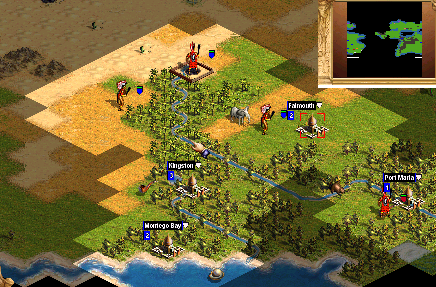
Here are my current standings, it is 1750BC and I am in theocracy with sliders set at 10 hrs, 5 gold, and 5 rations. The fortified warrior is a future city. Port Maria and Falmouth are fortified with knights I got from ruins, Kingston and Montego Bay are forted with warriors. I will get better defenders later. I am making settlers in Kingston right now but will switch that over to stonehenge and make them in other cities. PW at 20%. Soon I am gonna start on a few clerics and slavers to wreck havoc on the 4 discovered civs, espiecially those Zulus and Thai, they don't like me.
|
I don't remember the default slider settings in Theocracy. But I do find that it is worth pushing the workday (more production) first, reducing rations (for growth) second, and balancing happiness by increasing wages.
Kingston and Montego Bay are a little close for my taste (they share 4 tiles). But early, quick expansion has its' points.
Given the post I saw just after I wrote this, it may be too late, but the concepts are still usefull. I was going to suggest building your next city 2 tiles from your fortified warrior. Specifially, 1 tile South (vertical down) and 1 tile Southwest (diagonal down & left). This would not only have you building on a jungle river tile (see previous post), it would maximize the number of river tiles in the city limits (6 besides the center tile). It would still share one tile with Falmouth (the elephant on the plains), but the unimproved production & food & gold available would make it well worth it.
I'd be interested in hearing how the game progresses.
|
|
| |
|
|
|
kstolzy
|
|
Los Angeles, CA
May 2004
time: 21:21
|
|
quote:
Originally posted by Gamecube64
I have 3 slaves in Port Maria, and 1 in some new city northwest of Kingston... I took a walled city with 3 or 4 phalanx, I used 2 knights (the ones from ruins), 3 archers, 1 slaver, and 3 legions. I lost all of the front row and 1 archer was damaged a little. I don't think I got a slave though. (is this correct?)
|
You should have gotten a slave when you took the city (the troops are enslaved, not the population). Did the slaver survive? If not, no slave. But I would think so, since you said the archers survived.
BTW, slaves must be gaurded by troops or they will revolt. One military unit per 3 slaves. I've read that some have done better than this by keeping a slaver in the same city.
You'll be playing Deity level soon.
|
|
| |
|
|
|
joelfr
|
|
Thought I'd break into your private (to date) chat; have been playing CTP for almost 2 years now. By far my favorite. Think back to when I played my first few games, how much fun it was learning the neat tricks/techniques there were embedded in the game play. If you were to finish building a new unit in a city, but already have 9 units within the city, you'll get a message telling you just that your unit cannot be completed until you either move one unit out of the city, or else you should change what you are building to be a non-unit (i.e. city wall, cathedral). BTW, when you get that type of message, it means that you have now wasted one turn of production while the game waits for you to get someone out of your city (ex. is that if it should take you 9 turns to build a new phalanx, and on the ninth turn you get the message that you must move someone out of the city to complete building the phalanx, you'll end up not completing the building process until the 10th turn or later). Also, you need to be careful not to waste your precious accumulated work units---when another (computer) civ finished building the wonder just before you completed it, you should have gotten a message a turn or two beforehand letting you know that was about to occur. You should then consider switching your accumulated production units to building another item, so as to not lose them. So, all in all, it was awesome as I got better and better, being to slowly play the game on a higher level until I have now reached deity (which I can defeat sometimes). Thhis CTP game is lengthy, complicated and involved, but once you learn the in's and out's, it does move at a good pace, and I never get bored of it (just gotta remember not to play EVERY DAY. One of your responses actually reminded me of something I have forgotten to do in a long while, that is to right click on tiles to see what their value is. Something I'd like to know if there actually is an answer: how are you able to determine the production rate (i.e. higher the better) of building a city on a specific tile? In other words, if you build on a desert tile vs. building on a mountain, it will allow you to build something in a shorter period of time. Any one got that one for me??? I always agaonize over which tile will be best as I try to build up numerous new cities at the start. Obviously, you higher building powers early on have a huge impact on how quickly you will progress in comparison to your competition cities. Thanks, Joel
|
|
| |
|
|
|
joelfr
|
|
oh almost forgot. I know my civ has turned a corner when: (1) I have obtained the power to build cannons; then no loser combatabts can come knocking down my cities on short notice, (2) I get Edison's lab; then I get tons of new advances automatically and I super-quickly override the opponents technology advances, (3) also spies and clerics are impt; they gain me add'l slaves/workers and steal opponents' advances.
So, another question: is it true that placing one military unit within your city will prevent revolt's from occuring for each 3 slaves within your city? I got my CTP CD without any instruction/strategy guide. I initially had to go by the tutorial, and the attached strategy guide' within the CD itself (not worthy of too much info there). Had to learn a great deal myself while just attempting to play, and also from others' idea's wihtin this forum.
Joel
|
|
| |
|
|
|
joelfr
|
|
thanks for the reply, and very interesting. For example, if I have a choice of, say, 3 different types of terrain to build a city on. I want to know which particular area to 'settle' on so that I can produce a certain type of unit (military, city wall, etc.) in the least amount of turns. I can determine this solely on the 'production' value, based only on the amount of production it tells me when I right click on the tile (prior to settling on it)?
|
|
| |
|
|
|
joelfr
|
|
hey, kstolzy, who are you and how do you have thhis consummate CTP knowledge (blasts from the past, at this point??). Thanks for the precisely insightful answer. I never obtained a players manual so I've had to learn as I play, but never knowing what the formula's are for figuring this kind of stuff out.
|
|
| |
|
|
|
kstolzy
|
|
Los Angeles, CA
May 2004
time: 21:21
|
|
Actually I am a relative newcomer, I've only been playing since last year. There are many others with more knowledge and experience than I (e.g. J Bytheway). I have read the players manual (not much there), the official strategy guide(some errors, explains combat and gov't modifiers), GameSpot's Unofficial game guide(less valuable than the official), and most of this forum, as well as extensive reading in the GL (Great Library, most useful). I am still an active player, but my games move slow because I like to micromanage my empires.
Gamecube64, it occured to me to ask the obvious, have you already maxed out your sliders? The only places I can think of that you could look for clues are the Civ Status screen (use the buttons above each of the sliders with the gear, circled G, and bread icons to get details of resource use) or the happiness button on the city tab at the bottom (each city will have it's own).
|
|
| |
|
|
|
joelfr
|
|
I micromanage as well, especially late into the games. Playing on Deity, I am no doubt always behind early and have to make the gradual catch-up. Sometimes I get onto the bell curve early (in catching up) and I eventually kick computer butt; sometimes I 'win' by computer standards in time, and sometimes I don't 'win' the game. However, if I keep playing after another civ has 'won', I can always eventually kick all other civ's butts. The only question is whether I can position myself to do it in time. I will check out the gamespot site, and maybe others like it (thank you, Google?) that could have some add'l info...thanks
|
|
| |
|
| |
All times are GMT. The time now is 05:21.
Apolyton Time is 00:21. |
top of page
|
|
|
Forum Rules:
You may not post new threads
You may not post replies
You may not post attachments
You may not edit your posts
|
HTML code is ON
vB code is ON
Smilies are ON
[IMG] code is ON
|
|
|
|
|
|





 17-10-2004 23:55


 Attachment:


 they let me have enough extra food to mine some plains while still growing fast.)
 |
|