|
| |
|

|
punkbass2000
|
 |
Waterloo, ON, Canada
Feb 2002
time: 00:20
|
|
quote:
Originally posted by dmd175
Just curious, you generally build mktplace before temple on higher levels. I find myself delaying mktplace in cities that are only making a few gold and especially if I don't have lux. |
Cities with few shields and low commerce probably won't bother with a marketplace for a while, they will get a courthouse instead.
quote:
I always try to make a SSC. Wanted to confirm something I've noticed when I build Cop and Newton's...first time I did it I was looking for the science to outright double. But in fact the 2nd wonder only doubles the "base science", ie that part not including bonus of first wonder. I've noticed this same pattern with mkt-->bank-->stock exchange. If you have 15 to treasury with a mktplace, a bank gets you 20, and not 22.5. |
The Byzantines are especially good for a SSC, being both Sea. and Sci., though Com. is of course a good trait for it too. Sea will be more useful earlier, Com. would be later. And yes about the base beakers, same deal for factories, etc., BTW.
|
|
| |
|
| |
|
|
|
Dominae
|
|
Ok, I'm playing the save from 4000BC now both ways (Settler first, or Granary first) up until Philosphy to compare the different openings. I'll post more later, but for now I noticed this:
quote:
Originally posted by punkbass2000
3700BC Warrior NE to mountain. Meet Hittite warrior (Damn! That was quick) They have nothing to offer but a few gold and pottery, which by this point we'll have in four turns anyway and they want BW for it anyway. This early contact is really great, significantly decreasing the cost of Pottery for us and giving us a trading partner. |
According to my Advisor, I can get Pottery and 35 Gold from the Hittites for Bronze Working. That's not half bad, considering that the AI is probably researching Bronze Working anyway (unless there have been changes to the AU mod research preferences that I'm not aware of). In any case, trading for Pottery right away sets me 4*4=16 Beakers ahead on the way to Writing, which may mean up to a whole turn's difference. Technically I "lose" all the Beakers I've already accumulated and the Hittites "gain" them, but the AI does nothing with Pottery anyway. IMO, Philosophy is still worth beelining for in the AU mod, and this is one trick to get there faster.
Discuss!
|
|
| |
|
|
|
Modo44
|
 |
in western Poland
Jul 2004
time: 06:20
|
|
Cool. I'm on it then. Report to follow. And screenies, don't forget lots'a screenies. 
Complete turn report
For descriptions and screenies see below.
2150 BC
Up lux slider to 10%, to keep Constantinople content (had 2 unhappy and 1 happy citizen before the change).
Talked to the Constantinople Governor and told him to emphasize food. Didn't allow him to control the city, though.
2110 BC
One barb went towards the Hittie city. The other one back towards the camp.
Leave Settler standing. Warrior goes 2.
Western Warior continues exploring. Went for the coast for a turn.
2070 BC
Lux slider to 30%, to keep Constantinople from rioting. Settler in 1 turn.
Warrior moves 1, Settler moves 1.
Irrigation finished near Constantinople. Start roading with Worker and Slave. Second Worker goes to Contantinople 1.
Scouting Warrior goes south. He meets an Ottoman Warrior-Settler pair. We don't attack it.
2030 BC
Barb attacks our Warrior, loses. 1 HP lost, no promotion. Other barb follows our Settler.
Lux slider back to 0%, as Constantinople lost population.
Constantinople starts Worker.
Move Warrior and Settler away from the barb and towards each other, so the can meet next turn.
Settler goes to Constantinople 11. Heading for Constantinople 411.
Scouting Warrior goes south, finds out he's close to another coast.
1990 BC
Barb goes 7, towards our Settler, as anticipated.
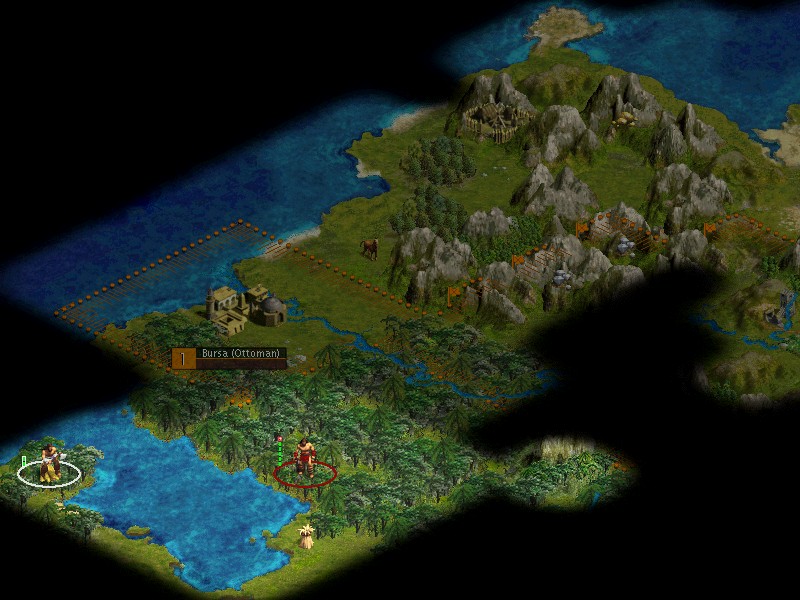
Ottomans found Bursa on the coast our Warrior has previously scouted.
Settler goes 9, Warrior fortifies to regain HP.
Road on Irrigated Wheat finished.
Worker goes to the Forest to chop it for Granary in Adrianople.
Slave goes to Constantinople 41 to start roading the tile.
Settler goes to Constantinople 114
Scouting Warrior goes farther south, hitting the coast.
1940 BC
Ottoman Warrior gets in the way of the barb that was following our Settler. They fight, barb dies.
Hitties found Ugarit at the base of their private volcano.
Warrior and Settler go 3, towards the planned city site (Tarsus 87).
Scouting Warrior goes south. Finds more prime real estate somebody else will claim, and some barbs.
Constantinople finished Worker, switched to Settler. Lux back to 0% because of the population loss.
Worker starts a mine at Constantinople 63.
Caesarea found at Constantinople 411. Starts Curragh.
1910 BC
Constantinople grows, lux to 10% to accomodate. No MM required yet (or so I think...).
Worker starts a Mine at Constantinople 1.
Settler and Warrior go 6, to planned city site near Tarsus.
Scouting Warrior goes south, to find even more prime real estate. Now he sees a Wheat, a Cattle and a Sugar tile, all on Grassland.
Ottomen just got Iron Working (I checed them every turn). We can't buy it yet. No one else can either.
1870 BC
Nicaea found at Tarsus 87. Starts Temple. Warrior fortified inside.
Scouting Warrior goes farther south, to find a Desert.
Sell Mysticism to Hitties for 50gp.
1830 BC
Scouting Warrior keeps walking, uncovering more desert.
Lux to 20% for Constantinople. MM done to make Adrianopole grow a turn later, just after it finishes Granary. Caesarea gets the Wheat tile for a turn.
Switched Constantinople to Colossus, to direct the chopped shields to Adrianople.
1790 BC
Warrior finds a barb camp in the Desert south of the Ottomen. Good, we'll leave it there.
Forest chopped at Constantinople, Granary in Adrianople in 2 turns, growth in 3 turns. Worker starts Road.
Food brought back to Adrianople, taken away from Caesarea. Caesarea citizen taken off the Wheat. Adrianople citizen put back on Wheat. Constantinople citizen switched from one Irrigation to another.
1750 BC
Scouting Warrior is attacked by a barb from the camp. Barb dies, no damage taken. Warrior comes closer to the camp, to take a look at the nearby Mountains.
Made a bad mistake. Constantinople shouldn't try to grow and build a Settler in the same turn, being at size 6, because it can't get to size 7 without an Aqueduct. So the Settler is ready and we're at size 4 for a turn.
Constantinople has a full food box, so it's set to max production for this turn (8 shields).
Lux slider back to 0% for a turn.
Settler sent to Constantinople 332, near the Fish and at least 2 Bonus Grassland Tiles.
End of 10 turns, over to the next player.
Last edited by Modo44 on 27-11-2004 at 15:56
|
|
| |
|
|
|
Modo44
|
|
in western Poland
Jul 2004
time: 06:20
|
|
2150 BC
Up lux slider to 10%, to keep Constantinople content (had 2 unhappy and 1 happy citizen before the change).
Talked to the Constantinople Governor and told him to emphasize food. Didn't allow him to control the city, though. This is only to help him keep the high food surpulus when the city changes size. Once the necessary improvements are all in place, this setting should allow us to keep MM in Constantinople to a minimum.
I take it the 2 Workers and 1 Slave are improving the Wheat tile for extreme speed only? Because if not, the situation is grossly inefficient. Personally, I almost never put more than 1 Worker on an unroaded tile - this just loses too many Worker turns. In our situation the Workers had to "pay" 3 turns - by using a turn for movement only - to road that tile, while it could have been roaded "paying" only 1 turn. You do the math...
I really, Really, REALLY (Thanks Arrian, for the text-formatting idea.  ) don't like the site for our Settler. My first choice would be to send him for Constantinople 411 (or even 44411). Later I'd send one to Adrianople 996, assuming I could deal with the barbs. The reasons are twofold. First, I tend to put my cities along AI ones, for easier conquest. A CxxC patern is great for this and doesn't require any razing, when I go bonking heads. Second, I really like to heve a Barracks city set up ASAP. The AI is simply terrified by Archers early on, or you can make Veteran Warriors for an upgrade to Swords (while they wait, they do MP duty). Also, there's the small possibility of getting 4-6 Archers out of a single city and going to rush someone. ) don't like the site for our Settler. My first choice would be to send him for Constantinople 411 (or even 44411). Later I'd send one to Adrianople 996, assuming I could deal with the barbs. The reasons are twofold. First, I tend to put my cities along AI ones, for easier conquest. A CxxC patern is great for this and doesn't require any razing, when I go bonking heads. Second, I really like to heve a Barracks city set up ASAP. The AI is simply terrified by Archers early on, or you can make Veteran Warriors for an upgrade to Swords (while they wait, they do MP duty). Also, there's the small possibility of getting 4-6 Archers out of a single city and going to rush someone.  And, last but not least, other sites are simply faster to reach. And, last but not least, other sites are simply faster to reach.
That being said, I think it would lose too many turns to go wandering with the Settler now, so he's going where planned. Except if the barbs kill our warrior...
2110 BC
One barb went towards the hittie city. The other one back towards the camp.
Leave Settler standing. Warrior goes 2.
Western Warior continues exploring. Went for the coast for a turn, will turn south into the jungle.
2070 BC
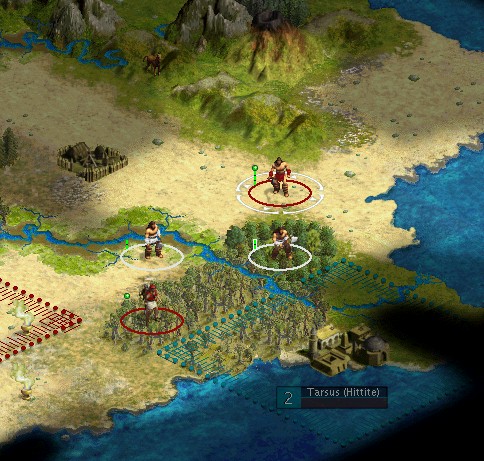
Dang you, Punkbass! Look what happened. That's exactly, why you don't want to send Settlers toward barbs.
 Attachment: trouble.jpg Attachment: trouble.jpg
This has been downloaded 78 time(s).
Last edited by Modo44 on 27-11-2004 at 12:52
|
|
| |
|
|
|
Modo44
|
|
in western Poland
Jul 2004
time: 06:20
|
|
2070 BC
Lux slider to 30%, to keep Constantinople from rioting. Settler in 1 turn, then what? A curragh would be in order, but we might be low on shields for that. There's too much food, I would find it too wasteful to do anything but Settlers/Workers in this city, at least unless we put some others to use the surpulus. Constantinople 411 comes back, hitting my head with hard objects...
Warrior moves 1, Settler moves 1. Try to lure the barbs into attacking. But this seems only possible while staying on open terrain. I definately don't want to attack them, while they sit fortified in the Forest, though. 
Irrigation finished near Constantinople. Start roading with Worker and Slave. Second Worker goes to Contantinople 1, as he couldn't have made the Road come any faster.
Scouting Warrior goes south. Seems the Ottomans will have a city on the coast there - Warrior-Settler pair walking along. No Settler-bop tried (a shame, having an Elite Warrior agains a Regular one). Too risky, because we have no Barracks city to deal with any possible counter-attacks. We could have, though, with our second Settler.
2030 BC
Barb attacks our Warrior, loses. No promotion. Other barb follows our Settler.
Move Warrior and Settler, so they can meet next turn. That's a lot of turns wasted walking around the barbs, and still no city. I don't know if it could be done faster. Could it???
Attachment: problem solved (or so i hope).jpg
This has been downloaded 76 time(s).
Last edited by Modo44 on 27-11-2004 at 16:00
|
|
| |
|
|
|
Modo44
|
|
in western Poland
Jul 2004
time: 06:20
|
|
2030 BC
Barb attacks our Warrior, loses. 1 HP lost, no promotion. Other barb follows our Settler.
Lux slider back to 0%, as Constantinople lost population. On unever turn (meaning, the Settler was not built exatly on the same turn the city population increased), unfortunately, but that couldn't be helped. Not enough improved tiles, yet.
Constantinople starts Worker. We simply have too much food, and thus population, to stay behind on tile improvements. And we would with our current Worker-capacity. I see no way to make the Worker in one turn, so it'll stay uneven for now. I think the next Settler will clear the matter, especially with 3 Irrigated tiles to help manage food surpulus.
Move Warrior and Settler away from the barb and towards each other, so the can meet next turn.
Settler goes to Constantinople 11. Heading for Constantinople 411. This will make a Barracks city and can grow using the Irrigated Wheat part-time. It's also exactly as far away from the capital as Adrianople, thus keeping corruption low for our core.
Scouting Warrior goes south, finds out he's close to another coast.
1990 BC
Barb goes 7, towards our Settler, as anticipated.
Settler goes 9, Warrior fortifies to regain HP (and defend, should the barb try to attack, sensing a Settler - I don't know if they actually do that if the Settler is protected, though  ). ).
Road on Irrigated Wheat finished.
Worker goes to the Forest to chop it for Adrianople. This way the city can have a Granary and grow in 7, instead of 10 (or more) turns. Hope you don't mind, but the early Granaries are worth it, IMO.
Slave goes to Constantinople 41 to start roading the tile for our Barracks city.
Settler goes to Constantinople 114
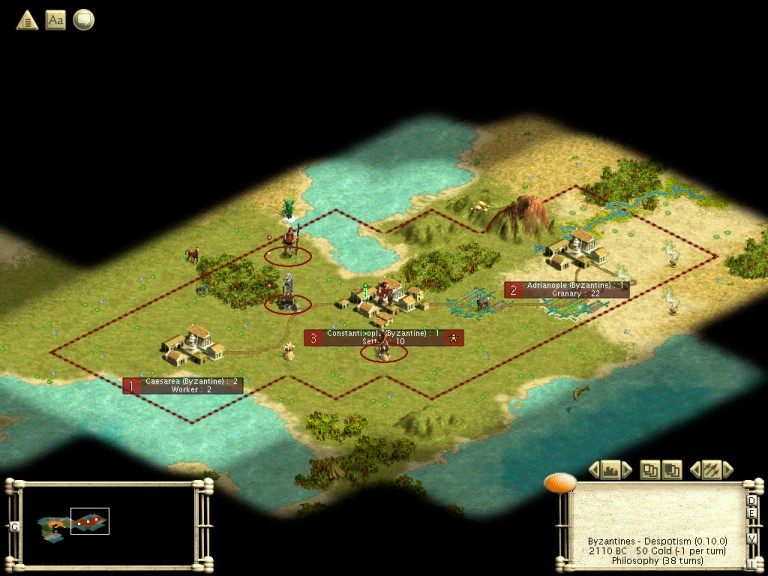
Scouting Warrior goes farther south, hitting the coast. Ottomans found Bursa on the coast he's been to reviously. Upon getting out of the jungle, he sees the following. They seem to have some nice city sites, so they'll be into clearing jungle in no time, methinks. After all, they're Industrious.
Attachment: west ottomania.jpg
This has been downloaded 76 time(s).
Last edited by Modo44 on 27-11-2004 at 16:00
|
|
| |
|
|
|
Modo44
|
|
in western Poland
Jul 2004
time: 06:20
|
|
1940 BC
Ottoman Warrior gets in the way of the barb that was following our Settler. They fight, barb dies.
Hitties found Ugarit at the base of their private volcano. How thoughtful of them. 
Warrior and Settler go 3. Will put a city at the designed site (Tarsus 87) 2 turns from now.
Scouting Warrior goes south. Finds more prime real estate somebody else will claim. And some barbs to boot. I guess that's the reason the Ottomen had a Worker for sale.
Constantinople finished Worker, switched to Settler. Lux back to 0% because of the population loss.
Worker starts a mine at Constantinople 63. Otherwise he'd have to do a road or waste turns joining others. We have enough tiles being roaded atm. I know it seems painfully slow to make workers do jobs on their own, but it's extremely efficient in the long run. The basic goal is to have solitary Workers do Forest Chops and Roads ahead of Worker bands that finish improvements and don't lose Worker-turns. Not many Worker-bands now, but they'll come. 
This makes me seriously consider adding another Worker, before returning to Settlers.. *thinking*... *thinking some more*... No. Good land NW and SE to settle first.
Caesarea found at Constantinople 411. Starts Curragh, to be followed with Barracks. I'm not entirely sure about this. It might be just as good to start another Granary (this city has access to 1 Irrigated Wheat) or go for Barracks first, depending on the chosen strategy. I feel we need to get more constacts pronto, or at least get the coastal line uncovered to plan our future better, so I start the Curragh. It won't be ready during my remaining 5 turns anyway, so anyone following can switch it.
Just in case you want to know - still no new trade deals possible at this moment.
1910 BC
Constantinople grows, lux to 10% to accomodate. No MM required yet (or so I think...).
Worker starts a Mine at Constantinople 1.
Settler and Warrior go 6, to planned city site.
Scouting Warrior goes south, to find even more prime real estate. Now he sees a Wheat, a Cattle and a Sugar tile. Some badass city the Ottomen gonna have.
Ottomen just got Iron Working. We can't buy it yet. No one else can either.
1870 BC
Nicaea found at Tarsus 87. Starts Temple. Warrior fortified.
Turns out Adrianople will have to slow down growth for a turn, to get it just after the Granary is done. Bad MM skills show again. 
But, the slowdown comes at a good time, as Constantinople just grew to size 6. Now it can be set to grow and produce a Settler in 2 turns. For this turn, Caesarea gets the Irrigated Wheat.
Lux to 20% for Constantinople.
Scouting Warrior goes farther south, to find a Desert. Good to know the nice land is limited for the Ottomen.
Sell Mysticism to Hitties for 50gp. Apparently they popped a barb hut or destroyed a camp. Didn't want to risk them buying Iron Working from the Ottomen, should they get lucky again.
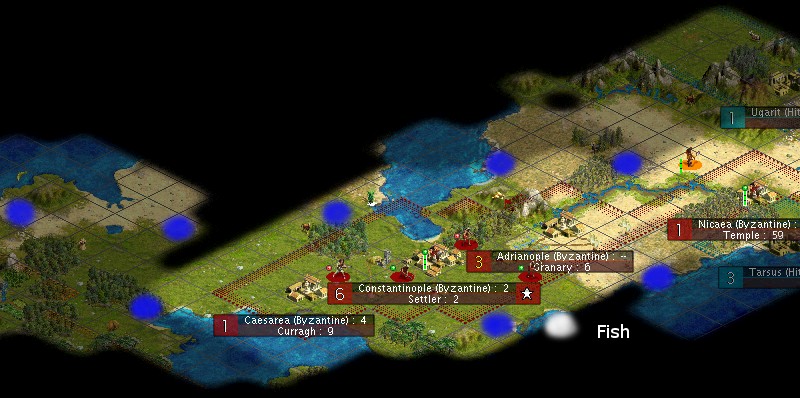
At this point, some proposals concerning city placement. Pretty tight towards the Hitties, a bit more loose towards the Ottomen. I usually try to mix a CxxC pattern with some more freedom for a couple of cities, so they can become wonder-factories later on.
We're definately in need of some scouting to the north and to the south from the capital. Might be a big peninsula or even a connection to the Ottomen there.
Attachment: plans.jpg
This has been downloaded 77 time(s).
Last edited by Modo44 on 30-11-2004 at 21:04
|
|
| |
|
|
|
Modo44
|
|
in western Poland
Jul 2004
time: 06:20
|
|
1830 BC
Warrior keeps walking, uncovering more desert.
Switched Constantinople to Colossus, to direct the chopped shields to Adrianople. I didn't think about this trick before.
1790 BC
Warrior finds a barb camp in the Desert south of the Ottomen. Good, we'll leave it there.
Forest chopped, Granary in Adrianople in 2 turns, growth in 3 turns.
Caesarea citizen taken off the Wheat. Adrianople citizen put back on Wheat. Constantinople citizen keeps running from one Irrigated field to another.
Switched Constantinople back to Settler.
1750 BC
Scouting Warrior is attacked by a barb from the camp. Barb dies, no damage taken. Warrior comes closer to the camp, to take a look at the nearby Mountains.
Bab, bad mistake. Constantinople shouldn't try to grow and build a Settler in the same turn, being at size 6, because it can't get to size 7 without an Aqueduct. So the Settler is ready and we're at size 4 for a turn.  Because of that, Constantinople is set to max production for this turn (8 shields). Hopefully it can be put to good use later. Because of that, Constantinople is set to max production for this turn (8 shields). Hopefully it can be put to good use later.
Lux slider back to 0% for a turn.
Settler sent to Constantinople 332, near the Fish and at least 2 Bonus Grassland Tiles.
End of 10 turns, over to the next player.
The save, 1750 BC.
 Attachment: training succession game, 1750 bc.sav Attachment: training succession game, 1750 bc.sav
This has been downloaded 4 time(s).
Last edited by Modo44 on 27-11-2004 at 15:58
|
|
| |
|
|
|
Dominae
|
|
Ok, here's my comparison of the "Granary first" and "Settler first" alternatives for this starting location. First some notes concerning my methodology.
I played the first 10 turns of the Granary first scenario just like punkbass did, and the subsequent turns based on this post:
quote:
The question is, 'How much faster are you going to get that settler out by not building the granary?". Let's assume you go for a settler immediately (six turns); you're now at pop one with a settler, what are you working? The improved BG, or the wheat? Assuming the wheat, you can't get another settler for at least 15 turns, so it will be 21 turns until you have built two settlers in your capital. Granary will be finished in 8 turns, growth in nine (I would MM the last turn to work both wheats to save a turn of pop 2ness). At size three, I have one shield towards a settler, three food per turn and five shields per turn (game, BG, Wheat). MM'ed, I have three turns till growth, during which time I will accumulate 13 shields, leaving 16 for my settler to complete. Now four fpt, 5 spt, same tiles, +wheat. MM'ed will have growth in three turns, with 17 shields. In a total of 15 turns I now have a 3 pop city with a granary and a settler. I can build another in six turns, for a total of 21, matching the previous method. The granary and (tons of) extra commerce are bonus. I don't believe the seven extra turns of an extra city (factoring in the fact that two turns will be lost the first way because the road won't be done) outweighs my other advantages. In seven turns it will have grown one pop, produced fewer shields and commerce compared to the extra the capital will produce during this time the second way.
|
Thus Constantinople's queue looked like:
Warrior
Granary
Settler
Settler
Warrior (to get to size 4)
Settlers
After the second Settler, I more or less took over and played the game just as I would from that point on. This, I hope, minimizes the "noise" between alternatives due to different prorities in micromanagement and high-level decisions (i.e. build order priorities and city placement).
For the Settler first scenario I adopted the following strategy:
Settler, with the help of a (Game) Forest Chop
Worker
Granary
Settlers
All non-capital cities followed more or less the same strategy, apart from the first builds in the second city (Adrianople), where in my game I could build Workers right away while in punkbass's version it had to build a Warrior first due to lower growth.
In both games I tried to get fresh water to the Wheat tiles as quickly as possible, although this obviously took longer in punkbass's version due to the constraints given by his planned sequence (as quoted above).
I rushed to Pottery, then Writing, then Philosophy in both games (as opposed to doing 40-turn research like punkbass decided) because I felt this would provide a good measure for comparing Commerce output (the alternative being counting Beakers, bleh).
If you can think of any way this comparison is invalid, I would like to hear them. For my part I believe this is as close as we can get (with a proviso...see below).
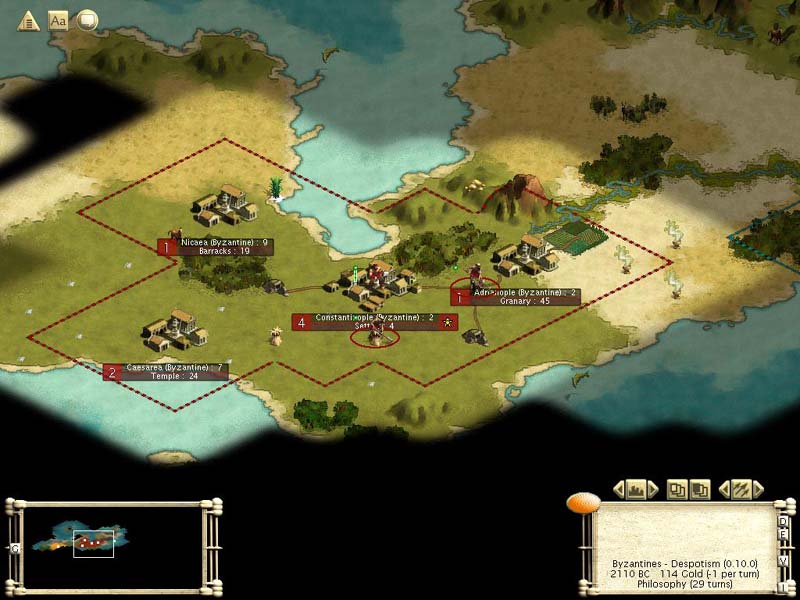
Anyway, here are the snapshots at 2110BC:
Granary first
Cities: 4
Pop: 8
Workers: 2
Granaries: 1
Warriors: 3
Curraghs: 1
Philosophy: 29 turns (14 bpt)
Constantinople: 5-turn Settlers
Adrianople: 15 Shields (toward Granary)
Tiles improved: 32 Worker-turns
Shields produced: 186
Attachment: pba, 2110bc.jpg
This has been downloaded 68 time(s).
Last edited by Dominae on 28-11-2004 at 09:54
|
|
| |
|
|
|
Dominae
|
|
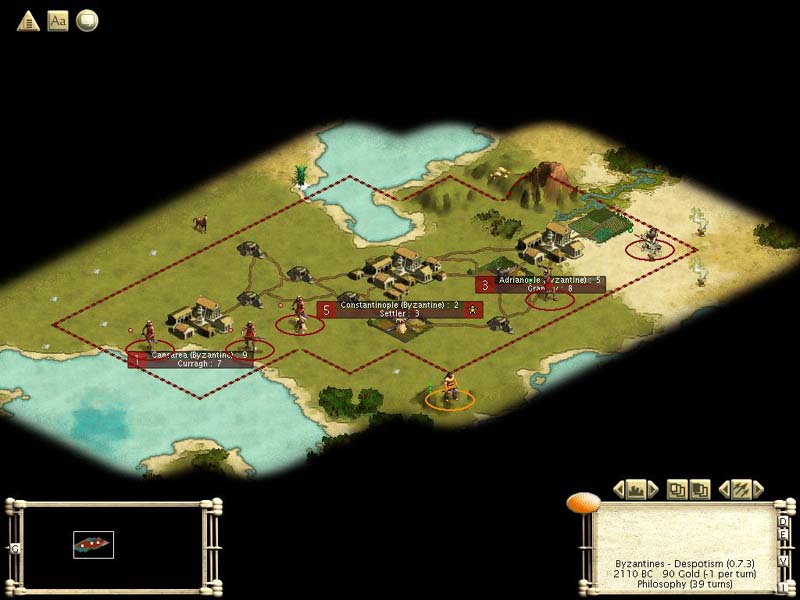
Settler first
Cities: 3
Pop: 9
Workers: 4 + 1 Slave
Granaries: 1
Warriors: 0
Curraghs: 0
Philosophy: 39 turns (10bpt)
Constantinople: 4-turn Settlers
Adrianople: 37 Shields (toward Granary)
Tiles improved: 75 Worker-turns
Shields produced: 203
Attachment: pbb, 2110bc.jpg
This has been downloaded 67 time(s).
|
|
| |
|
|
|
Dominae
|
|
Comparison
Granary-first has one extra city over Settler-first, which is a big deal in the early-game. Then again, Settler-first is only 3 turns behind, and has Constantinople spitting out Settlers at a nice 4-turn pace; Granary-first, OTOH, is awkwardly at 5-turns Settlers. So we can expect Settler-first to catch up in about 15 turns.
Granary-first has produced a lot more units than Settler-first. In fact, Settler-first has only Workers! This is a natural consequence of prioritizing Food early on; with the Food available, I always prefer Workers. However, this is a dangerous strategy because the AI could come around and mess everything up. This is why I traded techs around a lot in both games, to make sure the AIs were relatively happy with me. As expected, no attack came (one rarely does on Monarch), so Granary-first's Warriors are doing nothing more than police duty (still pretty good). Note that, had I wanted to be defensive, I could have built more units in Adrianople instead of proceeding straight to a Granary (there's a 22 Shields difference in Adrianople between the two games - a little over 2 Warriors).
Settler-first has double the number of Workers at the same time period, and a staggering double the number of Worker-turns of tile improvements down. Thus we can expect most of Settler-first's future cities to be working improved tiles the turn they're founded. A constant problem with Granary-first's start is that with so few Workers produced in the first turns (in favor of Settlers), many cities, including Constantinople, were working unimproved tiles for the first 40 turns. I assure that this is not omission on my part, but a reflection of what happens when you do not have enough Food to sustain your Granary-enabled Settler production.
Settler-first has produced slightly more Shields overall than Granary-first, but this will only get better because Settler-first has many more Shields coming in (again, due to the discrepancy in tile improvements).
Granary-first is (as punkbass predicted) ahead in the race to Philosophy, but (again!) due to the Settler-first's better developing economy I am guessing the latter will get there first (confirmed - see further posts).
Note that the extra Slave Worker in the Settler-first game was only acquired rather recently, and only contributed about 3-4 native Worker-turns.
---
Conclusion: IMO, Settler-first is the right call here. To "prove" it I will play each game all the way to Philosophy, to see if Settler-first's economy really outperforms Granary-first's.
Last edited by Dominae on 28-11-2004 at 09:53
|
|
| |
|
|
|
punkbass2000
|
|
Waterloo, ON, Canada
Feb 2002
time: 00:20
|
|
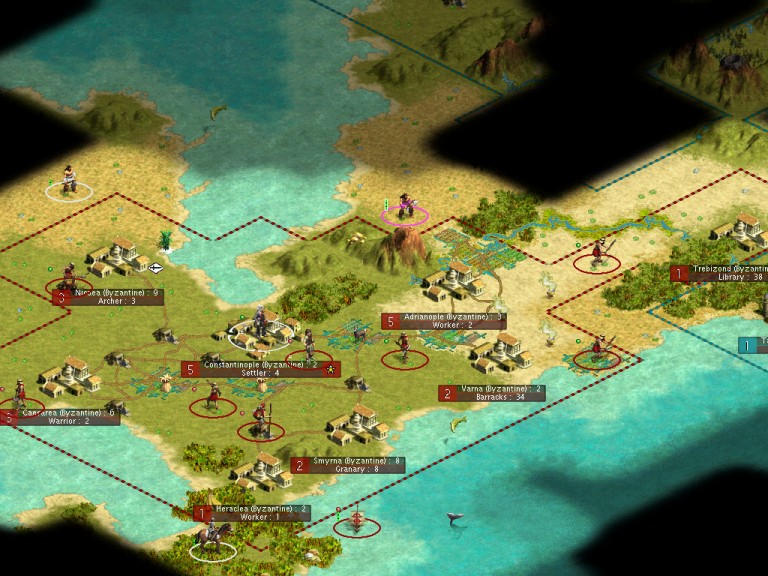
Well, not much time to post/report, but here's a screen and quick rundown of my 'granary first' run.
Cities: 3
Pop: 6 (though I will have growth next turn in two and two in the other as well as a settler about to found a city in tow turns.)
Workers: 2 (though significantly further ahead, I went settler-worker-settler instead of settler-settler-warrior.)
Granaries: 1
Warriors: 2
Curraghs: None
Constantinople currently at 5 turn, though that will be rectified next turn.
Adrianople: 38 shields towards granary.
Philosophy: 38 turns, 11bpt.
I didn't count shields or worker turns.
Oh, and yes, that's a SGL, which I obviously can't use for sake of comparison.
Attachment: granary.jpg
This has been downloaded 60 time(s).
|
|
| |
|
|
|
Dominae
|
|
quote:
Originally posted by punkbass2000
Constantinople currently at 5 turn, though that will be rectified next turn.
|
You mean Constantinople becomes a 4-tump next turn? How?
quote:
Oh, and yes, that's a SGL, which I obviously can't use for sake of comparison. |
If Granary-first grants you a SGL and Settler-first does not, then I concede that Granary-first is better.
Last edited by Dominae on 28-11-2004 at 09:53
|
|
| |
|
|
|
punkbass2000
|
|
Waterloo, ON, Canada
Feb 2002
time: 00:20
|
|
quote:
Originally posted by Dominae
You mean Constantinople becomes a 4-tump next turn? How? |
Sorry, I meant it will achieve sustainable 5fpt.
quote:
If Granary-first grants you a SGL and Settler-first does not, then I concede that Granary-first is better. |
Oh, yeeeeah, that SGL was an integral part of my strategy. So is the next one! (I disbanded the first, honest.)
Philosophy at 1350. Not gonna do a quick rundown yet, and will probably play and post settler first tommorow some time.
One thing I didn't notice before was the minimap, my exploration was far more extensive at 2110, and I removed the minimap for this screen.
Attachment: granary1350bc.jpg
This has been downloaded 59 time(s).
|
|
| |
|
| |
|
|
|
dmd175
|
|
Culturally linked starting location.
Oct 2003
time: 00:20
|
|
Hey guys. I will get to my turns this evening. Looks like we are a bit behind some of the other test runs so we'll try to catch up.
I for one appreciate the research efforts of PB, Dominae, et al. The early game is so important and the analysis will help us all.
In assessing Dominae's comparison of granary vs. settler first, I think I have the same question as Krill. Dominae did a good job standardizing the games, but I think the build queues should be as much as possible identical save for switching granary and settler. While settler first goes settler--> worker --> granary --> settler, granary first goes warrior--> granary --> settler---> settler.
It appears to me that the differences between the two tests (summed up as granary first has a larger economy quicker vs. settler first which has a slightly smaller economy but a higher rate of growth) are explained by the lack of workers and the lack of workers built, which is a function of the granary first queue. Instead, the granary first queue should be modified to build workers on par with settler first, so that we can extrapolate and isolate the effect not of order and intensity of build queues, but the effect of larger capital early/increased production later vs. more cities earlier.
Perhaps build queues with standard 1st four builds of worker, warrior, settler, granary, in different orders, followed by only settlers, or settlers/warriors, or...
Granary first: Warrior --> granary --> settler --> worker ----> settlers, etc.
Settler first: Settler --> warrior --> worker --> granary -----> etc. settlers, etc.
[girlfriend]
calls me away from computer. will edit and revise later
[/ugh]
|
|
| |
|
|
|
punkbass2000
|
|
Waterloo, ON, Canada
Feb 2002
time: 00:20
|
|
quote:
Originally posted by Dominae
Ok, here's my comparison of the "Granary first" and "Settler first" alternatives for this starting location. First some notes concerning my methodology.
I played the first 10 turns of the Granary first scenario just like punkbass did, and the subsequent turns based on this post: |
To begin with, I hope you're not offended by my (minor) criticism of your methodology. Beyond the fact that our tests will be far from conclusive given the many random factora in any civ game, I think it would have been slightly better to start from the ten-turn save to keep variable to a minimum (I think ideal for this comparison would be to continnue from the turn before the first settler would complete, and switching that to granary for the 'granary-first' scenario.)
quote:
Thus Constantinople's queue looked like:
Warrior
Granary
Settler
Settler
Warrior (to get to size 4)
Settlers |
I have quibbles here, but they're not your fault. I should have made myself more clear in my original dissection (the part you quoted and based the queue on). As you have seen in my run, I would not actually build two settlers immediately after the granary, I was just saying for the sake of argument that I could build a granary and two settlers in the same time it would take to build two settlers. Also, I presumed Adrianople was to be founded at 699 (which I still prefer, BTW). I had thought that warriors, etc. wouldn't matter for the purposes of this study, as we're primarily counting food, but workers can be a real wildcard here. For me it's almost problematic that workers only cost ten shields Anyway, for a "fair" comparison between the two I think you'd need to produce two settlers ASAP in 'settler-first' which would be sub-optimal and thus unfair anyway.
quote:
After the second Settler, I more or less took over and played the game just as I would from that point on. This, I hope, minimizes the "noise" between alternatives due to different prorities in micromanagement and high-level decisions (i.e. build order priorities and city placement). |
Aside from the inherent flaws I mentioned, above, this sounds like the best way to go. I think we can assume that over such relatively few and early turns that our overall goals (individually) will remain largely unchanged and fairly easy to keep on the generally same path for both scenarios, it will just be a matter of how many resources we have, which is the criteria and should be variable anyway.
|
|
| |
|
|
|
punkbass2000
|
|
Waterloo, ON, Canada
Feb 2002
time: 00:20
|
|
Yeah, I just realized that Dom didn't build any warriors, including the one I built immediately. I think this seriously throws off the results. I started from turn 10 on my granary-first run and there's no really good way to build a settler at that point. Assuming that granary-first doesn't *need* a warrior (and I can't see why it would, at least vs. settler-first), to compare to what I've already done will either probably make settler-first look worse than it should and Dom's way makes settler-first look better than it should. So much for trying to eliminate individual bias I wonder if this is largely a result of me generally believing in granary-first and thus knowing the "optimal" strats with it, while Dom is more familiar with settler-first. I suppose we could try to compare my granary-first to Dom's settler-first, though that still runs into some problems, it could be interesting. I'm interested to know what contacts you had in 2110BC Dom, and when you acquired them w/o warriors. Same for huts, as well as overall exploration.
|
|
| |
|
|
|
Dominae
|
|
quote:
Originally posted by Krill
Simple question: In Granary first, why did you not make Constantinople build workers when it could only build 5 turn settlers. If you built 2 workers, instead of one 5 turn settler, how far behind would you be compared to settler first @2110BC? |
This is a good point. By sticking to punkbass's plan (as quoted in my above post), I had to build back-to-back Settlers/cities with only one Worker for support. If it were up to me, I would have built at least one Worker in there somewhere; one Worker per three cities is simply not enough in the early-game, especially when we're talking multiple pump city potential.
Would this have made a difference in comparison to the Settler-first game? What we need is someone to figure that out...
|
|
| |
|
| |
All times are GMT. The time now is 05:20.
Apolyton Time is 00:20. |
top of page
|
|
|
Forum Rules:
You may not post new threads
You may not post replies
You may not post attachments
You may not edit your posts
|
HTML code is ON
vB code is ON
Smilies are ON
[IMG] code is ON
|
|
|
|
|
|





 24-11-2004 09:41






 (I play, and win, Emperor level.)


 |
|
.jpg)