|
| |
|

|
Asher
|
 |
Calgary, Alberta
Nov 1999
time: 22:18
|
|
World Community Grid is a new computing grid being launched by IBM and United Devices, to harness the idle processor cycles of people's computers to do research that benefits humanity.
The current project is called the "Human Proteome Folding" project:
quote:
The Human Proteome Folding project will provide scientists with data that predicts the shape of a very large number of human proteins. These predictions will give scientists the clues they need to identify the biological functions of individual proteins within the human body. With an understanding of how each protein affects human health, scientists can develop new cures for human diseases such as cancer, HIV/AIDS, SARS, and malaria. |
More information is available here: http://www.worldcommunitygrid.org/p...he_project.html
This does not affect your computer's performance, because it only uses processor cycles that are otherwise wasted on doing nothing.
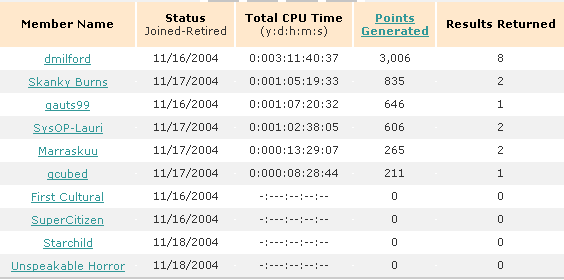
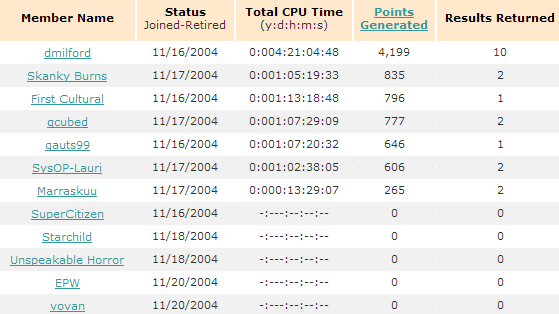
I have created an Apolyton team yesterday, and we have 7 members at the time of this writing. Every little bit helps, so join today. 
Step 1: Join (download, install, register): http://www.worldcommunitygrid.org/j...w/join_now.html
Step 2: Join the Apolyton team: http://www.worldcommunitygrid.org/t...mId=635XNJBR9N1
It would be cool if Markos or Dan made this a news item, too. 
|
|
| |
|
|
|
Asher
|
|
Calgary, Alberta
Nov 1999
time: 22:18
|
|
http://www.cnn.com/2004/TECH/11/17/...grid/index.html
quote:
Log on to tackle global problems
(CNN) -- Anyone with a computer can now contribute to tackling some of the world's biggest humanitarian problems simply by leaving their machine logged on when not in use.
This week saw the launch in New York of the World Community Grid, an initiative which aims to take advantage of the under-used power of business and home computers by recruiting them to analyze data for medical, social and environmental research.
By accelerating the pace of that work, organizers say the World Community Grid could aid our understanding of the genetic codes that underlie diseases such as HIV and AIDS, Alzheimer's and cancer.
It could also contribute to creating more accurate models of the world's food and water supplies, climate change or the spread of pollution.
The project is based on grid computing technology, which joins together individual computers via the Internet to create a large system with computational power far in excess of the world's most powerful supercomputers.
With an estimated 650 million PCs in use around the world, the World Community Grid will initially be able to handle up to 10 million participants.
In order to take part, computer users simply need to download a program from www.worldcommunitygrid.org.
Then, whenever the computer is idle, the computer requests data from a World Community Grid server, performs computations and sends the results back to the server.
"World Community Grid represents a new model for philanthropic giving," said Linda Sanford, a senior vice president at IBM, which helped build the infrastructure and is also hosting and providing support for the grid.
"The grid demonstrates that government, business and society can be the direct beneficiary of innovation if we are willing to rethink the way innovation and science both develop and prosper."
Grid computing has already proved its effectiveness in shortening the timescale of vital research projects. Last year a grid of more than two million volunteers contributed to the analysis of 35 million drug molecules in the search for a treatment for smallpox. The study identified 44 potential treatments for the disease and cut analysis that would otherwise have taken more than a year to less than three months.
It is also being used by Climateprediction.net, a project led by the Oxford University e-Science Centre, which is seeking to predict how the climate will change in the next century.
The first research to benefit from the new research will be the Human Proteome Folding Project, launched by the Seattle-based Institute for Systems Biology to study the genetic structure of proteins that cause diseases such as malaria and tuberculosis.
"Now that the Human Genome has been sequenced, the next critical phase in genomics research is to do as much as we can to understand protein functions," said ISB lead scientist Dr. Rich Bonneau.
"This database of protein structures and possible functions will let us take those next steps in understanding how diseases that involve these proteins work."
The World Community Grid Advisory Committee said it would consider further proposals from leading research, public and not-for-profit organizations to conduct humanitarian research, with the intention of conducting five or six studies in the first year.
"The World Community Grid is an exciting new initiative brought about by IBM to conduct humanitarian research using grid technology," said Professor Paul Jeffreys of the Oxford University e-Science Centre, a member of the Advisory Committee.
"Following close collaboration with IBM on e-science, Oxford University signed a strategic partnership with IBM earlier this year and it is delighted to extend the partnership into a worldwide grid activity." |
|
|
| |
All times are GMT. The time now is 05:18.
Apolyton Time is 00:18. |
top of page
|
|
|
Forum Rules:
You may not post new threads
You may not post replies
You may not post attachments
You may not edit your posts
|
HTML code is ON
vB code is ON
Smilies are ON
[IMG] code is ON
|
|
|
|
|
|






 17-11-2004 23:04










 Attachment:




 |
|