 |

|
DanS
|
 |
Kickball Capital of the World
Jan 1970
time: 00:30
|
|
quote:
The question is can we man survive on the most hospitable place outside earth with equipment that is commercially available and pretty much mass produced. |
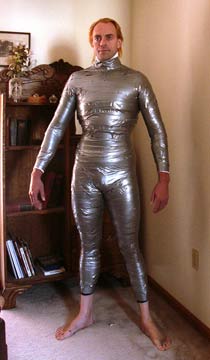
As I understand, theoretically you could use a skintight suit that is pressurized to human specifications. However, keeping warm and cool in the extremeties and dry all around would be damned near impossible in such a system.
There's lots of opportunities for modest research and development spending on spacesuits for potentially large payoff. You would think that NASA would spend considerable sums on making their suits better, but I don't think they do.
Last edited by DanS on 20-01-2005 at 08:41
|
|
| |
|
| |
|
|
|
DanS
|
|
Kickball Capital of the World
Jan 1970
time: 00:30
|
|
With regard to the NASA research, the thing that was holding them back from a skintight non-pressurized suit was the readily available materials in the late 60s. For all we know, suitable material might be commercially available nowadays (you see lots of different kinds of fabrics nowadays in the era of Polartec), but nobody has done follow-up research on it.
Edit: There has been some small follow-up research on this outside of NASA, after all.
Last edited by DanS on 20-01-2005 at 09:28
|
|
| |
|
| |
|
|
|
Geronimo
|
|
st cloud USA
Jan 1970
time: 05:30
|
|
quote:
Originally posted by chegitz guevara
Then you die. I don't think we have any other type of "clothing" that would suitably insulate us against the extreme cold of Mars. You also need a self-contained air supply, as the amount of CO2 is toxic and would immediately kill you.
After death you'd freeze and dehydrate, like an Andean mummy, and slowly the windstorms would scour your bones clean. |
but mars atmosphere is so thin. surely the partial pressure of CO2 isnt that much higher than earths despite mars having a nearly 100% CO2 atmosphere. And the cold youre thinking of only applies away from the equator and at night. Mars is typically above freezing near the equator in the day.
I think you'd need plenty of insulation and many many oxygen tanks until night fell at which point you would die.
|
|
| |
|
|
|
Geronimo
|
|
st cloud USA
Jan 1970
time: 05:30
|
|
quote:
Originally posted by KrazyHorse
Are you out of your mind?
P = 1KPa
have fun when all your blood vessels burst and your eyes pop out of your skull. |
this is popular misconception just ask nasa
Mars isn't a vacuum so you could breathe 1KPa oxygen from a tank and safely boost the pressure a bit higher with adustments to a regulator. Your best bet would be to land in a very very deep valley near the equator where the pressure will be considerably higher. Although admitably the body requires at least 47 mm Hg of ambient pressure to avoid excessive drying from boiling at exposed moistened surfaces such as the eyes or oral-nasal cavity. Furthermore, oxygen at partial pressures lower than 30mm Hg would be insuficient to maintain consciousness. So the valley would have to be *quite* deep, and you'd better hope the martian barometers are near record highs in that region that day.
Average surface pressure on mars is a bit less than 10 mm Hg
Last edited by Geronimo on 20-01-2005 at 16:11
|
|
| |
|
|
|
Geronimo
|
|
st cloud USA
Jan 1970
time: 05:30
|
|
quote:
Originally posted by KrazyHorse
Any skin exposed to Martian atmospheric pressure would suffer massive edema and cause serious internal bleeding.
Not a pleasant way to die.
For the slow: 1 Pascal is 1 Newton per metre squared. 1 kilopascal is 1000 Pascals. Regular atmospheric pressure at sea level on earth is around 100 kilopascals. On Mars atmospheric pressure at ground level is close to 1 kilopascal. |
This has to be the first time I've ever seen Krazyhorse demonstrably wrong about any science related question.
|
|
| |
|
|
|
Geronimo
|
|
st cloud USA
Jan 1970
time: 05:30
|
|
quote:
Originally posted by Spiffor
Low pressure can have important reverse effects for people, even ones that are very well acclimated. Professional alpinists can't stay long at the summit of mount Everest, despite their oxygen and water reserves, because of the ill effects of pressure alone. And pressure at the Everest Summit is ca 33% of the one at sea level. Mars's pressure is 1% |
it aint healthy certainly, but it kills you very slowly.
|
|
| |
|
|
|
Geronimo
|
|
st cloud USA
Jan 1970
time: 05:30
|
|
quote:
Originally posted by The Mad Monk
...and Mars will kill you less slowly. |
it might take a few hours if you prepare properly. AFAIK nobody in good health has died on everest exclusively from pressure effects from just a few hours exposure. Mars may have an average pressure 30 times lower than everest but it can be quite a bit warmer. I guess the main issue would be whether or not it would be possible to breath oxygen delivered at the minimum necessary partial pressure needed for gas exchange to function properly in the lungs under the highest possible atmospheric pressure found on mars and I suspect it might not be. In any case Mars's low pressure and indeed the vacuum of space are not the ultra lethal effcient killers they are made out to be. The degree of lethality of very low ambient pressure is vastly overstated by most people.
|
|
| |
|
|
|
Blake
|
 |
Brainfallocatione
Oct 2000
time: 17:30
|
|
Actually landing at a low altitude spot is a good point. Find a, ah, mohole, i think thats a good as word as any, a natural shaft, hole or crevice deep into Mars crusts, on Mars theres no water action to fill them in so they could easily exist. The pressure at the bottom would be a bit higher, and if deep enough, there would even be some heat from Mars core. Pack a torch.
But you don't want to go to mars and spend all the time in the deepest hole you can find. A better idea might be a big transparent plastic bubble, it could be reinforced with chain mesh (on the outside of the bubble) to help withstand the pressure and protect against pointy rocks. To get in and out a strong circular steel trapdoor would suffice, with a good seal designed for low pressure and extreme cold, it should open inwards so air pressure will keep it firmly sealed when you go for a roll on the martian surface.
I'm sure you can't get a chain mesh reinforced plastic bubble off the shelf (as not many civilians need equipment designed for low pressure enviroments, altough the trapdoor would be standard pressure/vacuum chamber/submarine stuff as used scientists), but you could get one made to order, and rolling around the surface of mars in a big bubble would be well worth it.
I also believe the pressure on Mars is high enough that you only need a sealed, airtight helmet for breathing, for the rest of your body a skin-tight reinforced fabric suit would do the trick (as in, theres very little air trapped between your body and the suit), you'd need heating tho. The combination of getting a strong enough fabric, heating for the entire body including gloves, flexible enough to still be mobile and precision made to fit your form probably puts this outside the scope of civilians.
edit: I didn't read the part about walking on Mars. But you can walk in the bubble making the bubble roll so you could travel around the surface at a pretty good pace. And the bubble would be way more comfortable than a suit. And besides the topology of a pressure suit is identical to that of a bubble. 
Last edited by Blake on 20-01-2005 at 17:02
|
|
| |
|
|
|
Geronimo
|
|
st cloud USA
Jan 1970
time: 05:30
|
|
quote:
Originally posted by Spiffor
Yep, but we're talking about a day trip here. It's true one may survive for a few seconds (probably even one or two minutes) in Mars with minimum equipment - but I don't think a minimal equipment makes much difference in comparison with going there naked.
With excellent equipment that cares for all problems but pressure (oxygen reserves, water, heat), and an excellent training, the day-traveller to Mars would still need acclimataion to 1 kPa pressure if he wanted to last more than a few minutes.
And considering that even the best trained humans cannot last very long in a 30 kPa environment, I don't see how the day-traveller to Mars would sustain the several hours of acclimatation that are required to reach 1 kPa.
(Mars' pressure is equivalent to Earth pressure at 35,000 m of altitude - it is recommanded to climb less than 1m/second to acclimate. The acclimatation would then last more than 9 hours and a half) |
from the USAF's flight surgeon guide I guess I would have to agree. It suggests that it is impossible to function without a pressure suit even with pressurized oxygen available when ambient pressure drops below 47 mm Hg. So much for the bubble free day trip, unless there are times in the deepest valley on mars when the pressure reaches 47 times average ambient pressure which I can't imagine ever occuring.
Oh well, the important thing I want people to understand is that exposure to low pressure or even vacuum is a fairly inefficient way to get killed, especially compared to popular misconceptions of boiling blood, bursting eyeballs and similar assorted nonsense.
|
|
| |
|
|
|
Spiffor
|
 |
CPA - Evil Clone brigade
Nov 2001
time: 06:30
|
|
BTW, since Mars is extremely dry, you'd need a good water supply. A good ol' solid gourd should be enough to store water at its usual pressure. But since the pressure in the gourd and the external pressure are completely different, I'd imagine the water would splash upon opening, like a shaken bottle of coke.
Edit: or for a better comparison, like a high-pressure cleaner: the pressure of the water in these things is 100 times the atmospheric pressure on earth.
Last edited by Spiffor on 20-01-2005 at 17:16
|
|
| |
|
|
|
Dr Strangelove
|
|
Could you use the high altitude flight suits used by the pilots of the U-2 and SR-7? IIRC the SR-7 often cruised at 100,000 feet. Does anyone know the atmospheric pressure at that altitude?
|
|
| |
|
|
|
Pax
|
|
The answer seems to be a pressure suit or a mechanical pressure suit that is heated. Some pressure suits are available for commericial purchase. These probably won't be able to withstand the requirements of mars but heated pressure suits sound cheaper than the current space suits. The price of a single space suit is about 1-2 million dollars. If you could make a pressure suit that would do the job for 100,000 that would be significantly better.
Methods for heating could be filaments, heated liquid running through a system through the suit, or anything.
My second question is could we make a habitat for the day traveller to sleep in so that he can extend his stay. Once again using items that are commercially available or at least relatively cheap.
|
|
| |
All times are GMT. The time now is 05:30.
Apolyton Time is 00:30. |
top of page
|
| archivepost |
|
Forum Rules:
You may not post new threads
You may not post replies
You may not post attachments
You may not edit your posts
|
HTML code is ON
vB code is ON
Smilies are ON
[IMG] code is ON
|
|
|
|
|
|






 20-01-2005 05:42






 |
|